Stumbling onto a story by qntm (pronounced “quantum”) for the first time leaves a feeling that is hard to recapture. You might click an unassuming link that leads to a mind-expanding gem of short fiction, a 40-chapter epic on a glitch-ridden magic system or a creepy online thread about a parallel-universe social media platform—all, somehow, by the same author. The latest book by qntm, known as Sam Hughes at his day job as a software developer, fittingly feels like finding your way into a mesmerizing, bizarre, fascinating and maybe a little cringey corner of the Internet, one that is somehow more rewarding for arriving unexpected.
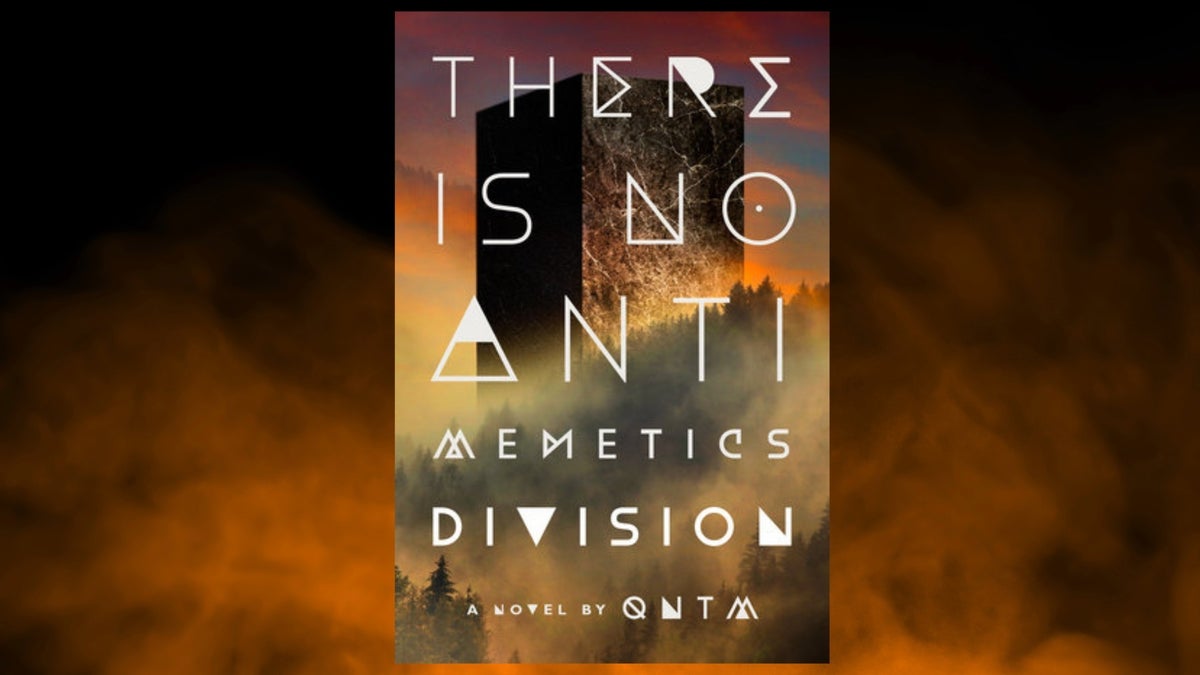
In There Is No Antimemetics Division, which came out in late 2025, a massive government agency—or is it?—squares off in roughly the present day against forces that, like the opposite of a catchy earworm song, draw their power from slipping out of the mind. How do you categorize something you can’t describe? How do you fight an enemy that’s impossible to remember, with teammates that keep on disappearing? “This is a story about what happens when someone weaponizes your fallible memory against you,” qntm tells Scientific American. “It’s a fast-moving sci-fi-thriller-slash-horror that will hopefully, in some fashion, melt your brain.”
Scientific American talked with qntm about so-called antimemes, the way to fight an idea and the power of collaborative storytelling.
On supporting science journalism
If you’re enjoying this article, consider supporting our award-winning journalism by subscribing. By purchasing a subscription you are helping to ensure the future of impactful stories about the discoveries and ideas shaping our world today.
[An edited transcript of the interview follows.]
So what is a meme, and then what is an antimeme?
“Meme” has several different definitions, but a meme, for my purposes, is a contagious idea. It’s an idea that is in some way catchy or invites you to spread it to other people. A lot of things can qualify as a meme for different reasons.
It can be anything from a joke you want to share to customs and traditions, you’ve said.
Most religions qualify as memes. Political standpoints and political systems and philosophical systems, all of these are memes of differing levels of scale, and, what I realized, differing levels of contagiousness. Some ideas really do catch on and can circle the globe really quickly, and some ideas kind of—don’t. They have difficulty finding purchase.
I decided an antimeme is an idea that doesn’t catch on and is difficult to spread. An idea can be difficult to spread because it’s complex and hard to explain clearly, or because it’s very large and confusing, or easily confused with some other idea. But equally an idea could be difficult to spread because it’s a secret, and you don’t want people to know that secret, even though that secret is potentially really juicy. It can be something that you don’t want to spread because it’s considered taboo or because it’s religiously or politically or socially unacceptable.
I was thinking about this for the purposes of fiction, and I realized that there’s a lot of mileage in the idea of something that you should be able to remember but you can’t. And you want to remember, and it’s really important to remember, but you just can’t. Maybe a thing that’s standing right in front of you but you can’t see it, and perhaps it trips you up and you fall on the floor, but you don’t remember who or what tripped you up—and when you get up again, you might not remember that you fell over at all. And that basic fictional concept of an antimeme gives rise to a lot of really interesting fiction, in my opinion.
The objects and beings studied by your book’s Antimemetics Division range from horrifying and potentially world-destroying to just kind of weird. Do you have an example you can share?
My idea was there could be this gigantic antimemetic ecosystem. There could be creatures at all levels of size and scale and threat level, from the very benign to the cosmically gigantic. The antagonist in the story is designed to be an apex predator from this ecosystem. But I think the fan favorite, my favorite, is called U-2256: “The Ones Who Walk Very Slowly.” They are these colossally, kilometers-tall creatures, like giraffes or brachiosaurs, and they walk on the surface of the Pacific Ocean, but they can’t be seen. No one can see them unless they take a particular hallucinogenic drug…, [and] they can only be seen from a distance.
I first learned about your work as a writer, but I quickly found out—and wasn’t surprised to hear—that you’re also a software developer. Does your programming inform how you write?
Software development is all about edge cases and taking things to extremes and making sure that things don’t break, even at the extremes. It’s all about reasoning. It’s an interesting way to approach science fiction, where you can take a new set of fictional rules and say, “Okay, given these rules, how does the world change? How does society change? How does the universe change? How does it have to change retroactively to get those rules in place in the first place?” Reasoning things out and then applying them at scale and figuring out what would happen when a billion human beings were interacting with that new system all at once—generally, if the “what if” is interesting, then, almost automatically, an interesting story comes out of that.
That’s why books like this feel like a good fit for a Scientific American reader—that concept of having an idea and stress-testing it and figuring out what would happen.
If we take a scientific approach to [paranormal] monsters, like you have a ghost or a werewolf or a haunted house or something but take a scientific approach, not many works of fiction will approach a haunted house in that way. That’s a novel way, and it usually comes up with novel results. And so you end up with a story that has an interesting twist to it in the way it’s presented. But equally, if the person who’s doing the reading is of that mind and has perhaps a software developer or scientist sort of mind, they might think of that stuff ahead of time and think, “Hmm, what would happen if you do this?” And when you do that in a story, that can actually be a really rewarding thing, where you go, “Ah, the characters are doing something intelligent! I’m on the characters’ side because they’ve decided to do something that I would have done!” I think that’s very positive as well.
Obviously, this is fully fictional. Is there anything you think people can take from the book about the crucially important ways ideas spread or don’t spread in the world?
The story, like a lot of science fiction, has some relevance to the real world. The first half of the story, to a great extent, is about losing one’s critical faculties, which is something that really happens in cases where people have mental illness and things like Alzheimer’s disease. That, speaking personally, is a prospect I find quite frightening. If you want to survive something like that, you need to be well-prepared, and you need a lot of help. You need assistance. You can build systems and habits and reminders and complicated processes that you always follow to keep yourself on track even though you can’t keep up properly anymore, up to a point. But [eventually] there’s no other way to deal with it other than with some kind of help.
The second half of the book is more about political ignorance and ideas that can bubble out of control, and ideas that might fester in the background of the world or a nation or something for a long period of time, and then suddenly they’re not in the background anymore and they’re a real problem. Unfortunately, one of the things that happens in the story is that I’m not really able to put words around the solution to that kind of problem. If you’re trying to combat an idea with a better idea, within the context of the story, ideas can just duel with one another in this higher ideatic space. In reality, ideas are embodied by people and brought forward by actions. And it’s not so simple as just producing or envisaging a better idea. You need to put it out there somehow…, and I’m not sure how to do that. Something I find in a lot of science fiction—it’s very easy to write something dystopian, but it’s much, much harder to write a solution to that dystopia or an exit from that dystopia.
This book got its start as part of the SCP Wiki, a collaborative writing space about fictional paranormal items and entities studied scientifically, and a lot of your previous works have been released as web serials. How has that affected your writing?
I think a lot of fiction these days is getting started in this way, where people are writing serial fiction online for almost a self-selecting fandom who just gradually gather in numbers over time until eventually you’ve got a reasonable following. I find it to be a very positive experience because you have that very rapid feedback loop. You put a chapter out there, and immediately you’re getting comments back from people who have read that chapter who are speculating on how it connects to the previous chapters and how future chapters could pan out, and what they’re responding positively to and what they might be responding negatively to. People will catch typos pretty quickly as well. It’s a very positive thing … but involves a lot of very careful forward planning. I think that also adds to the flavor.
You’ve mentioned that your next book, which will be unrelated to Antimemetics, will be written completely offline—a new experience for you. How will you know what’s working without that experimental feedback?
I have my editor and I have my agent, and they provide a sanity check. They know how to turn a good story into a better one, and I absolutely trust them in that kind of thing. But other than that, fingers crossed. We shall see.