
Close Menu
Beverly Hills Examiner

    Subscribe to Updates

    Get the latest creative news from FooBar about art, design and business.

    What's Hot

    La Paciencia, No. 1 Latin Producer, on Bad Bunny & What’s Next

    December 31, 2025

    ‘Quiet luxury’ is coming for the housing market, The Corcoran Group CEO says

    December 31, 2025

    Trump Issues First Vetoes of Second Presidential Term

    December 31, 2025
    Facebook X (Twitter) Instagram
    Beverly Hills Examiner
    • Home
    • US News
    • Politics
    • Business
    • Science
    • Technology
    • Lifestyle
    • Music
    • Television
    • Film
    • Books
    • Contact
      • About
      • Amazon Disclaimer
      • DMCA / Copyrights Disclaimer
      • Terms and Conditions
      • Privacy Policy
    Beverly Hills Examiner
    Home»Science»On December 7 the Moon Will Photobomb Mars
    Science

    On December 7 the Moon Will Photobomb Mars

    By AdminNovember 30, 2022
    Facebook Twitter Pinterest LinkedIn WhatsApp Email Reddit Telegram
    On December 7 the Moon Will Photobomb Mars


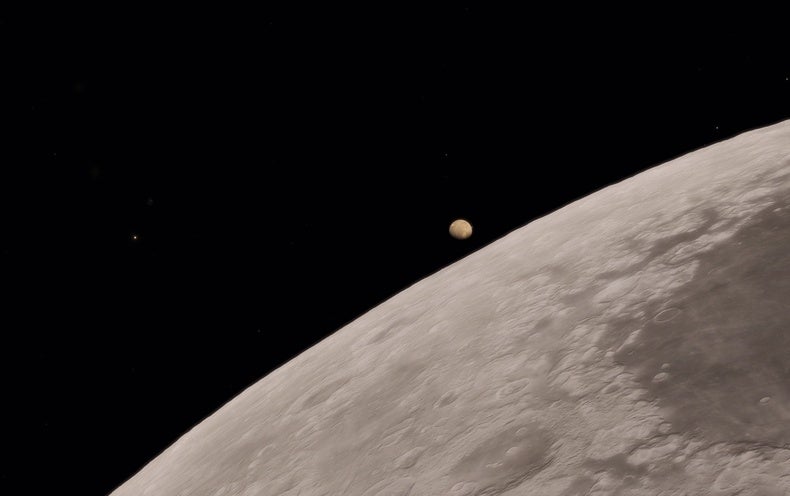
    On the evening of December 7, 2022, people in a large fraction of the U.S. will be able to see a rare and wonderful astronomical event: the moon will pass directly in front of Mars, blocking it from view.

    This event, called an occultation—from a Latin word meaning “hidden”—happens once or twice per year somewhere on Earth. But like a solar eclipse, you have to be in the right place at the right time to see it. Think of the upcoming one as a Martian eclipse.

    You don’t need any special equipment to watch: just your eyeballs (and probably something warm to wear). Like a well-plotted movie, the drama will build as the moon slowly approaches Mars in the sky, culminating in the moment when the edge of our satellite sweeps over the disk of the planet, causing it to fade away and finally wink out. A telescope improves the view of course, but it’s still fun to watch without optical aid.

    I’ve seen quite a few occultations of stars by the moon and even one in which our natural satellite passed right in front of Venus, which was honestly very cool to witness. I’ve never seen the moon occult Mars, though, so I’m looking forward to this.

    The folks at the International Occultation Timing Association (IOTA) have a map on their site that shows where the event will be visible.
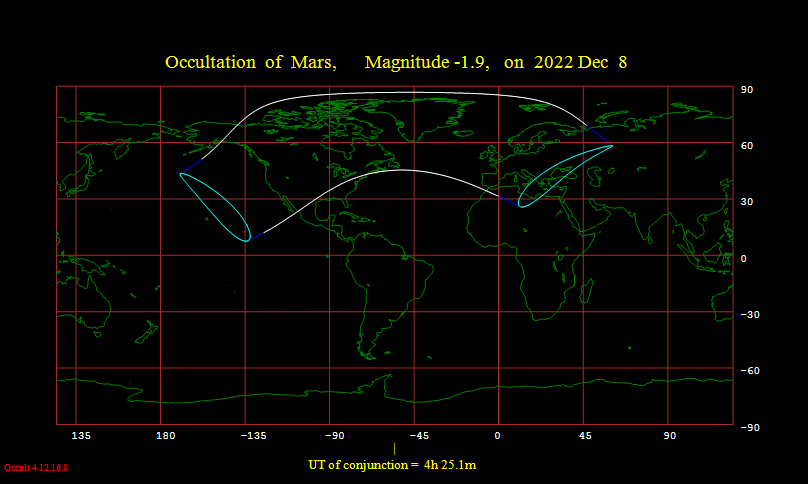
    A map shows the visibility of the lunar occultation of Mars on December 7, 2022.
    A map shows the visibility of the lunar occultation of Mars on December 7, 2022, local U.S. time (December 8 Universal Time). The teal ovals are where the event happens at moonrise (where it can be seen toward the west) or moonset (where it can be seen toward the east). The dark blue lines are where it happens at twilight. And the white line is where it’s completely visible at night. Credit: Rob Robinson, using Occult software written by David Herald/International Occultation Timing Association

    Everyone inside the curved white path can see the occultation. If you’re inside the teal ovals, then it happens when the moon rises or sets, so visibility will be limited. This shows that almost all of the U.S. except for the southeastern region, as well as all of Canada and much of Europe, will see the event. (Note that the IOTA map uses Universal Time (UT). So in UT, the occultation occurs in the morning of December 8, but in local time in the U.S., it happens in the evening of the night before that date.)

    The exact timing of the event for you depends on where you’re located. The moon is much closer to Earth than Mars, which affects how we see it. When you hold your thumb out at arm’s length and look at it with just your right eye, with your left eye closed, and then look with your left eye, with the right one closed, your thumb appears to jump back and forth, compared with more distant objects, because you’re seeing it from slightly different angles with each eye. This is called parallax, and it also works on astronomical scales, changing the moon’s relative position in the sky depending on your latitude and longitude.

    The IOTA page has a list of timings of the event for many cities. Look for one near you to get an idea of when it happens. But again, bear in mind your exact location changes the exact timing. Your best bet is to use some planetarium software to be as precise as possible. Stellarium is a free site, for example, and you can search online to get a list of quite a few apps for mobile devices. Once they have your location, they can give you pretty decent numbers for when the occultation occurs for you.

    So how does this all work, physically?

    The planets, including Earth, all orbit the sun more or less in the same plane. Because we’re in that plane, we see it edge on as a line across the sky called the ecliptic. The planets all stick pretty close to the ecliptic. The moon, however, has an orbit that’s tilted relative to it at an angle of about five degrees. As the moon orbits Earth every 29 days, it makes a big circle around the sky, crossing the ecliptic twice. (Imagine two hula hoops, one inside the other, and both tipped a bit. They cross in two places called nodes.) The moon passes any given planet in the sky once every month, but because of the former’s tipped orbit, the two usually miss each other by several degrees.

    Sometimes, however, a planet will happen to be at the exact spot in the sky where the moon’s orbit crosses the ecliptic. And if the moon happens to be there at the same time, an occultation will occur.

    This is RIGHT NOW. @NASA_Orion is looking back at Earth and the Moon from distant retrograde orbit. Watch the #Artemis I livestream: https://t.co/Qx1QFUdD08 pic.twitter.com/zMTorYQvjS


    — NASA (@NASA) November 28, 2022

    On November 28, 2022, on its journey into a distant retrograde lunar orbit, the Orion spacecraft on NASA’s Artemis I mission captured this image of our planet “setting” behind the moon: a lunar occultation of Earth! Credit: NASA

    In this case, what you’ll see after sunset is the moon and Mars very close together in the sky. As the moon orbits Earth, it moves by about half a degree—its own diameter, or roughly half the width of your thumb at arm’s length—in an hour. So just before the actual occultation, the two are quite close together. As the event progresses, the moon and Mars creep closer together, until finally the moon’s edge starts to slide across the planet’s disk.

    It takes about 30 to 45 seconds for the moon to cover Mars entirely, like slowly drawing a curtain across a window. By eye, the two will seem to kiss, and then Mars will fade from view in less than a minute.

    The moon’s motion will continue with Mars hidden behind its bulk, and depending on your location, it could take as much as an hour for the Red Planet to reappear on the other side of the moon.

    The specific circumstances for this event are remarkable. For one thing, the moon will be full, a silvery disk in the dark sky. For another, the occultation happens when Mars is at opposition. Once every two years or so, Earth catches up to and laps Mars around the sun, like a race car on an inside track passing a slower car on the outside. When this happens, Earth is directly between Mars and the sun, which means that, to us, they are on opposite sides of the sky (hence the event name). This arrangement also means Mars is as close to Earth as it will get for two years. In turn, this means the Red Planet looks its biggest and is at its brightest as well.

    If you’re an avid sky watcher, you may have noticed Mars in the evening sky, a brilliant “star” shining in the east after sunset, more brilliant than usual because of its proximity to us. It has a noticeable orange hue—most of the surface is covered in oxidized iron-rich dust, so it’s literally rusty. No wonder the ancient Greeks and Romans equated the planet with their god of war. It’s a bloodshot baleful eye glowering down at us from the heavens! And that eye will wink at us.

    Occultations have scientific use. The characteristics of a distant asteroid can be deduced when it passes in front of a star. Observers at different latitudes see the star pass behind a different chord through the asteroid, so the observations can be combined to measure the latter’s size and shape.

    Also, many exoplanets—alien worlds orbiting other stars—have been discovered using a similar method. If we happen to see an exoplanet’s orbit edge on, then once per revolution, it passes in front of its host star, creating a mini eclipse called a transit. The star dims a fraction, and from that the size of the planet can be found. In some cases, it’s also possible to determine the planet’s atmospheric composition. The majority of the more than 5,000 exoplanets that have been discovered were found using the transit method.

    One thing to keep in mind as you watch the upcoming occultation: Right now NASA and other space agencies have their own eyes on the moon. The recently launched Artemis I mission sent the Orion space capsule into a wide, looping orbit around our natural satellite, and it is due to return to Earth in mid-December. This mission is uncrewed, but the next will have people onboard to orbit the moon. And the third is planned to set humans down on its surface, the first boot prints to be left in the lunar dust since 1972.

    NASA already has long-term plans to send humans to Mars, too. Both worlds have quite a few space probes orbiting and sitting on them, and people may not be far behind. When you watch the moon cover Mars on the night of December 7, you will see a metaphor for our future in space.

    The moon looms large, with the more distant Mars patiently waiting for us.


    Original Source Link

    Share. Facebook Twitter Pinterest LinkedIn WhatsApp Email Reddit Telegram
    Previous Article15 Ways Henry Cavill Is The Most Comics-Accurate Superman
    Next Article ResortPass, backed by Jessica Alba and Gwyneth Paltrow, lands $26M so you can take a daycation • TechCrunch

    RELATED POSTS

    NASA Telescopes Capture Colliding Spiral Galaxies in Sparkling Detail

    December 31, 2025

    Star that seemed to vanish more than 130 years ago is found again

    December 31, 2025

    The Great Big Power Play

    December 30, 2025

    15 Million Years before the Megalodon, This Giant Ancient Shark Prowled the Oceans

    December 30, 2025

    Mathematicians unified key laws of physics in 2025

    December 29, 2025

    People Who Drink Bottled Water on a Daily Basis Ingest 90,000 More Microplastic Particles Each Year

    December 29, 2025
    latest posts

    La Paciencia, No. 1 Latin Producer, on Bad Bunny & What’s Next

    For Roberto Rosado, better known as La Paciencia, the key to his craft has always…

    ‘Quiet luxury’ is coming for the housing market, The Corcoran Group CEO says

    December 31, 2025

    Trump Issues First Vetoes of Second Presidential Term

    December 31, 2025

    Putin accuses Ukraine of drone attack on residence as peace talks falter

    December 31, 2025

    Factor Meal Delivery Promo: Free $200 Withings Body-Scan Scale

    December 31, 2025

    NASA Telescopes Capture Colliding Spiral Galaxies in Sparkling Detail

    December 31, 2025

    ARC Raiders’ Latest Exploit Is Giving Players Instant Kills

    December 31, 2025
    Categories
    • Books (969)
    • Business (5,877)
    • Film (5,811)
    • Lifestyle (3,914)
    • Music (5,879)
    • Politics (5,881)
    • Science (5,223)
    • Technology (5,810)
    • Television (5,496)
    • Uncategorized (2)
    • US News (5,862)
    popular posts

    How Quickly Can You Get Me Out Of Jail? A Simple Solution

    How Quickly Can You Get Me Out Of Jail? A Simple Solution – Daily LivingSwag…

    Ilya Sutskever isn’t done working on AI safety

    June 23, 2024

    20 Best Talk Show Hosts From US & UK

    June 7, 2022

    Streetlights in Europe are getting bluer – that may be bad for health

    September 14, 2022
    Archives
    Browse By Category
    • Books (969)
    • Business (5,877)
    • Film (5,811)
    • Lifestyle (3,914)
    • Music (5,879)
    • Politics (5,881)
    • Science (5,223)
    • Technology (5,810)
    • Television (5,496)
    • Uncategorized (2)
    • US News (5,862)
    About Us

    We are a creativity led international team with a digital soul. Our work is a custom built by the storytellers and strategists with a flair for exploiting the latest advancements in media and technology.

    Most of all, we stand behind our ideas and believe in creativity as the most powerful force in business.

    What makes us Different

    We care. We collaborate. We do great work. And we do it with a smile, because we’re pretty damn excited to do what we do. If you would like details on what else we can do visit out Contact page.

    Our Picks

    NASA Telescopes Capture Colliding Spiral Galaxies in Sparkling Detail

    December 31, 2025

    ARC Raiders’ Latest Exploit Is Giving Players Instant Kills

    December 31, 2025

    Disorders From TLC Show Explained

    December 31, 2025
    © 2025 Beverly Hills Examiner. All rights reserved. All articles, images, product names, logos, and brands are property of their respective owners. All company, product and service names used in this website are for identification purposes only. Use of these names, logos, and brands does not imply endorsement unless specified. By using this site, you agree to the Terms & Conditions and Privacy Policy.

    Type above and press Enter to search. Press Esc to cancel.

    We use cookies on our website to give you the most relevant experience by remembering your preferences and repeat visits. By clicking “Accept All”, you consent to the use of ALL the cookies. However, you may visit "Cookie Settings" to provide a controlled consent.
    Cookie SettingsAccept All
    Manage consent

    Privacy Overview

    This website uses cookies to improve your experience while you navigate through the website. Out of these, the cookies that are categorized as necessary are stored on your browser as they are essential for the working of basic functionalities of the website. We also use third-party cookies that help us analyze and understand how you use this website. These cookies will be stored in your browser only with your consent. You also have the option to opt-out of these cookies. But opting out of some of these cookies may affect your browsing experience.
    Necessary
    Always Enabled
    Necessary cookies are absolutely essential for the website to function properly. These cookies ensure basic functionalities and security features of the website, anonymously.
    CookieDurationDescription
    cookielawinfo-checkbox-analytics11 monthsThis cookie is set by GDPR Cookie Consent plugin. The cookie is used to store the user consent for the cookies in the category "Analytics".
    cookielawinfo-checkbox-functional11 monthsThe cookie is set by GDPR cookie consent to record the user consent for the cookies in the category "Functional".
    cookielawinfo-checkbox-necessary11 monthsThis cookie is set by GDPR Cookie Consent plugin. The cookies is used to store the user consent for the cookies in the category "Necessary".
    cookielawinfo-checkbox-others11 monthsThis cookie is set by GDPR Cookie Consent plugin. The cookie is used to store the user consent for the cookies in the category "Other.
    cookielawinfo-checkbox-performance11 monthsThis cookie is set by GDPR Cookie Consent plugin. The cookie is used to store the user consent for the cookies in the category "Performance".
    viewed_cookie_policy11 monthsThe cookie is set by the GDPR Cookie Consent plugin and is used to store whether or not user has consented to the use of cookies. It does not store any personal data.
    Functional
    Functional cookies help to perform certain functionalities like sharing the content of the website on social media platforms, collect feedbacks, and other third-party features.
    Performance
    Performance cookies are used to understand and analyze the key performance indexes of the website which helps in delivering a better user experience for the visitors.
    Analytics
    Analytical cookies are used to understand how visitors interact with the website. These cookies help provide information on metrics the number of visitors, bounce rate, traffic source, etc.
    Advertisement
    Advertisement cookies are used to provide visitors with relevant ads and marketing campaigns. These cookies track visitors across websites and collect information to provide customized ads.
    Others
    Other uncategorized cookies are those that are being analyzed and have not been classified into a category as yet.
    SAVE & ACCEPT