
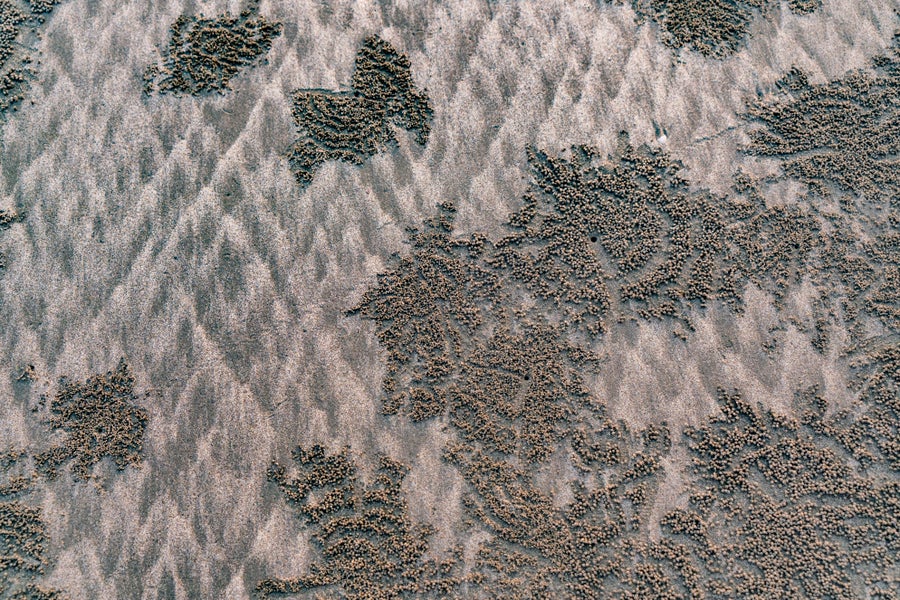
Walking along Kolatoli Beach in Cox’s Bazar, Bangladesh, environmental photographer Diane Tuft noticed the damp sand was textured with peculiar little bumps scattered along the shore. Tuft, fascinated with the unusual scene, whipped out her camera and took a picture.
She soon learned the pellets were signs of sand bubbler crabs. When water surges over the beach during high tide, the crabs stay hidden underground. Once the sea retreats, the centimeter-wide crustaceans emerge, eating bits of plankton and spitting up “bubbles” of sandy leftovers. But as sea levels rise and Kolatoli is more frequently submerged, catching the crabs in action is becoming a rarity.

Balls of sand made by sand bubbler crabs on Kolatoli Beach in Bangladesh.
On supporting science journalism
If you’re enjoying this article, consider supporting our award-winning journalism by subscribing. By purchasing a subscription you are helping to ensure the future of impactful stories about the discoveries and ideas shaping our world today.
Tuft’s photograph of the sand bubbler crabs is among dozens of images in her new book, Entropy, which aims to highlight the vanishing beauty and simultaneous devastation of the world’s coastal communities as climate change manipulates the once reliable behavior of Earth’s oceans and lakes. Featuring close-up and aerial photographs from six diverse locations experiencing severe droughts, floods, erosion or storms—with poems and essays by Westminster University biology professor Bonnie Baxter and artist Stacey Epstein—Entropy is Tuft’s way of encouraging art lovers to engage in conversations about climate change.
Scientific American spoke with Tuft about her process in creating Entropy, the role of photography in climate communication and why water best represents the extremity of the climate crisis.
[An edited transcript of the interview follows.]
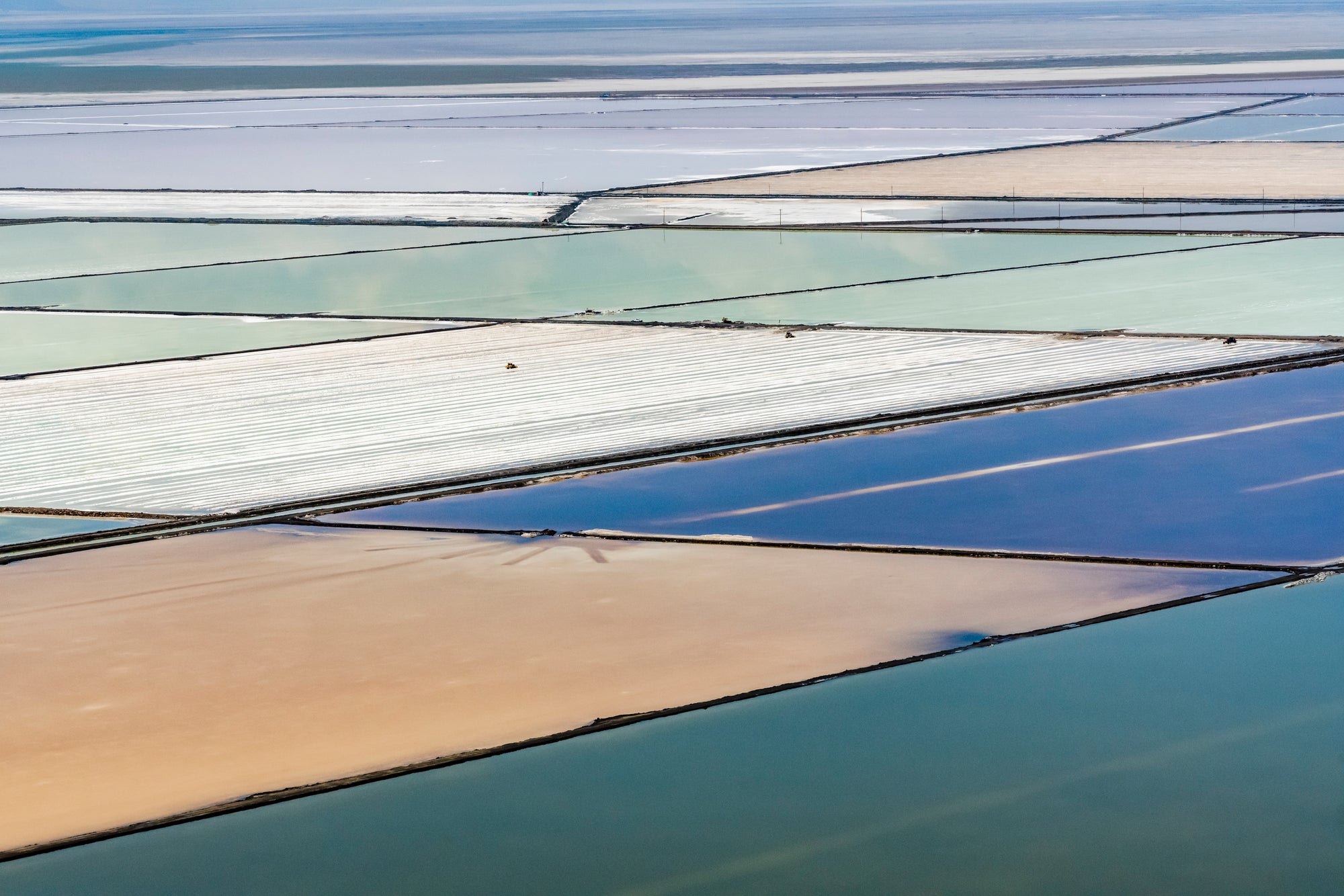
States of Transformation depicts the Great Salt Lake.
Why is climate change your chosen subject of photography?
I’d say nature has always been a driving force of mine. I grew up pretty poor and didn’t have any toys, and so my toys were nature. I’d go outside and play with sticks and stones in the river and create little art installations. Then in college I bought my first [film] camera and started taking pictures of trees and other things in nature. When I finished school I moved to New York [City] to work in mathematics and with computers, and I got married and had kids. When my youngest daughter turned 15, I decided that I needed to do something just for myself, and I started more seriously painting and sculpting and taking photographs…. In 2005 I bought a color digital camera and went to photograph [land artist Robert Smithson’s] Spiral Jetty sculpture [in Salt Lake City, Utah]. When I got back to New York and uploaded the pictures on the computer, they were much more vibrant than I saw with my own eyes. So I did some research and contacted Bonnie Baxter at Westminster University. She explained that the Great Salt Lake absorbs and reflects a lot of ultraviolet light because of its unique environmental conditions. At 4,200 feet above sea level, the lake is unusually close to the sun and therefore absorbs a lot of UV radiation—which my digital camera picked up. I thought, “Oh, my gosh. That’s crazy. Where else can I find ultraviolet light?” That’s when I became interested in the climate change element. As our ozone layer gets thinner and thinner, more ultraviolet light and radiation is hitting the Earth…. So I began looking into weather and climate patterns and thinking of how I could start to document it.
Why does the word Entropy encapsulate this collection of photographs?
I learned about the word entropy from Robert Smithson. He died in 1973 at 35 years old, but even then, when people weren’t talking much about climate change, he understood that something was happening and the landscapes were really changing. He says the word entropy quite a few times in his [posthumously published] book Robert Smithson: The Collected Writings, when he’s talking about molecular changes and the chaos of molecules. Water is the perfect example of this. Its molecular structure is chaotic and shifting all the time from frozen to liquid to vapor. So for me, entropy [in this book] is all about the changing of water.
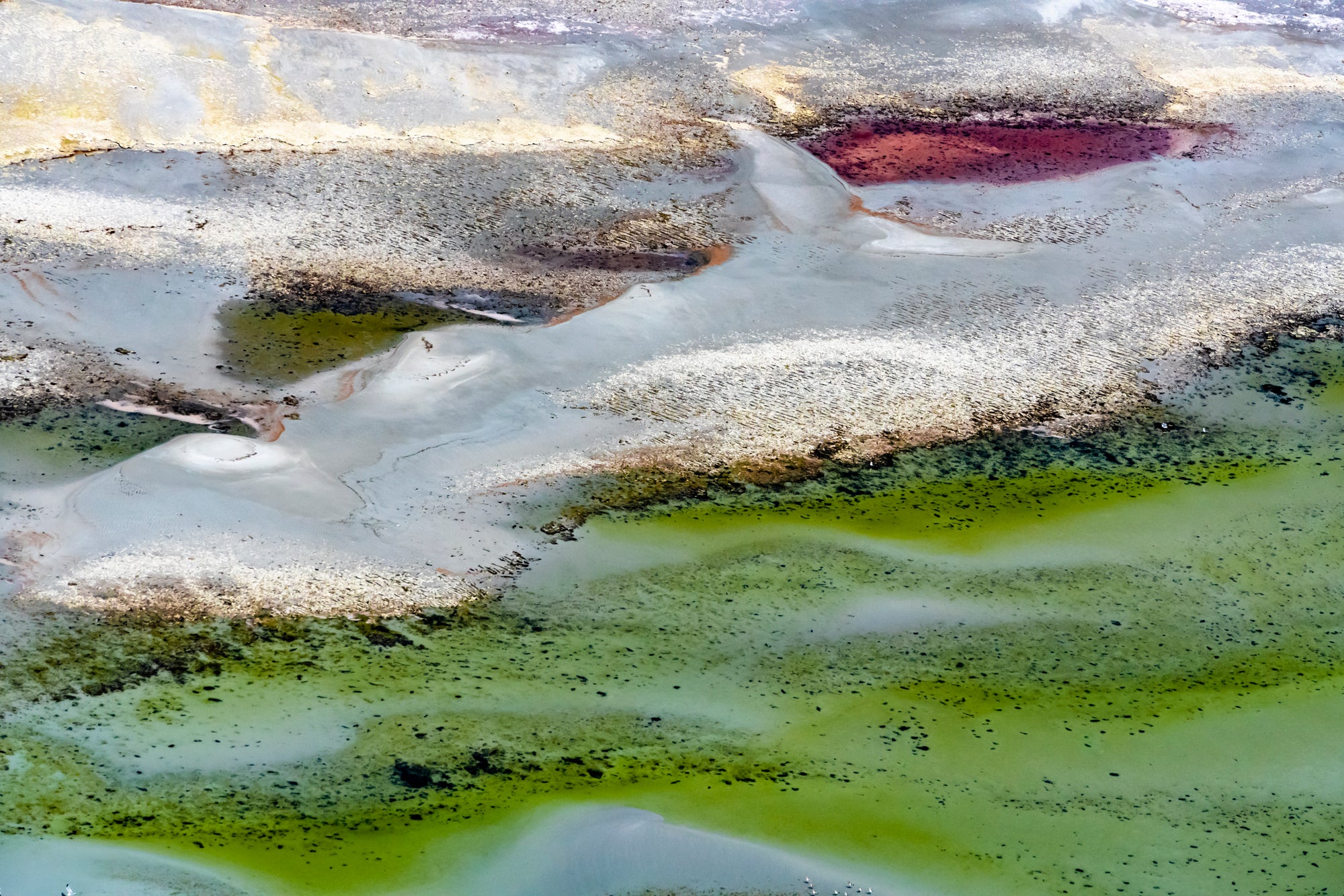
Paradox depicts the Great Salt Lake.
In 2017 you released your book The Arctic Melt: Images of a Disappearing Landscape, which highlights how climate change is affecting the world’s tundra. How did that project inform your process for Entropy?
We know scientifically that the ocean is expanding and we’re having real problems. Thermal expansion is occurring—the ocean is literally getting warmer—and mountain glaciers and ice sheets are melting, and fresh water is spilling into the ocean and making it rise. But my goal with these projects, which I make up entirely on my own, is to prove it visually. So to do that [for The Arctic Melt], I went to one of the northernmost glaciers in the world in Svalbard, Norway, on a Russian nuclear-powered icebreaker, to photograph what was happening. Then I thought, okay, this is the proof…. Now, I want to show how coastal erosion and floods are impacting … people in coastal communities.

Epitaph depicts Newfound Harbor Key in the Florida keys.
How did you decide what locations to photograph?
I couldn’t just go to one place. I needed to show what’s happening all around the world because there’s oceans everywhere, right? I chose [three] places in the U.S.: the Florida Keys, Chesapeake Bay and the Great Salt Lake. Then I went to the Pacific Ocean to visit the atoll nations—the Marshall Islands and Kiribati—and then finally Bangladesh. It’s all of these coastal places that are suffering from droughts or severe flooding and erosion. I mean, Kiribati was [one of the first nations] to bring attention to climate change because it was getting flooded constantly with king tides. Its [former president] was so frightened that his country was going to be destroyed that he basically [had Kiribati’s government buy land on an island in Fiji] to move citizens there. It wasn’t a very popular notion because no one wants to leave their home, but they technically still have that [land] just in case. So I really wanted to see what their situation was. I mean they’re in the middle of the Pacific Ocean, so if anyone is suffering [from sea-level rise], it’s them.

Spiral Jetty depicts the Great Salt Lake in June 2005 (left) and August 2022 (right).
Many images in the book, including its cover, are of Utah’s Great Salt Lake. Why did you choose to focus on this location?
I’ve kind of become a sort of spokesperson for the Great Salt Lake. When I bring it up, I feel like most people I talk to don’t even know where it is or don’t worry about it. But what’s happening to it really is so important. The lake carries all of these minerals, and many of them are toxic, such as arsenic. As the lake becomes depleted, parts of it become really dry. Then when the wind blows, these minerals in the sand become airborne and cause many people in the area to have health issues. I mean, the lake in 2022 was about two thirds the volume when I first saw it [in 2005]. So I felt that it’s unfortunately a prime example of how these environments are suffering.

Passages depicts the Great Salt Lake.
How do you try to balance conveying both beauty and devastation in your photographs?
I think of it all as tragic beauty. I love landscape photography, and I want to bring to the forefront that something beautiful is also disappearing by capturing it before it goes. Take my photographs of the Great Salt Lake, for instance. It’s the same lake and the same area, yet they look very different from each other after just [17 years]—both [are] beautiful, but a lot has changed…. And, you know, it’s frightening, too, and can sometimes be difficult to understand. So my art, as far as I’m concerned, is a way for people to look at something that can feel extremely abstract. It’s something that hopefully encourages them to ask questions. It’s about generating a new dialogue among people who are drawn to art and aren’t necessarily reading Scientific American or thinking about what’s going on with the climate all the time.

A salt field on Kutubdia Island in Bangladesh.
What role do you think photography can play in climate communication that videography and written words cannot?
Videography can be useful, but then someone has to sit down and watch something or go to the theater. And with written words, someone has to sit down and read something. So I think that if I can communicate with a [medium] that is easily and readily available—such as a book that everyone can just have on their table—then that’s powerful. I just hope that when people pick it up and flip through the pretty pictures, they start to wonder what it is they’re actually looking at. When they see the title, Entropy, and the different names of the pictures,I hope they wonder why exactly I chose those words and these places. In the end, I believe this is the most accessible form of climate change communication, and I hope that people just enjoy and think about it.