
Close Menu
Beverly Hills Examiner

    Subscribe to Updates

    Get the latest creative news from FooBar about art, design and business.

    What's Hot

    Startup sues Apple in India over tap-to-share contacts feature | TechCrunch

    November 21, 2026

    The US to become first nation to fully shun a UN Human Rights Council review

    November 21, 2026

    Grimes Releases Two New Psy Opera Songs

    November 20, 2026
    Facebook X (Twitter) Instagram
    Beverly Hills Examiner
    • Home
    • US News
    • Politics
    • Business
    • Science
    • Technology
    • Lifestyle
    • Music
    • Television
    • Film
    • Books
    • Contact
      • About
      • Amazon Disclaimer
      • DMCA / Copyrights Disclaimer
      • Terms and Conditions
      • Privacy Policy
    Beverly Hills Examiner
    Home»Business»Russia’s ruble is at strongest level in 7 years despite sanctions
    Business

    Russia’s ruble is at strongest level in 7 years despite sanctions

    By AdminJune 23, 2022
    Facebook Twitter Pinterest LinkedIn WhatsApp Email Reddit Telegram
    Russia’s ruble is at strongest level in 7 years despite sanctions

    [ad_1]

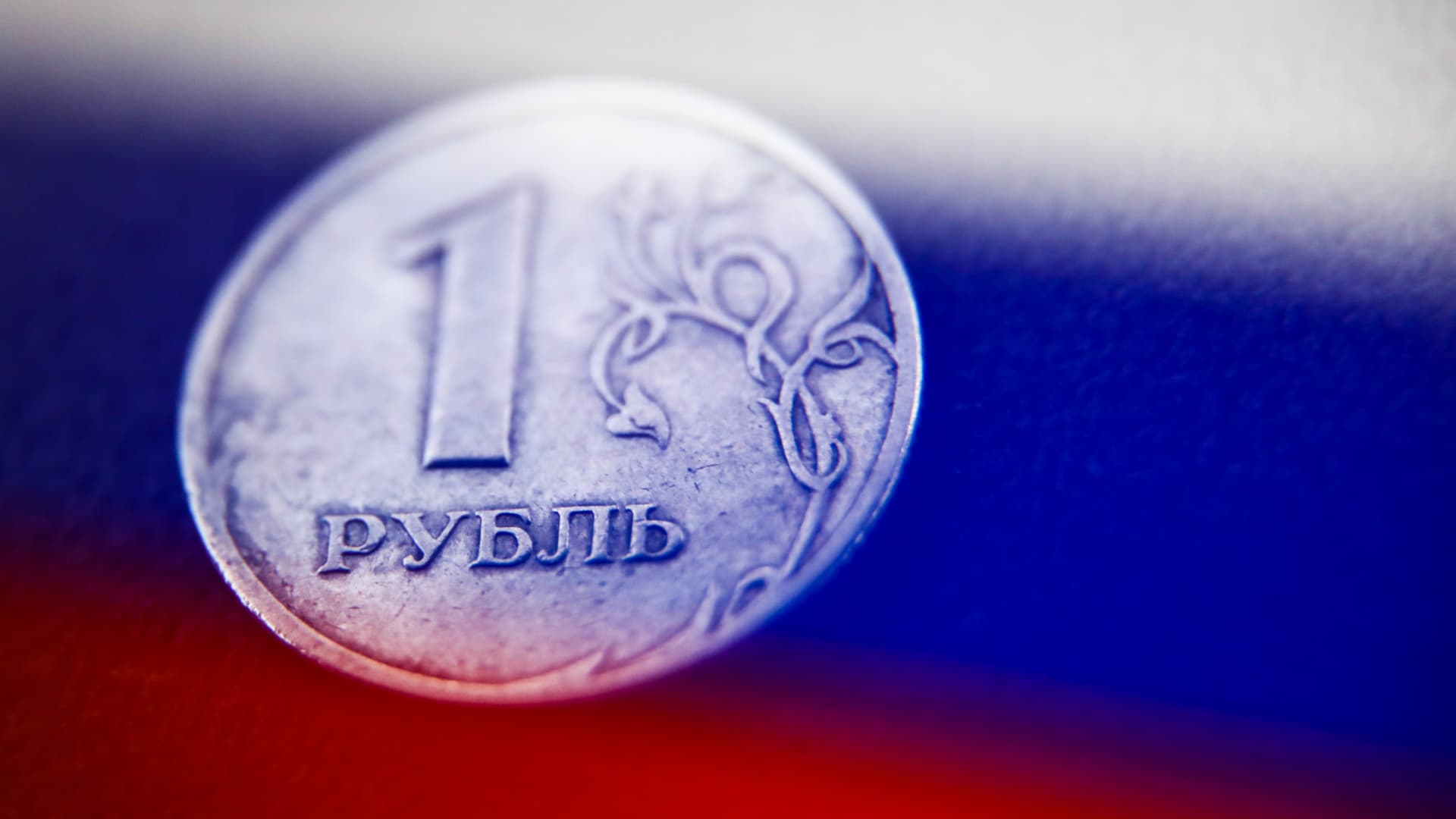
    Russian one ruble coin and Russian flag displayed on a screen are seen in this multiple exposure illustration photo taken in Krakow, Poland on March 8, 2022.

    Jakub Porzycki | Nurphoto | Getty Images

    Russia’s ruble hit 52.3 to the dollar on Wednesday, an increase of roughly 1.3% on the previous day and its strongest level since May 2015.

    That’s a world away from its plunge to 139 to the dollar in early March, when the U.S. and European Union started rolling out unprecedented sanctions on Moscow in response to its invasion of Ukraine. 

    The ruble’s stunning surge in the following months has given fuel to the Kremlin as “proof” that Western sanctions aren’t working. 

    “The idea was clear: crush the Russian economy violently,” Russian President Vladimir Putin said last week during the annual St. Petersburg International Economic Forum. “They did not succeed. Obviously, that didn’t happen.”

    In late February, following the ruble’s initial tumble and four days after its invasion of Ukraine began on Feb 24., Russia more than doubled the country’s key interest rate to a whopping 20% from a prior 9.5%. Since then, the currency’s value has improved to the point that it’s lowered the interest rate three times to reach 11% in late May.

    The ruble has actually gotten so strong that Russia’s central bank is actively taking measures to try to weaken it, fearing that this will make their exports less competitive. 

    But what’s really behind the currency’s rise, and can it be sustained? 

    Russia is raking in record oil and gas revenue 

    The reasons are, to put it simply: strikingly high energy prices, capital controls and sanctions themselves. 

    Russia is the world’s largest exporter of gas and the second-largest exporter of oil. Its primary customer? The European Union, which has been buying billions of dollars worth of Russian energy per week while simultaneously trying to punish it with sanctions. 

    That’s put the EU in an awkward spot – it has now sent exponentially more money to Russia in oil, gas and coal purchases than it has sent Ukraine in aid, which has helped fill the Kremlin’s war chest. And with Brent crude prices 60% higher than they were this time last year, even though many Western countries have curbed their Russian oil buying, Moscow is still making a record profit. 

    Russian President Vladimir Putin and Defence Minister Sergei Shoigu attend a wreath-laying ceremony, which marks the anniversary of the beginning of the Great Patriotic War against Nazi Germany in 1941, at the Tomb of the Unknown Soldier by the Kremlin wall in Moscow, Russia June 22, 2022. 

    Mikhail Metzel | Sputnik | Reuters

    In the Russia-Ukraine war’s first 100 days, the Russian Federation raked in $98 billion in revenue from fossil fuel exports, according to the Centre for Research on Energy and Clean Air, a research organization based in Finland. More than half of those earnings came from the EU, at about $60 billion.

    And while many EU countries are intent on cutting their reliance on Russian energy imports, this process could take years – in 2020, the bloc relied on Russia for 41% of its gas imports and 36% of its oil imports, according to Eurostat.

    Yes, the EU passed a landmark sanctions package in May partially banning imports of Russian oil by the end of this year, but it had significant exceptions for oil delivered by pipeline, since landlocked countries like Hungary and Slovenia couldn’t access alternative oil sources that are shipped by sea. 

    “That exchange rate you see for the ruble is there because Russia is earning record current account surpluses in foreign exchange,” Max Hess, a fellow at the Foreign Policy Research Institute, told CNBC. That revenue is mostly in dollars and euros via a complex ruble-swap mechanism. 

    “Although Russia may be selling slightly less to the West right now, as the West moves to cutting off [reliance on Russia], they are still selling a ton at all-time high oil and gas prices. So this is bringing in a big current account surplus.” 

    Russia’s current account surplus from January to May of this year was just over $110 billion, according to Russia’s central bank – more than 3.5 times the amount of that period last year. 

    Strict capital controls

    Capital controls – or the government’s limiting of foreign currency leaving its country – have played a big role here, plus the simple fact that Russia can’t import as much any more thanks to sanctions, meaning it’s spending less of its money buying stuff from elsewhere. 

    It’s really a Potemkin rate, because sending money from Russia abroad given the sanctions — both on Russian individuals and Russian banks — is incredibly difficult.

    Max Hess

    Fellow, Foreign Policy Research Institute

    “Authorities implemented pretty strict capital controls as soon as sanctions came on,” said Nick Stadtmiller, director of emerging markets strategy at ‎Medley Global Advisors in New York. “The result is money is flowing in from exports while there are relatively few capital outflows. The net effect of all this is a stronger ruble.”

    Russia has now relaxed some of its capital controls and lowered its interest rate in an effort to weaken the ruble, since a stronger currency actually hurts its fiscal account. 

    The ruble: really a ‘Potemkin rate’?

    Because Russia is now cut off from the SWIFT international banking system and blocked from trading internationally in dollars and euros, it’s been left to essentially trade with itself, Hess said. That means that while Russia’s built up a formidable volume of foreign reserves that bolster its currency at home, it can’t use those reserves to serve its import needs, thanks to sanctions.

    The ruble’s exchange rate “is really a Potemkin rate, because sending money from Russia abroad given the sanctions — both on Russian individuals and Russian banks — is incredibly difficult, not to mention Russia’s own capital controls,” Hess said. 

    In politics and economics, Potemkin refers to fake villages that were purportedly constructed to provide an illusion of prosperity to Russian empress Catherine the Great.

    “So yes, the ruble on paper is quite a bit stronger, but that’s the result of crashing imports, and what’s the point of building up forex reserves, but to go and buy things from abroad that you need for your economy? And Russia can’t do that.”

    People line up near Euro and U.S. dollars rates to ruble sign board at the entrance to the exchange office on May 25, 2022 in Moscow, Russia. Russia moved closer to a default on Wednesday after the U.S. Treasury let a key sanctions exemption expire.

    Konstantin Zavrazhin | Getty Images

    “We should really be looking at the underlying issues in the Russian economy, including the cratering imports,” Hess added. “Even if the ruble says it has a high value, that is going to have a devastating impact on the economy and on quality of life.” 

    Does this reflect the actual Russian economy?

    Does the ruble’s strength mean that Russia’s economic fundamentals are sound and have escaped the blow of sanctions? Not so fast, analysts say. 

    “Ruble strength is linked to a surplus in the overall balance of payments, which is much more driven by exogenous factors linked to sanctions, commodity prices and policy measures than by longer term underlying macroeconomic trends and fundamentals,” said Themos Fiotakis, head of FX research at Barclays.

    Russia’s Ministry of Economy said in mid-May that it expects unemployment to hit nearly 7% this year, and that a return to 2021 levels is unlikely until 2025 at the earliest.

    Since Russia’s war in Ukraine began, thousands of international companies have exited Russia, leaving huge numbers of unemployed Russians in their wake. Foreign investment has taken a massive hit, and poverty nearly doubled in just the first five weeks of the war alone, according to Russia’s federal statistics agency Rosstat.

    “The Russian ruble is no longer an indicator for the health of the economy,” Hess said. “While the ruble has surged thanks to the Kremlin’s interference, its inattention to Russian’s well-being continues. Even Russia’s own statistics agency, famous for massaging numbers to meet the Kremlin’s goals, acknowledged that the number of Russians living in poverty rose from 12 [million] to 21 million people in Q1 2022.”

    As for whether the ruble’s strength can be sustained, Fiotakis said, “It is very uncertain and depends on how the geopolitics evolve and policy adjusts.”

    [ad_2]

    Original Source Link

    Share. Facebook Twitter Pinterest LinkedIn WhatsApp Email Reddit Telegram
    Previous ArticleArmy Virtual Reality Could Waste Up To $22B
    Next Article Pusha T Extends 2022 Tour

    RELATED POSTS

    AI stocks are selling off after Anthropics record IPO, and Wall Street is split on whether this is the top | Fortune

    November 20, 2026

    Ex-Super Micro exec married to Nvidias former sales chief says she took CEO job days before smuggling scandal broke | Fortune

    November 20, 2026

    I helped grow a steel company from $750 million to $12 billion. CEOs should use AI before they grade employees on it | Fortune

    November 16, 2026

    We are losing ground: Professors log 55-hour weeks as pay stagnates and states question their workloads | Fortune

    November 15, 2026

    The ultimate adulting task: signing up for health insurance | Fortune

    November 15, 2026

    Gen Z believes using AI is making their colleagues dumb and lazy, but may paradoxically see it as key to their own promotion, Wharton says | Fortune

    November 15, 2026
    latest posts

    Startup sues Apple in India over tap-to-share contacts feature | TechCrunch

    Apple is being sued in India by a U.S.-based startup that alleges the iPhone maker’s…

    The US to become first nation to fully shun a UN Human Rights Council review

    November 21, 2026

    Grimes Releases Two New Psy Opera Songs

    November 20, 2026

    Book Riots Deals of the Day for November 20, 2026

    November 20, 2026

    Chips can survive the space environment. Can their financing? | TechCrunch

    November 20, 2026

    AI stocks are selling off after Anthropics record IPO, and Wall Street is split on whether this is the top | Fortune

    November 20, 2026

    NYC sightseeing helicopter makes emergency landing after reporting possible engine trouble

    November 20, 2026
    Categories
    • Books (1,620)
    • Business (6,525)
    • Cover Story (17)
    • Film (6,459)
    • Lifestyle (4,500)
    • Music (6,535)
    • Politics (6,511)
    • Science (5,865)
    • Technology (6,463)
    • Television (6,156)
    • Uncategorized (3)
    • US News (6,509)
    popular posts

    Want to Understand Canada’s Wildfire Crisis? Read This Book

    [ad_1] The day John Vaillant’s new book about Canadian wildfires, Fire Weather: A True Story From…

    SZA Announces Release Date For New Album S.O.S.

    December 4, 2022

    How VR technology is curing loneliness in seniors

    February 25, 2025

     Sequoia Capital to cut policy team and shutter Washington, D.C. office just as the tech industry increases its visibility under Trump

    March 19, 2025
    Archives
    Browse By Category
    • Books (1,620)
    • Business (6,525)
    • Cover Story (17)
    • Film (6,459)
    • Lifestyle (4,500)
    • Music (6,535)
    • Politics (6,511)
    • Science (5,865)
    • Technology (6,463)
    • Television (6,156)
    • Uncategorized (3)
    • US News (6,509)
    About Us

    We are a creativity led international team with a digital soul. Our work is a custom built by the storytellers and strategists with a flair for exploiting the latest advancements in media and technology.

    Most of all, we stand behind our ideas and believe in creativity as the most powerful force in business.

    What makes us Different

    We care. We collaborate. We do great work. And we do it with a smile, because we’re pretty damn excited to do what we do. If you would like details on what else we can do visit out Contact page.

    Our Picks

    AI stocks are selling off after Anthropics record IPO, and Wall Street is split on whether this is the top | Fortune

    November 20, 2026

    NYC sightseeing helicopter makes emergency landing after reporting possible engine trouble

    November 20, 2026

    Billie Eilish to Headline BST Hyde Park for First Time: She Inspires Fans, Challenges Our Industry to Be Better

    November 20, 2026
    © 2026 Beverly Hills Examiner. All rights reserved. All articles, images, product names, logos, and brands are property of their respective owners. All company, product and service names used in this website are for identification purposes only. Use of these names, logos, and brands does not imply endorsement unless specified. By using this site, you agree to the Terms & Conditions and Privacy Policy.

    Type above and press Enter to search. Press Esc to cancel.

    We use cookies on our website to give you the most relevant experience by remembering your preferences and repeat visits. By clicking “Accept All”, you consent to the use of ALL the cookies. However, you may visit "Cookie Settings" to provide a controlled consent.
    Cookie SettingsAccept All
    Manage consent

    Privacy Overview

    This website uses cookies to improve your experience while you navigate through the website. Out of these, the cookies that are categorized as necessary are stored on your browser as they are essential for the working of basic functionalities of the website. We also use third-party cookies that help us analyze and understand how you use this website. These cookies will be stored in your browser only with your consent. You also have the option to opt-out of these cookies. But opting out of some of these cookies may affect your browsing experience.
    Necessary
    Always Enabled
    Necessary cookies are absolutely essential for the website to function properly. These cookies ensure basic functionalities and security features of the website, anonymously.
    CookieDurationDescription
    cookielawinfo-checkbox-analytics11 monthsThis cookie is set by GDPR Cookie Consent plugin. The cookie is used to store the user consent for the cookies in the category "Analytics".
    cookielawinfo-checkbox-functional11 monthsThe cookie is set by GDPR cookie consent to record the user consent for the cookies in the category "Functional".
    cookielawinfo-checkbox-necessary11 monthsThis cookie is set by GDPR Cookie Consent plugin. The cookies is used to store the user consent for the cookies in the category "Necessary".
    cookielawinfo-checkbox-others11 monthsThis cookie is set by GDPR Cookie Consent plugin. The cookie is used to store the user consent for the cookies in the category "Other.
    cookielawinfo-checkbox-performance11 monthsThis cookie is set by GDPR Cookie Consent plugin. The cookie is used to store the user consent for the cookies in the category "Performance".
    viewed_cookie_policy11 monthsThe cookie is set by the GDPR Cookie Consent plugin and is used to store whether or not user has consented to the use of cookies. It does not store any personal data.
    Functional
    Functional cookies help to perform certain functionalities like sharing the content of the website on social media platforms, collect feedbacks, and other third-party features.
    Performance
    Performance cookies are used to understand and analyze the key performance indexes of the website which helps in delivering a better user experience for the visitors.
    Analytics
    Analytical cookies are used to understand how visitors interact with the website. These cookies help provide information on metrics the number of visitors, bounce rate, traffic source, etc.
    Advertisement
    Advertisement cookies are used to provide visitors with relevant ads and marketing campaigns. These cookies track visitors across websites and collect information to provide customized ads.
    Others
    Other uncategorized cookies are those that are being analyzed and have not been classified into a category as yet.
    SAVE & ACCEPT