
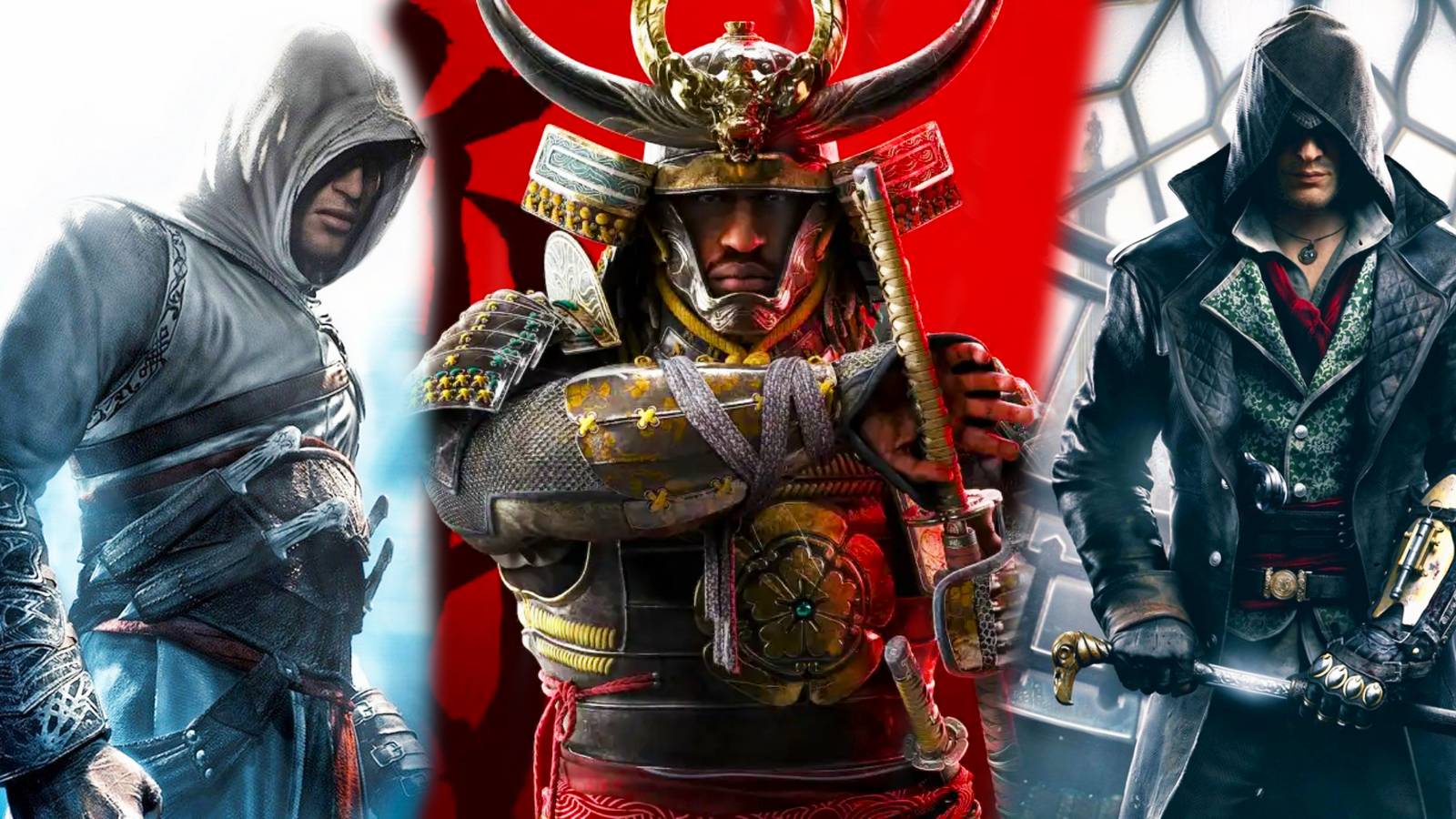
As one of the most iconic gaming franchises of all time, Assassin’s Creed has had its fair share of dramatic changes over the nearly two decades that the series has been running. With each entry experimenting with new mechanics that either become new mainstays in the series or long-forgotten gimmicks, it can be hard to keep track of them all at times.
To make things even more confusing, Assassin’s Creed has long since abandoned its already confusing naming structure, making it hard to follow the overarching storyline between each game in the series without a traditional number scheme. Thankfully, it’s a little easier to keep track of all 15 historical Assassin‘s Creed entries and the best games in the series once you know the true release order.
Assassin’s Creed (2007)
1191 AD

Introducing us to the world of Assassins, Templates, and Desmond’s character with Abstergo in the real world for the first time, the original Assassin’s Creed is easily the best place to start with the stealth franchise.
Loosely inspired by a novel, it offers plenty of unique mechanics and themes that still carry on with the series to this day despite its drastic changes. All these years later, revisiting the game makes for a more interesting comparison than ever.
Assassin’s Creed 2 (2009)
1459–1499 AD

Aside from expanding on the lore and developing the generational conflict between the Assassins and Templars, Assassin’s Creed 2 introduced one of the most beloved protagonists in the series by far, with Ezio Auditore.
Offering a journey from a simple noble to a master assassin, Assassin’s Creed 2 also expands on the classic gameplay loop of its predecessor, with even better stealth, parkour, and combat capabilities.
Assassin’s Creed: Brotherhood (2010)
1499–1507 AD

Being the first game in the series to start its more confusing naming scheme, Assassin’s Creed: Brotherhood acts more as a true sequel to Assassin’s Creed 2 rather than a spinoff game.
Assassin’s Creed: Brotherhood was also the first game in the series to introduce multiplayer with its PvP modes.
Assassin’s Creed: Brotherhood continues the story of Ezio, following his journey to Rome to take his fight to the Templars themselves and rebuild the Brotherhood once more. Desmond, meanwhile, desperately tries to find a solution to an apocalyptic scenario in the real world.
Assassin’s Creed: Revelations (2011)
1511–1512 AD

Acting as the final chapter in the Ezio storyline, Assassin’s Creed: Revelations is not only an excellent send-off to one of the series’ most beloved characters, but also a further refinement to the gameplay formula. Despite the familiar face, the game experiments in creative ways to keep the experience feeling fresh.
Some of the gameplay systems explored in Assassin’s Creed: Revelations didn’t make their way to future entries, but it’s still a core part of the original story with plenty of creative mechanics to offer for any fans of the series.
Assassin’s Creed 3 (2012)
1754–1783 AD

Assassin’s Creed 3 was the first Assassin’s Creed game to tackle a more easily recognizable historical setting for American audiences. Taking place during the American Revolution, Assassin’s Creed 3 has some of the most infamous moments in the series, for better or for worse.
On top of being the game to conclude Desmond’s storyline after 5 entries over 5 years, Assassin’s Creed 3 was a turning point for the series. New features included more seamless parkour, ranged combat, and future story expansions that didn’t end after closing the story of its protagonist, Connor Kenway.
Assassin’s Creed 4: Black Flag (2013)
1715–1722 AD

Assassin’s Creed 4: Black Flag takes a drastically different approach, embracing a Caribbean setting filled with pirates and customizable naval combat galore. It’s easily one of the most fun gameplay mixes the franchise has to offer, and it boasts another fan-favorite protagonist, Edward Kenway.
Perfectly enjoyed without prior experience of the series, Black Flag is still one of the most engaging pirate games on the market while remaining a solid Assassin’s Creed entry despite its age, even if the Abstergo segments and outdated stealth missions can take you out of the experience at times.
Assassin’s Creed Rogue (2014)
1752–1776 AD

Aside from sharing the unique naval combat mechanics like its predecessor, Assassin’s Creed Rogue stands out as being the first and only entry in the series to let you play as an Assassin-turned-Templar with its protagonist, Shay Cormac.
Taking place during the Seven Years’ War, Assassin’s Creed Rogue offers a more nuanced perspective on the Assassin organization as a whole, constantly asking moral questions throughout its story. On the gameplay side, it also has some fun bringing back and expanding on the stalker mechanics from Revelations with enemy assassins.
Assassin’s Creed Unity (2014)
1776–1808 AD

While Assassin’s Creed Unity had an abysmal launch that was filled with bugs and glitches galore, all of the updates to correct its mistakes paid off. The seamless parkour, iconic story set during the French Revolution, and fully co-operative multiplayer mechanics are still some of the best the series has ever seen.
Following its protagonist, Arno Dorian, with up to four total players in co-op missions and exploration, the immersive crowd simulations and visuals make Unity an incredibly immersive experience. Its technical ambition might have been its initial downfall, but it ultimately took full advantage of its hardware at the time.
Assassin’s Creed Chronicles (2015-2016)
1526–1918 AD

Assassin’s Creed Chronicles is one of the stranger parts of the series, offering a trilogy of three 2.5D side-scrolling action stealth games that take place in 16th-century China with Shao Jun, 19th-century India with Arbaaz Mir, and lastly, 20th-century Russia with Nikolai Orelov.
While the smaller-scale nature of Assassin’s Crreed Chronicles isn’t for everyone, each individual pack still has plenty to offer, and the more limited gameplay that acts more like a puzzle than a traditional action game can be intriguing. The third entry notably stands out for having the most modern setting the series has ever seen, as Nikolai’s story takes place during and after the October Revolution of 1917.
Assassin’s Creed Syndicate (2015)
1868 AD

The last entry to follow the traditional gameplay structure (until Mirage), Assassin’s Creed Syndicate follows the story of twin Assassins Jacob and Evie Frye as they work towards slowly liberating a transforming industrial London from the influence of the Templars.
Although Assassin’s Creed Syndicate is often skipped over as one of the more unforgettable and gimmicky entries in the series, it’s hard not to find something to enjoy with this more refined version of the original series, especially thanks to its surprisingly fun gang warfare mechanics.