
2025 Wasn’t the Hottest Year on Record. Earth Is Still Barreling to the Climate Brink
Global warming surpassed 1.5 degrees Celsius for the past three years, meaning Earth is currently on track to breach the Paris climate agreement by the end of the decade
Amanda Montañez; Source: Copernicus Climate Change Service (data)
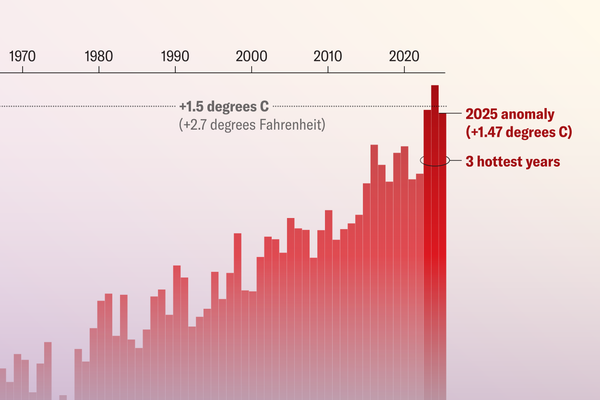
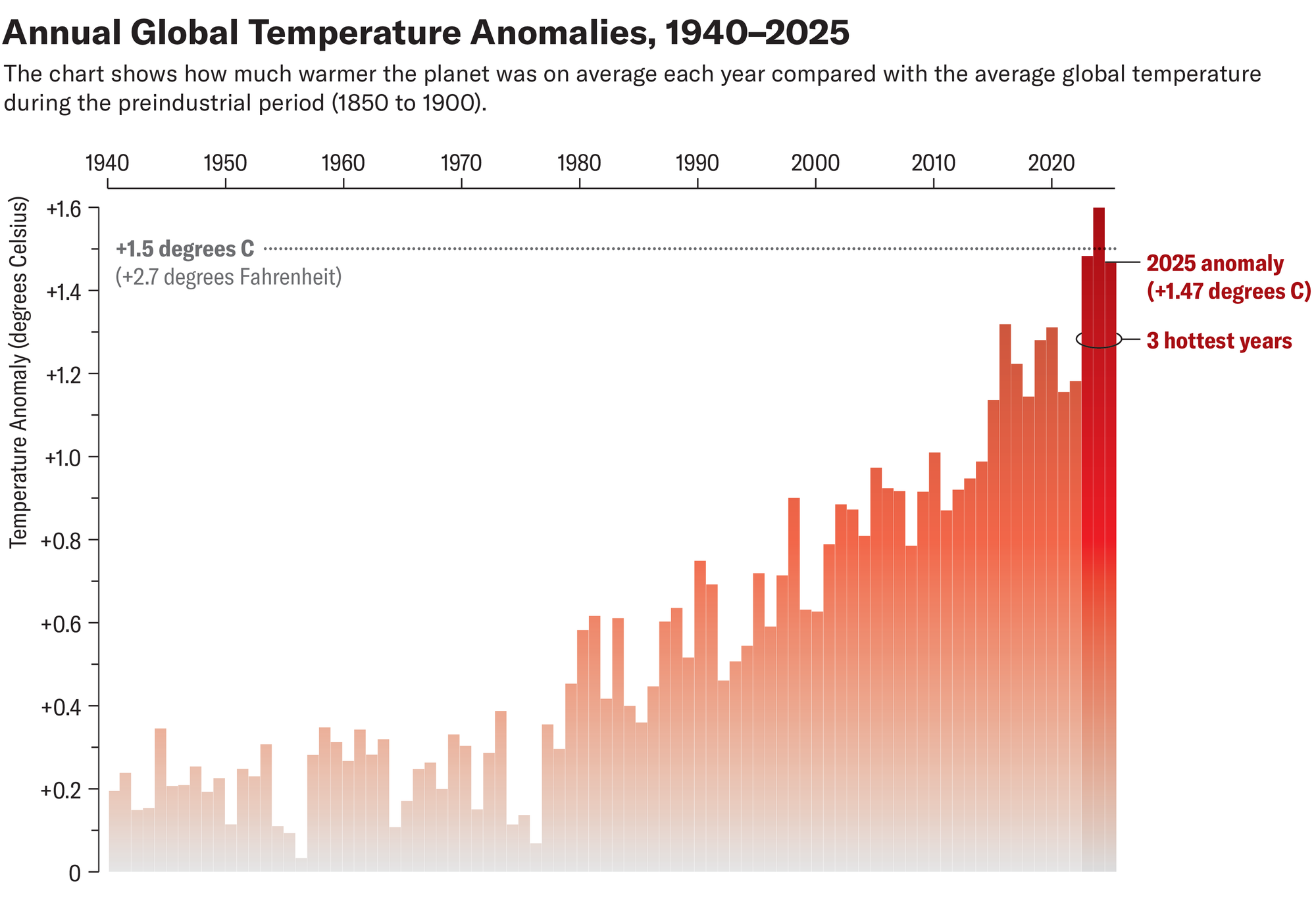
First, the good news: 2025 was not the hottest year on record. Now the bad news: last year was the third hottest on record, just a hair behind 2023. More importantly, it caps three years when global temperatures have surpassed 1.5 degrees Celsius above preindustrial levels.
The data, released by the European Union’s Copernicus Climate Change Service (C3S) on Tuesday, suggest we stand on a climate precipice.
“These three years stand apart from those that came before,” said Samantha Burgess, deputy director of C3S, in a press conference on Monday.
On supporting science journalism
If you’re enjoying this article, consider supporting our award-winning journalism by subscribing. By purchasing a subscription you are helping to ensure the future of impactful stories about the discoveries and ideas shaping our world today.
The past 11 years have been the 11 hottest on record, underscoring a global warming trend driven by rising levels of greenhouse gases in the atmosphere. If this trajectory doesn’t rapidly change, the world is on track to breach the landmark 2015 Paris climate agreement, which enjoins countries to limit warming to below 1.5 degrees C and “well below” two degrees C.
Amanda Montañez; Source: Copernicus Climate Change Service (data)
The global average temperature for 2025 was 1.47 degrees C above the average from 1850 to 1900, according to C3S. That’s just 0.01 degree C cooler than 2023; 2024 retains the title of hottest year on record, at 1.6 degrees C above the preindustrial global average—the first year to exceed 1.5 degrees C.
The Paris Agreement considers temperatures averages over many years. That’s why hitting a three-year warming milestone—and having the hottest years bunched over the past decade—is crucial evidence to show we are nearing a breach, likely by the end of this decade. That’s more than a decade sooner than was predicted when the agreement was first negotiated, C3S found.
“The world is rapidly approaching the long-term temperature limit set by the Paris agreement. We are bound to pass it; the choice we now have is how to best manage the inevitable overshoot and its consequences on societies and natural systems,” said Carlo Buontempo, C3S’s director, in a statement.
Achieving the goals of the Paris Agreement has been made all the harder by the Trump administration, which has sought to curtail U.S. climate action at home and abroad. As his current term began one year ago, President Donald Trump moved to pull the U.S. out of the agreement—an action he had taken in his first administration. And just a week ago Trump announced that he would go one step further, taking the U.S. out of the climate treaty under which the Paris accord was negotiated, as well as several other related agreements.
It’s Time to Stand Up for Science
If you enjoyed this article, I’d like to ask for your support. Scientific American has served as an advocate for science and industry for 180 years, and right now may be the most critical moment in that two-century history.
I’ve been a Scientific American subscriber since I was 12 years old, and it helped shape the way I look at the world. SciAm always educates and delights me, and inspires a sense of awe for our vast, beautiful universe. I hope it does that for you, too.
If you subscribe to Scientific American, you help ensure that our coverage is centered on meaningful research and discovery; that we have the resources to report on the decisions that threaten labs across the U.S.; and that we support both budding and working scientists at a time when the value of science itself too often goes unrecognized.
In return, you get essential news, captivating podcasts, brilliant infographics, can’t-miss newsletters, must-watch videos, challenging games, and the science world’s best writing and reporting. You can even gift someone a subscription.
There has never been a more important time for us to stand up and show why science matters. I hope you’ll support us in that mission.