
Close Menu
Beverly Hills Examiner

    Subscribe to Updates

    Get the latest creative news from FooBar about art, design and business.

    What's Hot

    David Byrne adds more UK and Ireland shows to summer 2026 ‘Who Is The Sky?’ world tour

    February 4, 2026

    Amazon AWS CEO Matt Garman pushes back against Elon Musk’s space data centers plan

    February 4, 2026

    Trump Just Made The Most Insane Statement About Elections In The History Of The Oval Office

    February 4, 2026
    Facebook X (Twitter) Instagram
    Beverly Hills Examiner
    • Home
    • US News
    • Politics
    • Business
    • Science
    • Technology
    • Lifestyle
    • Music
    • Television
    • Film
    • Books
    • Contact
      • About
      • Amazon Disclaimer
      • DMCA / Copyrights Disclaimer
      • Terms and Conditions
      • Privacy Policy
    Beverly Hills Examiner
    Home»Science»Astronomers Are Snapping Baby Pictures of Planets by the Dozen
    Science

    Astronomers Are Snapping Baby Pictures of Planets by the Dozen

    By AdminMarch 15, 2024
    Facebook Twitter Pinterest LinkedIn WhatsApp Email Reddit Telegram
    Astronomers Are Snapping Baby Pictures of Planets by the Dozen


    Astronomers Are Snapping Baby Pictures of Planets by the Dozen

    Snapshots of a plethora of planet-forming disks offer more than just eye candy—they also reveal some fundamental aspects of how worlds are born
    By Phil Plait

    Astronomers Are Snapping Baby Pictures of Planets by the Dozen

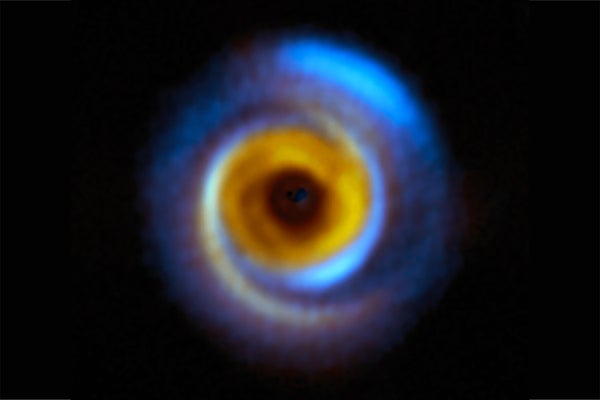
    Dust swirls around the MWC 758 planet-forming disk, located about 500 light-years away from Earth in the Taurus region, in this composite image from two different observatories. The yellow regions show scattered light from the dust, as seen by the Spectro-Polarimetric High-contrast Exoplanet REsearch (SPHERE) instrument on ESO’s Very Large Telescope (VLT); the blue regions correspond to light emitted from the warm dust, as detected by the Atacama Large Millimeter/submillimeter Array (ALMA). Such detailed views are helping astronomers see deeper than ever before into the mysterious process of planetary birth.

    Credit:

    ESO/A. Garufi et al.; R. Dong et al.; ALMA (ESO/NAOJ/NRAO) (CC BY 4.0)

    For centuries—and, frankly, until quite recently—astronomers have been baffled by planet formation. They saw these wandering points of light in the sky moving in a neat, orderly fashion, but many crucial details of how those worlds got there in the first place were a mystery.

    We’ve come a long, long way since those times—and with remarkable speed. Thanks to bigger telescopes, more precise instruments and advanced digital image processing techniques, this question of how planets form has gone from speculative guesswork to a robust field of study. And, like most new scientific disciplines, it’s evolving rapidly. We used to have just a few observations of embryonic planetary systems to analyze but now have hundreds, thanks to the breathtaking pace of discovery.

    In fact, astronomers have just delivered detailed observations of a staggering 86 nascent planetary families, adding a huge number of objects for researchers to gleefully analyze. And with that analysis will come a better understanding of how stars and planets are born.


    On supporting science journalism

    If you’re enjoying this article, consider supporting our award-winning journalism by subscribing. By purchasing a subscription you are helping to ensure the future of impactful stories about the discoveries and ideas shaping our world today.


    In Ye Olden Days—such as when I was a kid—our understanding of planetary formation was weak, and a lot of the ideas that were tossed around could safely be called “wacky.” For example, one was that a star passed so close to us that it drew strands of material out of the sun that coalesced to form the planets. This is a pretty cool idea—at least its proponents were “thinking big”—but it’s a stretch, to say the least. For one thing, collisions that close between stars in this part of the galaxy are so rare as to be nonexistent. And such a superheated solar streamer would dissipate to nothingness, not collapse into tidy, enduring worlds.

    But as time went on and our observations got better, so did our hypotheses. Now we know that stars form in gigantic clouds of gas called nebulae when overdense clumps of material collapse under their own gravity. The material flattens into a protostellar disk that swirls around the center, feeding the young star forming there. Eventually the disk—now called a protoplanetary disk—cools and can truly begin the planetary formation process. Planets grow either as small objects such as pebbles and rocks stick together to become bigger or as huge chunks of the disk collapse to directly create larger objects.

    These disks were theorized for decades, but the first wasn’t actually detected until the 1980s, when observations of the bright star Vega revealed it to be surrounded by a ring of starlight-warmed dust. More were quickly found, though the observations were short on diagnostic detail.

    That changed when a crew of astronauts installed the Space Telescope Imaging Spectrograph (STIS) on the Hubble Space Telescope in 1997. STIS was able to block most of a target star’s brilliant glare to deliver high-resolution images of any sizable circumstellar disk. Many of the disks discovered with STIS bore spiral arms—an indication of unseen planets that were setting the disks aswirl with their gravity. In others, clear gaps in the disk were seen where planets were either directly plowing through material and sweeping it up or pumping orbital energy into the particles there and changing their trajectory. (Full disclosure: I worked on STIS and was part of the project that looked at these disks. In that project, I helped to digitally remove the star’s light. Being one of the first people to ever see these disks in detail was an honor and a joy.)

    The study of these disks has of course moved on since then and, incredibly, gotten even better. The Atacama Large Millimeter/submillimeter Array (ALMA) observatory in Chile has scrutinized dozens of such structures and revealed previously unseen details in wavelengths of light near the radio range. And now astronomers are bridging the gap between visible light and radio with the European Southern Observatory’s immense Very Large Telescope (VLT) in Chile. It’s composed of four gigantic 8.2-meter telescopes, and on one of these beasts sits SPHERE, the Spectro-Polarimetric High-contrast Exoplanet REsearch instrument. This is a phenomenally high-resolution camera that takes images of such exquisite detail that, no joke, when I first saw its astonishing pictures of asteroids in our own solar system, I thought I was being pranked.

    Each of the VLT’s four telescopes is so big that it can collect a lot of light and see fine detail, so it’s able to observe many stars in the throes of creation and discern structures in the surrounding material—features created by massive objects such as protoplanets forming in a disk. In three papers just published in the journal Astronomy and Astrophysics, astronomers report their results from observing planetary systems emerging in three nearby nebulae in the constellations of Orion, Taurus and Chamaeleon. Each of these star-forming factories is close enough to Earth that the powerful VLT/SPHERE combo reveals a myriad of detail. In many of the observed disks, gaps and spiral arms can be seen, signaling the growth of planets and, importantly, putting the disks in context with their immediate astrophysical surroundings.

    For example, in the Taurus cloud, roughly 20 percent of all the nebula’s Class II objects (those where the light from the newly born star is just emerging from the protostellar murk) were observed by SPHERE, representing a complete sample of all stars with more than 0.4 times the sun’s mass—the rest were too faint to be reliably detected. Of these, nearly two thirds had faint disks that had been neither seen nor documented before.

    Importantly, nearly a third of the systems observed in the Taurus cloud were multiple star systems, with two or more stars orbiting each other. Statistics show that about half of all stars are—unlike our sun—in multiple systems, so studying planetary formation in these Tatooine-like environments will yield a lot of interesting data on how stellar multiplicity affects the stars’ planets. For example, in the Chamaeleon cloud studied by SPHERE, disks were sparse within binary systems where the higher-mass primary star was accompanied by a close-orbiting lower-mass secondary star; this implies that some aspect of that stellar configuration suppresses the formation of planet-birthing disks.

    Individual stars and disks are wonderful for learning about specific physical circumstances, but we need broader observations to get a better overview of how planets come into being—in a sense, we can only understand the fine details by seeing how they fit into the bigger picture. Comparing and contrasting the characteristics of these planetary nurseries, including density, age and chemical structure, is what will lead to that gestalt.

    The study of planetary birth is at an inflection point. In the past, these objects were found only rarely, but now observations are sweeping them up wholesale. As I like to say about new fields of science, this is when it goes from stamp collecting to zoology—from “We found another of these weird objects!” to “We have enough that we’re starting to note trends and see the underlying mechanisms that create them.”

    There are still many questions about how our own solar system came to be and how it evolved over the eons to its current configuration. A critical step within that is to observe other planetary systems and find the deeper connections between them and us.

    You might think astronomy is the study of everything over your head, but in fact it includes what’s under your feet, too.


    Original Source Link

    Share. Facebook Twitter Pinterest LinkedIn WhatsApp Email Reddit Telegram
    Previous ArticleLena Dunham in Tommy Dorfman Film
    Next Article India drops plan to require approval for AI model launches

    RELATED POSTS

    NASA’s Artemis II moon mission engulfed by debate over its controversial heat shield

    February 4, 2026

    Dutch air force reads pilots’ brainwaves to make training harder

    February 3, 2026

    HHS Is Using AI Tools From Palantir to Target ‘DEI’ and ‘Gender Ideology’ in Grants

    February 3, 2026

    The sun just unleashed its most powerful solar flare in years

    February 2, 2026

    The best new popular science books of February 2026 include titles by Maggie Aderin and Michael Pollan

    February 2, 2026

    How to Use Physics to Escape an Ice Bowl

    February 1, 2026
    latest posts

    David Byrne adds more UK and Ireland shows to summer 2026 ‘Who Is The Sky?’ world tour

    David Byrne has added fresh UK and Ireland shows to his ‘Who Is The Sky?’…

    Amazon AWS CEO Matt Garman pushes back against Elon Musk’s space data centers plan

    February 4, 2026

    Trump Just Made The Most Insane Statement About Elections In The History Of The Oval Office

    February 4, 2026

    Judge restricts use of tear gas on protesters at Portland ICE facility

    February 4, 2026

    Epstein-linked longevity guru Peter Attia leaves David Protein, and his own startup ‘won’t comment’

    February 4, 2026

    NASA’s Artemis II moon mission engulfed by debate over its controversial heat shield

    February 4, 2026

    Twinless review – a twee showcase for actor Dylan…

    February 4, 2026
    Categories
    • Books (1,039)
    • Business (5,945)
    • Film (5,881)
    • Lifestyle (3,983)
    • Music (5,949)
    • Politics (5,950)
    • Science (5,292)
    • Technology (5,879)
    • Television (5,568)
    • Uncategorized (2)
    • US News (5,931)
    popular posts

    Lionsgate Boards ‘Creepers’ Horror Book Adaptation – The Hollywood Reporter

    Lionsgate is joining Suretone Pictures, led by Jordan Schur, in jointly financing the adventure horror…

    5 things to know before the stock market opens Friday, May 13

    May 13, 2022

    The 10 Best High-Yield Savings Accounts for April 2023

    April 3, 2023

    Atlanta Popeyes workers ‘violently’ attacked woman attempting to correct order: lawsuit

    August 5, 2023
    Archives
    Browse By Category
    • Books (1,039)
    • Business (5,945)
    • Film (5,881)
    • Lifestyle (3,983)
    • Music (5,949)
    • Politics (5,950)
    • Science (5,292)
    • Technology (5,879)
    • Television (5,568)
    • Uncategorized (2)
    • US News (5,931)
    About Us

    We are a creativity led international team with a digital soul. Our work is a custom built by the storytellers and strategists with a flair for exploiting the latest advancements in media and technology.

    Most of all, we stand behind our ideas and believe in creativity as the most powerful force in business.

    What makes us Different

    We care. We collaborate. We do great work. And we do it with a smile, because we’re pretty damn excited to do what we do. If you would like details on what else we can do visit out Contact page.

    Our Picks

    NASA’s Artemis II moon mission engulfed by debate over its controversial heat shield

    February 4, 2026

    Twinless review – a twee showcase for actor Dylan…

    February 4, 2026

    ‘High Potential’ Boss Breaks Down Morgan’s Panic Attack and Comfort From Karadec Amid New Relationship (Exclusive)

    February 4, 2026
    © 2026 Beverly Hills Examiner. All rights reserved. All articles, images, product names, logos, and brands are property of their respective owners. All company, product and service names used in this website are for identification purposes only. Use of these names, logos, and brands does not imply endorsement unless specified. By using this site, you agree to the Terms & Conditions and Privacy Policy.

    Type above and press Enter to search. Press Esc to cancel.

    We use cookies on our website to give you the most relevant experience by remembering your preferences and repeat visits. By clicking “Accept All”, you consent to the use of ALL the cookies. However, you may visit "Cookie Settings" to provide a controlled consent.
    Cookie SettingsAccept All
    Manage consent

    Privacy Overview

    This website uses cookies to improve your experience while you navigate through the website. Out of these, the cookies that are categorized as necessary are stored on your browser as they are essential for the working of basic functionalities of the website. We also use third-party cookies that help us analyze and understand how you use this website. These cookies will be stored in your browser only with your consent. You also have the option to opt-out of these cookies. But opting out of some of these cookies may affect your browsing experience.
    Necessary
    Always Enabled
    Necessary cookies are absolutely essential for the website to function properly. These cookies ensure basic functionalities and security features of the website, anonymously.
    CookieDurationDescription
    cookielawinfo-checkbox-analytics11 monthsThis cookie is set by GDPR Cookie Consent plugin. The cookie is used to store the user consent for the cookies in the category "Analytics".
    cookielawinfo-checkbox-functional11 monthsThe cookie is set by GDPR cookie consent to record the user consent for the cookies in the category "Functional".
    cookielawinfo-checkbox-necessary11 monthsThis cookie is set by GDPR Cookie Consent plugin. The cookies is used to store the user consent for the cookies in the category "Necessary".
    cookielawinfo-checkbox-others11 monthsThis cookie is set by GDPR Cookie Consent plugin. The cookie is used to store the user consent for the cookies in the category "Other.
    cookielawinfo-checkbox-performance11 monthsThis cookie is set by GDPR Cookie Consent plugin. The cookie is used to store the user consent for the cookies in the category "Performance".
    viewed_cookie_policy11 monthsThe cookie is set by the GDPR Cookie Consent plugin and is used to store whether or not user has consented to the use of cookies. It does not store any personal data.
    Functional
    Functional cookies help to perform certain functionalities like sharing the content of the website on social media platforms, collect feedbacks, and other third-party features.
    Performance
    Performance cookies are used to understand and analyze the key performance indexes of the website which helps in delivering a better user experience for the visitors.
    Analytics
    Analytical cookies are used to understand how visitors interact with the website. These cookies help provide information on metrics the number of visitors, bounce rate, traffic source, etc.
    Advertisement
    Advertisement cookies are used to provide visitors with relevant ads and marketing campaigns. These cookies track visitors across websites and collect information to provide customized ads.
    Others
    Other uncategorized cookies are those that are being analyzed and have not been classified into a category as yet.
    SAVE & ACCEPT