
Close Menu
Beverly Hills Examiner

    Subscribe to Updates

    Get the latest creative news from FooBar about art, design and business.

    What's Hot

    David Byrne adds more UK and Ireland shows to summer 2026 ‘Who Is The Sky?’ world tour

    February 4, 2026

    Amazon AWS CEO Matt Garman pushes back against Elon Musk’s space data centers plan

    February 4, 2026

    Trump Just Made The Most Insane Statement About Elections In The History Of The Oval Office

    February 4, 2026
    Facebook X (Twitter) Instagram
    Beverly Hills Examiner
    • Home
    • US News
    • Politics
    • Business
    • Science
    • Technology
    • Lifestyle
    • Music
    • Television
    • Film
    • Books
    • Contact
      • About
      • Amazon Disclaimer
      • DMCA / Copyrights Disclaimer
      • Terms and Conditions
      • Privacy Policy
    Beverly Hills Examiner
    Home»Science»Astronomers Might See Dark Matter by Staring into the Void
    Science

    Astronomers Might See Dark Matter by Staring into the Void

    By AdminJune 8, 2022
    Facebook Twitter Pinterest LinkedIn WhatsApp Email Reddit Telegram
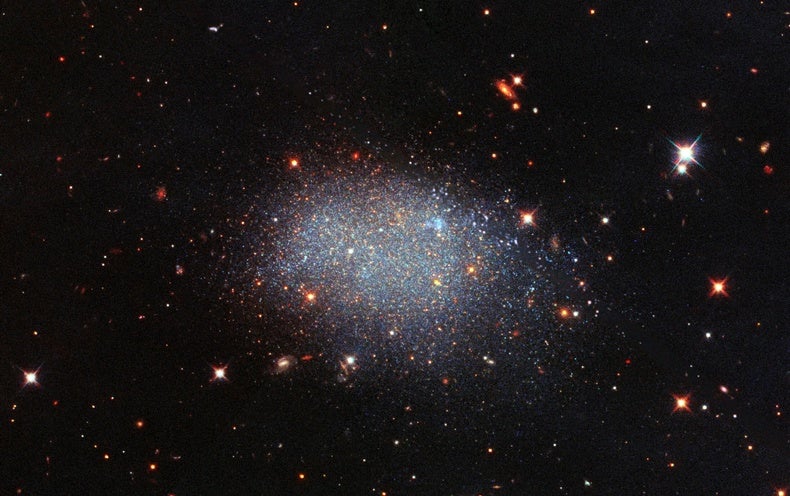
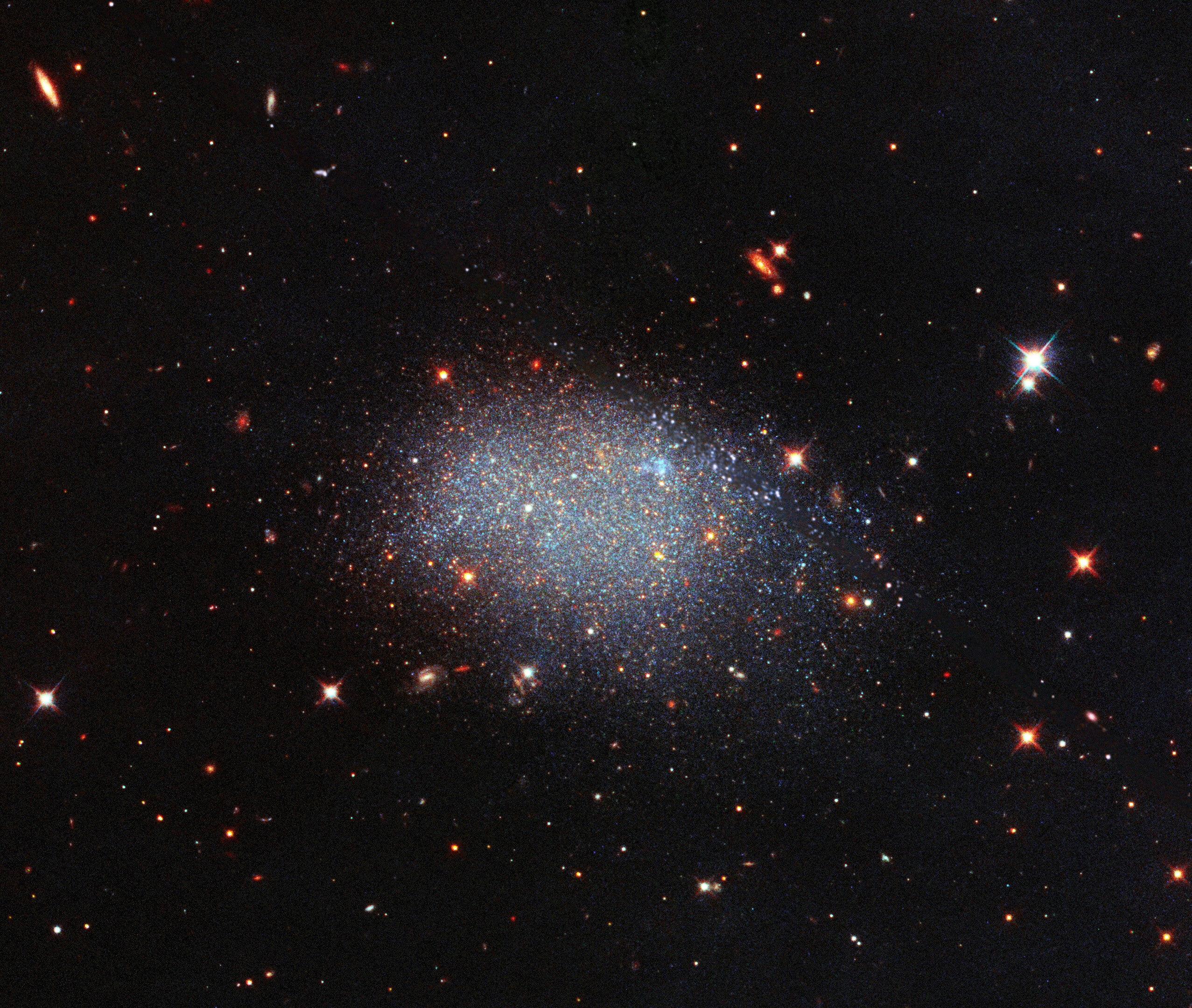
    Astronomers Might See Dark Matter by Staring into the Void


    In our search for cosmic signals of dark matter, we could be likened to drunkards looking for lost keys beneath lampposts, where the light shines the brightest. Here, the “lampposts” are regions of space teeming with galaxies and galaxy clusters, which are thought to be embedded in dense clouds, or “halos,” of dark matter. What if instead we trained our sights on cosmic voids—vast reaches of mostly empty space? In a new preprint study, a trio of researchers argue that while dark matter’s overall signal from these parts of the cosmos would be weaker, it would also be less contaminated by astrophysical sources and thus could be easier to spot.

    “It’s a fresh idea,” says Nico Hamaus, a cosmologist at the Ludwig Maximilian University of Munich in Germany, who was not part of the study. “And it’s not just the idea. It’s also backed up with some calculations [that] make sense.”

    Dark matter is thought to make up more than 80 percent of the material in the universe. This estimate is based mostly on the gravitational influence this mysterious substance seems to exert on the gas, dust, stars and galaxies that make up normal matter. For instance, the rotational speeds of galaxies are such that, without the gravity of dark matter to hold them together, they would have long since disintegrated.

    Physicists’ best collective guess is that dark matter is made of so-called weakly interacting massive particles (WIMPs). But direct evidence for WIMPs has been elusive, despite decades of looking for them in particle accelerators and exquisitely sensitive detectors buried deep underground to minimize spurious signals from cosmic rays and other sources. Still, WIMPs remain the favored candidate for dark matter, says study co-author Nicolao Fornengo of the University of Torino in Italy.

    According to almost all WIMP-based models, if these particles are, as expected, heavy—say, between a few giga-electron-volts (GeV) to a few tera-electron-volts (TeV), where a GeV is about the mass of a proton—then they should eventually decay or collide with one another and annihilate, which would produce gamma rays in both cases. “If dark matter produces [gamma rays], the signal should be in there,” Fornengo says.

    Current gamma-ray observatories, especially NASA’s Fermi mission with its large area telescope (LAT), detect a diffuse all-sky “background” of gamma rays. This background is the unexplained excess that remains once the contributions from all known astrophysical sources, such as pulsars and matter-slurping supermassive black holes, are subtracted. And it isn’t evenly distributed across the sky—which is consistent with what astrophysicists expect from dark matter emission and the astrophysical sources that are too small to be resolved with even the best-in-class Fermi LAT. When it comes to dark matter, the gamma-ray glow of decaying and annihilating WIMPs should correlate with large-scale cosmic structure, shining brighter from matter-packed regions and fainter from the voids. Early studies indicate that this correlation exists, but so far such studies have mostly avoided the voids and have focused instead on the brighter regions full of galaxies and clusters.

    To see whether such a signal can be teased out better from voids than overdense regions, the team modeled how it should emanate from both types of cosmic structures. Their results suggest that, although the combined gamma-ray emission from dark matter and normal matter within a void would be much weaker than that from an overdense region, this weakness actually confers an advantage: the relative lack of normal matter ensures fewer astrophysical sources that would otherwise obscure dark matter’s gamma-ray emission. “It’s a trade-off between having a stronger but more polluted signal to measure versus a weaker but cleaner signal,” Fornengo says. His and his colleagues’ study has been submitted to the Journal of Cosmology and Astroparticle Physics.

    The team also found—somewhat unsurprisingly—that most gamma rays from dark matter in these voids should emerge via the decay of the particles rather than their annihilation. In order for two particles to annihilate, they must first collide, and the odds of WIMPs finding each other in cosmic voids are low. But the particles should decay regardless of the density of their distribution. “Decay just probes the whole mass within [a volume of] space,” Fornengo says. “And the mass of a void is not a small number. It’s still a big object. It’s just less dense.”

    Because of its superior signal-to-noise ratio and its bias toward detecting gamma rays from decaying particles, Hamaus says, the technique might offer novel insights into dark matter’s properties that would be inaccessible via gamma-ray studies of overdense regions alone. For instance, the greater the average lifetime of a dark-matter particle, the less decay should occur over a given region of space and time. While such a faint signal would normally be undetectable, that should not be the case in voids. “Because your signal-to-background [noise] is higher, you can go further in the exploration of the parameter space,” he says.

    Anthony Pullen, an astrophysicist at New York University, who is unaffiliated with the study, is cautiously optimistic about near-future tests of its core ideas. Multiple large-scale surveys of cosmic structure are slated to commence later this decade on next-generation facilities such as the European Space Agency’s (ESA’s) Euclid space telescope, NASA’s Nancy Grace Roman Space Telescope and the ground-based Vera C. Rubin Observatory. “As those surveys come online, you’re going to have these very large data sets. The more galaxies we are able to detect, the better we’ll be able to actually map out where the voids are,” Pullen says. “And that would help with this type of study. In the next few years, you could see something like this demonstrated as a proof of concept.”

    Today such a proof of concept would have to rely on the gamma-ray data collected by Fermi LAT—which isn’t up to the task, according to Fornengo and his colleagues. Making unequivocal detections, they calculate, would require a new generation of gamma-ray instruments with twice the detector volume and five times the angular resolution (the ability to tell apart sources in the sky) of Fermi LAT. “It would be a great addition to have a ‘new Fermi,’” Fornengo says, although he acknowledges that, for now, such a detector only exists in their dreams. That hasn’t stopped the team from giving it an appropriately Italian nickname, however: Fermissimo.


    Original Source Link

    Share. Facebook Twitter Pinterest LinkedIn WhatsApp Email Reddit Telegram
    Previous ArticleBlack Adam Trailer Officially Released – The Hollywood Reporter
    Next Article How to Buy a Projector (2022): Throw Distance, Screen Size, Mounting, Long Cables

    RELATED POSTS

    NASA’s Artemis II moon mission engulfed by debate over its controversial heat shield

    February 4, 2026

    Dutch air force reads pilots’ brainwaves to make training harder

    February 3, 2026

    HHS Is Using AI Tools From Palantir to Target ‘DEI’ and ‘Gender Ideology’ in Grants

    February 3, 2026

    The sun just unleashed its most powerful solar flare in years

    February 2, 2026

    The best new popular science books of February 2026 include titles by Maggie Aderin and Michael Pollan

    February 2, 2026

    How to Use Physics to Escape an Ice Bowl

    February 1, 2026
    latest posts

    David Byrne adds more UK and Ireland shows to summer 2026 ‘Who Is The Sky?’ world tour

    David Byrne has added fresh UK and Ireland shows to his ‘Who Is The Sky?’…

    Amazon AWS CEO Matt Garman pushes back against Elon Musk’s space data centers plan

    February 4, 2026

    Trump Just Made The Most Insane Statement About Elections In The History Of The Oval Office

    February 4, 2026

    Judge restricts use of tear gas on protesters at Portland ICE facility

    February 4, 2026

    Epstein-linked longevity guru Peter Attia leaves David Protein, and his own startup ‘won’t comment’

    February 4, 2026

    NASA’s Artemis II moon mission engulfed by debate over its controversial heat shield

    February 4, 2026

    Twinless review – a twee showcase for actor Dylan…

    February 4, 2026
    Categories
    • Books (1,039)
    • Business (5,945)
    • Film (5,881)
    • Lifestyle (3,983)
    • Music (5,949)
    • Politics (5,950)
    • Science (5,292)
    • Technology (5,879)
    • Television (5,568)
    • Uncategorized (2)
    • US News (5,931)
    popular posts

    Aurora Police Chief Goes Scorched Earth On Biden Admin After Arrest Of 14 Violent Illegal Immigrant Gang Members

    Credit: Screenshot via Fox31 DenverCredit: Screenshot via Fox31 Denver. Police in Aurora, Colorado, have detained…

    ERASING HISTORY: Statue of Revolutionary War Hero Removed From City Hall in Albany, NY (VIDEO) | The Gateway Pundit | by Mike LaChance

    June 11, 2023

    Evolution Mining Founder Isn't Finished Yet

    November 3, 2024

    How to Explore Your City Like a Tourist, and Why You’d Want To

    June 21, 2025
    Archives
    Browse By Category
    • Books (1,039)
    • Business (5,945)
    • Film (5,881)
    • Lifestyle (3,983)
    • Music (5,949)
    • Politics (5,950)
    • Science (5,292)
    • Technology (5,879)
    • Television (5,568)
    • Uncategorized (2)
    • US News (5,931)
    About Us

    We are a creativity led international team with a digital soul. Our work is a custom built by the storytellers and strategists with a flair for exploiting the latest advancements in media and technology.

    Most of all, we stand behind our ideas and believe in creativity as the most powerful force in business.

    What makes us Different

    We care. We collaborate. We do great work. And we do it with a smile, because we’re pretty damn excited to do what we do. If you would like details on what else we can do visit out Contact page.

    Our Picks

    NASA’s Artemis II moon mission engulfed by debate over its controversial heat shield

    February 4, 2026

    Twinless review – a twee showcase for actor Dylan…

    February 4, 2026

    ‘High Potential’ Boss Breaks Down Morgan’s Panic Attack and Comfort From Karadec Amid New Relationship (Exclusive)

    February 4, 2026
    © 2026 Beverly Hills Examiner. All rights reserved. All articles, images, product names, logos, and brands are property of their respective owners. All company, product and service names used in this website are for identification purposes only. Use of these names, logos, and brands does not imply endorsement unless specified. By using this site, you agree to the Terms & Conditions and Privacy Policy.

    Type above and press Enter to search. Press Esc to cancel.

    We use cookies on our website to give you the most relevant experience by remembering your preferences and repeat visits. By clicking “Accept All”, you consent to the use of ALL the cookies. However, you may visit "Cookie Settings" to provide a controlled consent.
    Cookie SettingsAccept All
    Manage consent

    Privacy Overview

    This website uses cookies to improve your experience while you navigate through the website. Out of these, the cookies that are categorized as necessary are stored on your browser as they are essential for the working of basic functionalities of the website. We also use third-party cookies that help us analyze and understand how you use this website. These cookies will be stored in your browser only with your consent. You also have the option to opt-out of these cookies. But opting out of some of these cookies may affect your browsing experience.
    Necessary
    Always Enabled
    Necessary cookies are absolutely essential for the website to function properly. These cookies ensure basic functionalities and security features of the website, anonymously.
    CookieDurationDescription
    cookielawinfo-checkbox-analytics11 monthsThis cookie is set by GDPR Cookie Consent plugin. The cookie is used to store the user consent for the cookies in the category "Analytics".
    cookielawinfo-checkbox-functional11 monthsThe cookie is set by GDPR cookie consent to record the user consent for the cookies in the category "Functional".
    cookielawinfo-checkbox-necessary11 monthsThis cookie is set by GDPR Cookie Consent plugin. The cookies is used to store the user consent for the cookies in the category "Necessary".
    cookielawinfo-checkbox-others11 monthsThis cookie is set by GDPR Cookie Consent plugin. The cookie is used to store the user consent for the cookies in the category "Other.
    cookielawinfo-checkbox-performance11 monthsThis cookie is set by GDPR Cookie Consent plugin. The cookie is used to store the user consent for the cookies in the category "Performance".
    viewed_cookie_policy11 monthsThe cookie is set by the GDPR Cookie Consent plugin and is used to store whether or not user has consented to the use of cookies. It does not store any personal data.
    Functional
    Functional cookies help to perform certain functionalities like sharing the content of the website on social media platforms, collect feedbacks, and other third-party features.
    Performance
    Performance cookies are used to understand and analyze the key performance indexes of the website which helps in delivering a better user experience for the visitors.
    Analytics
    Analytical cookies are used to understand how visitors interact with the website. These cookies help provide information on metrics the number of visitors, bounce rate, traffic source, etc.
    Advertisement
    Advertisement cookies are used to provide visitors with relevant ads and marketing campaigns. These cookies track visitors across websites and collect information to provide customized ads.
    Others
    Other uncategorized cookies are those that are being analyzed and have not been classified into a category as yet.
    SAVE & ACCEPT