
Close Menu
Beverly Hills Examiner

    Subscribe to Updates

    Get the latest creative news from FooBar about art, design and business.

    What's Hot

    The Cure’s Perry Bamonte Dies at 65

    January 1, 2026

    Copper records biggest annual gain since 2009 on supply bets

    January 1, 2026

    Trump Takes One Final Big Loss In Court Before The End Of The Year

    January 1, 2026
    Facebook X (Twitter) Instagram
    Beverly Hills Examiner
    • Home
    • US News
    • Politics
    • Business
    • Science
    • Technology
    • Lifestyle
    • Music
    • Television
    • Film
    • Books
    • Contact
      • About
      • Amazon Disclaimer
      • DMCA / Copyrights Disclaimer
      • Terms and Conditions
      • Privacy Policy
    Beverly Hills Examiner
    Home»Science»Astronomers Spy First Star-Forming Disk beyond the Milky Way
    Science

    Astronomers Spy First Star-Forming Disk beyond the Milky Way

    By AdminDecember 8, 2023
    Facebook Twitter Pinterest LinkedIn WhatsApp Email Reddit Telegram
    Astronomers Spy First Star-Forming Disk beyond the Milky Way


    Astronomers Spy First Star-Forming Disk beyond the Milky Way

    Making stars is a messy business. Although the process takes far longer than any human life span, we’ve sufficiently studied its various stages in stellar nurseries scattered around our galaxy to gain a decent overall grasp of how it works. It starts, in general, with a huge swirling cloud of gas and cosmic dust—like the Orion nebula that currently graces our winter skies. Motions in the cloud can give rise to tenuous clumps of material If such a clump grows large enough, it can gain the necessary gravitational pull to collapse and become denser still, drawing in more matter from the surrounding cloud all the while.

    As this collapsing clump coalesces, infalling matter amplifies any rotational motion in the gas, causing the clump to spin up and flatten out into a disk with a glowing nascent star at the very center. This protostar becomes hotter and more massive as it feeds off the gas flowing in from that disk. Eventually it gains sufficient mass to squeeze hydrogen atoms together in its high-pressure core so tightly that they fuse, transmogrifying into helium and releasing huge amounts of energy. At this point a star is literally born.

    Although the central sun is, well, the “star” of this show, the disk that feeds it material plays a crucial supporting role—both for stellar birth and the emergence of accompanying planets. We had seen such disks around many still-forming stars in our own Milky Way galaxy but never outside it—until now.

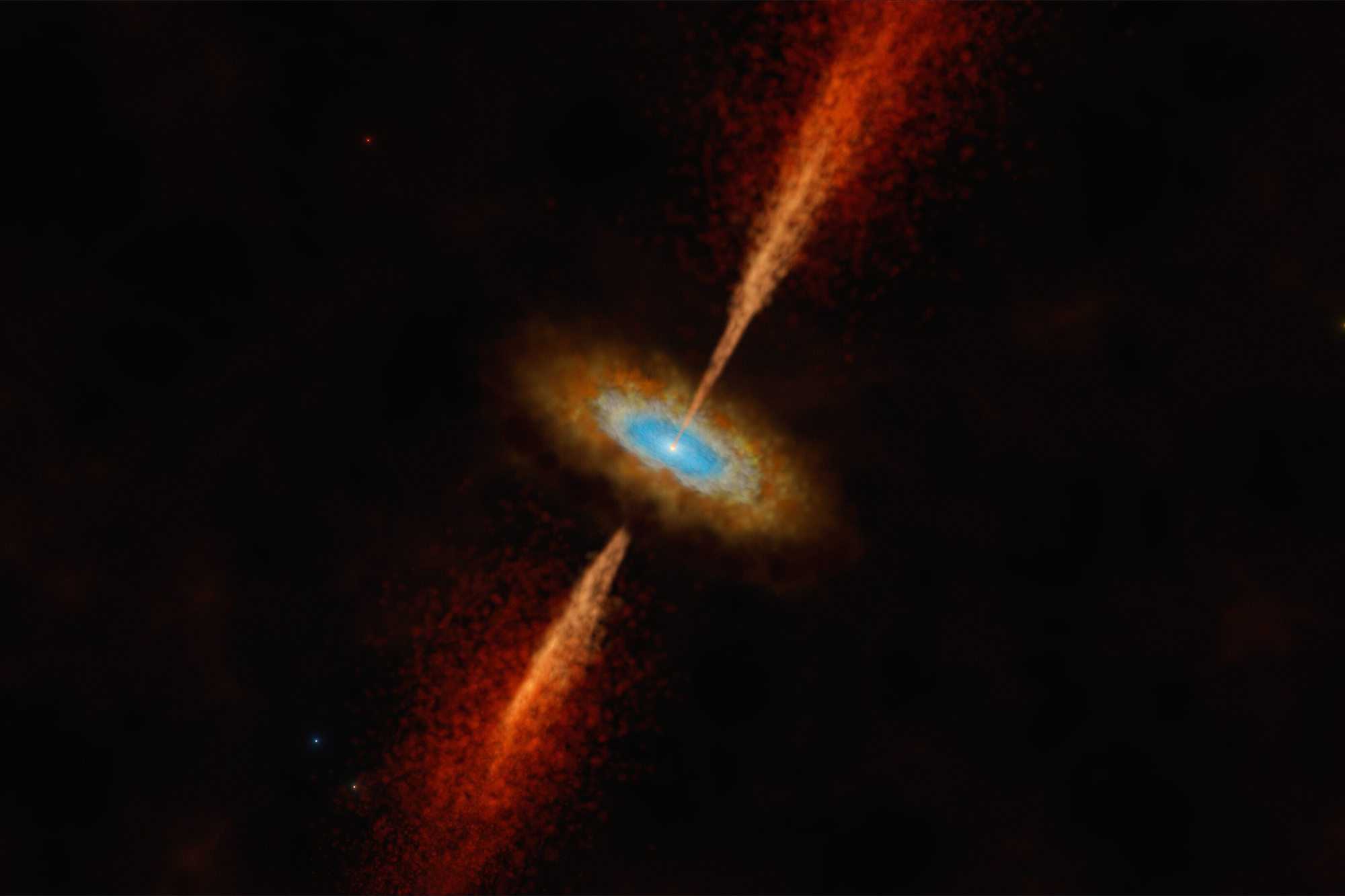
    Astronomers have, for the very first time, detected the rotating disk of material around a very young star in another galaxy, and the discovery is already offering fresh insights about how stars form under different cosmic conditions. The results were published in the journal Nature.

    The galaxy in question is the Large Magellanic Cloud (LMC), a smallish satellite of the Milky Way that is roughly 160,000 light-years from Earth. This nearby galactic companion is visible to unaided eyes in the Southern Hemisphere yet never crests above the night sky’s horizon at most northern latitudes. A few years ago astronomers took a peek at the gaseous nebula LH 117 (aka NGC 2122), a spectacular stellar factory in the LMC filled with hundreds of stars, and found that one of these stars stood out because of two long jets of material blasting away from it. Such jets are common around newborn stars.

    Although the details of how exactly these jets arise are still unclear, magnetic fields in the disk must somehow be involved. The gas in the disk is very hot—hot enough to strip electrons from their parent atoms in a process called ionization. Ionized gas, or plasma, creates an internal magnetic field as it moves such that plasma spiraling toward the disk’s central star gains an increasingly intense magnetic field. The plasma’s rapid orbital motion also coils up this strong magnetic field like spaghetti around a twirling fork. Right at the center, very close to the star itself, the magnetic field erupts outward—up and down relative to the disk—in twin vortices that pull material along with them. These stellar tornadoes create the jets and can carry so much energy that the matter in them is ejected at very high speed, sometimes in excess of 300,000 kilometers per hour. These kinds of objects are called Herbig-Haro objects, or HH objects.

    The tightly coiled magnetic field keeps the jets focused, so they often extend to great lengths. The star that caught the astronomers’ attention, called HH 1177, has jets that span a staggering 33 light-years tip to tip. We can even tell which way these jets are pointed in space; the light from one jet is blueshifted, with wavelengths squeezed and shortened by its source’s motion toward an observer. This jet is aimed toward us. The other jet is redshifted, aimed and traveling away from us such that the wavelengths of its emitted light are stretched out, becoming longer.

    The jets’ bipolar directionality strongly implies there must be a swirling disk at their source that focuses them and feeds the star. Hints of such a disk were apparent in the original images from the Very Large Telescope in Chile. For proof, however, astronomers turned to the Atacama Large Millimeter/submillimeter Array, or ALMA, also located in the high desert of Chile. ALMA can make high-resolution maps of the spatial distribution of gases such as carbon monoxide and carbon monosulfide (commonly seen around young stars). It can also measure the exact wavelengths of light emitted by such molecules, which can reveal their motion toward or away from us via blueshifts and redshifts.

    What the team found was a smoking gun, or at least a smoking disk: Very close to the star, at the base of the jets, was the telltale sign of a rotating disk, with blueshifted gas on one side moving toward us and redshifted gas on the other moving away. Our view of HH 1177 is thus much the same as standing before a merry-go-round and watching as it rotates in a counterclockwise direction: the gaudy plastic horses on the left are moving toward you, and those on the right are moving away. The gas in HH 1177’s disk exhibits exactly this same kind of motion.

    This extragalactic discovery is more than simply a new record for the farthest star-forming disk ever seen. It also provides a lovely example of stellar birth for comparison with what we see in our own galaxy. The star at HH 1177’s heart is massive, probably a dozen times the mass of our sun. In the Milky Way such massive stars are usually embedded in thick clouds of opaque dust, which makes them difficult to study directly.

    But the Large Magellanic Cloud is different. Its gas and stars are relatively impoverished of heavy elements such as carbon and iron, compared with the material of the Milky Way, which changes this small galaxy’s appearance and behavior. In particular, because dust is made of heavier elements such as carbon and silicon, there’s less of it in the LMC than in our galaxy, and that gives us a clearer view of massive stars being born there. HH 1177 is the first massive star that astronomers have seen unobscured in this stage of stellar evolution.

    The disk is different from its Milky Way counterparts as well. It’s bulky, two to four times the mass of the sun just by itself, and in our galaxy disks that are so dense tend to fragment and break apart. The disk around HH 1177 appears to be stable, however. Its discoverers think this, too, is because of the LMC’s lower abundance of heavy elements. Stars with sparse heavy elements often emit more ultraviolet radiation, which can more efficiently heat surrounding gas. That may be the case here. Hotter gas in a disk means the disk has more internal pressure to resist the inward pull of its own gravity, keeping the disk stable like a sturdy, well-inflated bicycle tire.

    Other than that, though, HH 1177 is remarkably like our own galaxy’s brood of young massive stars in the same developmental stage. This similarity suggests stars in other galaxies form much as they do right here in the Milky Way—but as we’ve seen, there can still be differences that reveal themselves in the details.

    That’s critical for our understanding of the dynamic complexity of how stars and planets are born from disks; we use the physics of gravity, radiation, gas dynamics, magnetism, and more to predict how such objects behave. And by seeing how the process unfolds under different conditions, we can push the limits of our models to learn how they perform under stress. If they remain intact, so, too, does our confidence in their correctness; if they break, then important gaps must linger in our accounts of stellar birth.

    Gas-rich regions of star formation are strewn throughout the Large Magellanic Cloud; HH 1177’s disk is the first we’ve directly seen there, but it won’t be the last. Each one we find will be another step toward understanding how stars are born—and how we all came to be.


    Original Source Link

    Share. Facebook Twitter Pinterest LinkedIn WhatsApp Email Reddit Telegram
    Previous ArticleInternational Losing An Original Cast Member In Latest Change For CBS Franchise
    Next Article With its second app, Amo wants to make photo-sharing as simple taking a photo

    RELATED POSTS

    Poor Sleep Quality Accelerates Brain Aging

    January 1, 2026

    NASA Telescopes Capture Colliding Spiral Galaxies in Sparkling Detail

    December 31, 2025

    Star that seemed to vanish more than 130 years ago is found again

    December 31, 2025

    The Great Big Power Play

    December 30, 2025

    15 Million Years before the Megalodon, This Giant Ancient Shark Prowled the Oceans

    December 30, 2025

    Mathematicians unified key laws of physics in 2025

    December 29, 2025
    latest posts

    The Cure’s Perry Bamonte Dies at 65

    Perry Bamonte, the Cure’s longtime guitarist and keyboardist, has died following an undisclosed illness. He…

    Copper records biggest annual gain since 2009 on supply bets

    January 1, 2026

    Trump Takes One Final Big Loss In Court Before The End Of The Year

    January 1, 2026

    Zohran Mamdani sworn in as NYC mayor in midnight ceremony at Old City Hall

    January 1, 2026

    ‘College dropout’ has become the most coveted startup founder credential

    January 1, 2026

    Poor Sleep Quality Accelerates Brain Aging

    January 1, 2026

    Avengers, Toy Story 5, The Odyssey

    January 1, 2026
    Categories
    • Books (970)
    • Business (5,878)
    • Film (5,812)
    • Lifestyle (3,915)
    • Music (5,880)
    • Politics (5,882)
    • Science (5,224)
    • Technology (5,811)
    • Television (5,497)
    • Uncategorized (2)
    • US News (5,863)
    popular posts

    Dave Grohl Names Weezer + Bush Albums Influenced by ‘In Utero’

    There’s no denying the impact Nirvana’s had on both their legions of fans and their…

    Mikey Madison Spoofs SpongeBob as an HBO Drama on SNL

    March 31, 2025

    6 Best Soap for Men’s Private Parts – Intimate Wash For 2024

    September 20, 2024

    Sheryl Crow Announces New Album Evolution, Shares New Song “Alarm Clock”: Listen

    November 3, 2023
    Archives
    Browse By Category
    • Books (970)
    • Business (5,878)
    • Film (5,812)
    • Lifestyle (3,915)
    • Music (5,880)
    • Politics (5,882)
    • Science (5,224)
    • Technology (5,811)
    • Television (5,497)
    • Uncategorized (2)
    • US News (5,863)
    About Us

    We are a creativity led international team with a digital soul. Our work is a custom built by the storytellers and strategists with a flair for exploiting the latest advancements in media and technology.

    Most of all, we stand behind our ideas and believe in creativity as the most powerful force in business.

    What makes us Different

    We care. We collaborate. We do great work. And we do it with a smile, because we’re pretty damn excited to do what we do. If you would like details on what else we can do visit out Contact page.

    Our Picks

    Poor Sleep Quality Accelerates Brain Aging

    January 1, 2026

    Avengers, Toy Story 5, The Odyssey

    January 1, 2026

    ‘The Challenge’ Star Reveals Horrific Accident Blinded Him

    January 1, 2026
    © 2026 Beverly Hills Examiner. All rights reserved. All articles, images, product names, logos, and brands are property of their respective owners. All company, product and service names used in this website are for identification purposes only. Use of these names, logos, and brands does not imply endorsement unless specified. By using this site, you agree to the Terms & Conditions and Privacy Policy.

    Type above and press Enter to search. Press Esc to cancel.

    We use cookies on our website to give you the most relevant experience by remembering your preferences and repeat visits. By clicking “Accept All”, you consent to the use of ALL the cookies. However, you may visit "Cookie Settings" to provide a controlled consent.
    Cookie SettingsAccept All
    Manage consent

    Privacy Overview

    This website uses cookies to improve your experience while you navigate through the website. Out of these, the cookies that are categorized as necessary are stored on your browser as they are essential for the working of basic functionalities of the website. We also use third-party cookies that help us analyze and understand how you use this website. These cookies will be stored in your browser only with your consent. You also have the option to opt-out of these cookies. But opting out of some of these cookies may affect your browsing experience.
    Necessary
    Always Enabled
    Necessary cookies are absolutely essential for the website to function properly. These cookies ensure basic functionalities and security features of the website, anonymously.
    CookieDurationDescription
    cookielawinfo-checkbox-analytics11 monthsThis cookie is set by GDPR Cookie Consent plugin. The cookie is used to store the user consent for the cookies in the category "Analytics".
    cookielawinfo-checkbox-functional11 monthsThe cookie is set by GDPR cookie consent to record the user consent for the cookies in the category "Functional".
    cookielawinfo-checkbox-necessary11 monthsThis cookie is set by GDPR Cookie Consent plugin. The cookies is used to store the user consent for the cookies in the category "Necessary".
    cookielawinfo-checkbox-others11 monthsThis cookie is set by GDPR Cookie Consent plugin. The cookie is used to store the user consent for the cookies in the category "Other.
    cookielawinfo-checkbox-performance11 monthsThis cookie is set by GDPR Cookie Consent plugin. The cookie is used to store the user consent for the cookies in the category "Performance".
    viewed_cookie_policy11 monthsThe cookie is set by the GDPR Cookie Consent plugin and is used to store whether or not user has consented to the use of cookies. It does not store any personal data.
    Functional
    Functional cookies help to perform certain functionalities like sharing the content of the website on social media platforms, collect feedbacks, and other third-party features.
    Performance
    Performance cookies are used to understand and analyze the key performance indexes of the website which helps in delivering a better user experience for the visitors.
    Analytics
    Analytical cookies are used to understand how visitors interact with the website. These cookies help provide information on metrics the number of visitors, bounce rate, traffic source, etc.
    Advertisement
    Advertisement cookies are used to provide visitors with relevant ads and marketing campaigns. These cookies track visitors across websites and collect information to provide customized ads.
    Others
    Other uncategorized cookies are those that are being analyzed and have not been classified into a category as yet.
    SAVE & ACCEPT