Editor’s Note (7/25/22): This story is being republished in light of Pope Francis’s visit to Canada to apologize to the Indigenous community for more than a century of abuses by missionaries at residential schools across the country.
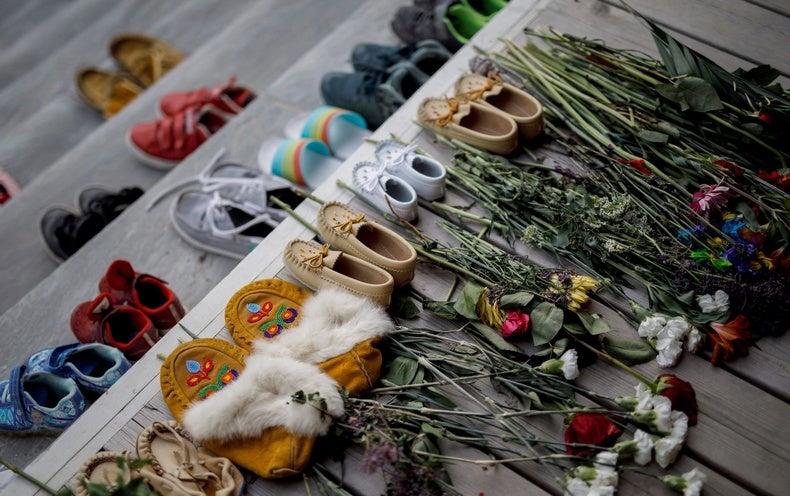
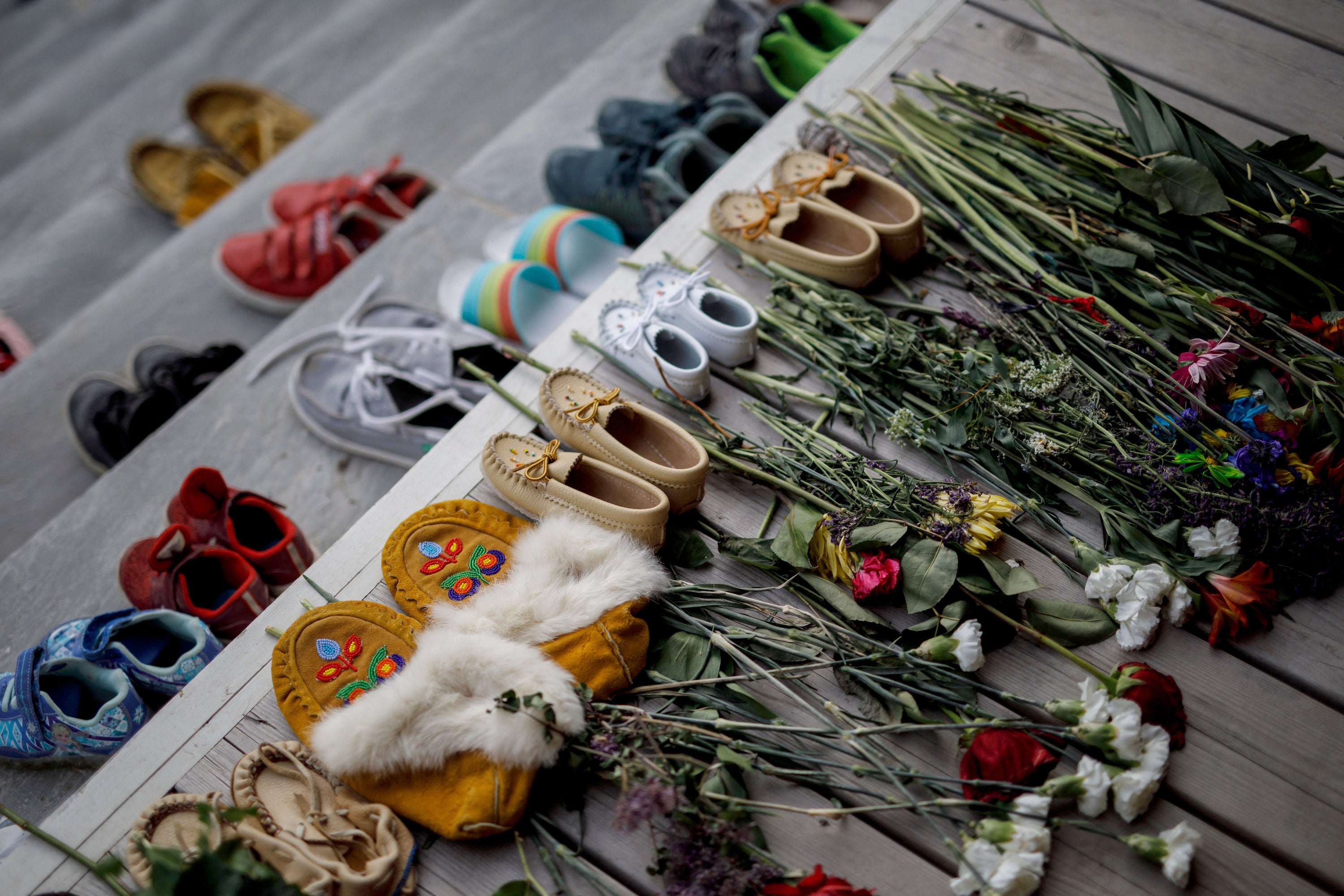
The recent discoveries of more than 1,300 unmarked graves at the sites of four former residential schools in western Canada have shocked and horrified Canadians. Indigenous peoples, whose families and lives have been haunted by the legacy of Canada’s Indian residential school system, have long expected such revelations. But the news has still reopened painful wounds.
Residential school survivor testimony has long been filled with stories of students digging graves for their classmates, of unmarked burials on school grounds, and of children who disappeared in suspicious circumstances. Many of these stories were heard by the Truth and Reconciliation Commission of Canada (TRC), which was formed in 2008 and collected testimonies from over 6,750 survivors. The TRC’s 2015 Final Report made it quite clear that further recoveries of unmarked graves at the schools were inevitable.
The goal of Canada’s Indian residential school system, after all, shared that of its U.S. Indian boarding school counterpart: “Kill the Indian, and save the man.” More than 150,000 children were taken from their homes between 1883 and 1997, often forcibly, and placed in distant boarding schools where the focus was on manual labour, religious instruction and cultural assimilation. The TRC Final Report concluded that the Indian Residential School system was an attempted “cultural genocide,” but the escalating number of recovered unmarked graves points to something even darker. Given that more than 1,300 graves have been identified using ground-penetrating radar at only four of the 139 federally run residential schools, the current official number of 4,120 students known to have died in the schools will end up being only a fraction of the actual total.
Apologists for the residential school system have argued in recent weeks that the children buried at these schools largely died of diseases like tuberculosis (TB) and that the schools did the best they could to provide education and medical care to First Nations, Inuit and Métis children during a time when their communities were being devastated by similar diseases. But even a cursory reading of the historical literature on residential schools shows just how wrong this line of thinking is.
The reality is that the conditions in the schools themselves were the leading contributor to the often-shocking death rates among the students. In 1907, Indian Affairs chief medical officer Peter Bryce reported some truly disturbing findings to his superiors. After having visited 35 government funded schools in western Canada, Bryce reported that 25 percent of all children who had attended these schools had died; at one school, the number was 69 percent. While Bryce reported that “the almost invariable cause of death given is tuberculosis,” he by no means saw this as natural or inevitable. Bryce, instead, placed the blame for these appalling death rates on the schools themselves, which were poorly constructed, lacked proper ventilation and frequently housed sick students in the dormitories alongside their healthy classmates.
Bryce wasn’t alone in sounding the warnings about the schools. Throughout the system’s 100-plus-year history, school inspectors, school principals, medical officials and Indian agents repeatedly issued warnings about the unhealthy conditions in the schools. This archival record details the schools’ inadequate medical facilities, nonexistent isolation rooms and lack of school nurses. It also documents perennially overcrowded and dilapidated buildings with poor ventilation and insufficient heating as well as the woefully inadequate nutrition provided to students.
The issue of food and nutrition, in particular, speaks to the ways in which the poor conditions in the schools undermined student health. As residential school historian J.R. Miller has written, “‘We were always hungry’ could serve as the slogan for any organization of former residential school students.” The TRC collected haunting testimony from survivors, including Andrew Paul, who described his time at the Aklavik Roman Catholic Residential School in the Northwest Territories: “We cried to have something good to eat before we sleep. A lot of the times the food we had was rancid, full of maggots, stink.”
Malnutrition, of course, compromised children’s immune systems, making them more vulnerable to TB and other infectious diseases. In the case of TB, studies have consistently shown that malnutrition of the type commonly described by Paul and other survivors leads to significantly higher mortality among infected individuals. And, as our own research has shown, it would also have led to a much higher lifetime risk of a whole range of chronic conditions including obesity, type 2 diabetes and hypertension.
Government and church authorities were well aware of the extent of hunger and malnutrition in the schools, both before and after Bryce’s damning report. In the 1940s, for instance, a series of school inspections by the federal Nutrition Division found almost universally poor food service in the schools and widespread malnutrition. After attempts to improve the training for school cooks ended in failure, the head of the Nutrition Division, L.B. Pett, chose to use the poor health of the children as an opportunity to study the effectiveness of a variety of experimental nutrition interventions (and noninterventions, as it turned out) into the diets of malnourished children.
The result was a series of nutrition experiments conducted on nearly 1,000 children in six residential schools between 1948 and 1952. These included a double-blind, randomized experiment examining of the effects of nutrition supplements on children showing clinical signs of vitamin C deficiency, with half of the students receiving placebos and the other half receiving vitamin tablets; an examination of the impact of an experimental fortified flour mixture that included ground bonemeal, among other things, at St. Mary’s School in Kenora, Ontario; and an examination of the effects of both inadequate and adequate milk consumption on a population of children with clinical signs of riboflavin deficiency at the Alberni School in British Columbia.
None of these experiments did anything to address the underlying causes of malnutrition at the schools, which was simply that the food being provided to the students was insufficient in both quantity and quality. By Pett’s own calculations, after all, the per capita federal grant provided for food in most schools was often half that required to maintain a balanced diet. And the same was true for nearly every aspect of the residential school system, which, from its inception to the closure of the last school in 1997, was structurally underfunded. In comparison with provincially funded public and boarding schools, residential schools received sparse funding. In Manitoba, Indian Affairs paid $180 per year for students in residential school in 1938, while boarding schools like the Manitoba School for the Deaf and the Manitoba Home for Boys received $642 and $550 per annum, respectively, from the provincial government. American Indian boarding schools, by comparison, were funded at a per capita rate of $350.
A similar picture emerges when we look at the kind of health care provided to residential school students who were diagnosed with TB—a disease with effects that were made worse by the conditions within residential schools. By the 1940s, students with TB were sent from residential schools to racially segregated Indian Hospitals or TB sanatoria—typically without their parents’ knowledge or consent—where they often remained for years at a time. Indian hospitals and sanatoriums, like residential schools, were funded at a much lower rate—often just 50 percent of the per capita cost for non-Indigenous patients in provincial and municipal hospitals and sanatoria—meaning that the health care provided to Indigenous child patients with TB was substandard.
Indigenous patients, some as young as newborns, were also more likely to receive permanently debilitating surgeries and were kept in hospital for much longer than non-Indigenous patients. This was partly a result of the belief that Indigenous patients could not be “trusted” to follow a drug regime at home, and partly because the hospitals were an arm of the federal government’s program of assimilation for Indigenous peoples. The longer patients, and particularly child patients, remained in the Indian hospital, the more likely they were to lose their Indigenous languages and connections to their home communities.
Similar to common practice in residential schools, hospital and sanatoria administrators were lax in informing families about the conditions of a child’s death, where they were buried or, disturbingly, that the child patient had passed away at all. Many families still have no idea what happened to loved ones who left for these institutions and never returned.
It’s clear, then, that the claim of residential school apologists that these children “only” died of TB is, ultimately, an attempt to whitewash what many residential school survivors and a growing number of scholars—ourselves included—have characterized as genocide, full stop. Many children did die of TB as well as epidemics of measles, influenza and other infectious diseases. But it is clear that these chronically and intentionally underfunded institutions actually caused the high death rates among students. What is also indisputable, based on the government’s own records, is that generations of federal government officials and politicians knew that the subpar conditions in the schools were killing children and chose to do nothing.
This is an opinion and analysis article; the views expressed by the author or authors are not necessarily those of Scientific American.