
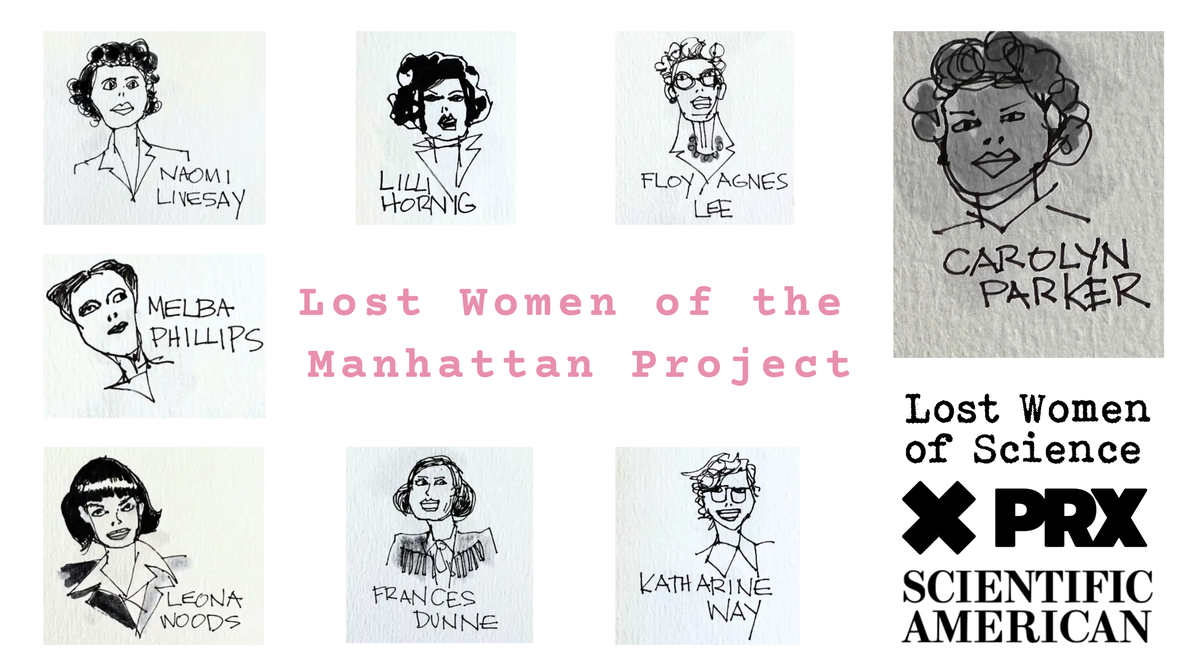
Carolyn Beatrice Parker came from a family of doctors and academics, and she worked during World War II as a physicist on the Dayton Project, a critical part of the Manhattan Project tasked with producing polonium. (Polonium is a radioactive metal that was used in early nuclear weapons.)
After the war, she continued her research and, a few years later, resumed her studies at the Massachusetts Institute of Technology. But she died of leukemia at age 48 before she was able to defend her Ph.D. dissertation. Decades later, during the height of the Black Lives Matter protests, the school board of Alachua County, Florida., voted to rename an elementary school in her hometown of Gainesville in her honor. November 18 would have been her 107th birthday.
LISTEN TO THE PODCAST
On supporting science journalism
If you’re enjoying this article, consider supporting our award-winning journalism by subscribing. By purchasing a subscription you are helping to ensure the future of impactful stories about the discoveries and ideas shaping our world today.
TRANSCRIPT
Erica Huang: This is the final episode in our series “Lost Women of the Manhattan Project” that started in 2023. At that time the film, “Oppenheimer,” had just come out and we noticed just how few female scientists were represented in the film. So, in the vein of what we do at “Lost Women of Science,” we wanted to remind people that there were scores of women—physicists, chemists, mathematicians, engineers, researchers—who worked at Los Alamos and the other “Manhattan Project” sites.
And on the week that would have seen her 107th birthday, we’re ending our “Lost Women of the Manhattan Project” series with a tribute to physicist Carolyn Parker, who, more than 50 years after her death, was remembered in an extraordinary way.
NEWS TAPE: Today the Alachua County School Board will have their first public session. Now, just last month, the school district voted to change the name of the school, which was named after a confederate general…
Erica Huang: In June 2020, during the height of the Black Lives Matter protests sweeping across the U.S., one small school in Florida was facing its own reckoning. A sort of reckoning of memory. Citizens of the city of Gainesville, many of them parents and former students, were demanding that the name of one of their local elementary schools be changed. And the school board agreed. But change the name to what?
NEWS TAPE: We’ve already received more than 150 suggestions from people throughout the community for new names. So when the committee that’s been selected to look over the names and make a recommendation to the school board gets together, they’ll have a lot of information to go through.
Erica Huang: Many of the names submitted were black historical figures; writers, army officers, congressmen. And a physicist. One of Gainesville’s own who had worked on the top-secret “Manhattan Project” during World War II: Carolyn Beatrice Parker.
Carolyn Edwards: She was my aunt. She was my aunt Carolyn. Um, notice that my name is Carolyn. Um, I was named after her, so. I have a kind of special connection in some ways.
Erica Huang: This is Carolyn Parker’s niece, Leslie Carolyn Edwards.
Carolyn Edwards: She was a person who my mother just held in really high esteem. Carolyn was the, my mother’s oldest sister. She was so, so much enamored with my aunt that she named me, I was my mother’s first child, that she named me Carolyn.
Erica Huang: Carolyn Parker, eldest of seven children, was born in Gainesville in 1917, to a family of doctors and academics. And her family was exceptional.
Carolyn Edwards: Remember this is the 1930s and 40s, 30s, the height of, you know, just coming out of the Depression and going into the um, still very much in the Jim Crow area. Being a doctor and an African American doctor at that time is not the same as, as, as it is today.
Erica Huang: Carolyn Parker’s father was Julius A. Parker, a physician who graduated from Meharry Medical College, the first medical school in the South for African Americans.
Carolyn Edwards: He practiced from his home. It’s a small town, but it’s in a rural area, and all of the black people would come to this one doctor, who at the time was my grandfather, and sometimes they would, you know, pay, pay him with a bunch of greens or some peanuts or, or, um, something, so he was not rich. But you know, he was able to take care of his family. He instilled the importance of education.
Erica Huang: Carolyn Parker went to Fisk University and graduated with a B.A. in Physics, then went on to earn an M. S. in Physics specializing in spectroscopy from the University of Michigan in 1941. In 1942, Carolyn began teaching physics and mathematics at Bluefield State College in Bluefield, West Virginia. But she didn’t stay there long.
In 1943, Carolyn Parker was recruited from her teaching position to begin work on the Dayton Project.
The Dayton Project was an important part of the “Manhattan Project”, run by the Monsanto Chemical Company in Dayton, Ohio. And it was top secret. All the Dayton recruits had to sign the Espionage Act, which made it a crime to share information about their work. According to one of Carolyn Parker’s sisters, Parker’s work was “so secret she couldn’t discuss it, even with us, her family.”
This makes it hard to determine exactly what Carolyn was doing at the project site. But we know that she was hired as a research physicist. And her listings in the tabulations indicate she was a “scientist” and not considered a “technician” or “laborer.”
The aim of the Dayton project was to produce polonium.
George Mahfouz: Polonium is a radioactive alpha-emitter, radioactive material. It’s a metal.
Erica Huang: This is George Mahfouz, a chemical engineer who worked on the Dayton Project. He passed away in 2015. What you’re hearing is a 2005 interview with him from the Atomic Heritage Foundation’s “Voices of the Manhattan Project” series.
George Mahfouz: When polonium is in contact with beryllium, neutrons by the bazillions are the result of this interaction between the polonium and the beryllium. You need all the neutrons because if you don’t have any neutrons, there’s no bomb.
It’s the trigger for the bomb, actually, in simple English.
Erica Huang: By 1943, “Manhattan Project” scientists were beginning to establish the need for Polonium as a trigger for the atomic bomb. But polonium was a difficult element to study.
George Mahfouz: Because at that point in time, the amount of polonium available in the world was next to nothing. There was no material, no knowledge of its chemical, physical, or any other properties.
Erica Huang: And it’s almost entirely processed material–the small amount that exists in nature has to be extracted.
George Mahfouz: You have to process tons to get practically no material out of it–I mean less than a milligram. And you need more than that to make lots of initiators. So you have to get a lot of it made.
Erica Huang: So the team at Dayton was working against the clock developing and improving a complicated process to extract polonium.
George Mahfouz: The way they get polonium, or had gotten polonium then, they took bismuth, encased, of course, in aluminum, because bismuth is very friable. It fractures, just looking at it practically, and then that bismuth slug is irradiated with neutrons, again, in a reactor. The bismuth is then converted, byproduct of that is polonium-210, a very small fraction.
That whole process, by the way, was developed in Dayton by Monsanto. Now, this all took place in a very short time. We need to keep one thing in mind: nothing started until ’43, relatively early in ’43. The bomb went off in ’45. I mean, that’s a miracle, for that kind of result when nothing was known of how to make a bomb work.
Erica Huang: After the war ended, Carolyn Parker spent a couple more years in Dayton, winding down her work as a research physicist. In 1947, she left to teach as an assistant professor at Fisk, and in 1951, she decided to pursue higher degree status. She was accepted to the physics graduate program at MIT, though without financial support.
While she was living in Boston, she often sent “letters, postcards, and gifts” to her
family–sometimes toys to her younger siblings, and “written materials related to rockets, aviation, and science”.
Carolyn earned her second master’s degree in physics in 1953 from MIT. And she began working on a Ph.D., but by the mid 1950s, Carolyn started to get sick.
George Mahfouz: Now, you can decontaminate some things by just plain soap and water. If that doesn’t do it, you then go to Clorox. If that doesn’t do it, the procedure then that we had was, you go to dilute hydrochloric acid.
Erica Huang: As George Mahfouz recalls, there were some pretty thorough health and safety precautions in place at Dayton, including frequent urinalysis and hand washing every time you left the area.
George Mahfouz: You couldn’t leave Unit 4 and go home unless your hands were zero.
Erica Huang: But it was difficult to work with polonium and avoid getting the material in your system.
One Dayton Project director, W.C. Fernelius, shares a story in a 1983 article about an employee at Unit 4. He says “When she did her hair, she would put the bobby pins in her mouth. She had the highest urine count in the place.” Though it’s impossible to say for certain, later references say that this story is very likely about Carolyn.
And the building that housed Unit 4, where Carolyn worked, was so contaminated that at the end of the war it was destroyed.
Carolyn Edwards: Part of her story was that she, um, had a, had an illness and, and died before she could complete her, uh, dissertation.
Erica Huang: Carolyn Parker became sick with leukemia, very likely due to her polonium exposure. According to Carolyn’s family, she was nearing completion of the coursework for her Ph.D. in physics at MIT, but financial setbacks and the onset of leukemia prevented her from defending her dissertation. She died in her hometown of Gainesville on March 17th, 1966.
Carolyn Edwards: I did always feel like I should become a doctor, and I did. But it was a Ph.D. And, um, that, that was inspired by my aunt.
Erica Huang: Carolyn Edwards became a Doctor of Philosophy.
Carolyn Edwards: So I, um, made a point of making sure that I would complete my dissertation and become Dr. Edwards. That was something, it wasn’t like it was pressure, but it was an objective and something that, that I took that I should do because to honor my aunt and, and the rest of the family.
Erica Huang: These connections we have to our namesakes run deep. In Alachua County, in 2020, a committee of volunteers came together to try to reckon with this same question. What name do we give this institution? Whose legacy do we want our children to carry?
COMMITTEE TAPE: All right, so Hal, you were helping us, um, last meeting with keeping track of the names that we need to go through.
Erica Huang: This is a recording of one of the Zoom meetings that this committee of volunteers had, in which they laid out many of the names that the community had sent, discussed the names, and eventually voted.
COMMITTEE TAPE: Hal? Hal sorry you’re muted.
Erica Huang: These meetings are long, virtual, and often a little bit confusing.
COMMITTEE TAPE: And will you send all the choices as well? Yes, I can do that too. And don’t put it in that, awfully long link.
Erica Huang: But everyone there is really committed to hearing about all of these people. And to choosing the right name. Eventually everyone on the call decides that they’re going to vote on who they want to rename the elementary school after.
COMMITTEE TAPE: So, um, I know I did a tally and I know a few other people have submitted, but it looks as though, um, Carolyn Parker, uh, met the expectations of the rank choice voting. Does anyone want to speak to this? Do we have agreement?
Erica Huang: On August 18, 2020, J. J. Finley Elementary School changed its name to Carolyn Beatrice Parker Elementary School.
Her niece, Carolyn Edwards, lived in the northeast for a time but moved back to Gainesville a few years ago. She is nothing short of a local celebrity at the elementary school.
Carolyn Edwards: I went to the school and did an interpretation of my aunt as my aunt. I mean, I dressed up like she might have dressed in the 19- in the 1940s and 50s and, um, took on her persona and talked to several different groups of, of, of children as Carolyn Parker and, you know, answered their questions and, um, told them about my life as, as Carolyn Parker, and then, um, very dramatically for the kids, you know, I had a wig on because my hair is not the same style. I took it off and, and then became Carolyn and talked to them and they were, they were thrilled.
Erica Huang: That’s amazing.
Carolyn Edwards: That was the highlight, taking off the wig that I had on. But, but yeah, so I’ve been to the school and they’ve invited me to events and they treat me like royalty when I go there. I mean, they say, this is Carolyn. She’s the niece of Carolyn Parker. And they all clap and I get embarrassed and it’s, you know, it’s really sweet.
Erica Huang: In this deeply divided America, many of us still reeling from the recent election, local power can feel like a small wave in a vast sea. But in the face of distrust and turmoil, the people of Alachua County made a choice to do the right thing in their community. They made a choice, almost 80 years after the completion of the “Dayton Project,” to speak Carolyn Parker’s name aloud, to write it large on the walls of their institutions, to plant it in the minds of their children.
Erica Huang: This episode of “Lost Women of Science” was produced by me, Erica Huang. Thanks to our co-executive producers Amy Scharf and Katie Hafner, to our senior managing producer Deborah Unger and to our program manager Eowyn Burtner.
And of course, a tremendous thank you to our guest Leslie Carolyn Edwards. Our fact-checking was done by Lexi Atiya and all our music is composed by Lizzie Younan. Art for the “Lost Women of the Manhattan Project” was created by Paula Mangin. And thanks to Jeff DelVisio at “Scientific American.” “Lost Women of Science” is funded in part by the Alfred P. Sloan Foundation and the Anne Wojcicki Foundation.
We’re distributed by PRX and published in partnership with “Scientific American.” Please visit us at lostwomenofscience.org, and don’t forget to click on that all-important donate button.
Host and Producer
Erica Huang
Guests
Dr. Leslie Carolyn Edwards, Carolyn Parker’s niece
Lily Whear (composite); Paula Mangin (image)
Further reading:
Carolyn Beatrice Parker. Atomic Heritage Foundation
Polonium in the Playhouse : The Manhattan Project’s Secret Chemistry Work in Dayton, Ohio. Linda Carrick Thomas. Trillium, 2017