
This week researchers claimed to have discovered a superconducting material that can shuttle electricity with no loss of energy under near-real-world conditions. But drama and controversy behind the scenes have many worried that the breakthrough may not hold up to scientific scrutiny.
“If you were to find a room-temperature, room-pressure superconductor, you’d have a completely new host of technologies that would occur—that we haven’t even begun to dream about,” says Eva Zurek, a computational chemist at the University at Buffalo, who was not involved in the new study. “This could be a real game changer if it turns out to be correct.”
Scientists have been studying superconductors for more than a century. By carrying electricity without shedding energy in the form of heat, these materials could make it possible to create incredibly efficient power lines and electronics that never overheat. Superconductors also repel magnetic fields. This property lets researchers levitate magnets over a superconducting material as a fun experiment—and it could also lead to more efficient high-speed maglev trains. Additionally, these materials could produce super strong magnets for use in wind turbines, portable magnetic resonance imaging machines or even nuclear fusion power plants.
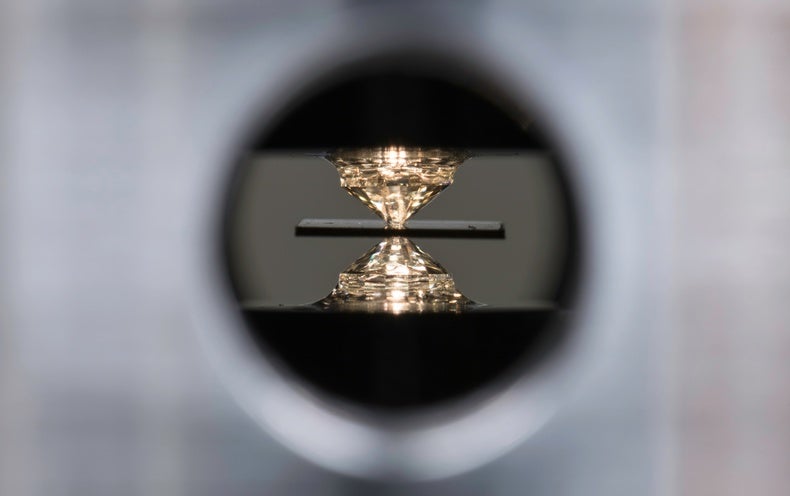
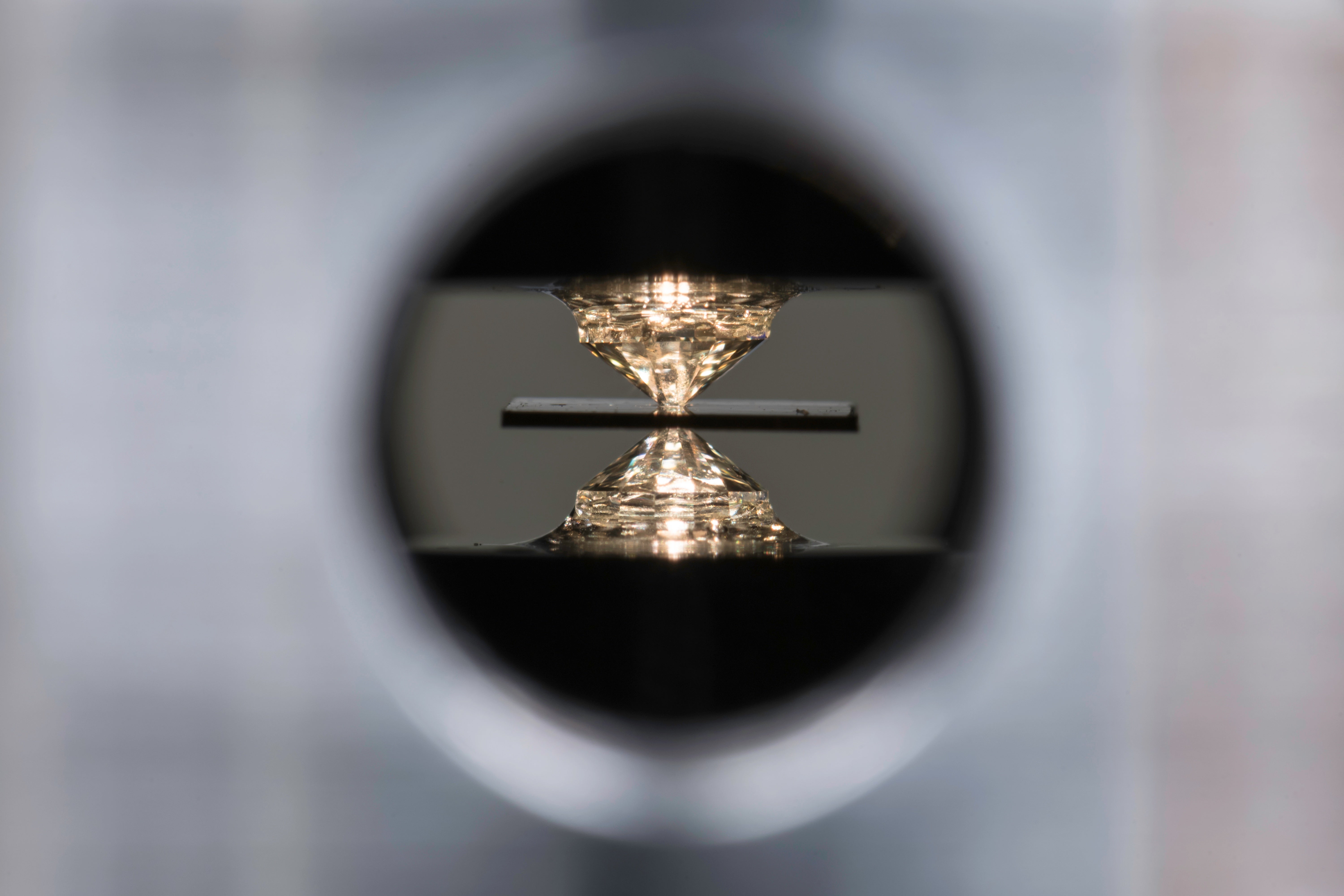
The only superconducting materials previously discovered require extreme conditions to function, which makes them impractical for many real-world applications. The first known superconductors had to be cooled with liquid helium to temperatures only a few degrees above absolute zero. In the 1980s researchers found superconductivity in a category of materials called cuprates, which work at higher temperatures yet still require cooling with liquid nitrogen. Since 2015 scientists have measured room-temperature superconductive behavior in hydrogen-rich materials called hydrides. but they have to be pressed in a sophisticated viselike instrument called a diamond anvil cell until they reach a pressure of about a quarter to half of that found near the center of Earth.
The new material, called nitrogen-doped lutetium hydride, is a blend of hydrogen, the rare-earth metal lutetium and nitrogen. Although this material also relies on a diamond anvil cell, the study found that it begins exhibiting superconductive behavior at a pressure of about 10,000 atmospheres—roughly 100 times lower than the pressures that other hydrides require. The new material is “much closer to ambient pressure than previous materials,” says David Ceperley, a condensed matter physicist at University of Illinois at Urbana-Champaign, who was not involved in the new study. He also notes that the material remains stable when stored at a room pressure of one atmosphere. “Previous stuff was only stable at a million atmospheres, so you couldn’t really take it out of the diamond anvil” cell, he says. “The fact that it’s stable at one atmosphere of pressure, that also means that it’d be easier to manufacture.”
Hydrogen is key to the new material’s superconducting ability and to that of any hydride. In the 1960s researchers first calculated that the metallic form of this element might be a superconductor. The idea is that superconductivity occurs when electrons pair up and form a new state of matter and that this could happen in the soup of electrons that surrounds a metal’s nuclei—particularly when those nuclei belong to ultralight hydrogen atoms. Unfortunately, making those atoms shift their phase from gas to metal would require extreme pressure—about one and a half times greater than pressures at the center of this planet. But if a hydrogen atom is combined with one or two other elements in the form of a hydride, researchers think the other atoms would compress the hydrogen, allowing it to attain a metallic state at lower, much more easily obtainable pressures. “We wanted to find the right rare-earth material to mimic these same metallic hydrogen properties as much lower pressures. So that’s where the lutetium metal came into the picture,” says study co-author Ranga Dias, a physicist at the University of Rochester. “And then the use of nitrogen is to stabilize these structures.”
The material, described in a Nature paper published this week, could raise hopes for other hydrides that lower the pressure requirements still further. Unfortunately, the work is dogged by controversy over previous papers by Dias and study co-author Ashkan Salamat, a physicist at the University of Nevada, Las Vegas. “There are two approaches possible. One is just ignore the past and look at this paper and just see what it is,” says Dirk van der Marel, a professor emeritus at the University of Geneva, who was not involved in the new study. “And if I do that, then it is a great paper.” The authors, he notes, used multiple tests of superconductivity, which provided an “extraordinary richness of data.” But van der Marel does not automatically trust these data, in part because of his experience analyzing previous work from the same authors.
In 2020 Dias, Salamat and their colleagues published a Nature paper describing room-temperature superconductivity in a different material, called carbonaceous sulfur hydride. Jorge Hirsch, a physicist at University of California, San Diego, questioned the appearance of data demonstrating the extent to which the material could become magnetized, referred to as its “magnetic susceptibility,” and called on the authors to release their raw data. This measurement is important because it indicates one sign of a superconductor: the ability to expel a magnetic field, a phenomenon called the Meissner effect. Because this measurement must be made while the superconducting hydride is in a diamond anvil cell, results contain background noise. To remove that noise, researchers take a separate measurement of the background and subtract it from the raw data to give the final magnetic susceptibility value. Dias and Salamat pushed back against Hirsch’s claims and eventually released the requested data. Hirsch and van der Marel worked together to analyze those data and concluded they had been processed in an unconventional way at best or had been manipulated at worst. Dias and Salamat contend that their processing method had been misunderstood.
The controversy drove Nature to retract the 2020 paper in 2022, a decision to which all its authors objected. Dias and Salamat say they stand by their results, and two investigations by the University of Rochester, where Dias works, found no wrongdoing. The authors also say they have rerun the original experiments at two different Department of Energy labs with outside observers present and that this effort verified the original results. “Time is a great peer-review process,” Salamat says. Dias says the researchers have updated their original paper as a preprint and resubmitted it to Nature. Other labs, however, have not been able to replicate the original results independently. But it can take a long time for a lab to reproduce and then test a specific material. The drawn out conflict has involved the release of multiple preprints, with neither side accepting the other’s arguments. And it eventually became so acrimonious that administrators of the preprint server arXiv.org removed papers from both parties and put Hirsch under a temporary publishing ban, which he objected to. “My papers analyzed the data and pointed out inconsistencies,” he says.
Hirsch previously earned a reputation as an outspoken critic of superconductivity research, but he and van der Marel were not the only researchers to investigate these authors. In addition to looking at magnetic susceptibility, James Hamlin, a physicist at the University of Florida, examined the electrical resistance data from the 2020 Nature paper. When a material reaches a superconducting state, its electrical resistance drops to zero. The measurement of this phenomenon does not require any processing to remove background noise like the magnetic susceptibility data do. Yet Hamlin notes that even the resistance data appeared to have undergone this processing, which was not disclosed in the paper. He finds Dias’s and Salamat’s responses to be insufficient explanations of these discrepancies. “They’ve kind of muddied the waters by publishing these things that have the appearance of a scientific argument,” Hamlin says. “But if you actually examine their response…, it just holds no water. And it does not address the concerns” raised by other researchers.
Hamlin went on to analyze a paper that Dias and Salamat published in Physical Review Letters (PRL) in 2021 in which they and their colleagues measured another hydride called manganese sulfide. Hamlin noted similarities between the electrical resistance data in the 2021 paper and those in Dias’s 2013 Ph.D. thesis, which had involved a completely different superconducting material. He shared these concerns with the journal and the paper’s authors. Salamat has since responded, suggesting that even though the two data sets may appear similar, the resemblance is not indicative of copied data. “We’ve shown that if you just overlay other people’s data qualitatively, a lot of things look the same,” he says. “This is a very unfair approach.”
This did not satisfy at least one of Salamat’s co-authors on the PRL paper: Simon A. J. Kimber, a former researcher, was disturbed to hear about the potential problem with the data and agrees with Hamlin’s conclusions. “I’ve been at this game for a long time, and I couldn’t think of a single reasonable explanation as to why those data sets should overlap like that,” he says. “I replied to everybody, to PRL’s editors, and said, ‘I think this should be retracted. I can’t think of any logical reason why this should be—retract, retract, retract.’” According to Jessica Thomas, executive editor at the journal’s publisher, the American Physical Society, editors are currently investigating these claims. “We take allegations of data fabrication very seriously,” she says. “At the same time, professional reputations are at stake, and we have to gather information thoughtfully and accurately. We also strive to ensure that the exchanges remain professional and respectful.”
Given the past controversies, Dias and Salamat took pains to test the new material thoroughly for their new paper, performing three different categories of experiments that suggest superconductivity had occurred. “The key fields that you wanted to provide, in order to prove superconductivity, is electrical resistance goes to zero, magnetic susceptibility—which is a demonstration of this expelling the magnetic fields—and heat capacity measurements. These are three different directions,” Dias says. “In this paper, our group has done all three measurements, including submeasurements,” such as two different measurements of magnetic susceptibility for both continuous and fluctuating fields.
The new paper also provides a “recipe” for other researchers who want to synthesize the new hydride and test it themselves, but the authors have not shared existing samples of the material. They are co-founding a start-up called Unearthly Materials to commercialize room-temperature superconductors and say they do not wish to reveal their intellectual property. “We have incredibly clear, detailed instructions on how to make these materials, like all of our studies. We just ask that the groups that are in denial … go through the protocols themselves,” Salamat says. “We’re excited to see other groups replicate and push forward the field of high-temperature superconductivity.” Some researchers, such as Kimber, have stated they would not devote time and resources to replicating the results because they do not trust the new paper. But other superconducting labs may make the attempt.
If they do succeed at replicating these results, they could open up fascinating new lines of research. For instance, the exact structure of the new material is not yet fully understood. Salamat has used imaging methods that reveal where the heavy lutetium atoms are within the compound, but the team isn’t yet certain about the configuration of the lighter hydrogen and nitrogen atoms. The material also contains relatively little hydrogen, even though this is the substance that theoretically gives hydrides their superconducting ability. Multiple researchers, including Zurek and Ceperley, were intrigued by this contradiction. It could point to alternate theories for how superconductivity arises in hydride materials.
The big claims made in this paper, as well as past controversies, have raised the bar for proof, says Michael Norman, group leader of the condensed matter theory group at Argonne National Laboratory in Illinois, who was not involved in the new study. But a reluctance to trust results until they are replicated is not unusual in the field of superconductivity. He points to the 1986 discovery of cuprates, which were found to be superconducting at much higher temperatures than previous materials. After it was published, “over the first six months, people pretty much didn’t pay the paper much attention. But then when the result was reproduced by a Japanese group, that’s sort of when everybody jumped into the field,” Norman says. As for the new study, “I’m pretty sure that people will be cautiously optimistic until they see another group reproduce it.”