
Close Menu
Beverly Hills Examiner

    Subscribe to Updates

    Get the latest creative news from FooBar about art, design and business.

    What's Hot

    Bring on 2027 I mean 2026 I mean Happy Easter

    December 31, 2025

    ‘I opened her door and the wind caught me, and I went flying’: The U.S. Arctic air surge is sweeping northerners off their feet

    December 31, 2025

    The Trump Regime Threatens Artists As The Kennedy Center Will Be Empty On New Year’s Eve

    December 31, 2025
    Facebook X (Twitter) Instagram
    Beverly Hills Examiner
    • Home
    • US News
    • Politics
    • Business
    • Science
    • Technology
    • Lifestyle
    • Music
    • Television
    • Film
    • Books
    • Contact
      • About
      • Amazon Disclaimer
      • DMCA / Copyrights Disclaimer
      • Terms and Conditions
      • Privacy Policy
    Beverly Hills Examiner
    Home»Science»Europe’s Oldest Human-Made ‘Megastructure’ Discovered under Baltic Sea
    Science

    Europe’s Oldest Human-Made ‘Megastructure’ Discovered under Baltic Sea

    By AdminFebruary 21, 2024
    Facebook Twitter Pinterest LinkedIn WhatsApp Email Reddit Telegram
    Europe’s Oldest Human-Made ‘Megastructure’ Discovered under Baltic Sea


    The following essay is reprinted with permission from Europe’s Oldest Human-Made ‘Megastructure’ Discovered under Baltic SeaThe Conversation, an online publication covering the latest research.

    Archaeologists have identified what may be Europe’s oldest human-made megastructure, submerged 21 meters below the Baltic Sea in the Bay of Mecklenburg, Germany. This structure – which has been named the Blinkerwall – is a continuous low wall made from over 1,500 granite stones that runs for almost a kilometer. The evidence suggests it was constructed by Palaeolithic people between 11,700 and 9,900 years ago, probably as an aid for hunting reindeer.

    The archaeologists investigating the Bay of Mecklenburg used a range of submarine equipment, sampling methods and modelling techniques to reconstruct the ancient lake bed and its surrounding landscape. This revealed that the Blinkerwall stands on a ridge running east to west, with a 5km-wide lake basin a few meters below the ridge to the south.


    On supporting science journalism

    If you’re enjoying this article, consider supporting our award-winning journalism by subscribing. By purchasing a subscription you are helping to ensure the future of impactful stories about the discoveries and ideas shaping our world today.


    The human, rather than natural, origin for the Blinkerwall was confirmed by an archaeological diving team who photographed sections of the wall. These show that it is made up of 288 very large boulders, which were probably dropped in that location by the retreating glacier, connected by 1,673 smaller stones.

    These smaller stones appear to have been collected from the immediate vicinity, as the area just to the north of the wall has many fewer stones than the areas even further north. The resulting structure stands a little under a meter in height and up to two meters wide, with remarkable regularity over its 971-meter length.

    A different landscape

    At the time of its construction, the landscapes and seascapes of northwest Europe were very different from today. The climate was beginning to warm as the colder Pleistocene era ended and the warmer Holocene era began. Sea levels were much lower, and large glaciers sat over much of Fennoscandia.
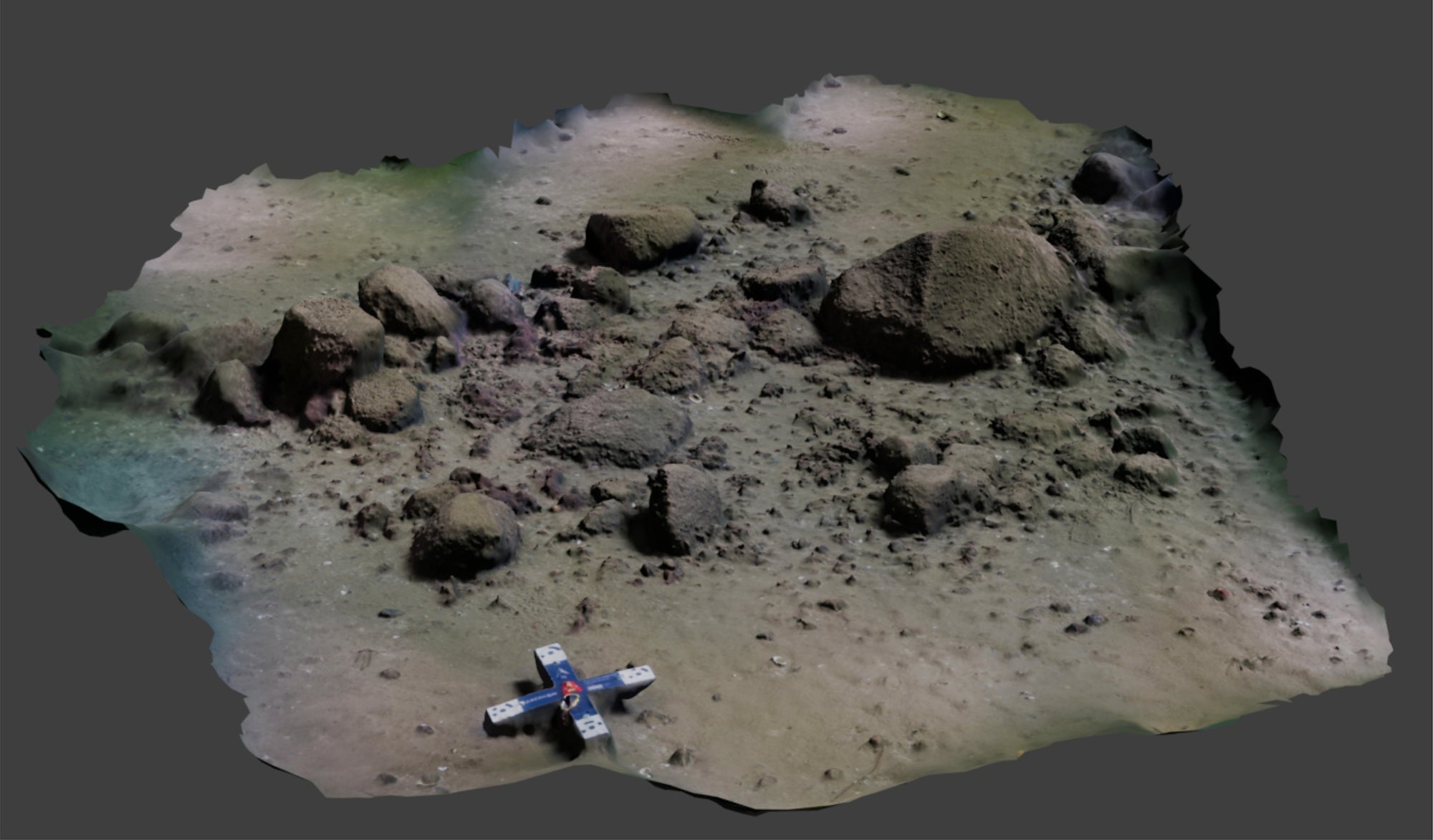
    3D model of a short section of the stone wall. The scale at the bottom of the image measures 50cm.
    This 3D model shows a short section of the stone wall called Blinkerwall under the Baltic Sea. The scale at the bottom of the image measures 50 cm. Credit: P. Hoy, University of Rostock, model created using Agisoft Metashape: J. Auer, LAKD M-V

    The land around the Baltic Sea basin was rising rapidly, released from the weight of the retreating glaciers and transforming a brackish body of water known as the Yoldia sea into the freshwater Ancylus lake. Great Britain was a peninsula of the European continental landmass, with a vast lowland plain known as Doggerland stretching from Norfolk to the Netherlands. Herds of reindeer, European bison and wild horse migrated across its sparsely forested landscape.

    In cultural terms, this period, known as the Late Upper Palaeolithic, is marked by significant hallmarks in technological innovation by the people who lived at this time. Dogs had been recently domesticated; there are regionally distinct forms of stone projectile points; and there is frequent use of decorated bone and antler harpoons, as well as specialist hunting strategies employed to target migrating prey.

    The identification of the Blinkerwall now demonstrates that Palaeolithic hunters were managing their landscape to aid their hunting activities more deliberately than was previously thought.

    Construction of walls and other features in the landscape is familiar to us, particularly in the context of land enclosure for farming. Both contemporary and ancient societies that have traditionally subsisted by hunting and gathering wild resources are also known to alter their environments by constructing features such as stone walls. These are used for a variety of purposes including fishing, shellfishing and hunting.

    The researchers compared the Blinkerwall to other archaeologically documented structures of a similar length and construction type that have been identified in the Middle East, North America, Canada and Greenland. These structures are interpreted as having been built for the purpose of game drive hunting. In this strategy, hunters use landscape and built features to gain an advantage over their prey by directing its movements to a location where they are more vulnerable to attack by other hunters.

    The similarity of the Blinkerwall to these other structures, and its construction adjacent to a body of water, led to the suggestion that the wall had been created for the same purpose. The lake itself may also have been used in this strategy.

    Supporting evidence

    One archaeological site from Germany that supports this interpretation is Stellmoor, located just north of Hamburg and which dates to the latest time that the Blinkerwall could have been constructed.

    The site is located at the end of a narrow valley where thousands of reindeer bones – some bearing hunting impact traces, flint points and even pinewood arrow shafts – were found preserved in the ancient lake sediments. The hunting evidence at Stellmoor shows the reindeer were shot by arrows as they were driven down the valley into the lake.

    While there is no archaeological evidence at Stellmoor to suggest people had deliberately created or changed the landscape to enhance their hunting success, it shows how the topography of the landscape was used to the hunters’ advantage. The Blinkerwall construction provides evidence that Palaeolithic people took this level of planning and coordination a step further.

    It shows they recognised and understood the instincts of their prey so well that they were able to predict their movements – and how they would react when faced with an artificially created obstacle like the Blinkerwall.

    The discovery of this monumental piece of hunting architecture is unique in Europe. At a maximum of 11,700 years old, it is one of the oldest examples in the world, potentially predating a desert hunting “kite” at Jibal al-Gadiwiyt in Jordan by over a thousand years.

    The Blinkerwall adds a new element to our understanding of the highly skilled and specialised hunting strategies engineered by people at the end of the last glacial period – strategies that have continued to be used in different landscapes for millennia. And the discoveries are unlikely to stop here.

    The Bay of Mecklenburg has the potential to reveal further archaeological evidence of equal significance. The researchers do not rule out the possibility that another wall or other associated features could be found, buried under later sedimentation of the ancient lake.

    If weapons, tools or animal remains were to be recovered at the site, this would reveal information about the nature and duration of its use – and far greater insights into the sophisticated subsistence strategies of the Palaeolithic hunters of the Baltic.

    This article was originally published on The Conversation. Read the original article.


    Original Source Link

    Share. Facebook Twitter Pinterest LinkedIn WhatsApp Email Reddit Telegram
    Previous ArticleA Dark and Little-Known Chapter of History – The Hollywood Reporter
    Next Article Uber Eats is launching a delivery service with Cartken’s sidewalk robots in Japan

    RELATED POSTS

    Star that seemed to vanish more than 130 years ago is found again

    December 31, 2025

    The Great Big Power Play

    December 30, 2025

    15 Million Years before the Megalodon, This Giant Ancient Shark Prowled the Oceans

    December 30, 2025

    Mathematicians unified key laws of physics in 2025

    December 29, 2025

    People Who Drink Bottled Water on a Daily Basis Ingest 90,000 More Microplastic Particles Each Year

    December 29, 2025

    Why Active Rest Is Important During the Holidays

    December 28, 2025
    latest posts

    Bring on 2027 I mean 2026 I mean Happy Easter

    Liam Gallagher has stoked rumours by teasing possible Oasis activity for next year. Earlier this month, the frontman appeared to confirm that the band would…

    ‘I opened her door and the wind caught me, and I went flying’: The U.S. Arctic air surge is sweeping northerners off their feet

    December 31, 2025

    The Trump Regime Threatens Artists As The Kennedy Center Will Be Empty On New Year’s Eve

    December 31, 2025

    Treat yourself: Save up to 50% on tech from Apple, Bose and more

    December 31, 2025

    The phone is dead. Long live . . . what exactly?

    December 31, 2025

    Star that seemed to vanish more than 130 years ago is found again

    December 31, 2025

    Bowie: The Final Act review – revisiting the…

    December 31, 2025
    Categories
    • Books (968)
    • Business (5,876)
    • Film (5,810)
    • Lifestyle (3,913)
    • Music (5,878)
    • Politics (5,880)
    • Science (5,222)
    • Technology (5,809)
    • Television (5,495)
    • Uncategorized (2)
    • US News (5,861)
    popular posts

    Hiring Demand Remained Strong as Summer Started, Economists Estimate

    This copy is for your personal, non-commercial use only. Distribution and use of this material…

    How China Hacked US Phone Networks

    June 11, 2022

    Essential Viewing: 11 Jensen Ackles Movies and TV Shows You Must See

    May 12, 2024

    Scientists Just Tried Growing Human Kidneys in Pigs

    September 10, 2023
    Archives
    Browse By Category
    • Books (968)
    • Business (5,876)
    • Film (5,810)
    • Lifestyle (3,913)
    • Music (5,878)
    • Politics (5,880)
    • Science (5,222)
    • Technology (5,809)
    • Television (5,495)
    • Uncategorized (2)
    • US News (5,861)
    About Us

    We are a creativity led international team with a digital soul. Our work is a custom built by the storytellers and strategists with a flair for exploiting the latest advancements in media and technology.

    Most of all, we stand behind our ideas and believe in creativity as the most powerful force in business.

    What makes us Different

    We care. We collaborate. We do great work. And we do it with a smile, because we’re pretty damn excited to do what we do. If you would like details on what else we can do visit out Contact page.

    Our Picks

    Star that seemed to vanish more than 130 years ago is found again

    December 31, 2025

    Bowie: The Final Act review – revisiting the…

    December 31, 2025

    ’90 Day Fiance’ Debbie Johnson Shares Devastating Family Death

    December 31, 2025
    © 2025 Beverly Hills Examiner. All rights reserved. All articles, images, product names, logos, and brands are property of their respective owners. All company, product and service names used in this website are for identification purposes only. Use of these names, logos, and brands does not imply endorsement unless specified. By using this site, you agree to the Terms & Conditions and Privacy Policy.

    Type above and press Enter to search. Press Esc to cancel.

    We use cookies on our website to give you the most relevant experience by remembering your preferences and repeat visits. By clicking “Accept All”, you consent to the use of ALL the cookies. However, you may visit "Cookie Settings" to provide a controlled consent.
    Cookie SettingsAccept All
    Manage consent

    Privacy Overview

    This website uses cookies to improve your experience while you navigate through the website. Out of these, the cookies that are categorized as necessary are stored on your browser as they are essential for the working of basic functionalities of the website. We also use third-party cookies that help us analyze and understand how you use this website. These cookies will be stored in your browser only with your consent. You also have the option to opt-out of these cookies. But opting out of some of these cookies may affect your browsing experience.
    Necessary
    Always Enabled
    Necessary cookies are absolutely essential for the website to function properly. These cookies ensure basic functionalities and security features of the website, anonymously.
    CookieDurationDescription
    cookielawinfo-checkbox-analytics11 monthsThis cookie is set by GDPR Cookie Consent plugin. The cookie is used to store the user consent for the cookies in the category "Analytics".
    cookielawinfo-checkbox-functional11 monthsThe cookie is set by GDPR cookie consent to record the user consent for the cookies in the category "Functional".
    cookielawinfo-checkbox-necessary11 monthsThis cookie is set by GDPR Cookie Consent plugin. The cookies is used to store the user consent for the cookies in the category "Necessary".
    cookielawinfo-checkbox-others11 monthsThis cookie is set by GDPR Cookie Consent plugin. The cookie is used to store the user consent for the cookies in the category "Other.
    cookielawinfo-checkbox-performance11 monthsThis cookie is set by GDPR Cookie Consent plugin. The cookie is used to store the user consent for the cookies in the category "Performance".
    viewed_cookie_policy11 monthsThe cookie is set by the GDPR Cookie Consent plugin and is used to store whether or not user has consented to the use of cookies. It does not store any personal data.
    Functional
    Functional cookies help to perform certain functionalities like sharing the content of the website on social media platforms, collect feedbacks, and other third-party features.
    Performance
    Performance cookies are used to understand and analyze the key performance indexes of the website which helps in delivering a better user experience for the visitors.
    Analytics
    Analytical cookies are used to understand how visitors interact with the website. These cookies help provide information on metrics the number of visitors, bounce rate, traffic source, etc.
    Advertisement
    Advertisement cookies are used to provide visitors with relevant ads and marketing campaigns. These cookies track visitors across websites and collect information to provide customized ads.
    Others
    Other uncategorized cookies are those that are being analyzed and have not been classified into a category as yet.
    SAVE & ACCEPT