
Close Menu
Beverly Hills Examiner

    Subscribe to Updates

    Get the latest creative news from FooBar about art, design and business.

    What's Hot

    Britney Spears’ representative shuts down “ridiculous” claim she behaved erratically with knife in restaurant, as star breaks silence after DUI and rehab

    May 15, 2026

    I run Valvoline and work with young people every day. They’re in crisis—and we all have to try to help

    May 15, 2026

    HUD Secretary’s BDS Gets Totally Shut Down

    May 15, 2026
    Facebook X (Twitter) Instagram
    Beverly Hills Examiner
    • Home
    • US News
    • Politics
    • Business
    • Science
    • Technology
    • Lifestyle
    • Music
    • Television
    • Film
    • Books
    • Contact
      • About
      • Amazon Disclaimer
      • DMCA / Copyrights Disclaimer
      • Terms and Conditions
      • Privacy Policy
    Beverly Hills Examiner
    Home»Science»How Countries ‘Import’ and ‘Export’ Extinction Risk around the World
    Science

    How Countries ‘Import’ and ‘Export’ Extinction Risk around the World

    By AdminMay 31, 2022
    Facebook Twitter Pinterest LinkedIn WhatsApp Email Reddit Telegram
    How Countries ‘Import’ and ‘Export’ Extinction Risk around the World


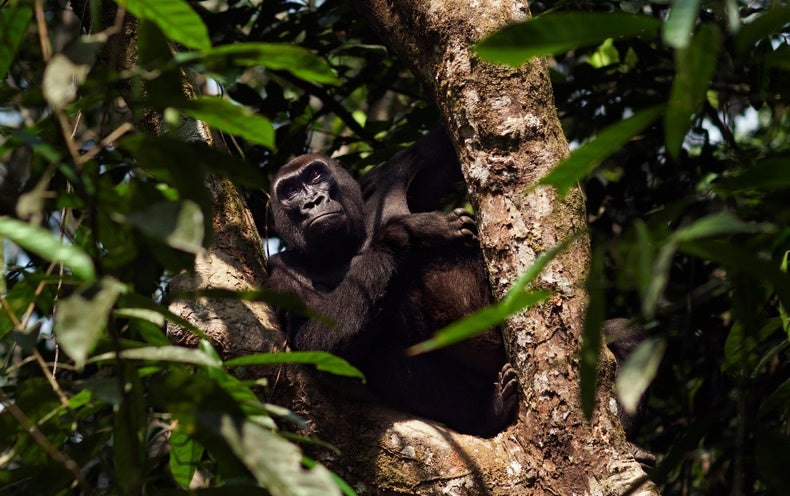
    In the dense jungles of Cameroon and nearby countries, the population of the iconic and critically endangered western lowland gorilla declined by nearly 20 percent between 2005 and 2013 to about 360,000 individuals—and their number is expected to plunge by another 80 percent over about the next 65 years. Raw materials extracted from their habitat and used for goods manufactured in China and then sold in the U.S. and elsewhere have contributed to that decline. This is just one of thousands of species the world stands to lose as part of the global biodiversity crash caused by human activities, including international trade, which alone drives 30 percent of extinction threats to species.

    A new study quantifies how the consumption habits of people in 188 countries, through trade and supply networks, ultimately imperil more than 5,000 threatened and near-threatened terrestrial species of amphibians, mammals and birds on the International Union for the Conservation of Nature (IUCN) Red List of Threatened Species. For the study, recently published in Scientific Reports, researchers used a metric called the extinction-risk footprint. The team found that 76 countries are net “importers” of this footprint, meaning they drive demand for products that contribute to the decline of endangered species abroad. Top among them are the U.S., Japan, France, Germany and the U.K. Another 16 countries—with Madagascar, Tanzania and Sri Lanka leading the list—are designated as net “exporters,” meaning their extinction-risk footprint is driven more by consumption habits in other countries. In the remaining 96 countries, domestic consumption is the most significant driver of extinction risk within those nations.
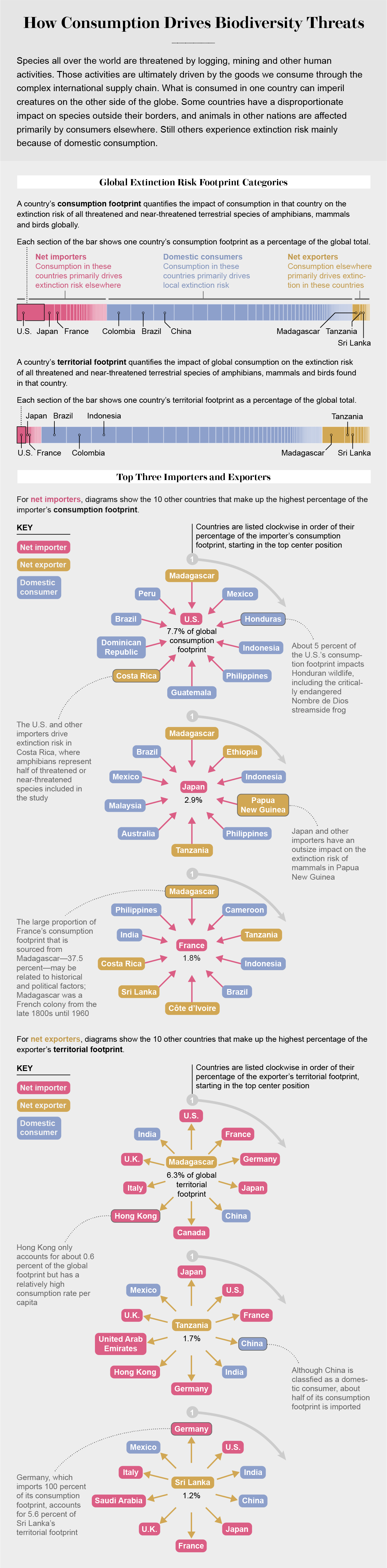
    Graphic shows global consumption and territorial extinction-risk footprint data and highlights top 3 importers and exporters.


    Credit: Amanda Montañez; Source: “Quantifying and Categorising National Extinction-Risk Footprints,” by Amanda Irwin et al., in Scientific Reports, Vol. 12, Article No. 5861. Published online April 7, 2022

    Amanda Irwin, a Ph.D. student at the University of Sydney, and her colleagues examined global supply chain data, along with IUCN data on species populations and locations. They also consulted the organization’s Species Threat Abatement and Recovery (STAR) Metric, which weighs the scope and severity of threats to species. The researchers then paired those data with computer models of the interactions between different economic sectors. This allowed them to determine the impact of consumption from particular sectors, such as agriculture or construction, caused rapid declines in specific animal populations. “What we’re actually doing is tracing the flow of money through the global economy until we get to the point of what we call ‘final demand’ or ‘consumption,’ which is where you and I spend our money,” Irwin says.

    She and her collaborators found that in western Africa, 44 percent of the extinction risk of the western gorilla (predominantly represented by the western lowland gorilla) is exported. This means a substantial amount of the threat to the species ultimately comes from international consumers. The largest single slice of that exported footprint (14 percent) stems from China’s demand for raw materials such as wood and iron. African trees logged in gorilla habitat, for example, could end up as flooring in Asia. The individual percentages for such industries may sound small, but “if we don’t have this understanding of the connection between consumption and production that ultimately happens through these many, many, many interconnected supply chains and flows of money,” Irwin says, “then we’re not in a position to really be able to slow it down at the point of production.”

    Other species highlighted in the study include the Malagasy giant jumping rat, a mammal that can jump 40 inches high and is found only in Madagascar. Demand for food and drinks in Europe contributes to 11 percent of this animal’s extinction-risk footprint through habitat loss caused by expanding agriculture. Tobacco, coffee and tea consumption in the U.S. accounts for 3 percent of the extinction-risk footprint for Honduras’s Nombre de Dios streamside frog, an amphibian that suffers from logging and deforestation related to agriculture.

    “This study is significant as it provides the first application of the STAR Metric to understand the biodiversity impacts associated with consumption patterns and international trade,” says Alexandra Marques, a researcher at the PBL Netherlands Environmental Assessment Agency, who investigates the causes of biodiversity loss and was not involved in the study.

    The study authors say their findings could help consumers, companies and governments make decisions that take species health into consideration. Though this has been done in the past for certain ecosystems such as forests, the new study could help expand the number and type of products that take endangered species into account. Someone buying a dining room table, for example, could look for labels certifying that the wood did not destroy habitat for a specific species. A coffee and tea company could ensure its supply chain does not include products grown in areas that amphibians depend on or that are being deforested for agriculture. Governments could calculate specific industries’ effects on IUCN Red List species in their economic accounting and could negotiate international trade agreements to ensure that biodiversity hotspots are protected.

    Even though some countries protect endangered species domestically, people might not realize the outsize impact their purchases have on species in other countries. For example, the U.S.—which accounts for the largest global consumption footprint—has effectively protected endangered species domestically and should extend that effort to other countries, says study co-author and IUCN chief economist Juha Siikamӓki. “We do need to ask whether some of that relative success came at the expense of our creating impacts elsewhere,” he says. And is it sufficient that we only focus on what’s happening in our country if our consumption, in the end, is driving impact elsewhere? We should think about our responsibility in a broader way.”


    Original Source Link

    Share. Facebook Twitter Pinterest LinkedIn WhatsApp Email Reddit Telegram
    Previous ArticleMaha Haj’s Cannes Prize Winner – The Hollywood Reporter
    Next Article New Patent Reveals How Future Apple Watch Models Could Hide a Camera Inside the Digital Crown

    RELATED POSTS

    To celebrate Endangered Species Day, meet the scaly-foot snail, the most metal animal in the world

    May 15, 2026

    Vocal fry is more common in men, actually, find scientists

    May 14, 2026

    What It Will Take to Make AI Sustainable

    May 14, 2026

    Almost half of the objects in Earth’s orbit are junk—and that’s only the stuff we know about

    May 13, 2026

    Can cloud seeding save us from water bankruptcy?

    May 13, 2026

    All Your Hantavirus Questions, Answered by an Infectious Disease Expert

    May 12, 2026
    latest posts

    Britney Spears’ representative shuts down “ridiculous” claim she behaved erratically with knife in restaurant, as star breaks silence after DUI and rehab

    Britney Spears’ reps have shut down “ridiculous” reports that the singer behaved erratically with a…

    I run Valvoline and work with young people every day. They’re in crisis—and we all have to try to help

    May 15, 2026

    HUD Secretary’s BDS Gets Totally Shut Down

    May 15, 2026

    Hollywood director Adam McKay slams White liberals in Democratic Party critique

    May 15, 2026

    What the jury will actually decide in the case of Elon Musk vs. Sam Altman

    May 15, 2026

    To celebrate Endangered Species Day, meet the scaly-foot snail, the most metal animal in the world

    May 15, 2026

    Paint the Legend: Behind the scenes on The…

    May 15, 2026
    Categories
    • Books (1,241)
    • Business (6,147)
    • Cover Story (4)
    • Film (6,085)
    • Lifestyle (4,170)
    • Music (6,155)
    • Politics (6,148)
    • Science (5,496)
    • Technology (6,081)
    • Television (5,774)
    • Uncategorized (3)
    • US News (6,132)
    popular posts

    Moderna (MRNA) earnings Q1 2023

    Moderna’s sign is seen outside of their headquarters in Cambridge, MA on March 11, 2021.Boston…

    Feds Continue Borrowing Over $5 Billion Per Day Despite Credit Downgrade

    August 10, 2023

    ‘Stranger Things,’ ‘The Umbrella Academy’ & More

    May 26, 2022

    Trump and China close in on trade deal after productive talks, Bessent says

    May 11, 2025
    Archives
    Browse By Category
    • Books (1,241)
    • Business (6,147)
    • Cover Story (4)
    • Film (6,085)
    • Lifestyle (4,170)
    • Music (6,155)
    • Politics (6,148)
    • Science (5,496)
    • Technology (6,081)
    • Television (5,774)
    • Uncategorized (3)
    • US News (6,132)
    About Us

    We are a creativity led international team with a digital soul. Our work is a custom built by the storytellers and strategists with a flair for exploiting the latest advancements in media and technology.

    Most of all, we stand behind our ideas and believe in creativity as the most powerful force in business.

    What makes us Different

    We care. We collaborate. We do great work. And we do it with a smile, because we’re pretty damn excited to do what we do. If you would like details on what else we can do visit out Contact page.

    Our Picks

    To celebrate Endangered Species Day, meet the scaly-foot snail, the most metal animal in the world

    May 15, 2026

    Paint the Legend: Behind the scenes on The…

    May 15, 2026

    Rip & Beth On The ‘Dutton Ranch,’ ‘Outlander’ Finale, ‘Rivals’ Returns, Tip of the ‘Top Hat’

    May 15, 2026
    © 2026 Beverly Hills Examiner. All rights reserved. All articles, images, product names, logos, and brands are property of their respective owners. All company, product and service names used in this website are for identification purposes only. Use of these names, logos, and brands does not imply endorsement unless specified. By using this site, you agree to the Terms & Conditions and Privacy Policy.

    Type above and press Enter to search. Press Esc to cancel.

    We use cookies on our website to give you the most relevant experience by remembering your preferences and repeat visits. By clicking “Accept All”, you consent to the use of ALL the cookies. However, you may visit "Cookie Settings" to provide a controlled consent.
    Cookie SettingsAccept All
    Manage consent

    Privacy Overview

    This website uses cookies to improve your experience while you navigate through the website. Out of these, the cookies that are categorized as necessary are stored on your browser as they are essential for the working of basic functionalities of the website. We also use third-party cookies that help us analyze and understand how you use this website. These cookies will be stored in your browser only with your consent. You also have the option to opt-out of these cookies. But opting out of some of these cookies may affect your browsing experience.
    Necessary
    Always Enabled
    Necessary cookies are absolutely essential for the website to function properly. These cookies ensure basic functionalities and security features of the website, anonymously.
    CookieDurationDescription
    cookielawinfo-checkbox-analytics11 monthsThis cookie is set by GDPR Cookie Consent plugin. The cookie is used to store the user consent for the cookies in the category "Analytics".
    cookielawinfo-checkbox-functional11 monthsThe cookie is set by GDPR cookie consent to record the user consent for the cookies in the category "Functional".
    cookielawinfo-checkbox-necessary11 monthsThis cookie is set by GDPR Cookie Consent plugin. The cookies is used to store the user consent for the cookies in the category "Necessary".
    cookielawinfo-checkbox-others11 monthsThis cookie is set by GDPR Cookie Consent plugin. The cookie is used to store the user consent for the cookies in the category "Other.
    cookielawinfo-checkbox-performance11 monthsThis cookie is set by GDPR Cookie Consent plugin. The cookie is used to store the user consent for the cookies in the category "Performance".
    viewed_cookie_policy11 monthsThe cookie is set by the GDPR Cookie Consent plugin and is used to store whether or not user has consented to the use of cookies. It does not store any personal data.
    Functional
    Functional cookies help to perform certain functionalities like sharing the content of the website on social media platforms, collect feedbacks, and other third-party features.
    Performance
    Performance cookies are used to understand and analyze the key performance indexes of the website which helps in delivering a better user experience for the visitors.
    Analytics
    Analytical cookies are used to understand how visitors interact with the website. These cookies help provide information on metrics the number of visitors, bounce rate, traffic source, etc.
    Advertisement
    Advertisement cookies are used to provide visitors with relevant ads and marketing campaigns. These cookies track visitors across websites and collect information to provide customized ads.
    Others
    Other uncategorized cookies are those that are being analyzed and have not been classified into a category as yet.
    SAVE & ACCEPT