
Close Menu
Beverly Hills Examiner

    Subscribe to Updates

    Get the latest creative news from FooBar about art, design and business.

    What's Hot

    Smashing Pumpkins to reissue classic debut album ‘Gish’ on vinyl for 35th anniversary

    February 11, 2026

    The Gen Z job nightmare is so bad billionaires are worried their kids won’t be able to keep a job

    February 11, 2026

    Pelosi endorses JFK’s grandson in Democratic House primary

    February 11, 2026
    Facebook X (Twitter) Instagram
    Beverly Hills Examiner
    • Home
    • US News
    • Politics
    • Business
    • Science
    • Technology
    • Lifestyle
    • Music
    • Television
    • Film
    • Books
    • Contact
      • About
      • Amazon Disclaimer
      • DMCA / Copyrights Disclaimer
      • Terms and Conditions
      • Privacy Policy
    Beverly Hills Examiner
    Home»Science»How Supermassive Black Holes Can Become Cosmic Nightmares
    Science

    How Supermassive Black Holes Can Become Cosmic Nightmares

    By AdminOctober 31, 2025
    Facebook Twitter Pinterest LinkedIn WhatsApp Email Reddit Telegram
    How Supermassive Black Holes Can Become Cosmic Nightmares


    Galaxies are spooky places.

    Space itself is scary enough—dark, vast, cold and empty—but galaxies have all manner of terrifying beasts lurking inside. Most of these astrophysical monsters are stars with various behavioral issues, such as explosive supernovae or ridiculously powerful (and tempestuous) magnetars. Getting too close to one of these stellar tantrums guarantees a very bad time.

    On top of that, galaxies themselves can be terrifying. In a recent The Universe column, I wrote about particularly nasty cosmic nightmares called active galaxies. You see, all big galaxies have a supermassive black hole haunting their heart, and some of these black holes have billions of times the mass of the sun. If matter is falling into one of these black holes at a high rate, that infalling material heats up to frightening temperatures and blasts out high-energy radiation. This also drives intense winds of subatomic particles that flow away at high speed to wreak havoc around the galactic core. That’s all bad enough, but the spin of the black hole can also launch twin beams of matter called jets that can scream across space like death rays, cooking everything in their path for many thousands of light-years.


    On supporting science journalism

    If you’re enjoying this article, consider supporting our award-winning journalism by subscribing. By purchasing a subscription you are helping to ensure the future of impactful stories about the discoveries and ideas shaping our world today.


    This doesn’t sound like a clement environment! After the article was published, I received quite a few inquiries from readers asking some unsettling questions: How dangerous is it to live in an active galaxy—and is the Milky Way one?

    As usual, the answer is: it depends. The Milky Way’s supermassive black hole, called Sgr A*, seems to be pretty sedate at present, but we don’t know just how active our galaxy was in its youth. We can see echoes of previous events around the galactic center, however; stretching away from the Milky Way’s heart are two immense bubbles of hot gas that are softly glowing with gamma rays. It’s unclear if these bubbles, called Fermi Bubbles, are blown by some wind of material from Sgr A* after a snack or if a burst of star formation created enough high-mass stars to expel winds that expand the gas.

    And as for the more fundamental question of active galaxy hazards, this hasn’t been very well studied, but I did find a couple of papers that tackled it under limited circumstances. The results, not too surprisingly, show that the two most important factors are how powerful the active galaxy is and how far you are from it.

    In extreme cases, even being outside the active galaxy will not keep you safe. A prime example of this is the galaxy pair 3C321, where a jet from one of the galaxies is slamming into the other about 20,000 light-years away. Being in the path of all that high-energy radiation must be rough, but the impact of the jet is also causing clouds of gas in the second galaxy to collapse, which triggers scads of star formation. That, in turn, means the creation of many high-mass stars, which explode as supernovae in just a few million years.

    Opinions vary on how close a planet can be to an exploding star and survive, but a few hundred light-years is a conservative estimate. On a galactic scale, that’s very close, so on average, it’s unlikely to afflict any particular world. Then again, on galactic scales, a few million years is an instant, so all those jet-sparked supernovae would be detonating almost simultaneously—which can’t be good for any worlds in the general vicinity. I’d advise you stay away from jets.

    What about the other effects? The wind of subatomic particles is a problem—two problems, really. One is that if the wind strikes a planet such as Earth, it can deposit energy in the atmosphere, heating it up. This causes the air to expand, making it more prone to be lost to space. The other is that when those particles hit the atmosphere, they can trigger a few different kinds of chemical reactions, including the creation of nitrogen oxides, major components of smog. This has several effects, but one of the most deleterious is that smog destroys ozone, a molecule composed of three oxygen atoms. Ozone absorbs energetic ultraviolet light from the host star that can otherwise reach the surface and be harmful to life.

    In a paper published earlier this year in the Monthly Notices of the Royal Astronomical Society, a team of astronomers modeled these two effects from an active galaxy. The researchers first assumed the galaxy had a black hole similar to our Milky Way’s Sgr A*, with a mass of four million suns. They then calculated the energy from the wind, finding that it could erode the atmosphere of an Earth-like world as far out as 1,300 light-years—or just deplete the planet’s ozone if it was within about 3,000 light-years. These might seem like worrisomely large distances, but the Milky Way is 60,000 light-years in radius, and our solar system is about 26,000 light-years out from the center, so we’re safe from nasty winds.

    That’s nice. Even if some event were to dump lots of material into our local supermassive black hole, we’d get a light show but should survive.

    Not every galaxy is so lucky, however. Sgr A* is actually a lightweight for galaxies our size, and many galaxies have supermassive black holes that are far larger—large enough, the researchers say, to potentially sterilize an entire galaxy when they erupt with activity. That makes me glad that our local beast is undersize.

    Another paper, published in 2022 in the Astrophysical Journal, looked at the effects of ultraviolet radiation on a galaxy’s habitability. What the authors found is interesting: UV radiation flooding out from an active galaxy could actually promote the growth of protective ozone in a planet’s atmosphere, assuming there’s enough oxygen available to make it. So, oddly, an active galaxy can bolster the conditions for life, at least in this very narrow circumstance.

    Much like the relatively localized hazards from supernovae, though, the “dead zone” from any supermassive black hole’s UV radiation would still be mostly limited to the galactic core and so would only affect a small percentage of all stars. In a spiral galaxy like ours, which has a flat disk filled with opaque, UV-absorbing dust, the effects would be essentially zero for a planet like Earth that was embedded in the disk’s outer suburbs.

    This does raise the question of just how habitable our galaxy is in general. This has actually been studied, though, again, conclusions differ. An early attempt at this from 2004 found that there’s a “galactic habitable zone,” analogous to those around stars, in which it’s possible for life to arise. At too close to the center, there are too many exploding stars early on. (Plus, younger galaxies tend to be more active.) At too far out, the stars tend to be too old, impoverished of heavy elements, such as iron and carbon, that are needed for life as we know it. This initial work sketched out a galactic habitable zone that stretches from about 22,000 to 30,000 light-years from the center—that is, essentially right where we are. But later research widened that; one team of astronomers found the Milky Way’s life-friendly region reaches from nearly 7,000 to more than 40,000 light-years, well out into our galaxy’s extended disk.

    Still, I wonder—and worry—about what future possibilities await us. If the enormous Andromeda galaxy collides with the Milky Way, which might happen in a few billion years, a lot of matter could be dumped into Sgr A*, as well as the much more massive black hole at Andromeda’s center. This could resurrect both as active galaxies for a short time. Any planets within a few thousand light-years of either’s core could be in for a rough ride.

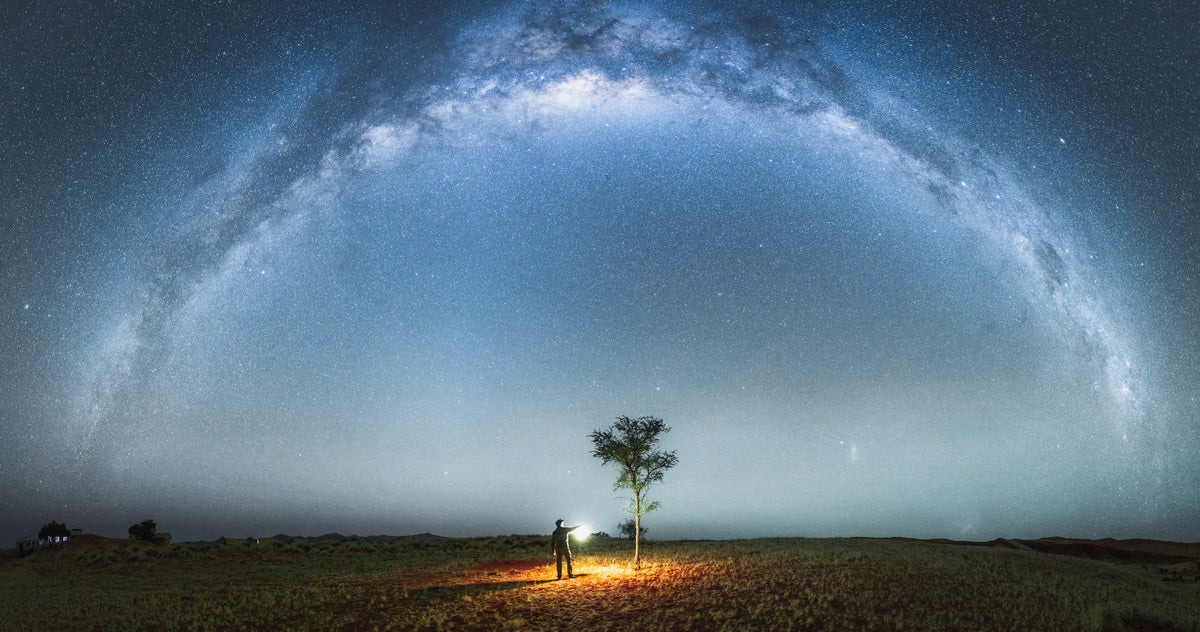
    Either way, all this is an eerie reminder that the universe tolerates us but doesn’t necessarily maintain a stable environment for life. If you need to feel a chill down your spine on Halloween, then take a look up at a dark sky while you’re out trick-or-treating. Gaze upon the Milky Way’s ominous glow and wonder just how welcoming our galaxy really is.


    Original Source Link

    Share. Facebook Twitter Pinterest LinkedIn WhatsApp Email Reddit Telegram
    Previous ArticleJapanese Director Yuichiro Sakashita Delivers Social Satire in ‘Blonde’
    Next Article 20+ Gifts for Women Who’ve Checked Out of Planet Earth (2025)

    RELATED POSTS

    This ancient South American kingdom ran on bird poop

    February 11, 2026

    Newborn marsupials seen crawling to mother’s pouch for the first time

    February 11, 2026

    This Startup Thinks It Can Make Rocket Fuel From Water. Stop Laughing

    February 10, 2026

    Obesity increases risk of severe infections, study finds

    February 10, 2026

    ‘Hidden’ group of gut bacteria may be essential to good health

    February 9, 2026

    New York Is the Latest State to Consider a Data Center Pause

    February 9, 2026
    latest posts

    Smashing Pumpkins to reissue classic debut album ‘Gish’ on vinyl for 35th anniversary

    Smashing Pumpkins are set to reissue their classic debut album, ‘Gish’ on vinyl for its…

    The Gen Z job nightmare is so bad billionaires are worried their kids won’t be able to keep a job

    February 11, 2026

    Pelosi endorses JFK’s grandson in Democratic House primary

    February 11, 2026

    NPR host compares masked Guthrie suspect in FBI video to immigration agent

    February 11, 2026

    The ICE Expansion Won’t Happen in the Dark

    February 11, 2026

    This ancient South American kingdom ran on bird poop

    February 11, 2026

    The President’s Cake review – polished but…

    February 11, 2026
    Categories
    • Books (1,054)
    • Business (5,960)
    • Film (5,896)
    • Lifestyle (3,998)
    • Music (5,964)
    • Politics (5,965)
    • Science (5,307)
    • Technology (5,894)
    • Television (5,584)
    • Uncategorized (2)
    • US News (5,946)
    popular posts

    ‘The Crowded Room’ Star Sasha Lane on Ariana’s Actions Catching Up With Danny

    [This interview was conducted prior to the SAG-AFTRA strike authorization.] [Warning: The below contains MAJOR…

    6 Best Vegan Sneakers for Men: Cruelty-free Styling in 2024

    September 19, 2024

    Former Congresswoman Tulsi Gabbard Calls Hillary Clinton a ‘Dangerous Person’ Who is Incredibly Jealous of Joe Biden

    February 13, 2023

    Fresh Faces and Legendary Detectives Collide in Jon Land’s Latest Thrill List

    February 4, 2026
    Archives
    Browse By Category
    • Books (1,054)
    • Business (5,960)
    • Film (5,896)
    • Lifestyle (3,998)
    • Music (5,964)
    • Politics (5,965)
    • Science (5,307)
    • Technology (5,894)
    • Television (5,584)
    • Uncategorized (2)
    • US News (5,946)
    About Us

    We are a creativity led international team with a digital soul. Our work is a custom built by the storytellers and strategists with a flair for exploiting the latest advancements in media and technology.

    Most of all, we stand behind our ideas and believe in creativity as the most powerful force in business.

    What makes us Different

    We care. We collaborate. We do great work. And we do it with a smile, because we’re pretty damn excited to do what we do. If you would like details on what else we can do visit out Contact page.

    Our Picks

    This ancient South American kingdom ran on bird poop

    February 11, 2026

    The President’s Cake review – polished but…

    February 11, 2026

    ‘The View’ Alyssa Farah Griffin Gives Birth To 1st Baby

    February 11, 2026
    © 2026 Beverly Hills Examiner. All rights reserved. All articles, images, product names, logos, and brands are property of their respective owners. All company, product and service names used in this website are for identification purposes only. Use of these names, logos, and brands does not imply endorsement unless specified. By using this site, you agree to the Terms & Conditions and Privacy Policy.

    Type above and press Enter to search. Press Esc to cancel.

    We use cookies on our website to give you the most relevant experience by remembering your preferences and repeat visits. By clicking “Accept All”, you consent to the use of ALL the cookies. However, you may visit "Cookie Settings" to provide a controlled consent.
    Cookie SettingsAccept All
    Manage consent

    Privacy Overview

    This website uses cookies to improve your experience while you navigate through the website. Out of these, the cookies that are categorized as necessary are stored on your browser as they are essential for the working of basic functionalities of the website. We also use third-party cookies that help us analyze and understand how you use this website. These cookies will be stored in your browser only with your consent. You also have the option to opt-out of these cookies. But opting out of some of these cookies may affect your browsing experience.
    Necessary
    Always Enabled
    Necessary cookies are absolutely essential for the website to function properly. These cookies ensure basic functionalities and security features of the website, anonymously.
    CookieDurationDescription
    cookielawinfo-checkbox-analytics11 monthsThis cookie is set by GDPR Cookie Consent plugin. The cookie is used to store the user consent for the cookies in the category "Analytics".
    cookielawinfo-checkbox-functional11 monthsThe cookie is set by GDPR cookie consent to record the user consent for the cookies in the category "Functional".
    cookielawinfo-checkbox-necessary11 monthsThis cookie is set by GDPR Cookie Consent plugin. The cookies is used to store the user consent for the cookies in the category "Necessary".
    cookielawinfo-checkbox-others11 monthsThis cookie is set by GDPR Cookie Consent plugin. The cookie is used to store the user consent for the cookies in the category "Other.
    cookielawinfo-checkbox-performance11 monthsThis cookie is set by GDPR Cookie Consent plugin. The cookie is used to store the user consent for the cookies in the category "Performance".
    viewed_cookie_policy11 monthsThe cookie is set by the GDPR Cookie Consent plugin and is used to store whether or not user has consented to the use of cookies. It does not store any personal data.
    Functional
    Functional cookies help to perform certain functionalities like sharing the content of the website on social media platforms, collect feedbacks, and other third-party features.
    Performance
    Performance cookies are used to understand and analyze the key performance indexes of the website which helps in delivering a better user experience for the visitors.
    Analytics
    Analytical cookies are used to understand how visitors interact with the website. These cookies help provide information on metrics the number of visitors, bounce rate, traffic source, etc.
    Advertisement
    Advertisement cookies are used to provide visitors with relevant ads and marketing campaigns. These cookies track visitors across websites and collect information to provide customized ads.
    Others
    Other uncategorized cookies are those that are being analyzed and have not been classified into a category as yet.
    SAVE & ACCEPT