
Close Menu
Beverly Hills Examiner

    Subscribe to Updates

    Get the latest creative news from FooBar about art, design and business.

    What's Hot

    Jensen Huang scheduled to testify next week in Senate following reinstatement as Nvidia CEO | TechCrunch

    November 23, 2026

    Intuit moves to sell Mailchimp for $3.68 billion as AI reshapes its growth strategy | Fortune

    November 23, 2026

    Everyone Comes Here to Be Wowed: Las Vegas Grand Prix Hits Live Music Jackpot With Backstreet Boys, Kacey Musgraves & More

    November 23, 2026
    Facebook X (Twitter) Instagram
    Beverly Hills Examiner
    • Home
    • US News
    • Politics
    • Business
    • Science
    • Technology
    • Lifestyle
    • Music
    • Television
    • Film
    • Books
    • Contact
      • About
      • Amazon Disclaimer
      • DMCA / Copyrights Disclaimer
      • Terms and Conditions
      • Privacy Policy
    Beverly Hills Examiner
    Home»Science»How the Higgs Boson Ruined Peter Higgs’s Life
    Science

    How the Higgs Boson Ruined Peter Higgs’s Life

    By AdminJune 24, 2022
    Facebook Twitter Pinterest LinkedIn WhatsApp Email Reddit Telegram
    How the Higgs Boson Ruined Peter Higgs’s Life

    [ad_1]

    Ten years ago scientists announced one of the most momentous discoveries in physics: the Higgs boson. The particle, predicted 48 years earlier, was the missing piece in the Standard Model of particle physics. The machine built in part to find this particle, the 27-kilometer-long, circular Large Hadron Collider (LHC) at CERN near Geneva, had fulfilled its promise by showing signals of a new fundamental bit of nature that matched expectations for the Higgs.

    The existence of this tiny object had first been proposed by physicist Peter Higgs in 1964. For years, the significance of the prediction was lost on most scientists, including Higgs himself. But gradually it became clear that the Higgs boson was not just an exotic sideshow in the particle circus but rather the main event. The particle and its associated Higgs field turned out to be responsible for giving all other particles mass and, in turn, creating the structure of galaxies, stars and planets that define our universe and enable our species. Physicists believed this story for many decades, but it wasn’t proved until July 4, 2012, when researchers from two experiments at the LHC announced their discovery and confirmed the prediction Higgs made all those years ago.
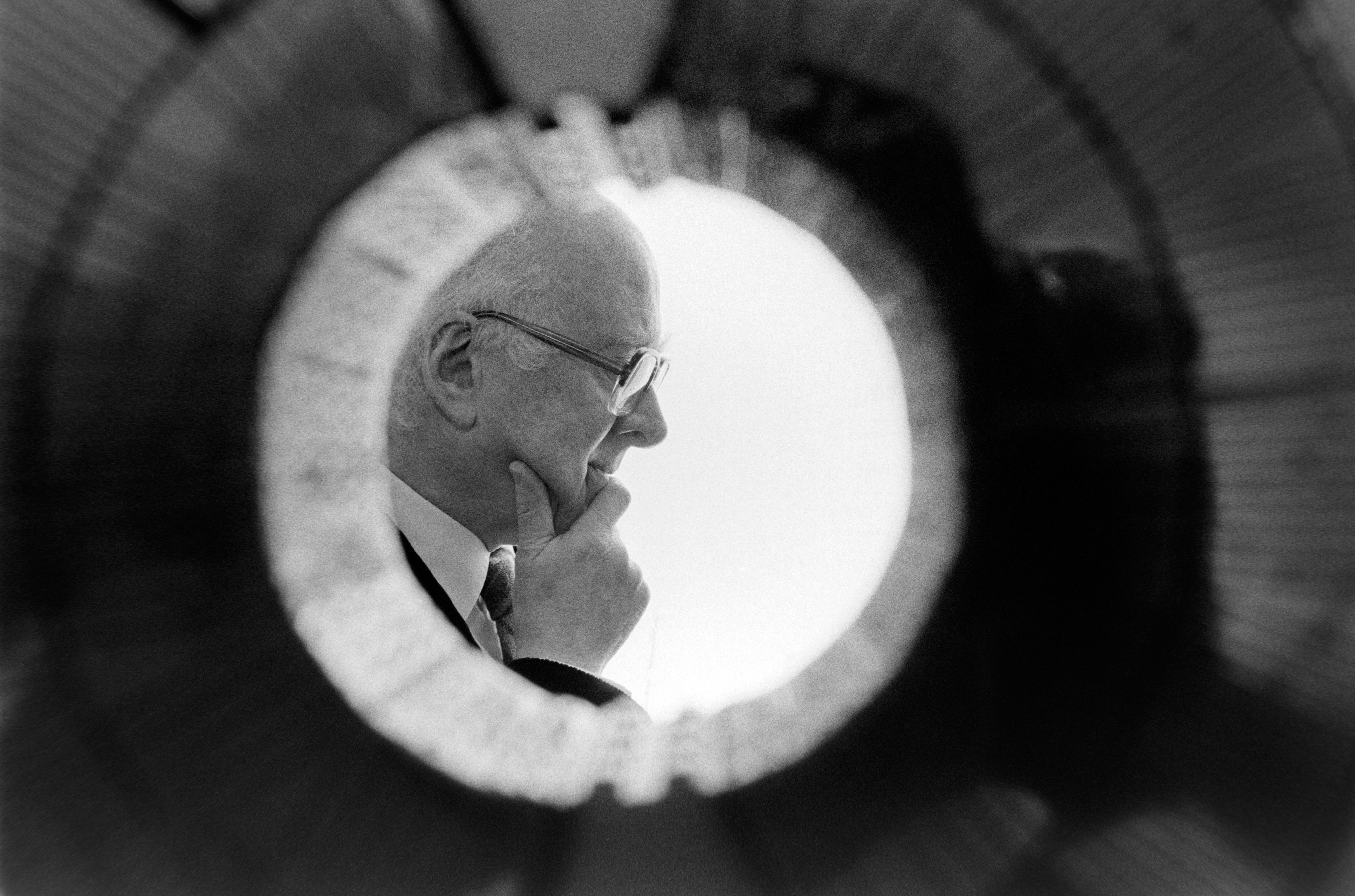
    Credit: Gary Doak / Alamy Stock Photo

    Yet the finding, however scientifically thrilling, pushed a press-shy Peter Higgs into the public eye. When he shared the Nobel Prize in Physics the next year, Higgs left his home in Edinburgh and camped out at a pub across town on the day of the announcement so the prize committee wouldn’t be able to reach him. Physicist Frank Close tells the story of Higgs and the physicist’s big idea in his new book Elusive: How Peter Higgs Solved the Mystery of Mass (Basic Books, 2022). Scientific American spoke to Close about the particle, the quest to find it and the man who began it all.

    [An edited transcript of the interview follows.]

    Your book is called Elusive. Certainly the Higgs boson itself was elusive and took physicists decades and many billions of dollars to find. But Higgs the man emerges in your book as an elusive person as well.

    One of the biggest shocks I had when I was interviewing him was when he said the discovery of the boson “ruined [his] life.” I thought, “How can it ruin your life when you have done some beautiful mathematics, and then it turns out you had mysteriously touched on the pulse of nature, and everything you’ve believed in has been shown to be correct, and you’ve won a Nobel Prize? How can these things amount to ruin?” He said, “My relatively peaceful existence was ending. My style is to work in isolation and occasionally have a bright idea.” He is a very retiring person who was being thrust into the limelight.

    That, to my mind, is why Peter Higgs the person is still elusive to me even though I’ve known him for 40 years.

    You quote Higgs as saying that this idea was “the only really original idea I’ve ever had.” Do you think that’s true?

    Yes, but how many of us can say we’ve even had one really brilliant idea? There’s no doubt that he had a really brilliant idea. In physics, the people who have done really big things tend to do many big things. Higgs is unique in this being once and once only. It’s easy to dismiss it as luck, and clearly luck was part of it. But being in the right place at the right time, you have to recognize it. Higgs had spent two to three years really trying to understand a particular problem. And because he had done that hard work and was still trying to deepen his understanding of this very profound concept, when a paper turned up on his desk posing a related question, Higgs happened to have the answer because of the work he’d done. He sometimes says, “I’m primarily known for three weeks of my life.” I say, “Yes, Peter, but you spent two years preparing for that moment.”

    The discovery of the Higgs boson came nearly 50 years after Higgs’s prediction, and he said he never expected it to be found in his lifetime. What did it mean to him that the particle was finally detected?

    He said to me that his first reaction was one of relief that it was indeed confirmed. At that moment he knew [the particle existed] after all, and he felt a profound sense of being moved that that was really the way it was in nature—and then panic that his life was going to change.

    Why was Higgs’s discovery so important?

    Higgs’s discovery was that mass is not something intrinsic to particles. It is a result of the whole cosmos. This comes about because there is some field of stuff out there that does this. And the strange, counterintuitive aspect of it is that if the vacuum [of space] was completely empty, it would be less stable than if you filled it with this mysterious stuff that we call the Higgs field. That’s so counterintuitive that I wonder if that’s why it took so long for this idea to emerge. And we now know it is true.

    Most people have heard of the electromagnetic field. If you add energy to an electromagnetic field, you can excite it into photons. Similarly, there is this stuff we call the Higgs field. If we could apply enough energy to that, we could, in principle, excite it and produce Higgs bosons. The Higgs boson and the Higgs field are analogous to photons and the electromagnetic field.

    However, striking a match produces millions of photons, but to produce one Higgs boson, we have to concentrate 125 billion electron volts into one spot, which is what they did at the LHC. That’s the reason we’ve known about photons for 100 years and just recently found the Higgs boson.

    It’s been 10 years since the discovery of the Higgs boson, and some people have been decrying the lack of a similarly exciting finding at the LHC since then. Are you disappointed that there hasn’t been another high-profile discovery after the Higgs?

    This discovery was a seminal moment in human culture. It’s a discovery that will rank alongside the discovery of the Rutherford atom and the nucleus. It’s the discovery that we are immersed in this still mysterious essence, the Higgs field, which ultimately leads to structure in the universe. To expect other discoveries since then to meet this standard is to miss how profound this one was.

    What is the outlook for the next 10 years at the LHC?

    Finding the Higgs boson was like climbing up a mountain. When Higgs did his work, we didn’t even know where the mountain range was or how tall it might be. The Standard Model of particle physics didn’t even exist. There was a vague awareness that somewhere on this peak, there was a Higgs boson that would really be proof that this whole structure was there. As of the late 1990s, we had a sense of how high the mountain was. And then it wasn’t until 2012 when we finally scaled that peak.

    Now we’re going down the other side of the mountain, across the plains, and they extend all the way out to the Planck scale [the minimum limit of the universe]. If we’re correct, somewhere out there on the plains are other mountain ranges where particles of supersymmetry exist or dark matter particles exist. But we have no clear indication of how far across the plains you have to travel to see these new mountain ranges. That is the difference between where we are now and where we have been these past decades. We don’t have any compelling way of telling how far we have to go. It’s elusive.

    [ad_2]

    Original Source Link

    Share. Facebook Twitter Pinterest LinkedIn WhatsApp Email Reddit Telegram
    Previous ArticleDavid Cronenberg To Get Lifetime Honor at San Sebastian Film Festival – The Hollywood Reporter
    Next Article Amsterdam cyber startup Hadrian closes €10.5M Seed for platform which simulates hacker attacks – TechCrunch

    RELATED POSTS

    Voyager 1 Beat the Odds and Is Still Working a Light-Day Away From Earth

    November 18, 2026

    The Dark Side of the Moon Was the Brightest Part of 2026

    November 17, 2026

    Just 400 US Data Centers Use More Electricity Than Michigan

    November 16, 2026

    The EPAs Chemical-Detecting Plane Isnt Doing Its Job Anymore

    November 16, 2026

    Its Getting Too Dry for Even Cactuses to Survive

    November 15, 2026

    New Species of Giant Fungus Discovered in China Grows up to 20 Inches Tall

    November 15, 2026
    latest posts

    Jensen Huang scheduled to testify next week in Senate following reinstatement as Nvidia CEO | TechCrunch

    Jensen Huang is scheduled to testify before the Senate Banking Committee on December 3, according…

    Intuit moves to sell Mailchimp for $3.68 billion as AI reshapes its growth strategy | Fortune

    November 23, 2026

    Everyone Comes Here to Be Wowed: Las Vegas Grand Prix Hits Live Music Jackpot With Backstreet Boys, Kacey Musgraves & More

    November 23, 2026

    Avengers: Doomsday Final Trailer Shows Major X-Men Moment

    November 23, 2026

    Someone did the math on the Democrats first 100-day agenda: It saves $30 billion on the Iran war but ultimately adds $4.1 trillion to national debt | Fortune

    November 23, 2026

    How Notable Capital, GIC, and Baillie Gifford bet big on Anthropic before its IPO | TechCrunch

    November 23, 2026

    Why data centers are at the center of the Big Tech backlash | TechCrunch

    November 22, 2026
    Categories
    • Books (1,624)
    • Business (6,530)
    • Cover Story (18)
    • Film (6,464)
    • Lifestyle (4,502)
    • Music (6,540)
    • Politics (6,516)
    • Science (5,870)
    • Technology (6,468)
    • Television (6,162)
    • Uncategorized (3)
    • US News (6,513)
    popular posts

    Curing and Preventing iPhone Thumb

    [ad_1] Curing and Preventing iPhone ThumbWritten by: Gerda Endemann, PhD | Published on: October 20,…

    Facebook change to control covid-19 vaccine misinformation failed

    September 17, 2023

    Will Smith Posts Emotional Apology Video for Oscars Slap: ‘I Hate When I Let People Down’

    July 30, 2022

    Jamie Raskin’s Description Of Republicans Defending Trump Is Devastating

    June 9, 2024
    Archives
    Browse By Category
    • Books (1,624)
    • Business (6,530)
    • Cover Story (18)
    • Film (6,464)
    • Lifestyle (4,502)
    • Music (6,540)
    • Politics (6,516)
    • Science (5,870)
    • Technology (6,468)
    • Television (6,162)
    • Uncategorized (3)
    • US News (6,513)
    About Us

    We are a creativity led international team with a digital soul. Our work is a custom built by the storytellers and strategists with a flair for exploiting the latest advancements in media and technology.

    Most of all, we stand behind our ideas and believe in creativity as the most powerful force in business.

    What makes us Different

    We care. We collaborate. We do great work. And we do it with a smile, because we’re pretty damn excited to do what we do. If you would like details on what else we can do visit out Contact page.

    Our Picks

    How Notable Capital, GIC, and Baillie Gifford bet big on Anthropic before its IPO | TechCrunch

    November 23, 2026

    Why data centers are at the center of the Big Tech backlash | TechCrunch

    November 22, 2026

    Prince Fleet Easton Guests On “If These Walls Could Talk” With Hosts Wendy Stuart and Tym Moss Wednesday, November 25th, 2026

    November 22, 2026
    © 2026 Beverly Hills Examiner. All rights reserved. All articles, images, product names, logos, and brands are property of their respective owners. All company, product and service names used in this website are for identification purposes only. Use of these names, logos, and brands does not imply endorsement unless specified. By using this site, you agree to the Terms & Conditions and Privacy Policy.

    Type above and press Enter to search. Press Esc to cancel.

    We use cookies on our website to give you the most relevant experience by remembering your preferences and repeat visits. By clicking “Accept All”, you consent to the use of ALL the cookies. However, you may visit "Cookie Settings" to provide a controlled consent.
    Cookie SettingsAccept All
    Manage consent

    Privacy Overview

    This website uses cookies to improve your experience while you navigate through the website. Out of these, the cookies that are categorized as necessary are stored on your browser as they are essential for the working of basic functionalities of the website. We also use third-party cookies that help us analyze and understand how you use this website. These cookies will be stored in your browser only with your consent. You also have the option to opt-out of these cookies. But opting out of some of these cookies may affect your browsing experience.
    Necessary
    Always Enabled
    Necessary cookies are absolutely essential for the website to function properly. These cookies ensure basic functionalities and security features of the website, anonymously.
    CookieDurationDescription
    cookielawinfo-checkbox-analytics11 monthsThis cookie is set by GDPR Cookie Consent plugin. The cookie is used to store the user consent for the cookies in the category "Analytics".
    cookielawinfo-checkbox-functional11 monthsThe cookie is set by GDPR cookie consent to record the user consent for the cookies in the category "Functional".
    cookielawinfo-checkbox-necessary11 monthsThis cookie is set by GDPR Cookie Consent plugin. The cookies is used to store the user consent for the cookies in the category "Necessary".
    cookielawinfo-checkbox-others11 monthsThis cookie is set by GDPR Cookie Consent plugin. The cookie is used to store the user consent for the cookies in the category "Other.
    cookielawinfo-checkbox-performance11 monthsThis cookie is set by GDPR Cookie Consent plugin. The cookie is used to store the user consent for the cookies in the category "Performance".
    viewed_cookie_policy11 monthsThe cookie is set by the GDPR Cookie Consent plugin and is used to store whether or not user has consented to the use of cookies. It does not store any personal data.
    Functional
    Functional cookies help to perform certain functionalities like sharing the content of the website on social media platforms, collect feedbacks, and other third-party features.
    Performance
    Performance cookies are used to understand and analyze the key performance indexes of the website which helps in delivering a better user experience for the visitors.
    Analytics
    Analytical cookies are used to understand how visitors interact with the website. These cookies help provide information on metrics the number of visitors, bounce rate, traffic source, etc.
    Advertisement
    Advertisement cookies are used to provide visitors with relevant ads and marketing campaigns. These cookies track visitors across websites and collect information to provide customized ads.
    Others
    Other uncategorized cookies are those that are being analyzed and have not been classified into a category as yet.
    SAVE & ACCEPT