
Close Menu
Beverly Hills Examiner

    Subscribe to Updates

    Get the latest creative news from FooBar about art, design and business.

    What's Hot

    Bring on 2027 I mean 2026 I mean Happy Easter

    December 31, 2025

    ‘I opened her door and the wind caught me, and I went flying’: The U.S. Arctic air surge is sweeping northerners off their feet

    December 31, 2025

    The Trump Regime Threatens Artists As The Kennedy Center Will Be Empty On New Year’s Eve

    December 31, 2025
    Facebook X (Twitter) Instagram
    Beverly Hills Examiner
    • Home
    • US News
    • Politics
    • Business
    • Science
    • Technology
    • Lifestyle
    • Music
    • Television
    • Film
    • Books
    • Contact
      • About
      • Amazon Disclaimer
      • DMCA / Copyrights Disclaimer
      • Terms and Conditions
      • Privacy Policy
    Beverly Hills Examiner
    Home»Science»How to Improve Indoor Air Quality
    Science

    How to Improve Indoor Air Quality

    By AdminAugust 30, 2022
    Facebook Twitter Pinterest LinkedIn WhatsApp Email Reddit Telegram
    How to Improve Indoor Air Quality


    Did you know that we spend about 90 percent of our time indoors?

    So why aren’t we talking about indoor air quality, especially when COVID is still spreading and so many people are being encouraged to return to offices?

    Let me explain.

    We know that SARS-CoV-2, the virus that causes COVID, is transmitted by airborne droplets called aerosols that hang in the air and can travel over short and long distances.

    And aside from reducing COVID transmission rates, we  know that fresh air is really important for health in general.

    Florence Nightingale, for example, once highlighted the importance of bedroom ventilation for tuberculosis patients. And Nordic parents often let their babies nap outside—in the freezing cold. 

    SARS-CoV-2 isn’t the only virus that spreads through the air indoors. Influenza and other respiratory viruses also spread this way. Studies have also shown that poor ventilation leads to cognitive impairment and “sick building syndrome.”

    So why aren’t we prioritizing clean indoor air the same way we prioritize, say, clean drinking water?

    And is there actually anyone regulating our indoor air quality?

    It turns out there is. 

    That would be ASHRAE—a U.S. industry body that sets standards for what’s called “acceptable indoor air quality.”

    ASHRAE standards aim to limit exposure to harmful substances with known exposure limits, such as formaldehyde, but not to pathogens.

    And here’s the problem: according to experts, these air quality standards are far below those needed to stop the spread of COVID. 

    That’s because minimum ventilation rates, for example, don’t totally stop the spread of airborne pathogens. And many buildings don’t even meet those standards. 

    Changing these standards takes time. But we’re going to break down the components of improving indoor air quality and exactly what you need to do so. 

    1. SOURCE CONTROL 

    In 1858 chemist Max von Pettenkofer, one of the pioneers of the indoor air quality movement, said that if a space contains a pile of manure, one should not try to remove the odor by ventilation but rather remove the manure.

    For example, one could reduce cooking gas fumes by using an electric stove instead of a gas one.

    So if you wanted to limit the amount of SARS-CoV-2 particles in the air, you could theoretically mandate that people wear high-quality masks and ensure that anyone who feels sick stays home instead of coming into the office.

    Of course, such measures alone can’t not prevent all pathogens or other pollutants from entering the air, which is why other steps are needed.

    2. VENTILATION

    A building’s ventilation level refers to how much fresh outdoor air is being brought in. This fresh air dilutes the concentration of virus-laden particles in the air. 

    Imagine a SARS-CoV-2 particle indoors as a drop of food coloring in a cup of water. Outdoors, it is more like a drop of dye in the ocean—it rapidly becomes so diluted that it’s largely undetectable. Ventilation makes the indoor “cup” more like the outdoor “ocean.”

    The simplest and cheapest way to improve ventilation is to open a window, but that’s not always viable—especially if the air outside is more polluted than that inside.

    Experts say this can become a major equity issue. People of color, for example, are more likely to live and work in places where they are exposed to harmful pollution.

    Aside from windows, another source of indoor ventilation is a heating, ventilation and air conditioning, or HVAC, system. Most of these systems allow a building manager to vary the amount of fresh air intake. It should generally be set to maximum, experts say—provided the outdoor air quality is safe. Yet before the pandemic, many buildings had their HVAC system set to recirculate old, stale air.

    A good rule of thumb is to aim for having at least six air exchanges per hour through ventilation or the equivalent amount of fresh air through filtration.

    One way we can indirectly measure the amount of ventilation in a space is to use a carbon dioxide monitor. Humans exhale CO2 when we breathe, so levels of this gas provide a good proxy for how diluted the air is. Values below about 800 parts per million are potentially well ventilated. 

    3. FILTRATION

    Filtration basically just means removing particles and other pollutants from the air. A standard called MERV offers a way of comparing different filters. The gold-standard filter, HEPA, can remove 99.97 percent of airborne particles that are 0.3 micron in size and an even greater percentage of larger or smaller particles. HEPA is equivalent to a rating of MERV 17 or higher.

    A best practice is to upgrade filters to at least MERV 13 for most indoor settings. Many HVAC systems can be upgraded to this standard—but some very old ones may have trouble with higher-efficiency filters, and this could cause air to leak around the filters. 

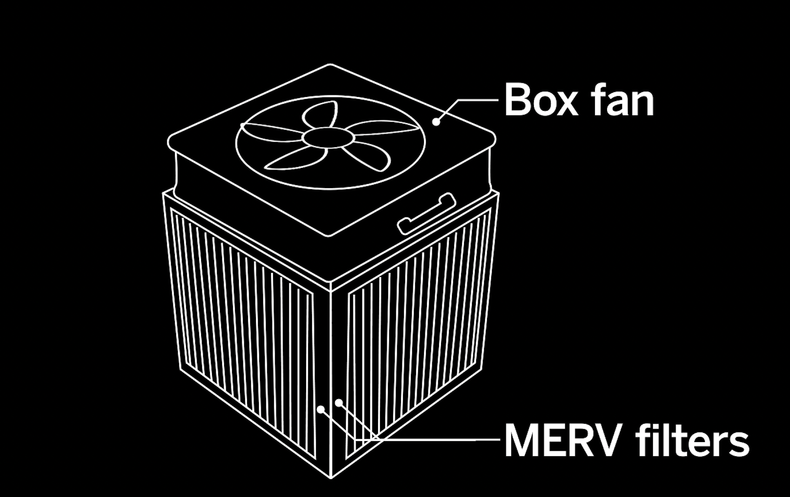
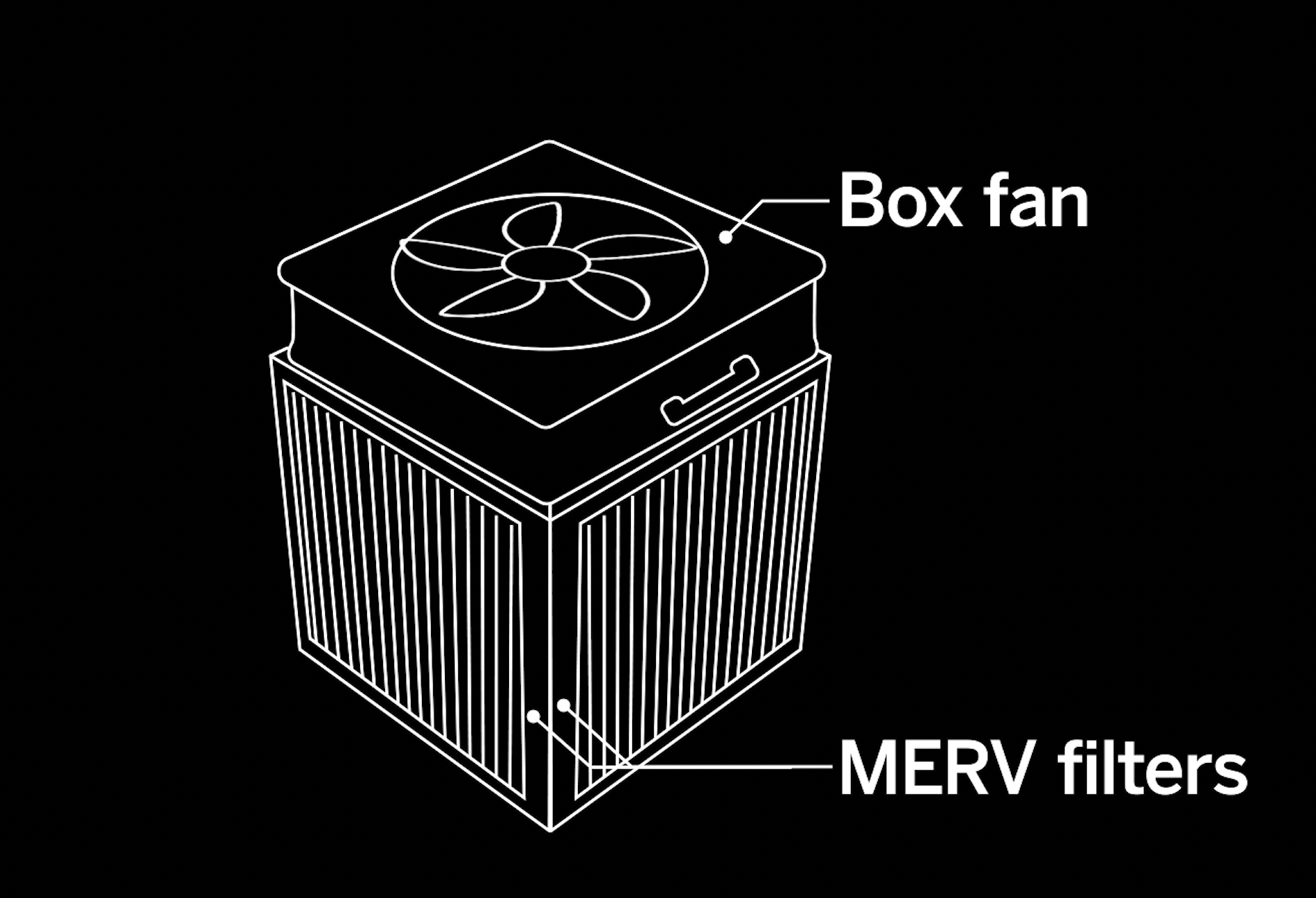
    You can also buy a freestanding device called a portable air cleaner. But these devices aren’t cheap. Fortunately, some researchers have come up with a more affordable solution known as a Corsi-Rosenthal box. Basically, it’s a DIY air cleaner made up of a box fan and four or five MERV filters duct-taped together. You can even find the instructions online. 

    It’s also pretty effective. A Corsi-Rosenthal box in a 200-square-foot (about 19-square-meter) dorm room achieved the equivalent of about 24 air exchanges per hour—on par with a typical U.S. hospital and better than most similarly sized portable air cleaners.

    4. AIR DISINFECTION

    Finally, there’s a method called air disinfection—that’s basically inactivating viruses using ultraviolet light. 

    Some systems work by shining UV light across the top of a room, which neutralizes airborne pathogens as they circulate through that space. Some wavelengths of UV light are harmful to humans, although there is a wavelength called far UVC that appears to be safer for people.

    This method is best for places such as hospitals and school cafeterias rather than homes or offices.

    5. INVESTING IN BETTER AIR 

    The Biden administration recently called on building managers in schools, universities and other settings to improve indoor air quality. Upgrading it can be expensive, but there are federal funds to support such efforts.

    Indoor air quality is important—for reducing the rate of COVID transmission and for improving our health in general.


    Original Source Link

    Share. Facebook Twitter Pinterest LinkedIn WhatsApp Email Reddit Telegram
    Previous ArticleChris Rock Declined to Host 2023 Oscars – The Hollywood Reporter
    Next Article Kenyan fintech Pezesha raises $11M backed by Women’s World Banking, Cardano parent IOG – TechCrunch

    RELATED POSTS

    Star that seemed to vanish more than 130 years ago is found again

    December 31, 2025

    The Great Big Power Play

    December 30, 2025

    15 Million Years before the Megalodon, This Giant Ancient Shark Prowled the Oceans

    December 30, 2025

    Mathematicians unified key laws of physics in 2025

    December 29, 2025

    People Who Drink Bottled Water on a Daily Basis Ingest 90,000 More Microplastic Particles Each Year

    December 29, 2025

    Why Active Rest Is Important During the Holidays

    December 28, 2025
    latest posts

    Bring on 2027 I mean 2026 I mean Happy Easter

    Liam Gallagher has stoked rumours by teasing possible Oasis activity for next year. Earlier this month, the frontman appeared to confirm that the band would…

    ‘I opened her door and the wind caught me, and I went flying’: The U.S. Arctic air surge is sweeping northerners off their feet

    December 31, 2025

    The Trump Regime Threatens Artists As The Kennedy Center Will Be Empty On New Year’s Eve

    December 31, 2025

    Treat yourself: Save up to 50% on tech from Apple, Bose and more

    December 31, 2025

    The phone is dead. Long live . . . what exactly?

    December 31, 2025

    Star that seemed to vanish more than 130 years ago is found again

    December 31, 2025

    Bowie: The Final Act review – revisiting the…

    December 31, 2025
    Categories
    • Books (968)
    • Business (5,876)
    • Film (5,810)
    • Lifestyle (3,913)
    • Music (5,878)
    • Politics (5,880)
    • Science (5,222)
    • Technology (5,809)
    • Television (5,495)
    • Uncategorized (2)
    • US News (5,861)
    popular posts

    OJ Simpson Acquittal Was Necessary Response To Racist System

    Screenshot: Inside Edition Marc Lamont Hill, a professor of urban education at the CUNY Graduate…

    Challengers review – everything is sex, except sex, which is power

    April 12, 2024

    Yellen says ‘hard choices’ will need to be made if debt ceiling is not raised

    May 21, 2023

    It’s Only A Matter Of Time Until Kyle Katarn Becomes Canon

    July 10, 2022
    Archives
    Browse By Category
    • Books (968)
    • Business (5,876)
    • Film (5,810)
    • Lifestyle (3,913)
    • Music (5,878)
    • Politics (5,880)
    • Science (5,222)
    • Technology (5,809)
    • Television (5,495)
    • Uncategorized (2)
    • US News (5,861)
    About Us

    We are a creativity led international team with a digital soul. Our work is a custom built by the storytellers and strategists with a flair for exploiting the latest advancements in media and technology.

    Most of all, we stand behind our ideas and believe in creativity as the most powerful force in business.

    What makes us Different

    We care. We collaborate. We do great work. And we do it with a smile, because we’re pretty damn excited to do what we do. If you would like details on what else we can do visit out Contact page.

    Our Picks

    Star that seemed to vanish more than 130 years ago is found again

    December 31, 2025

    Bowie: The Final Act review – revisiting the…

    December 31, 2025

    ’90 Day Fiance’ Debbie Johnson Shares Devastating Family Death

    December 31, 2025
    © 2025 Beverly Hills Examiner. All rights reserved. All articles, images, product names, logos, and brands are property of their respective owners. All company, product and service names used in this website are for identification purposes only. Use of these names, logos, and brands does not imply endorsement unless specified. By using this site, you agree to the Terms & Conditions and Privacy Policy.

    Type above and press Enter to search. Press Esc to cancel.

    We use cookies on our website to give you the most relevant experience by remembering your preferences and repeat visits. By clicking “Accept All”, you consent to the use of ALL the cookies. However, you may visit "Cookie Settings" to provide a controlled consent.
    Cookie SettingsAccept All
    Manage consent

    Privacy Overview

    This website uses cookies to improve your experience while you navigate through the website. Out of these, the cookies that are categorized as necessary are stored on your browser as they are essential for the working of basic functionalities of the website. We also use third-party cookies that help us analyze and understand how you use this website. These cookies will be stored in your browser only with your consent. You also have the option to opt-out of these cookies. But opting out of some of these cookies may affect your browsing experience.
    Necessary
    Always Enabled
    Necessary cookies are absolutely essential for the website to function properly. These cookies ensure basic functionalities and security features of the website, anonymously.
    CookieDurationDescription
    cookielawinfo-checkbox-analytics11 monthsThis cookie is set by GDPR Cookie Consent plugin. The cookie is used to store the user consent for the cookies in the category "Analytics".
    cookielawinfo-checkbox-functional11 monthsThe cookie is set by GDPR cookie consent to record the user consent for the cookies in the category "Functional".
    cookielawinfo-checkbox-necessary11 monthsThis cookie is set by GDPR Cookie Consent plugin. The cookies is used to store the user consent for the cookies in the category "Necessary".
    cookielawinfo-checkbox-others11 monthsThis cookie is set by GDPR Cookie Consent plugin. The cookie is used to store the user consent for the cookies in the category "Other.
    cookielawinfo-checkbox-performance11 monthsThis cookie is set by GDPR Cookie Consent plugin. The cookie is used to store the user consent for the cookies in the category "Performance".
    viewed_cookie_policy11 monthsThe cookie is set by the GDPR Cookie Consent plugin and is used to store whether or not user has consented to the use of cookies. It does not store any personal data.
    Functional
    Functional cookies help to perform certain functionalities like sharing the content of the website on social media platforms, collect feedbacks, and other third-party features.
    Performance
    Performance cookies are used to understand and analyze the key performance indexes of the website which helps in delivering a better user experience for the visitors.
    Analytics
    Analytical cookies are used to understand how visitors interact with the website. These cookies help provide information on metrics the number of visitors, bounce rate, traffic source, etc.
    Advertisement
    Advertisement cookies are used to provide visitors with relevant ads and marketing campaigns. These cookies track visitors across websites and collect information to provide customized ads.
    Others
    Other uncategorized cookies are those that are being analyzed and have not been classified into a category as yet.
    SAVE & ACCEPT