[Clip: Levenofi welcome song]
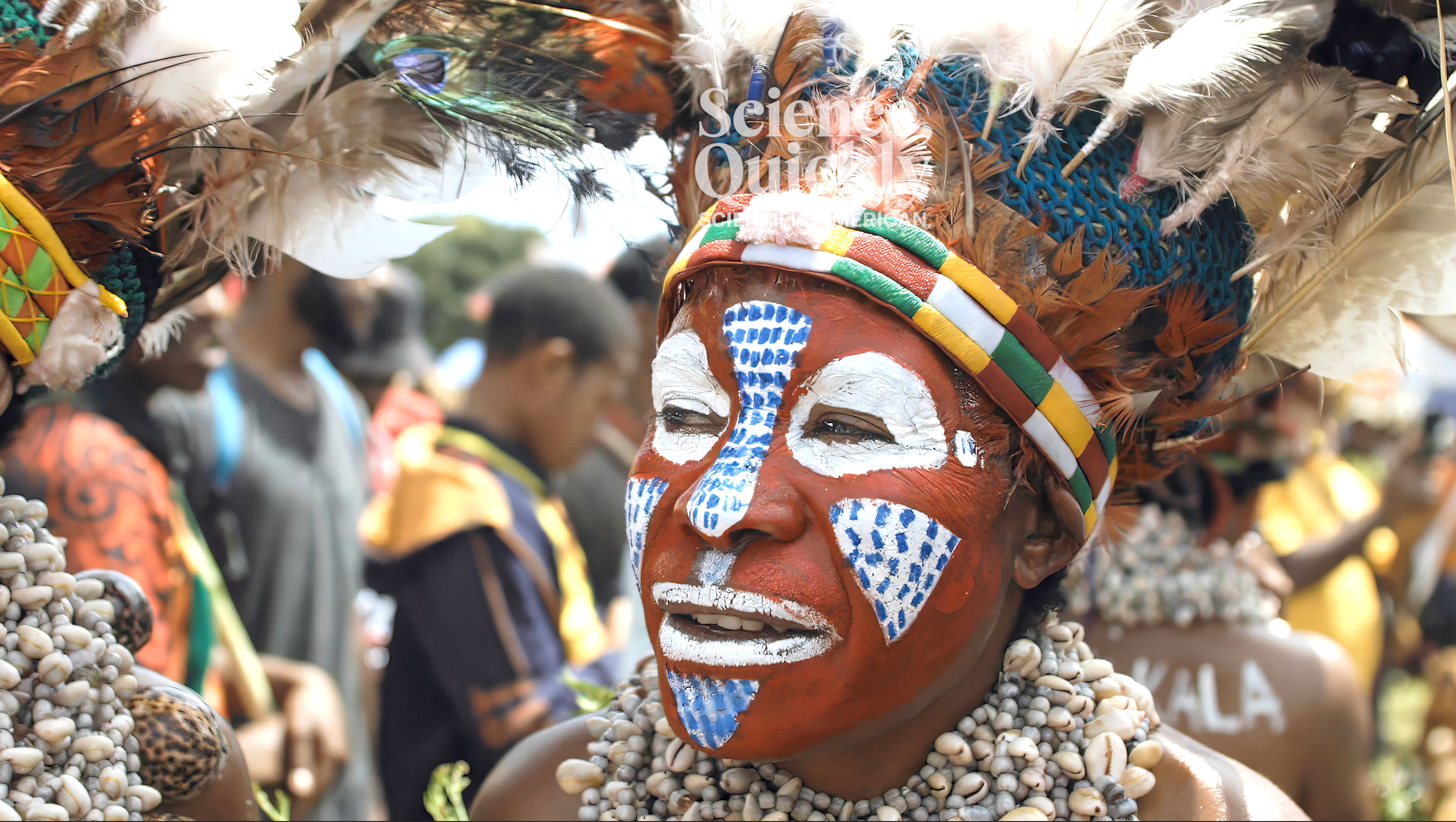
Tulika Bose: You’re listening to a celebration in the Levenofi village in the remote highlands of the island nation of Papua New Guinea. I was here with our Scientific American video crew last year to make a documentary.
I and my co-producer Kelso Harper didn’t know what any of these words meant. But as the entire village—men, women, kids, grannies—swung their hips, waved branches and sang in this beautiful, heartfelt chorus, we knew intuitively that we were being welcomed. The energy was infectious—we were encouraged to dance along.
[Sound clip]
After all of the singing, we were invited to partake in a mumu. It’s this delicious feast that’s made from wrapping meats and vegetables and spices in banana leaves and then cooking them in this massive earth oven with steam and hot stones.
Finding myself here—in an island nation that’s home to more than 300 tribes and about 850 different languages—was one of the most remarkable experiences of my entire life. Papua New Guinea also happens to be the most linguistically diverse place on earth.
But that incredible diversity is declining. Half of the roughly 7,000 languages spoken today could be gone by the end of the century. And Papua New Guinea, which hosts more than 10 percent of the world’s languages, is now finding its own linguistic diversity under threat.
After this experience, I had to learn more. Where have we lost languages in other parts of the world, and how have they been forgotten? Are we trying to bring them back? More importantly, how do we trace the roots of our collective memory back to the very sounds that first made us human?
For Scientific American’s Science, Quickly, this is Tulika Bose.
[CLIP: Intro music]
Anvita Abbi: Everybody said, “Why have you come? We have forgotten our language. We do not know what you’re talking about. We cannot help you at all.”
Bose: That’s Anvita Abbi. She’s this incredible Indian linguist who specializes in Indigenous languages and has this unbelievable passion for decoding grammatical structure.
Abbi: Lately, I had—for [the] last two decades, I had been working on the languages of the Andaman and Nicobar Islands. These are the 550 islands in the Bay of Bengal, south of India.
She’s talking to me about the year 2001, when she first arrived in Port Blair, the capital of the Andiman and Nicobar Islands, a territory of India in the Bay of Bengal. Anvita also wrote an article that appeared in our June 2023 issue that goes into this more in depth. (I highly, highly recommend reading it and subscribing.)
Bose: Anvita had previously researched more than 80 Indian languages from five different families. But she was there to conduct a preliminary survey of Indigenous languages. At first, some of the Indigenous residents—known as the Great Andamanese—balked at her request.
Abbi: So I knew that they have some memory of the language, of course, but they were denying it.
Bose: But Anvita was really persistent. And then she met someone who would change the scope of her research. She called him Nao Junior.
Abbi: I tried to ask him several words. He said, “Listen, madam, I have not spoken my language for quite some years, but I know my language. So I’ll have to remember.” And that gave me a big clue—that I can see some ray of hope.
Bose: When I first heard Anvita’s story, I was stunned. I’m half Bengali myself, but I had never heard of the Great Andamanese, the original Indigenous peoples who lived in the Great Andaman archipelago, or about how the British—who established a penal colony in Port Blair in 1858—wiped almost all of them out through a combination of gunfire and disease. In the 1960s, by which time the islands were governed by India, only 19 members of the Great Andamanese people were left. India settled them on this tiny island called Strait island. And then Anvita visited.
Abbi: There were only nine speakers in 2001, when I reached the island.
Bose: She knew she had to try to preserve this language family before it all faded away. And so she set out on foot to follow it.
Abbi: It was a very, very tough … I still remember those crocodile-laden creeks that we had to cross and lot of snakes who were visiting us day and night—especially at night, in the evening.
Bose: While on this trip, Anvita realized something crucial.
Abbi: When I presented my results, I claimed that it appears that Great Andamanese is a separate language family. and Onge and Jarawa constitute another language family. Before me, some linguists had traveled to the Andaman Islands, and they had always considered Andamanese as one language family, which had three branches — Great Andamanese, Onge, and Jawara. Which I denied. That there are no such branches — there are two independent language families.
Bose: I’m going to pause here. For those of you who aren’t familiar with historical linguistics, it’s a little like archaeology. But instead of excavating through dirt, a linguist separates layers of a language to uncover the different stages of evolution. And that’s what Anvita decided she was going to do.
Abbi: Subseqently, I reached the Andaman Islands with—fully equipped with my gear for deciding, deciphering the, you know, the unknown language in 2005.
Bose: She stayed with people she had met, including Nao Jr., and collected more than 150 Great Andamanese names for different fish species and 109 for birds.
But Anvita still couldn’t understand the grammar and the linguistic structure of this language family. It was unlike anything she had ever encountered before. So British officials, while figuring out that the Andamanese languages were a little bit like chain links, in that neighboring tribes could understand each other, had also failed to understand it. This fancy comparative lexicon published by a British military administrator in 1887 didn’t help, either.
Then Abbi had what she thought was an innocuous conversation with Nao Jr.
Abbi: I asked him to tell me the word for blood. He looked at me as if I were an utter fool…, abut I resisted. He said, “Tell me where it is coming from.” I replied, “From nowhere,” because I just wanted the word, meaning just one word: blood. He got irritated. And he repeated his sentence. He says, “Where did it come from, tell me?” So I just made up, and I said, “On the finger….” The moment I said that, he immediately said, “Oh, that will be called ongtei.” And then he ratted off several words for blood on different parts of [the] body. If the blood emerged from the feet or legs, it was otei. If it’s internal, it was etai—it was a clot on the skin, it was ertei. Something as basic as a noun changed forms because of its location.
Bose: Basically, Anvita realized that the entire grammatical structure of this ancient language family changed depending on the zones of the body.
Abbi: I realized that it was changing its form several times because every word every open-class word, as we know in grammar, was prefixed by some of the body division markers.
Bose: To explain, while in English we might say, “She heads the company” or “We face the window,” But great Andamanese use body parts even more and to describe everything. Anvita divided the lexicon into two classes: free and bound. Words that were free occurred alone—such as the word ra for pig. But words that were bound, nouns, verbs, adjectives and adverbs, all existed with relation to other objects—specifically, parts of the body.
Abbi: And body division markers were seven of them.
Bose: You might wonder why this is so significant. Because no other known language family has a grammar based on the human body, Great Andamanese actually constitutes its own family. According to genetic evidence, the Great Andamanese lived in isolation for tens of thousands of years. Anvita realized that the grammar she decoded meant that this original language family came from a time when people conceptualized the whole world through the body.
Abbi: The most beautiful aspect of the language, that it is, the whole grammar is anthropocentrism. It is—depends upon how people perceive the world through their body: every activity, every modification, and every object is seen through the body. Only those which are natural forces, are natural elements like words and fauna and flora, they don’t have these prefixes.
Bose: That gives us insight into early humans—and a worldview where everything that happens is connected to everything else. I’m take you back to Papua New Guinea, to the famous cultural show in the highlands. We asked some people at the festival if they could speak to us in their language.
Harper: What about nice to meet you?
Villagers: Kande!
Bose: Like the Great Andamanese, some tribes in Papua New Guinea have lived in isolation for years. But its linguistic diversity is still under threat. In fact, most of the thousands of languages that may go extinct in the next century are Indigenous. Nao Jr. left this world in February 2009. In his untimely death, he took with him a treasure trove of knowledge that can never be resurrected.
I’ll leave you with these words from Anvita’s article: “When the older generation can no longer teach the tongue to the younger ones, a language is doomed. And with every language lost, we lose a wealth of knowledge about human existence, perception, nature and survival.“
For Science, Quickly, I’m Tulika Bose.
Science Quickly is produced by myself, Tulika Bose, and Jeffrey Delviscio. This episode was edited by me, Tulika Bose, with music by Dominic Smith. Subscribe to Scientific American to read the article by Anvita Abbi and more in-depth Science News.
See you next time.