
Close Menu
Beverly Hills Examiner

    Subscribe to Updates

    Get the latest creative news from FooBar about art, design and business.

    What's Hot

    Startup sues Apple in India over tap-to-share contacts feature | TechCrunch

    November 21, 2026

    The US to become first nation to fully shun a UN Human Rights Council review

    November 21, 2026

    Grimes Releases Two New Psy Opera Songs

    November 20, 2026
    Facebook X (Twitter) Instagram
    Beverly Hills Examiner
    • Home
    • US News
    • Politics
    • Business
    • Science
    • Technology
    • Lifestyle
    • Music
    • Television
    • Film
    • Books
    • Contact
      • About
      • Amazon Disclaimer
      • DMCA / Copyrights Disclaimer
      • Terms and Conditions
      • Privacy Policy
    Beverly Hills Examiner
    Home»Science»How ‘Wood Vaulting’ Could Help Slow Climate Change
    Science

    How ‘Wood Vaulting’ Could Help Slow Climate Change

    By AdminOctober 16, 2025
    Facebook Twitter Pinterest LinkedIn WhatsApp Email Reddit Telegram
    How ‘Wood Vaulting’ Could Help Slow Climate Change

    [ad_1]

    October 16, 2025

    5 min read

    Can We Bury Enough Wood to Slow Climate Change?

    Wood vaulting, a simple, low-tech approach to storing carbon, has the potential to remove 12 billion tons of carbon dioxide from the atmosphere every year—and some companies are already trying it

    By Syris Valentine edited by Andrea Thompson

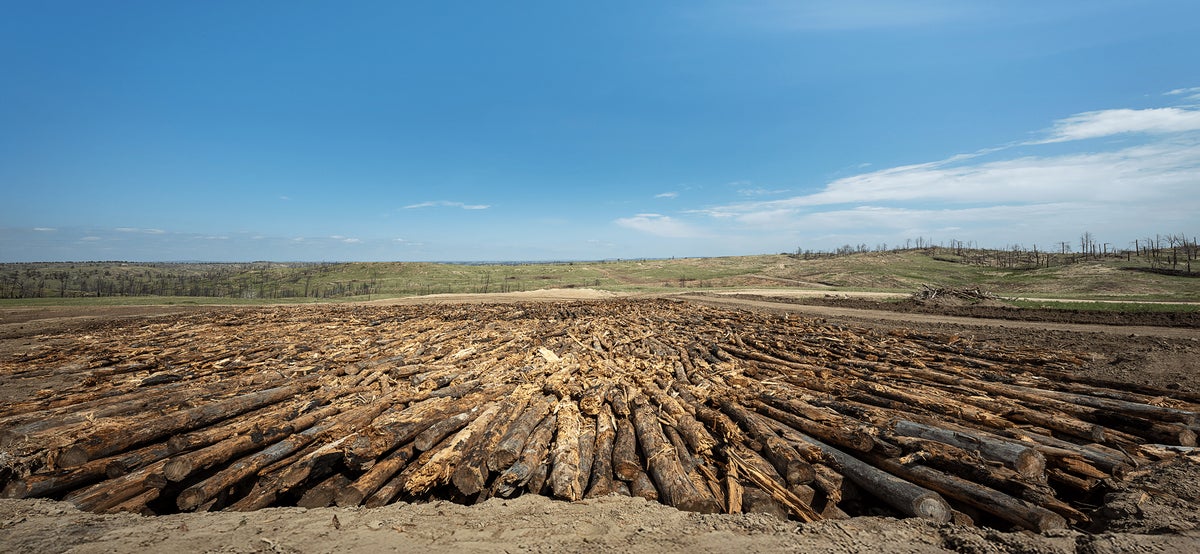
    10M lbs. of fire-killed trees loaded in chamber

    10M lbs. of fire-killed trees loaded in chamber.

    Humanity has only so much time to limit global warming and minimize the severity of future climate disasters. And with mostly tepid attempts to slash greenhouse gas emissions, researchers are scrambling for realistic ways to pull carbon out of the atmosphere. Flashy, high-tech proposals that promise to vacuum pollutants out of the sky, or to scrub them from smokestacks before they hit the atmosphere, have attracted attention and investment—but are falling far short of expectations. Now a growing number of scientists and entrepreneurs are trying a vastly simpler approach: collecting truckloads of logs, branches, wood chips and sawdust—and burying them.

    Wood burial, also called wood vaulting or biomass burial, could potentially store more than 12 billion tons of carbon dioxide every year and decrease global warming by more than a third of a degree Celsius (more than half a degree Fahrenheit), according to a recent study in Nature Geoscience. This difference sounds small, but preventing a few tenths of a degree of warming could keep polar ice caps from completely disintegrating, coral reefs from collapsing and other tipping points from triggering.

    “If we want to remove carbon dioxide from the atmosphere,” says the study’s lead author Yiqi Luo, a Cornell University ecosystem ecologist, “we basically need to create new reservoirs in land, ocean or geological structures.”


    On supporting science journalism

    If you’re enjoying this article, consider supporting our award-winning journalism by subscribing. By purchasing a subscription you are helping to ensure the future of impactful stories about the discoveries and ideas shaping our world today.


    How Wood Vaulting Works

    The concept is straightforward: instead of constructing massive machines to collect atmospheric carbon dioxide and inject it miles into the Earth’s crust, wood vaulters simply divert materials from Earth’s fast-paced biological carbon cycle into the much-slower geological carbon cycle.

    “Every year, terrestrial plants alone capture six times as much carbon as our fossil fuel emissions,” says Ning Zeng, a University of Maryland climate scientist, who has been a leader in the field of biomass burial for two decades and was not involved in the new research. “But pretty much all of that goes back into the atmosphere as leaves fall and trees die and decay.” If carbon dioxide is buried under just a few yards of dirt—where bacteria no longer have the oxygen they need to break down woody tissues—however, none or very little of it is released. If even a small fraction of woody debris that decays aboveground each year was treated this way, it would be easier to achieve the 10 billion tons per year of carbon that the Intergovernmental Panel on Climate Change (the United Nations body that is responsible for informing global climate policies) agrees must be achieved by 2050 in order to keep the planet’s temperature rise to less than two degrees C (3.6 degrees F).

    Download the video

    The new study by Luo and his team shows that global logging alone involves more than enough wood to reach that benchmark. As they await the axe, trees in logging-focused forests take up roughly 170 billion tons of carbon every year, 14 billion tons of which finds its way into wood. The researchers contend that all of this wood eventually ends up wasted in one form or another: branches cut from trees before processing, sawmill debris, landfilled furniture, demolished homes. If all this wood could be collected and buried instead of burned or allowed to decompose, those 14 billion tons of carbon would be safely removed every year. And according to the research team’s models, this would remove a grand total of at least 770 billion tons from the atmosphere by 2100, turning the global thermostat down by at least 0.35 degree C (0.63 degree F).

    There’s no reason to doubt the study’s math or methods, says Kevin Fingerman, a professor and carbon accounting expert at California State Polytechnic University, Humboldt. But as the proposed technique gets implemented in the real world, practitioners would need to carefully and accurately calculate how much carbon their vaults have kept out of the atmosphere. This would involve assessing what the fate of the wood would have been without intervention—and that’s no trivial feat. “It’s somewhere between difficult and impossible to prove what would happen to this particular pile of biomass if we hadn’t buried it,” Fingerman says. “We can never really know.”

    Wood Vaulting in Action

    In practice, of course, it likely won’t be feasible to divert every single scrap of wood from dumpster to earthen vault and achieve the maximum amount of carbon capture that Luo has calculated. But collecting the debris from lumber and forestry projects is feasible, and several start-ups have already begun to do so.

    In Colorado, for instance, Serge Bushman and his company Woodcache have collected and buried leftover logging debris from forest thinning operations aimed at reducing fire risks, diverting it from being burned or decaying in the open air. They claim that their first commercial project alone should prevent more than 100,000 tons of carbon dioxide from being released into the atmosphere, and they’ve got several more under development in the U.S. Mountain West and the Southeast.

    Another start-up, Mast Reforestation, has cut down dead and burned trees on a plot of private land in Montana, removing what the company estimates is 5,000 tons of carbon in its first phase, with the potential for 30,000 tons in the long run, says CEO Grant Canary. The carbon credits they sell will be used to fund the reforestation of the burned and denuded acreage, a program Canary hopes to repeat in burned forests throughout the West. Zeng also has his own company, Carbon Lockdown, which has completed a couple of demonstration projects in the Northeast and has one 5,000-ton project underway.

    Though more research is needed to prove that biomass burial works in practice the way that the theories say it should, Zeng’s own work has shown that wood interned in clay soils can remain stable for millennia. Clay’s fine-grained structure ensures that little to no oxygen reaches buried wood, preventing bacteria from decomposing it. In 2013 his team unearthed a red cedar log that had been preserved in clay for 3,775 years.
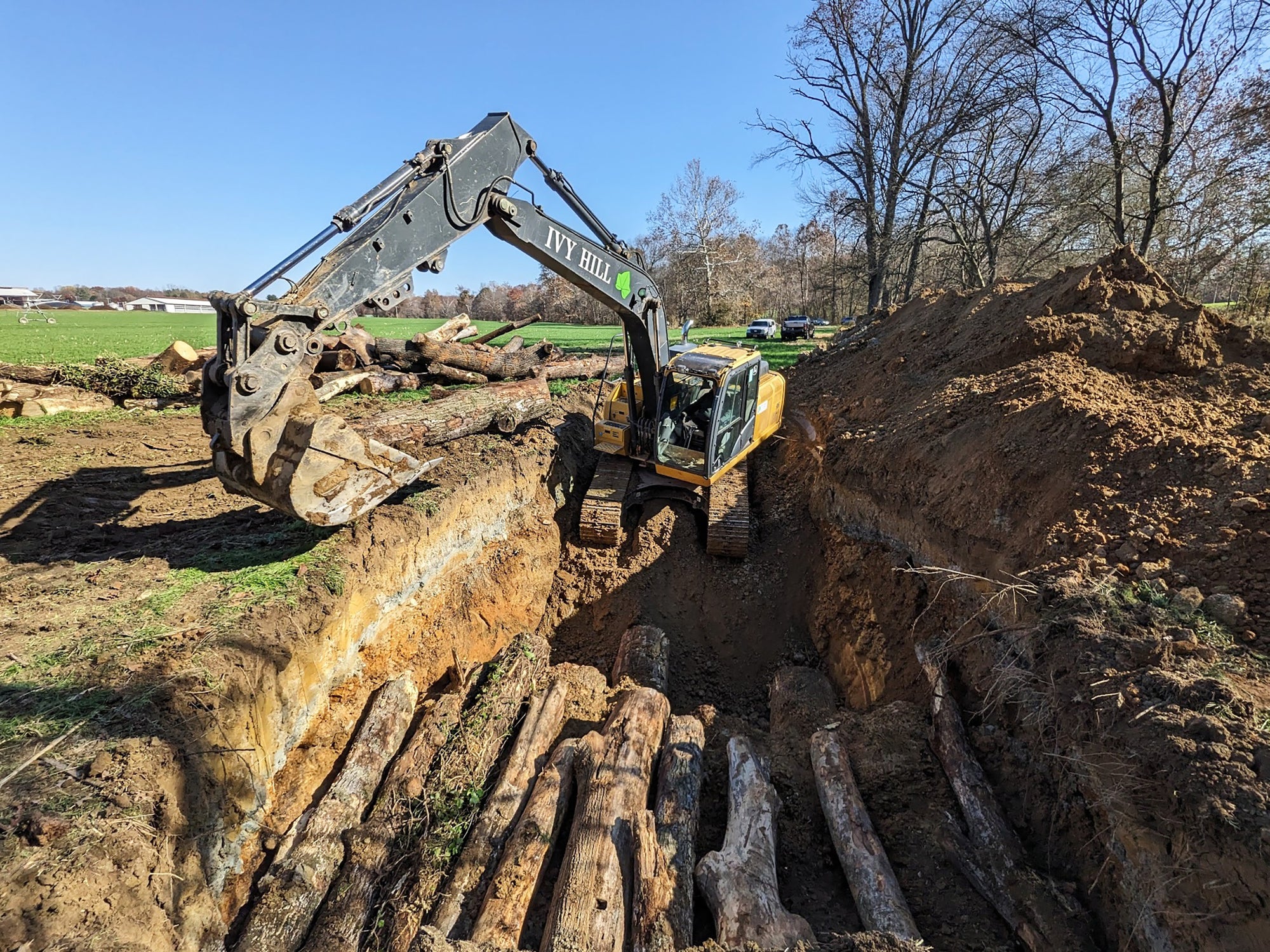
    Log piles being buried with an excavator

    Construction of the first trench of the world’s first commercial-scale wood vault, near the Potomac River, where the equivalent of 100 metric tons of carbon dioxide were buried.

    But no matter what’s been shown in the past, each wood vault must be robustly monitored to ensure the wood is staying stable as planned. This is why Mast, Woodcache and Carbon Lockdown design their wood vaults to include instruments that will, for example, monitor methane coming off the soil surface. Abnormally high values could indicate the wood is decomposing faster than expected, which would suggest the vault may need to be opened and potentially redesigned.

    Though there are some potential obstacles to implementing wood vaulting—such as concerns over roads being able to handle heavy machinery or about securing bank financing—there are fewer such impediments compared with large direct-air-capture machines, says Holly Jean Buck, an environmental social scientist at the University at Buffalo, who focuses on carbon removal and geoengineering. Communities are far more likely to support something that they perceive as natural than something that involves lacing miles of pipeline through their communities (which would be necessary in many direct-capture scenarios), she says.

    Given the investments pouring into much more complex and futuristic climate tech ventures, the implications of Luo’s paper amuse Buck. “What if the answer was just digging a hole and putting some wood in there?” she says. “A kindergartner could figure that out.”

    [ad_2]

    Original Source Link

    Share. Facebook Twitter Pinterest LinkedIn WhatsApp Email Reddit Telegram
    Previous ArticleJennifer Lopez Turned Down Movie That Landed Actress an Oscar Nom
    Next Article Yamaha True X Surround 90a Review: Not Quite Perfect

    RELATED POSTS

    Voyager 1 Beat the Odds and Is Still Working a Light-Day Away From Earth

    November 18, 2026

    The Dark Side of the Moon Was the Brightest Part of 2026

    November 17, 2026

    Just 400 US Data Centers Use More Electricity Than Michigan

    November 16, 2026

    The EPAs Chemical-Detecting Plane Isnt Doing Its Job Anymore

    November 16, 2026

    Its Getting Too Dry for Even Cactuses to Survive

    November 15, 2026

    New Species of Giant Fungus Discovered in China Grows up to 20 Inches Tall

    November 15, 2026
    latest posts

    Startup sues Apple in India over tap-to-share contacts feature | TechCrunch

    Apple is being sued in India by a U.S.-based startup that alleges the iPhone maker’s…

    The US to become first nation to fully shun a UN Human Rights Council review

    November 21, 2026

    Grimes Releases Two New Psy Opera Songs

    November 20, 2026

    Book Riots Deals of the Day for November 20, 2026

    November 20, 2026

    Chips can survive the space environment. Can their financing? | TechCrunch

    November 20, 2026

    AI stocks are selling off after Anthropics record IPO, and Wall Street is split on whether this is the top | Fortune

    November 20, 2026

    NYC sightseeing helicopter makes emergency landing after reporting possible engine trouble

    November 20, 2026
    Categories
    • Books (1,620)
    • Business (6,525)
    • Cover Story (17)
    • Film (6,459)
    • Lifestyle (4,500)
    • Music (6,535)
    • Politics (6,511)
    • Science (5,865)
    • Technology (6,463)
    • Television (6,156)
    • Uncategorized (3)
    • US News (6,509)
    popular posts

    Yungblud releases fierce new song ‘The Emperor’

    [ad_1] Yungblud has shared ‘The Emperor’, a track from the recently announced deluxe bundle of…

    Ancient Human Fossil Trip to Space Raises Questions and Criticism

    September 13, 2023

    5 Best Black Metal Covers of Iron Maiden Songs

    June 6, 2026

    Helping caregivers help people with dementia eat at home

    February 16, 2024
    Archives
    Browse By Category
    • Books (1,620)
    • Business (6,525)
    • Cover Story (17)
    • Film (6,459)
    • Lifestyle (4,500)
    • Music (6,535)
    • Politics (6,511)
    • Science (5,865)
    • Technology (6,463)
    • Television (6,156)
    • Uncategorized (3)
    • US News (6,509)
    About Us

    We are a creativity led international team with a digital soul. Our work is a custom built by the storytellers and strategists with a flair for exploiting the latest advancements in media and technology.

    Most of all, we stand behind our ideas and believe in creativity as the most powerful force in business.

    What makes us Different

    We care. We collaborate. We do great work. And we do it with a smile, because we’re pretty damn excited to do what we do. If you would like details on what else we can do visit out Contact page.

    Our Picks

    AI stocks are selling off after Anthropics record IPO, and Wall Street is split on whether this is the top | Fortune

    November 20, 2026

    NYC sightseeing helicopter makes emergency landing after reporting possible engine trouble

    November 20, 2026

    Billie Eilish to Headline BST Hyde Park for First Time: She Inspires Fans, Challenges Our Industry to Be Better

    November 20, 2026
    © 2026 Beverly Hills Examiner. All rights reserved. All articles, images, product names, logos, and brands are property of their respective owners. All company, product and service names used in this website are for identification purposes only. Use of these names, logos, and brands does not imply endorsement unless specified. By using this site, you agree to the Terms & Conditions and Privacy Policy.

    Type above and press Enter to search. Press Esc to cancel.

    We use cookies on our website to give you the most relevant experience by remembering your preferences and repeat visits. By clicking “Accept All”, you consent to the use of ALL the cookies. However, you may visit "Cookie Settings" to provide a controlled consent.
    Cookie SettingsAccept All
    Manage consent

    Privacy Overview

    This website uses cookies to improve your experience while you navigate through the website. Out of these, the cookies that are categorized as necessary are stored on your browser as they are essential for the working of basic functionalities of the website. We also use third-party cookies that help us analyze and understand how you use this website. These cookies will be stored in your browser only with your consent. You also have the option to opt-out of these cookies. But opting out of some of these cookies may affect your browsing experience.
    Necessary
    Always Enabled
    Necessary cookies are absolutely essential for the website to function properly. These cookies ensure basic functionalities and security features of the website, anonymously.
    CookieDurationDescription
    cookielawinfo-checkbox-analytics11 monthsThis cookie is set by GDPR Cookie Consent plugin. The cookie is used to store the user consent for the cookies in the category "Analytics".
    cookielawinfo-checkbox-functional11 monthsThe cookie is set by GDPR cookie consent to record the user consent for the cookies in the category "Functional".
    cookielawinfo-checkbox-necessary11 monthsThis cookie is set by GDPR Cookie Consent plugin. The cookies is used to store the user consent for the cookies in the category "Necessary".
    cookielawinfo-checkbox-others11 monthsThis cookie is set by GDPR Cookie Consent plugin. The cookie is used to store the user consent for the cookies in the category "Other.
    cookielawinfo-checkbox-performance11 monthsThis cookie is set by GDPR Cookie Consent plugin. The cookie is used to store the user consent for the cookies in the category "Performance".
    viewed_cookie_policy11 monthsThe cookie is set by the GDPR Cookie Consent plugin and is used to store whether or not user has consented to the use of cookies. It does not store any personal data.
    Functional
    Functional cookies help to perform certain functionalities like sharing the content of the website on social media platforms, collect feedbacks, and other third-party features.
    Performance
    Performance cookies are used to understand and analyze the key performance indexes of the website which helps in delivering a better user experience for the visitors.
    Analytics
    Analytical cookies are used to understand how visitors interact with the website. These cookies help provide information on metrics the number of visitors, bounce rate, traffic source, etc.
    Advertisement
    Advertisement cookies are used to provide visitors with relevant ads and marketing campaigns. These cookies track visitors across websites and collect information to provide customized ads.
    Others
    Other uncategorized cookies are those that are being analyzed and have not been classified into a category as yet.
    SAVE & ACCEPT