
Close Menu
Beverly Hills Examiner

    Subscribe to Updates

    Get the latest creative news from FooBar about art, design and business.

    What's Hot

    Ryan Beatty on Beyonce, Songwriting, His Boyfriend & ‘Sweet Fortune’

    August 11, 2026

    Germany weighs options as low water levels trigger price surges

    August 11, 2026

    Trump Falls Asleep In Front Of Reporters, But Wakes Up Long Enough To Endanger Kids

    August 11, 2026
    Facebook X (Twitter) Instagram
    Beverly Hills Examiner
    • Home
    • US News
    • Politics
    • Business
    • Science
    • Technology
    • Lifestyle
    • Music
    • Television
    • Film
    • Books
    • Contact
      • About
      • Amazon Disclaimer
      • DMCA / Copyrights Disclaimer
      • Terms and Conditions
      • Privacy Policy
    Beverly Hills Examiner
    Home»Science»Joints Are the Ultimate Flex
    Science

    Joints Are the Ultimate Flex

    By AdminJanuary 25, 2025
    Facebook Twitter Pinterest LinkedIn WhatsApp Email Reddit Telegram
    Joints Are the Ultimate Flex


    Middle age is when you get to know your joints. I have spent the last few years learning that my many youthful party tricks—popping shoulders out of their sockets on a whim, bending elbows backward—had painful long-term consequences. Twenty years of high-impact sports on an imperfect skeleton have also taken their toll.

    I’m now gritting my teeth through the tiny movements assigned by physical therapy, desperately trying to save these things that let me bend, twist and move around. It’s not just the big-name celebrities of the skeleton—the hips and knees and shoulders—that scream at us as we accumulate mileage, but tiny joints that suddenly grab our attention, if not the ibuprofen. The vertebrae and the squishable, intervertebral discs between them. The joints between the teeth and the jaw. Even the joint at the very front of the pelvis, one most people never think about unless they are giving birth or taking a hit in sports, reveals it’s been taking hard knocks from life. These points of movement get arthritic, stiff. Bones begin to grind against one another. Movements that used to only pull or create pressure now produce pain.

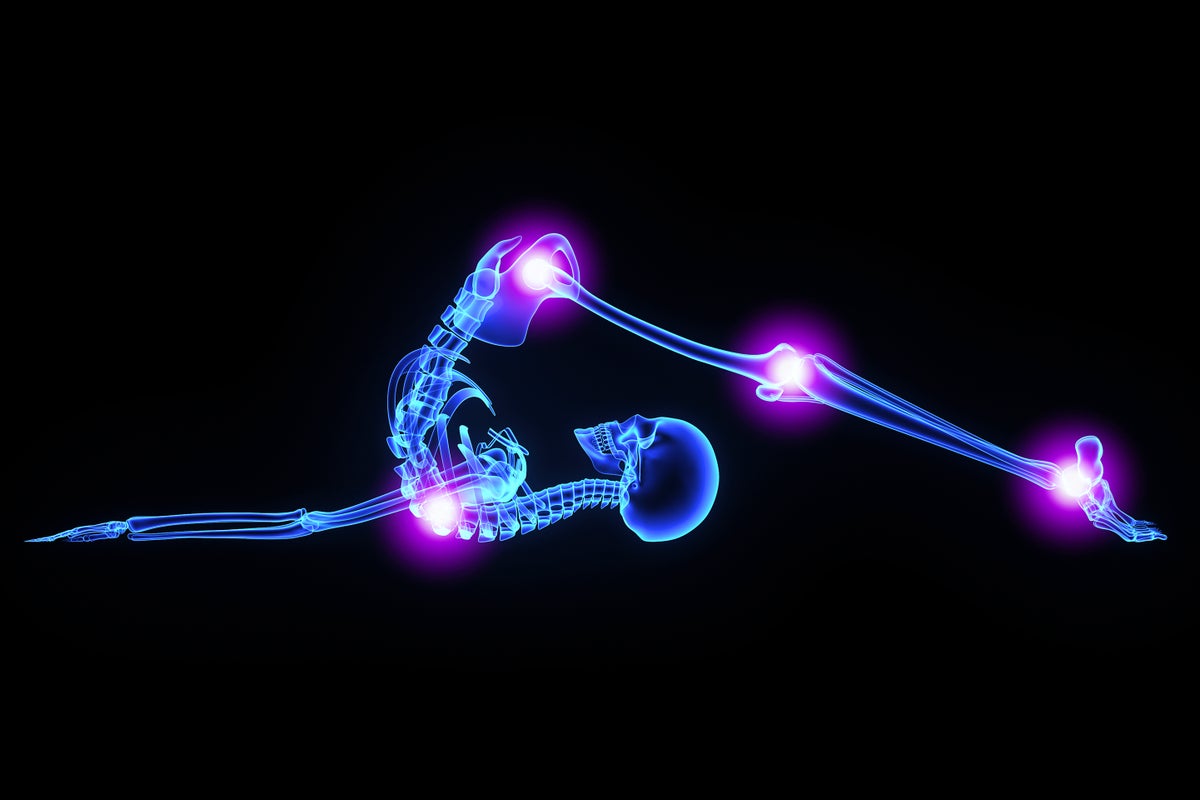
    It’s easy to blame joints themselves. Weak. Old. Crumbling. We’ve been betrayed by joints so small we never even really registered they were there. But joints are signs of anatomical triumph. They bend so we don’t break.


    On supporting science journalism

    If you’re enjoying this article, consider supporting our award-winning journalism by subscribing. By purchasing a subscription you are helping to ensure the future of impactful stories about the discoveries and ideas shaping our world today.


    These points where two parts of the skeleton meet are so essential for movement that evolution has come up with them at least twice. Arthropods—whether crabs or cockroaches—developed their own version: joints in their exoskeletons that allow these creatures to bend and scuttle. Our rendition—the internal skeleton—probably also started out on the outside of the body of ancient creatures, as bony scales. Our spinal cords, the things that make us chordates, got a segmented bony coat around 420 million years ago. What’s now modern vertebrae are nothing but a pile of 25 joints (or occasionally 26 or 24, if you happen to have one more or less vertebra). The bones are stacked on top of each other, separated by spongy cartilage called intervertebral discs. We had lubricated joints before we even crawled out of the sea. Heck, without them, the crawling wouldn’t have happened in the first place. Joints have been modified now to let insects and animals skitter, slither, climb, run. Even fly. Without firm bones and the joints between them, there’s no defying gravity.

    Joints are more than one bone on another. In between the majority of our joints, we have connective tissue, cartilage and bursas—thin flat sacs of fluid. They cushion and lubricate, helping our bodies bend easily, quickly and without sounding like a rusty door hinge. Joints that don’t bend still need this cushion. The joints—and the sacs between each one—allow the skeleton to shift and withstand pressure, even if that particular joint isn’t helping anyone do a backbend.

    Many joints go almost entirely unnoticed—until something is about to go wrong. It might seem, for example, that adult teeth should not be wiggling around in the jaw socket. But in fact these dental alveolar syndesmoses (technical speak for the tiny ligamentous joint between the tooth and jaw socket) move all the time. They have mechanoreceptors—ways to measure movement—which process the tiny vibrations that inform you of a food’s texture. A larger tooth movement, and the very jolt that sometimes comes with it, is the final warning system that you should shell that nut first, please. Your uncracked tooth will thank you later.

    Our feet balance a large load into two impossibly small points, and they don’t just stand, they point, arch, bend and flex. That flexibility is due to the 26 different bones and all the joints in between that make up the ankle and foot. It’s an evolutionary work-around, adapting the flexible tree-clinging feet of our ancestors to the pavement pounding model we use today.

    In contrast, the pelvic girdle seems like a fairly continuous ring of bone. But it’s the joining of three bones on each side, the ilium, ischium and pubis. In the back, the pelvic girdle joins to the sacrum at the base of the spine. In the front, though, there’s a joint, the pubic symphysis. This joint can move a tiny bit in adults. But what it really does is help to distribute weight and absorb the shock that comes with the weight of the upper body. This joint splits that mass evenly over your legs. In people who give birth, this joint softens and becomes extra flexible. It bends and curves and stretches—creating extra space for a baby to pass through the birth canal. Then, most of the time, it snaps back to normal.

    Joints are essential to how we experience the world, and we take them for granted—until they start to fail. Arthritis, that painful chronic swelling that often comes with age, creeps into the joints between our bones. Bursae become inflamed and bulbous. Decades of grinding up food take a toll on the teeth. Years of running and walking take the spring out of our step, and alongside childbearing, grind down the joints in the pelvis and spine.

    As we age, intravertebral discs become compressed with the weight of our years—and the weight of our weight. They may bulge out into the spaces between the vertebrae themselves, pressing on nerve roots—a herniated disc. The spine doesn’t just bear the weight of our youthful indiscretions, but of our evolutionary fate. When our ancestors stood upright, we asked a lot of our vertebrae. A rigid spine couldn’t defy physics and stand straight, and so it curved. We acquired a lumbar lordosis, a sway in our lower backs. Unfortunately, that curve bears the pressure of our upper bodies. When sitting down, our lumbar spines are taking loads between 100 to 175 kilograms (220–385 pounds). When standing, it’s 90 to 120 kilograms (198 to 264 pounds). Despite this, our intervertebral discs bear the mass cheerfully—even improving in response to exercise.

    When we think of bodily strength we think of long bones or muscles, things that only crack or tear under the worst pressure. In contrast, joints seem weak—in part because they give way before bones do. But their flexibility is our defense. Every weird tooth movement is a sensation, a broken tooth avoided. Every shift of the hips is a time they didn’t crack. Each step or lifted weight places pressure on the joints in our bones, and the joints gently give way. Joints remind us that there’s strength in flexibility.

    This is an opinion and analysis article, and the views expressed by the author or authors are not necessarily those of Scientific American.


    Original Source Link

    Share. Facebook Twitter Pinterest LinkedIn WhatsApp Email Reddit Telegram
    Previous ArticlePresence review – an enjoyably swift chiller
    Next Article Wall Street banks plan sale of X debt at a discount

    RELATED POSTS

    Scientists are closer than ever to understanding the power of the vagus nerve

    August 11, 2026

    A California Program Is Bringing Down the Cost of Heat Pumps by Buying Bulk

    August 11, 2026

    World ocean temperatures hit extreme new record for July

    August 10, 2026

    Spokane Shows What the New Era of Wildfires Looks Like

    August 10, 2026

    Europe’s wildfires are igniting forgotten WWII and Cold War bombs

    August 9, 2026

    Here Are the First Images of the Crater Left on the Moon by SpaceX’s Rocket

    August 9, 2026
    latest posts

    Ryan Beatty on Beyonce, Songwriting, His Boyfriend & ‘Sweet Fortune’

    It’s the kind of day in Manhattan where subway stations turn into saunas, the air…

    Germany weighs options as low water levels trigger price surges

    August 11, 2026

    Trump Falls Asleep In Front Of Reporters, But Wakes Up Long Enough To Endanger Kids

    August 11, 2026

    Tulsa National Little League reinstated by Texas judge for Williamsport bid

    August 11, 2026

    Bumble ditches its rule that kept men from making the first move

    August 11, 2026

    Scientists are closer than ever to understanding the power of the vagus nerve

    August 11, 2026

    PlayStation Officially Announces New Hardware Alongside Impending Pre-Order Date

    August 11, 2026
    Categories
    • Books (1,419)
    • Business (6,323)
    • Cover Story (9)
    • Film (6,262)
    • Lifestyle (4,320)
    • Music (6,333)
    • Politics (6,306)
    • Science (5,672)
    • Technology (6,257)
    • Television (5,953)
    • Uncategorized (3)
    • US News (6,308)
    popular posts

    A Study in Contrasts: Spring Outfits That Balance Sweet and Tough

    A Study in Contrasts: Spring Outfits That Balance Sweet and ToughCreated with CartierWritten by: Gillian…

    York County Library (SC) Proposes Restrictions on Trans, Gender Books for Those Under 18

    June 19, 2025

    6 Stunning New Literary Fiction Novels for Your TBR

    March 11, 2025

    Doughnut-shaped swirls of laser light can be used to transmit images

    May 11, 2024
    Archives
    Browse By Category
    • Books (1,419)
    • Business (6,323)
    • Cover Story (9)
    • Film (6,262)
    • Lifestyle (4,320)
    • Music (6,333)
    • Politics (6,306)
    • Science (5,672)
    • Technology (6,257)
    • Television (5,953)
    • Uncategorized (3)
    • US News (6,308)
    About Us

    We are a creativity led international team with a digital soul. Our work is a custom built by the storytellers and strategists with a flair for exploiting the latest advancements in media and technology.

    Most of all, we stand behind our ideas and believe in creativity as the most powerful force in business.

    What makes us Different

    We care. We collaborate. We do great work. And we do it with a smile, because we’re pretty damn excited to do what we do. If you would like details on what else we can do visit out Contact page.

    Our Picks

    Scientists are closer than ever to understanding the power of the vagus nerve

    August 11, 2026

    PlayStation Officially Announces New Hardware Alongside Impending Pre-Order Date

    August 11, 2026

    ‘Crystal Lake’ Creator Explains How Show Differs From ‘Friday the 13th’

    August 11, 2026
    © 2026 Beverly Hills Examiner. All rights reserved. All articles, images, product names, logos, and brands are property of their respective owners. All company, product and service names used in this website are for identification purposes only. Use of these names, logos, and brands does not imply endorsement unless specified. By using this site, you agree to the Terms & Conditions and Privacy Policy.

    Type above and press Enter to search. Press Esc to cancel.

    We use cookies on our website to give you the most relevant experience by remembering your preferences and repeat visits. By clicking “Accept All”, you consent to the use of ALL the cookies. However, you may visit "Cookie Settings" to provide a controlled consent.
    Cookie SettingsAccept All
    Manage consent

    Privacy Overview

    This website uses cookies to improve your experience while you navigate through the website. Out of these, the cookies that are categorized as necessary are stored on your browser as they are essential for the working of basic functionalities of the website. We also use third-party cookies that help us analyze and understand how you use this website. These cookies will be stored in your browser only with your consent. You also have the option to opt-out of these cookies. But opting out of some of these cookies may affect your browsing experience.
    Necessary
    Always Enabled
    Necessary cookies are absolutely essential for the website to function properly. These cookies ensure basic functionalities and security features of the website, anonymously.
    CookieDurationDescription
    cookielawinfo-checkbox-analytics11 monthsThis cookie is set by GDPR Cookie Consent plugin. The cookie is used to store the user consent for the cookies in the category "Analytics".
    cookielawinfo-checkbox-functional11 monthsThe cookie is set by GDPR cookie consent to record the user consent for the cookies in the category "Functional".
    cookielawinfo-checkbox-necessary11 monthsThis cookie is set by GDPR Cookie Consent plugin. The cookies is used to store the user consent for the cookies in the category "Necessary".
    cookielawinfo-checkbox-others11 monthsThis cookie is set by GDPR Cookie Consent plugin. The cookie is used to store the user consent for the cookies in the category "Other.
    cookielawinfo-checkbox-performance11 monthsThis cookie is set by GDPR Cookie Consent plugin. The cookie is used to store the user consent for the cookies in the category "Performance".
    viewed_cookie_policy11 monthsThe cookie is set by the GDPR Cookie Consent plugin and is used to store whether or not user has consented to the use of cookies. It does not store any personal data.
    Functional
    Functional cookies help to perform certain functionalities like sharing the content of the website on social media platforms, collect feedbacks, and other third-party features.
    Performance
    Performance cookies are used to understand and analyze the key performance indexes of the website which helps in delivering a better user experience for the visitors.
    Analytics
    Analytical cookies are used to understand how visitors interact with the website. These cookies help provide information on metrics the number of visitors, bounce rate, traffic source, etc.
    Advertisement
    Advertisement cookies are used to provide visitors with relevant ads and marketing campaigns. These cookies track visitors across websites and collect information to provide customized ads.
    Others
    Other uncategorized cookies are those that are being analyzed and have not been classified into a category as yet.
    SAVE & ACCEPT