
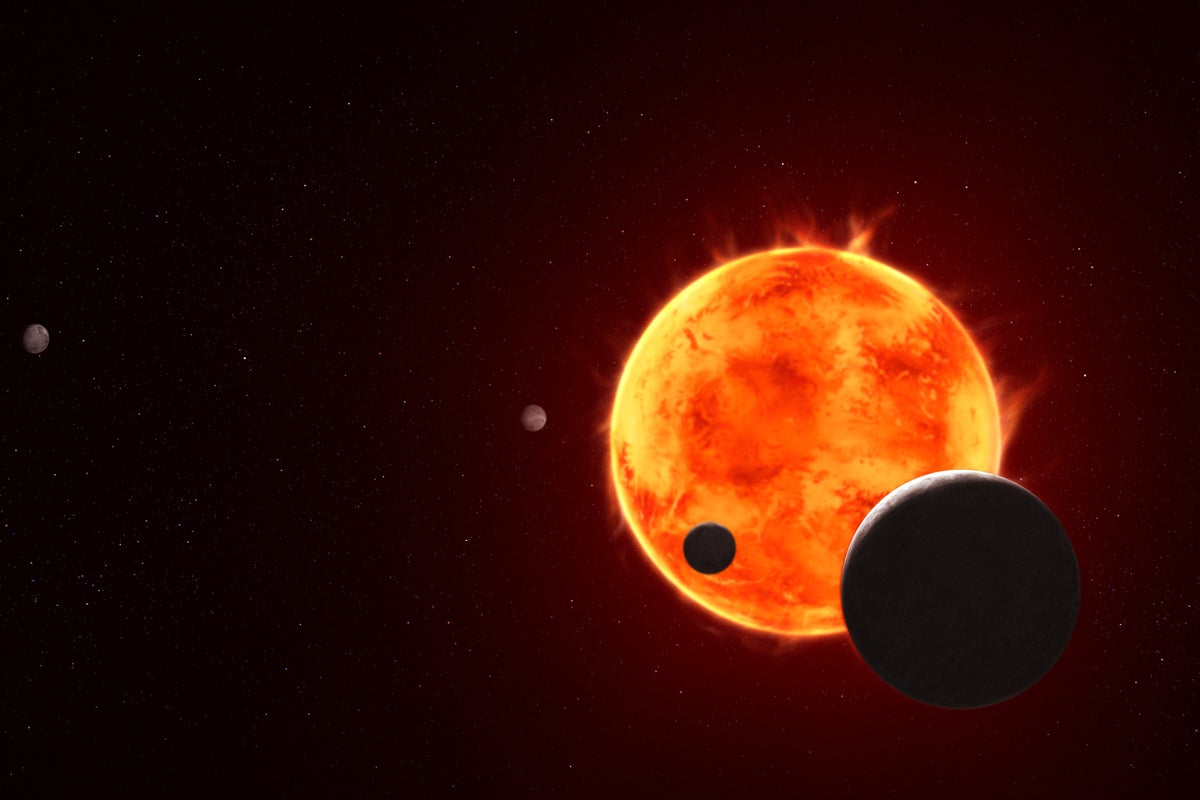
If we’ll ever find life outside our solar system, it will not be an instant discovery. Save for the slim possibility of an intelligent civilization beaming a message in our direction, evidence for aliens will most likely come from scrutinizing nearby rocky worlds by using giant telescopes to study their atmospheres for gases that could hint at living, breathing somethings dwelling unseen on the planet’s surface. This is no easy feat. For stars like our sun, no telescope will be capable of doing this for a generation. For smaller stars, we have only recently developed this capability thanks to the James Webb Space Telescope (JWST).
That’s why two papers published on September 8 in the Astrophysical Journal Letters are so exciting. Using JWST, for the first time, astronomers have managed to find tentative evidence for an atmosphere on a rocky planet in a clement orbit around another star some 40 light-years from Earth. Called TRAPPIST-1e, the planet is one of seven small worlds orbiting its host star, a red dwarf far smaller and dimmer than our sun. Efforts to find atmospheres on any of these planets have been otherwise unsuccessful; the three innermost worlds, it seems, are barren rocks stripped of any wisp of air. But now, thanks to JWST, we’ve seen that might not be the case for TRAPPIST-1e, the fourth planet of this system. If there is life somewhere out there, right now this world seems to be our best bet of finding it.
“We’re seeing something tantalizing,” says Ryan MacDonald at the University of St Andrews in Scotland, a co-author on the papers. “If it is confirmed, it is a huge deal. We would have the first atmosphere on a habitable zone rocky planet beyond our own solar system.”
On supporting science journalism
If you’re enjoying this article, consider supporting our award-winning journalism by subscribing. By purchasing a subscription you are helping to ensure the future of impactful stories about the discoveries and ideas shaping our world today.
The planets of the TRAPPIST-1 system were discovered in 2016 and 2017 by exoplanet scientist Michaël Gillon at the University of Liège in Belgium and colleagues using the Transiting Planets and Planetesimals Small Telescope–South (TRAPPIST–South) facility at the La Silla Observatory in Chile and NASA’s Spitzer Space Telescope. Those discoveries showed this relatively nearby system was worthy of astronomers’ attention. It contained seven rocky worlds each roughly the same size as Earth, several of which seemed to be in the star’s habitable zone, the region where temperatures should be just right for liquid water, and perhaps life, to exist.
For a red dwarf like TRAPPIST-1, this region is much smaller than our own solar system. In fact, all of the TRAPPIST-1 planets would fit comfortably inside the orbit of Mercury around our own sun. This proximity to a red dwarf is problematic, however, as these pipsqueak stars can punch well above their weight by regularly unleashing violent stellar outbursts. Stars like TRAPPIST-1 “emit a lot of extreme ultraviolet radiation” that can strip away the atmospheres of nearby worlds, says Yuka Fujii, an exoplanet scientist at the National Astronomical Observatory of Japan, who was not involved in the papers. “We have not confirmed Earth-sized planets in the habitable zone of red dwarfs can have atmospheres,” she says. “So if there is an atmosphere on TRAPPIST-1e, it would be very encouraging.”
If even a star this volatile can support habitable worlds, “it would mean a lot more stars than we think can have planets with atmospheres,” says Caroline Piaulet-Ghorayeb, an astronomer at the University of Chicago who has studied the TRAPPIST-1 system.
Ever since JWST launched in December 2021, astronomers have been desperate to use its unmatched infrared vision to probe systems like TRAPPIST-1. To do so requires staring at the star for long periods of time as each planet completes an orbit, up to about 19 days for the outermost planet, and crosses in front of the star relative to us. This is known as a transit, and when this happens, JWST can see the light from the star passing over the planet. If there is an atmosphere present, the signal looks noticeably different than that from a bare rock, such as Mercury, as the light passes through the atmosphere and is scattered by any gases afloat in the alien skies, a process called transmission spectroscopy.
Until now, things had not looked promising. Reconnaissance of TRAPPIST-1 b, c and d has found no atmospheres, leaving some to wonder if any of the TRAPPIST-1 planets were potentially habitable. “I was optimistic that we’d be seeing atmospheres on most of the planets in the system,” MacDonald says. “We’re really hoping that TRAPPIST-1e is the one.”
The team’s analysis involved four transits of TRAPPIST-1e observed in 2023. The data ruled out the planet having a super-thick atmosphere, like Jupiter’s, full of hydrogen and helium—something we wouldn’t expect for an Earth-sized rocky world anyway. The signals the researchers saw from the star were instead consistent with an atmosphere containing nitrogen and methane but lacking carbon dioxide, ruling out the planet being a CO2-dominated orb like Venus or Mars. “Perhaps the closest analogue in our own solar system would be [Saturn’s moon] Titan,” MacDonald says, although he notes that an Earth-like atmosphere is also a possibility.
The team wasn’t able to completely rule out that TRAPPIST-1e is a barren rock like its inner siblings, however, partly because of interference from its hyperactive star. “It’s about equally likely if there is an atmosphere or not,” says Ana Glidden of the Massachusetts Institute of Technology, the lead author on one of the papers, but crucially these are the best odds astronomers have found yet for any of TRAPPIST-1’s worlds. If there is an atmosphere, the team suggests it would be a “secondary” one like Earth’s, formed through volcanic eruptions and other processes after the planet lost its initial “primary” envelope of gas early in its existence.
The team calculates that, based on its distance from the star, TRAPPIST-1e might also be a relatively cool world, conceivably with liquid-water oceans or frozen expanses of ice on its surface. All of the TRAPPIST-1 planets are tidally locked, meaning the same face always points to the host star, but TRAPPIST-1e could have a substantial ocean on its “starward” side. “It could be frozen except at the substellar point,” where temperatures would be warmest, Glidden says. Such a world, she adds, could resemble a lidless, staring eyeball—a dark, oceanic pupil surrounded by an iris of bright, gleaming ice.
As alien and unearthly as this may be, it still would make TRAPPIST-1e by far the most promising of the TRAPPIST-1 worlds to host life. Sarah McIntyre, an exoplanet scientist and founder of the Australian astrophysics start-up Beyond Exo, has previously suggested that the planet’s magnetic field might be similar to Earth’s; coupled with its toasty estimated temperature, that would make TRAPPIST-1e arguably the most alluring astrobiological target in our celestial catalogs. “[TRAPPIST]-1e was definitely a forerunner for me,” she says. No better planetary system more amenable to JWST’s scrutiny has been found in our pocket of the galaxy, Gillon says—and TRAPPIST-1e may be its crown jewel. “There is nothing comparable,” he says. “In the Earth-sized regime, this is the best target we have.”
JWST has also been observing TRAPPIST-1f, g and h in the system for signs of an atmosphere, and results from those other worlds are expected to appear within the next year. But for TRAPPIST-1e, astronomers still need to look at the planet in more detail, and they are already doing so. A follow-up campaign is underway right now to observe 15 more transits of the planet. “We’re halfway through,” says Néstor Espinoza at Johns Hopkins University in Maryland, lead author on the other TRAPPIST-1e paper. “The observations should be done this year, hopefully in December.” The results should be published in 2026. “Next year is going to be exciting for TRAPPIST-1e,” Espinoza says.
Those forthcoming results could be enthralling. The follow-ups use a fortuitous alignment with the innermost planet, TRAPPIST-1b, to reduce some of the noise from the star and better work out exactly what sort of atmosphere TRAPPIST-1e has. “If there is an atmosphere, we will see it,” MacDonald says.
And if the follow-ups clinch the case for an atmosphere on 1e—or if one of the other planets turns out to have one, for that matter—a new era will begin, in which astronomers lavish those targets with attention from JWST and other next-generation telescopes. “If we confirm an atmosphere and we detect different gases, it would be very easy to approve a very large program to dig in and go up to 50 or 100 transits,” MacDonald says. “It’s incredibly exciting to be at this point. It’s the reason why I went into astronomy, to look at potentially habitable planets.”
Of course, there remains the possibility that all the TRAPPIST-1 planets are bare rocks. Perhaps the hints of air on TRAPPIST-1e are yet another bit of stellar mischief from the planet’s problematic star. That would be disappointing, and it would bolster the case that red dwarfs are not as hospitable to life as many astronomers have hoped.
Either way, the next phase of the hunt for habitability on exoplanets—namely, looking for atmospheres on planets like Earth orbiting stars like our sun—will not truly arrive until the 2040s, when NASA is set to launch its Habitable Worlds Observatory, a behemoth space telescope built from the ground up to probe promising worlds around other stars. It will be the first telescope capable of directly imaging Earth-like planets around sunlike stars to look for signs of life. “To push towards planets really similar to Earth, we need a next-generation space telescope,” says Laura Kreidberg, an exoplanet scientist at the Max Planck Institute for Astronomy in Heidelberg, Germany.
To recap: Within a year, we should know if any of the TRAPPIST-1 planets have atmospheres. By the end of the decade, we might know if they have a mixture of gases that suggest signs of life. But we will “have to be patient” in our search for any true-blue Earth 2.0, Gillon says. There’s still no doubt that we are entering an extremely exciting time, where the possibility of finding life beyond the solar system is within our grasp; these TRAPPIST-1e observations represent one small, important step toward that future. “To use an analogy, we have the rocket to go to the moon, and with these results, we know it works,” Gillon says. That pivotal “giant leap” moment might not be too far away.