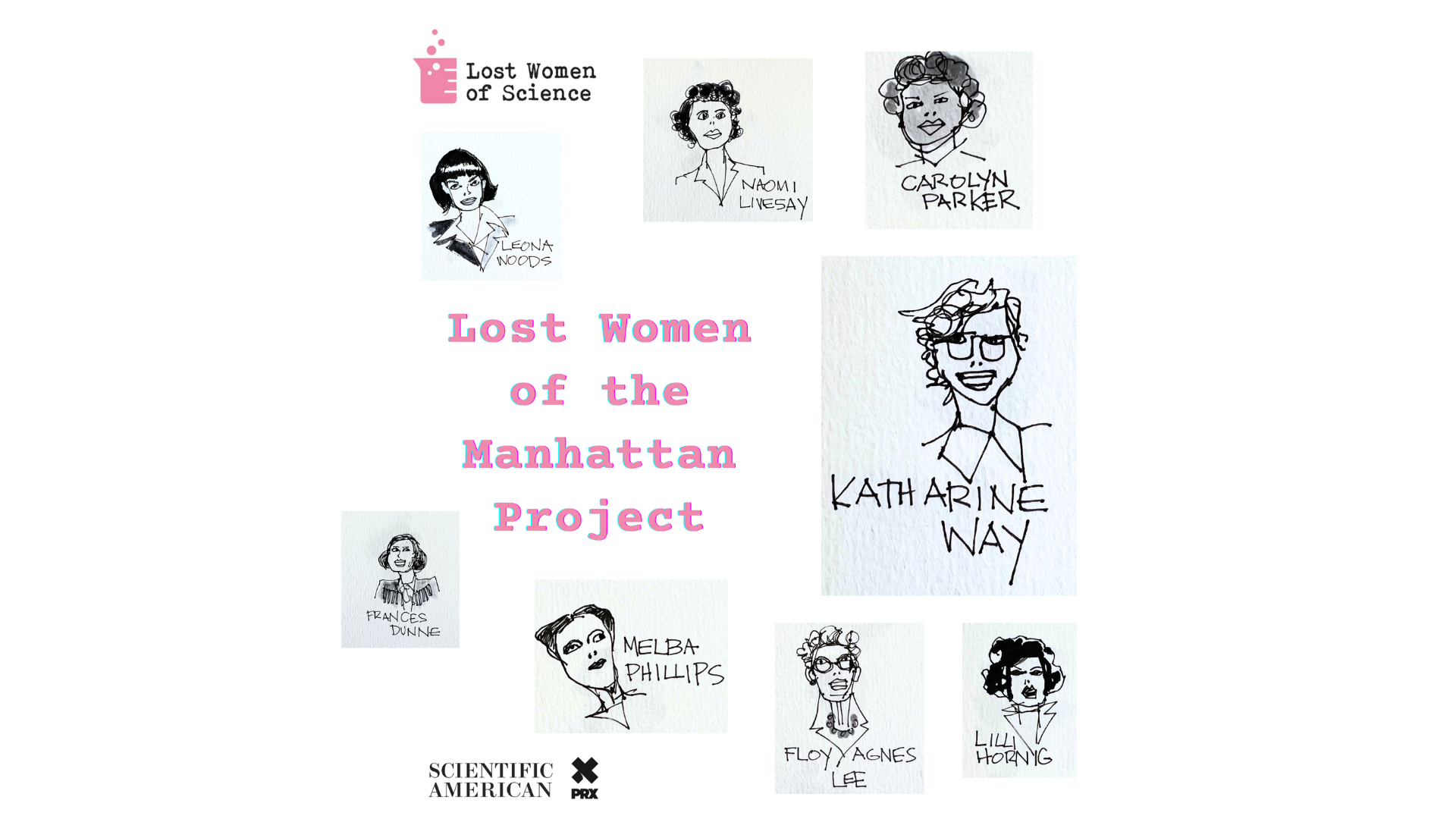
Katharine “Kay” Way was a nuclear physicist who worked at multiple Manhattan Project sites. She was an expert in radioactive decay. But after atomic bombs were dropped on Japan, she became increasingly concerned about the ethics of nuclear weapons. Way signed the Szilard Petition and worked to spread awareness of the moral responsibility surrounding atomic weaponry. Her efforts included co-editing the influential One World or None: A Report to the Public on the Full Meaning of the Atomic Bomb, and she remained an outspoken advocate for fairness and justice.
LISTEN TO THE PODCAST
[New to Lost Women of Science? You can listen to our most recent episode of Lost Women of Science Shorts here and the beginning of our most recent multiepisode season here.]
Speaker: Ethel Taylor
Speaker: Amanda Blume
Speaker: Elizabeth Wilson
Speaker: Lotti Grieff
Speaker: Ruth Casler
Speaker: Kay Hamilton
Speaker: Elaine Bernstein
Speaker: Dorothy Axelwright
Katie Hafner: This is Lost Women of the Manhattan Project, a special series of Lost Women of Science. I’m Katie Hafner. This week we’re going to tell you about Katharine Way, a nuclear physicist who did important work on radioactive decay. We think the world needs to know about her. And while we’re at it this week, we’re also going to tell you a little more about the Szilard Petition from 1945.
I’m sitting here with producer Erica Huang. Well, we’re not – I’m actually not sitting here with you. I’m in my closet in my house. And you are….
Erica Huang: I’m in a studio in Brooklyn.
Hafner: You know, let me just start by saying that when we were trying to figure out who, among the many women who worked on the Manhattan Project, who we would be focusing on, Amy Scharf, my co-executive producer said we have to focus on at least one woman who signed the Szilard petition. To which I said, ‘What’s that?’
Huang: Yeah.
Hafner: So we decided to focus on Kay Way.
Huang: Yes. And I’m very excited to talk about Kay Way. But before we sort of get into her story, I wanted to play you this piece of tape.
Announcer: It is therefore an imperative necessity that all the nations of the world unite to avert catastrophe.
Huang: Okay, so this is a a clip from a short film that was made in 1946. It’s this like animated black and white movie. It’s got this very dramatic voiceover and the movie is called One World or None.
Announcer: Representatives of the peoples of the world must together make laws, which will abolish war, laws, which will hold the individual in all lands responsible for crime against World Peace.
Huang: One World or None is kind of interesting because it was one of the first atomic scare films ever made, which I guess is like a genre of films that were made to try and both like spread awareness about nuclear weaponry, but also sort of like impress upon the public the fact that it was like a very big and scary deal.
Hafner: And I am just hearing it. Have you actually seen it?
Huang: Yeah. So there’s some visuals of atoms, and big world maps with circles around major cities, like if there were an atomic bomb dropped here, this is how much destruction there would be. And also these images of mass grave sites to show just the staggering number of people that would be killed.
The film was inspired by a book of the same name, One World or None, which was composed of essays and contributions from all of the biggest stars in physics at the time. Albert Einstein wrote something for it. Hans Bethe, Neils Bohr, J. Robert Oppenheimer and Leo Szilard all contributed to this book and it was the first major publication that said we are in the atomic age. It’s important for us to understand what the magnitude of this scientific breakthrough is gonna mean for the world.
Hafner: So very, very serious. This was not just, I thought it was sort of like just, um, a bunch of amateur filmmakers making a scare movie. But this was really the scientists who, some of whom helped build the bomb, who afterwards, I guess really regretted it.
Huang: Yeah. And the woman who was behind it, who sort of turned that regret and the shock over what had happened at Hiroshima and Nagasaki into this book was a woman named Katharine Way.
Hafner: But went by Kay. Is that right?
Huang: Yes. Born Katharine, went by Kay Way to her friends.
Hafner: Have you seen a photo of her?
Huang: Yes. She’s got these amazing tortoise shell glasses on, and this kind of short, curly hair, and she’s just smiling at the camera. She looks full of energy. She’s like, here to do physics. Um, I don’t know. I just, I saw this picture and I was like, she looks so cool. Like, I want, I wanna be her friend.
Hafner: Aw, tell me about her.
Huang: So, Kay Way was born in 1903 in Pennsylvania and she went to boarding school in New Jersey and Connecticut. And while she was at boarding school in Connecticut, there’s this interesting anecdote about her. She was assigned a term paper on what she had learned at school. And she and her friend, instead of writing what they had learned, they instead wrote a scathing critique of the school’s curriculum.
Hafner: You mean the very school she was attending?
Huang: Yes, the school she was attending. They decided they weren’t gonna write about what they learned. They were gonna write about the issues with the curriculum, and she expected the teacher to fail them, but turned it in anyway, and instead she was praised for her independent thought.
Hafner: So did that set her up well for college? Where did she go?
Huang: So Kay started at Vassar and then transferred to Barnard and eventually got her undergraduate degree in physics in 1932, which was awarded by Columbia University. She then went on to receive her PhD in nuclear physics at the University of North Carolina in 1938.
Hafner: Wow. So she really wasn’t discouraged. I mean, I don’t have the exact numbers. Let’s just say, it was highly unusual. For a woman back then to get a PhD in nuclear physics.
Huang: Yeah. It’s pretty astonishing. And the other thing about her being in North Carolina is that in the 1930s, North Carolina was the largest textile producer in the country, and it had just been hit very hard by the Great Depression.
So the textile workers that did manage to hang onto their jobs faced low pay and dangerous working conditions, and they were forming unions, they were going on strike for livable wages. And Kay heard about this and decided that she had to support these strikes, so she and a few other graduate students collected clothing and food for the workers that were on strike.
Hafner: You know, that is just amazing. I mean, I, I know that I’m stereotyping physicists here, but don’t they tend to have their head down in the bits, just sort of doing their work?
Huang: Absolutely. I think she was just someone that paid attention. When World War II broke out, she was working on the construction of a neutron source to produce Neptunium-239 at the University of Tennessee.
Hafner: Do we know what nep… excuse my ignorance here, it sounds like it – Neptunium?
Huang: Ok, we decided to actually ask an expert about this.
Alex Wellerstein: So Neptunium-239 is an artificial isotope that you can create when Uranium-238 absorbs a neutron.
Huang: This is Alex Wellerstein, a professor at the Stevens Institute of Technology who studies the history of nuclear weapons.
Wellerstein: Now, the key thing here is that Neptunium-239 is not very stable. So within a couple days, most of your Neptunium-239 is gonna have turned into something else, which is Plutonium-239 and Plutonium-239 is what you use in nuclear weapons. So I don’t know exactly what Kay Way was, uh, researching about Neptunium-239, but that’s going to be a very important step in producing plutonium.
Huang: She was also teaching as an assistant professor in physics. And in 1942, she heard rumors that there was a nuclear project happening in Chicago. And she said, okay, I know who to call about this: John Wheeler, who had been her professor. She’d been his PhD student at UNC. So she called him up and she asked if there was work for her on this nuclear project.
Hafner: So was he, was Wheeler on the project?
Huang: Yes. Wheeler at that point was on the project and he brought her onto the project. So she transferred. She went to Chicago at first and the first thing that she did after she got to Chicago was she started working with this other physicist who was working there named Eugene Wigner, and together they developed the Way-Wigner formula for fission product decay.
Hafner: I assume you’re gonna tell me what that is, but just let me say I’m so happy to hear her name first in this Way-Wigner formula, because that means not only did she do all of the, well, maybe I’m presuming most of the work, but got credit for it.
Huang: Yeah. Okay. I love that too
We asked Alex to explain the importance of the Way-Wigner formula.
Wellerstein: The tricky thing in understanding fission products is that there are a lot of ’em. So when you’re splitting a uranium or plutonium atom, depending on how many protons and neutrons end up in each half, you get a totally different, often totally unusual isotope. In an ideal world, if you wanted to say what’s happening to the stuff after that gets split after an atomic bomb goes off, or what’s collecting in a reactor, you would look at each and every single one of the possible isotopes that comes out. Trying to do that for all of these things. It, it’s, it’s not something that they could do in the 1940s and fifties.
Huang: So Way and Wigner crunched a bunch of numbers and came up with a way to generalize for all fission products.
Wellerstein: So instead of saying Xenon-135 has a half-life of X, you’re essentially saying, fission products have a half-life, and here’s how we talk about it. This is a generalization. You’re sort of averaging everything, but it’s so much faster to have one little half-life than to try and manage hundreds of half lives over huge amounts of time.
Huang: And although we have the computing power today to get more specific in our calculations, the Way-Wigner formula’s ease of use and ability to be easily adjusted to fit different contexts means that it still gets a lot of modern use. For example, to calculate decay heat in nuclear reactors.
Wellerstein: You sort of think, oh, you turn a reactor off, it’s off. No, it’s actually still very hot. This has been the issue at Fukushima, uh, this was an issue at Three Mile Island is the decay heat is, poses problems, if you don’t have, you know, fresh water coming in and things like that. I mean, I’ve, I’ve used it. I, I have a website that simulates nuclear weapon detonations, and it calculates fallout and it uses the Way-Wigner, because that’s just the way you do it.
Hafner: So this was really, really important work that she did. So she worked in Chicago, was Kay in that Fermi group?
Huang: She wasn’t in Enrico Fermi’s group, but she worked with a lot of Fermi’s data. So she really was the person working on fission decay, and that was both with Fermi’s data, and then she also ended up going to a lot of different sites where they were building reactors and using this data in these formulas.
Hafner: So she, when you say she went to a lot of different sites, different Manhattan Project sites?
Huang: Yes. She went to Hanford, she went to Los Alamos and she eventually went to Oak Ridge, which was unique because the project was so segmented. Not a lot of people went to more than one site, let alone, you know, four.
Hafner: And they needed her in particular?
Huang: Because of her work on fission product decay. So when they were producing reactors across the country, they were using her designs and they wanted her to come and look at what they were doing ’cause she was the expert.
Hafner: You know, we’re about to start talking about the Szilard petition, which I will remind everyone is part of the reason that we wanted to, to look at Kay Way and I just discovered something pretty amazing that I wanna tell you about, which is I went online, I found the petition itself. And this thing was signed by all the, all the scientists who signed it on July 17th, 1945. That was the day after the Trinity test: So they had this thing ready to go. So can you tell us what it was and who Szilard was?
Huang: Leo Szilard was a physicist who conceived of the nuclear chain reaction, and over the course of working on the Manhattan Project, he became increasingly concerned about dropping this weapon of mass destruction on Japan.
So he wrote this petition and passed it around and got a lot of signatures on it, which basically implored Truman to consider the moral implications of dropping the atomic bomb on Japan.
Hafner: Yes, exactly. It says, we, the undersigned respectfully petition, first that you exercise your power as commander in chief – that would be Truman – to rule that the United States shall not resort to the use of atomic bombs in this war unless the terms, which will be imposed upon Japan – have been made public in detail and Japan, knowing these terms has refused to surrender.
Huang: Apparently Truman never saw this petition. There were 70 scientists in all that signed the petition. We have tape actually of Lilli Hornig who is the subject of one of our previous episodes.
Hafner: Oh, Lilli. Oh, you have tape? Oh, Lilli. Okay. Wait, we should hear this.
Lilli Hornig: Of course, it made no difference, but we thought in our innocence that if we petitioned hard enough, uh, they might do a demonstration test and invite the Japanese to witness it.
Hafner: Kay, of course, signed the petition.
Huang: Of course. She was pretty shocked, I think when she realized the full scale of what the bomb would do. And after the bomb was dropped, she was really taken aback by the scale of the destruction.
Hafner: What did she do after the war?
Huang: Kay had a vision for the world of nuclear studies post Manhattan project.
Roger Cloutier: After the war was over, Katharine Way came back to the University of Tennessee.
Huang: This is Roger Cloutier, who served as the director of Oak Ridge Associated Universities professional training programs, a nonprofit organization working in science, health, and education.
Cloutier: And somebody held a reception for Katharine Way, and while they were at the reception, she was talking about the institutes that were being established at Princeton and other places where Oppenheimer ended up at. And she said they ought to start one in Oak Ridge.
Hafner: Oh, that’s amazing. So they started a program at Oak Ridge, a lot like the Institute for Advanced Study in Princeton. They actually did that. Oh, that’s, I didn’t, I had no idea.
Huang: Yeah. To train up, train up scientists and it was, it was Kay’s idea to do that.
Hafner: Mm-hmm. And then came One World or None. Tell me how, how was that received?
Huang: So Kay also came up with the idea for this book, along with one of her colleagues. She made a list of suggested contributors. She communicated this idea to her eventual co-editor and to a publishing company. And in order to convince them that this project was viable, she telephoned all of these people that she’d written on the list.
So called up I presume Albert Einstein, and said, hi, I’m, I’m putting together this book of essays. I want you to contribute to it. And she persuaded enough people on this list to contribute to this book that the publishing company greenlit the project.
Hafner: Einstein, Bethe, Neils Bohr.
Huang: Yes.
Hafner: So the rock stars, the physics rock stars.
Huang: Here’s Cloutier again talking about that.
Cloutier: For her to get around and be able to go and get all these people, including Albert Einstein and so on, uh, in order to write little articles about what’s gonna happen, it says she deserves some credit.
Hafner: How did it do as a book?
Huang: It was a New York Times bestseller.
Hafner: Really!
Huang: It sold a hundred thousand copies.
Hafner: Oh, I hope she got a big royalty check.
Huang: I hope so too.
She went on to do a lot of other things. So she joined the Federation of Atomic Scientists.
Hafner: Aha. You know, that is a very familiar organization to me because my grandfather was part of it, and this was the group who became really deeply concerned about the use of nuclear weapons for mass destruction. And as I understand it, the um, Federation of Atomic Scientists then became the Federation of American Scientists, which is what it is today, which continues to work to minimize the risks of global threat, from nuclear weapons and chemical weapons and all those very bad things.
Huang: Kay’s work after the war, also extended way beyond physics. Just to give you a little bit of a list, she marched in civil rights demonstrations in the sixties. She established the Nuclear Data Sheets journal, which influenced a whole generation of evaluation experts. She spoke out against investigations against her fellow scientists during the wave of McCarthyism that spread across the US, and she even wrote to the Atomic Energy Commission to complain about the proceedings.
Hafner: You mean the anti-communist proceedings?
Huang: Yes, the anti-communist proceedings and the way that her fellow scientists were caught up in these proceedings based on rumors and hearsay and things like that.
Hafner: Did she ever get married?
Huang: No. Kay never got married.
Hafner: Mhm. We can hope she wasn’t lonely and isolated when she, as she grew old.
Huang: She definitely wasn’t lonely in her older years, she actually was an advocate at her retirement community. So she, she, uh,
Hafner: I love that.
Huang: I know.
Hafner: I’m sure they loved it too. I think she probably unionized the residents.
Huang: She, I mean, she formed a committee called Durham Seniors for Better Health in the City of Medicine and championed seniors’ health and financial rights.
So she was, she was surrounded by good people and championing for them.
Hafner: And this was in Durham, North Carolina.
Huang: Yes, in Durham, in her retirement years.
Hafner: What year did she die?
Huang: She died in 1995.
I wanted to share this part from her obituary, which ran in physics today.
Kay Way felt and expressed herself passionately, not only about the analysis of nuclear data, but also about many issues of human fairness and social justice. In such matters, she was an outspoken advocate rather than merely a sympathetic bystander.
Hafner: This has been Lost Women of the Manhattan Project, a special series from Lost Women of Science. This episode was produced by Huang with help from Deborah Unger. Lizzy Younan composes our music. Paula Mangin creates our art and Danya AbdelHameid is our fact-checker. I’m Hafner and I’m your host. Thanks to Amy Scharf, Jeff DelViscio, Eowyn Burtner, Lauren Croop, Jeannie Stivers and Carla Sephton.
Lost Women of Science is funded in part by the Alfred P. Sloan Foundation and Schmidt Futures. We’re distributed by PRX and produced in partnership with Scientific American.
You can find a lot more about us – along with the all-important donate button – at lostwomenofscience.org.
In this special series, we can’t tell you all the stories of the hundreds of women who worked on the Manhattan Project, but we can tell you many of their names, which we’ve been reading aloud for you on and off through this series. Here are a few more….
Speaker: Pearl Leach Gordon
Speaker: Jane Heydorn
Speaker: Elsie Mae Freeman
Speaker: Bernice Brode
Speaker: Miriam Finkel
Speaker: Susan Herrick
Speaker: Beatrice Foreman
Speaker: Edna K. Marks
Speaker: Kay Tracy
Speaker: Naomi Livesay
Speaker: Ardis Monk
Speaker: Eleanor Ewing
Speaker: Hazel Genzel
Further reading:
Their Day in the Sun: Women of the Manhattan Project, Ruth H. Howes & Caroline L. Herzenberg. Temple University Press, 1999. https://www.amazon.co.uk/Their-Day-Sun-Manhattan-Project/dp/1592131921
One World or None: A Report to the Public on the Full Meaning of the Atomic Bomb, edited by Dexter Masters and Katharine Way. The New Press, 2007 (first published 1946). https://thenewpress.com/books/one-world-or-none
The Rate of Decay of Fission Products, K. Way & E. P. Wigner, Physical Review Journals Archive, Phys. Rev. 73, 1948. https://journals.aps.org/pr/abstract/10.1103/PhysRev.73.1318