
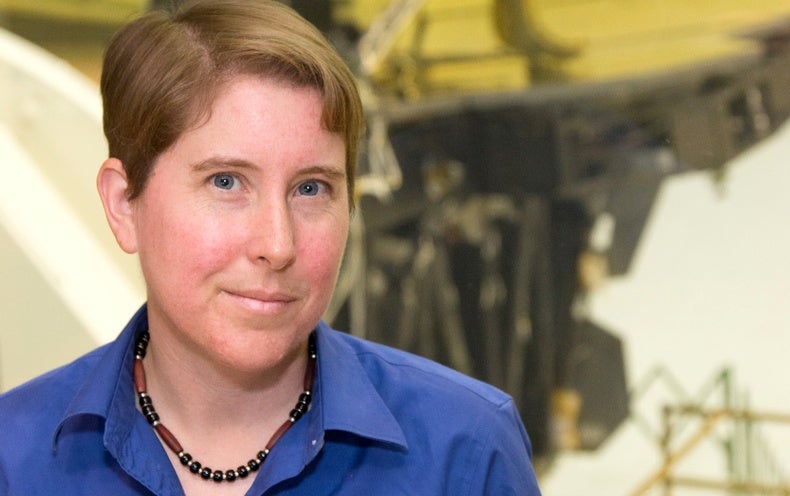
“Give me a telescope, and I can come up with something good to do with it,” says Jane Rigby, an astrophysicist at NASA’s Goddard Space Flight Center who serves as the agency’s operations project scientist for the $10-billion James Webb Space Telescope, the largest and most powerful off-world observatory yet built by humankind. Over the course of her career, Rigby has used many of the world’s premier ground- and space-based astronomical facilities—and she is helming one of Webb’s many “early release science” campaigns front-loaded for its first year of observations, utilizing the telescope to study star formation in galaxies across eons of cosmic time. But her main work with Webb is to work with her team to ensure everyone fortunate enough to use it can do “something good,” by looking after the full breadth of scientific investigations the telescope will perform for researchers around the globe during its planned five-year primary mission. This is no small task: For those hoping to squeeze as much science as possible out of this one-of-a-kind observatory, each and every moment of Webb’s time is precious—and Rigby oversees the schedule.
Ever since Webb launched on Christmas Day of 2021, she and her colleagues have been working nonstop to prepare the observatory to deliver breakthrough discoveries about the universe’s first galaxies, nearby exoplanets and much more. Now, with its mirrors and instruments ready and its inaugural batch of science images and data set for imminent release, Webb’s revolutionary studies are poised to truly begin. Scientific American spoke with Rigby about the teamwork it takes to operate Webb, the observatory’s uncertain longevity and the delicate task of maximizing returns on a $10-billion investment in the biggest and best telescope in the known universe.
[An edited transcript of the interview follows.]
Things are looking good for Webb, aren’t they? We’re on the verge of seeing the telescope’s first science images, its performance has exceeded expectations during commissioning, and its voyage to deep space left it with enough surplus propellant to continue operations into the 2040s—many years beyond its “nominal” mission lifetime. How remarkable to think we might get so much “extra” time out of this thing that’s required decades of steady, diligent work and $10 billion, this amazing facility that may in some respects be the single biggest investment ever made in astrophysics. So I wanted to talk to you about how the project is protecting this investment, and how it’s going to maximize the juice for the squeeze, so to speak.
Things are looking great, absolutely. This telescope really is not only as good as we promised—in many ways, it’s better. And I’m happy to talk about all aspects of juice-making. Like everyone else on the team I’m excited to unveil Webb’s first science images. This will be the first time we actually put some “juice” out, and from there everyone can judge for themselves how sweet it is. I like this “juice” metaphor—so long as we’re not talking about steroids.
Wait, but isn’t Webb “Hubble on steroids”? Sorry, bad joke.
It would take a lot of steroids, actually. Webb is a hundred times more powerful than existing observatories.
Ha, okay. So you’re Webb’s project scientist for operations. Does that mean you’re making all the juice?
Well, one of the things a project scientist does is act as the conscience for the science. This telescope was mostly built by engineers and managers, but scientists had to be in the loop, too, to ensure that it can do the science for which it’s being built. Now, as an “operations” project scientist, that means I worry about how we’re going to use the telescope—everything from selecting proposed observations to making observing schedules, from operating the telescope to getting the data back to Earth and removing all the instrumental signatures. Whatever it takes to get the science done.
Right. So, just to be clear, you’re operations project scientist, but that doesn’t mean you choose where Webb looks or who gets to use it.
There’s no “who you know” inside track. Most of Webb’s time is allocated through very competitive peer review. For Cycle 1 General Observer programs, we enlisted a panel of 200 experts—all virtual because of COVID—to review and rank more than a thousand proposals from all over the world. The top quarter of proposals were selected. That’s done dual anonymously: reviewers don’t know who wrote the proposals, and the proposers don’t know who reviews them. We want to judge by the quality of the ideas. That means, for instance, it’s possible for an autodidact from outside academia to get time on Webb. You could live in a country that doesn’t necessarily like our country, or that didn’t do anything to help build the telescope, and in most cases you can still use it, right? It’s an open competition because we want the best ideas.
How do you juggle all of these “best” ideas, though, to figure out which ones take priority? Seems like a hard job.
This will be like explaining the difference between building a juicer versus actually using it to make juice, seeing where it gets jammed up, and fixing it.
So, first some basics: Webb can point anywhere within a third of the sky on any given day. That restriction makes sure that the sunshield is always oriented so that it blocks light from the Earth, the Sun and the moon. That field of observability precesses such that Webb can see 100 percent of the sky over the course of a year. Knowing that, for any fixed target (as in one not whizzing around the solar system), we can calculate which and how many days per year Webb can see it. Targets in the plane of our solar system are available for about 60 days a year. Targets out of the plane (straight up to the north or south poles of our solar system) are available year-round. Targets in intermediate ecliptic latitudes fall between those extremes.
Some targets we need to observe at certain times. Like exoplanets at certain points in orbit around their stars, or an exploding star, or some other phenomenon that’s time-dependent.
There is also a question of how dark the sky is. For some targets and wavelengths, it matters a lot whether you’re looking through hot dust toward the Sun or colder dust further out in the solar system. So for a given target, how dark the sky is for observing it varies seasonally. For some observations, we don’t really care. But if we’re looking at really faint things, then we want to schedule when the background sky is as dark as possible.
We also don’t want Webb to be idle. And, we need to get the data back to Earth. We talk to Earth about a third of the time during normal science operations, with a gimbaled antenna we can point while we’re observing. The data rate isn’t bad—about 30 megabits per second—but it’s slower than a cable modem, and there are 57 megapixels of memory within Webb’s instruments. We manage that by asking users not to be data hogs, and by doing a lot of data compression.
We schedule the telescope by optimizing over all those constraints, to generate a family of acceptable solutions. We make a long-range plan, in which for every observation, we assign maybe a month-long time slot where it’s likely to go. And then every seven to 10 days we’ll make a detailed schedule for that week—the batting order, so to speak. This process is adapted from Hubble, which also has lots of constraints, though Webb’s are quite different than Hubble’s.
Such as?
First off, for Hubble the Earth is in the way half the time. Hubble uses that time to slew to the next target, and otherwise get ready. Webb doesn’t have that issue, since it’s in deep space. That means Webb can’t hide its slews behind the Earth like Hubble does. Webb is a big telescope, so it slews slower than the minute hand on a clock. So if you want to turn it 180 degrees, that takes most of an hour. So to use gendered language, scheduling is the classic “traveling salesman” problem—how do you optimize a bunch of different “stops” to form a route? We link up a bunch of visits that are close together in the sky to avoid doing big, time-consuming slews.
There is another way Webb and Hubble are different which is important for scheduling and taking care of the telescope, and that’s momentum buildup. It turns out that the fact that photons carry momentum sets a limit on the lifetime of the telescope. Because propellant is one of the main constraints on Webb’s lifetime, and momentum management is one of Webb’s main uses of propellant.
Could you unpack that for us a bit?
Photons striking Webb’s sunshield apply torque. Now, we could orient the sunshield to cancel out the torques—but we want to point the telescope at targets, not get the sunshield perfectly balanced by sunlight. So the photons hit the sunshield, they apply torque, and Webb’s reaction wheels spin up to counteract this effect and keep the telescope pointed. But the reaction wheels can only spin so fast. They occasionally have to dump their angular momentum. In low-Earth orbit, Hubble just couples the reaction wheels to the Earth’s magnetic field to slow them down. That doesn’t work out in deep space, so instead Webb fires thrusters to push against the spin of the reaction wheels. We do these momentum dumps periodically, each time using little propellant. But, as you mentioned, at this stage we have enough propellant to get into the 2040s, so Webb’s longevity is more likely to be limited by how long components last…. Honestly, though, it feels weird to be plotting the nursing-home days of this telescope when it’s still a newborn just opening its eyes!
You might not like this next question, then: Assuming everything else stays peachy, and propellant inevitably runs out, how will Webb die?
Wow, so we really are talking about the death of this thing. I almost don’t want to talk about this; it feels premature, because it’s a brand-new telescope. It’s like talking about the death of a baby. If we’re talking about being propellant-limited, once that resource runs out, we’d be unable to control the pointing to ensure the solar panels always see the Sun and the telescope never sees it. Eventually the solar panels would fall into shadow for long enough that recovery would be unlikely. I guess that would be like Webb’s last breath. That would be when we’d know it was really dead. But, again, it’s hard to know what exactly will happen to Webb in its twilight years since it’s a newborn.
We’ve already been surprised, for instance, by a micrometeorite impact that had a greater than expected effect on one of the primary mirror segments, and we’re actively studying what such events might mean for Webb’s ongoing optical performance. Micrometeorites are a fact of life in orbit that will gradually degrade the quality of the mirrors and the sunshield—and we’ve overengineered and built in margins with that in mind—but was this a once-every-five-years event, and we just got unlucky, or are we going to be getting more hits like this than we expected? We’re working to figure that out. I’m still planning for a long, fruitful mission, of course.
Indeed. You know, it does seem like you and other folks who work on Webb have, quite reasonably, formed an emotional attachment to it. Has that made it more challenging to navigate all the various make-or-break moments in the telescope’s so-far-short life?
Well, the feelings change for each distinct phase of Webb’s commissioning. During the launch and in the first couple of weeks afterward when we were doing major deployments, there were several key days where we knew we might lose the mission that day. We were up front about that; NASA even made this video called “29 Days on the Edge.” I tried to approach those days with fatalism: “If it doesn’t work, we don’t have a mission.” As one deployment after another worked, I realized I was going through the stages of grief. Mostly bargaining: “Oh, let’s please just get the secondary mirror out, I don’t even need the primary mirror to unfold its two wings!”
Why the secondary mirror?
The word “secondary” makes it sound like it’s not that important, or a backup. But in a telescope, secondary just means the light hits it second, after the primary. Webb’s primary mirror is iconic and much larger. But that 0.7-meter secondary is utterly critical. If the secondary mirror deployment hadn’t worked, then the light bouncing off that gorgeous primary mirror would fly out to space, lost forever, instead of being collected in a science instrument. Even if the primary mirror hadn’t fully unfolded, if we still had that secondary mirror, we’d have a functioning but degraded telescope. So when the secondary mirror deployed, perfectly, I realized how much worry I had been holding onto, after working on this thing for the past 11 years—and a lot of my colleagues have worked on it longer.
We’re thankfully done with those make-or-break moments, as well as the “commissioning” phase of intense choreography and testing. The telescope has cooled to its target temperature, the optics are aligned, the science instruments are ready. We’ve been getting to know the actual telescope’s true performance in space, and with the first science images we’ll show not only that Webb is working, but that it’s fully capable of doing all the amazing science for which it was built. It’s a wonderful feeling.