
Close Menu
Beverly Hills Examiner

    Subscribe to Updates

    Get the latest creative news from FooBar about art, design and business.

    What's Hot

    Biggest Rock + Metal Albums Released Each Day in October History

    October 2, 2026

    ‘Playing a dangerous game’: Putin threatens using ‘all its arsenal’ if Russian territory is attacked

    October 2, 2026

    After Reflecting Pool Humiliation, Rep. Jamie Raskin Gives DOJ Hot Tip On Felon Orange Vandal Desecrating DC

    October 2, 2026
    Facebook X (Twitter) Instagram
    Beverly Hills Examiner
    • Home
    • US News
    • Politics
    • Business
    • Science
    • Technology
    • Lifestyle
    • Music
    • Television
    • Film
    • Books
    • Contact
      • About
      • Amazon Disclaimer
      • DMCA / Copyrights Disclaimer
      • Terms and Conditions
      • Privacy Policy
    Beverly Hills Examiner
    Home»Science»NASA’s DART Spacecraft Successfully Smacks a Space Rock–Now What?
    Science

    NASA’s DART Spacecraft Successfully Smacks a Space Rock–Now What?

    By AdminSeptember 27, 2022
    Facebook Twitter Pinterest LinkedIn WhatsApp Email Reddit Telegram
    NASA’s DART Spacecraft Successfully Smacks a Space Rock–Now What?


    An asteroid wiped out the dinosaurs; now Earthlings are fighting back. The sight of saurian fossils in most any science museum is a potent reminder that asteroids can threaten Earth as they swing around our sun, occasionally coming dangerously close to our planet—or, 66 million years ago, too close. Now scientists have tested a method that might save our planet from future doomsdays. In the past hour, NASA’s Double Asteroid Redirection Test (DART) spacecraft crashed into a small asteroid called Dimorphos.

    As DART’s full name implies, this impact was no accident. It’s meant to shift the space rock’s trajectory by a tiny but noticeable amount—a change that observers will carefully confirm and track from afar with a plethora of ground- and space-based telescopes. In the future, if a dangerous asteroid is found on a collision course with Earth, we might use this same technique to nudge it off course and avert disaster. “We’re not blowing up the Death Star,” says Andy Rivkin, DART investigation team lead at the Johns Hopkins University Applied Physics Laboratory (APL), which runs the mission. “We’re using the momentum from the spacecraft to change the orbit of the asteroid.”

    DART launched in November 2021 on a collision course with Dimorphos, a small asteroid 160 meters in size that orbits another asteroid, Didymos, that is almost five times larger. Over nearly a year the vending-machine-sized, circa 600-kilogram spacecraft caught up to the asteroids, taking ever sharper images as it approached. That was until today, at 7:15 P.M. ET, when engineers at APL’s mission control stopped receiving signals from the spacecraft, confirming its self-destructive slam into Dimorphos about 11 million kilometers from Earth.

    “We are embarking on a new era for humankind,” said Lori Glaze, director of NASA’s planetary science division, in post-impact remarks during the space agency’s livestream of the event. “An era in which we have the potential capability to protect ourselves from something like a dangerous asteroid impact.”

    Traveling at about 23,000 kilometers per hour, the spacecraft hit the asteroid with the approximate energy of three metric tons of TNT, exploding in a superheated shower of metal and asteroid debris. A small Italian spacecraft called LICIACube (Light Italian Cubesat for Imaging of Asteroids) following three minutes behind took images of the impact that will be released in the coming days. Yet the true mission has just begun. Now scientists will watch Dimorphos with everything from ground-based telescopes to deep-space observatories and see exactly how much of an effect DART’s dramatic impact had on its target. “We’re demonstrating for the first time that if humanity needed to alter the course of an asteroid, we would be capable of doing that,” says Harrison Agrusa of the University of Maryland, a member of the DART team.

    The DART mission was originally conceived some two decades ago, when scientists in the U.S. and Europe began to discuss a joint mission that could practice a kinetic asteroid deflection technique. Originally called AIDA (Asteroid Impact and Deflection Assessment), the mission would involve NASA’s DART spacecraft and Europe’s AIM (Asteroid Impact Mission) spacecraft, which would orbit the target and watch the impact. Sadly, European officials canceled AIM in 2016 because of a lack of funding. In 2019, however, the mission was reborn as the Hera spacecraft (named for the Greek goddess of marriage). But that reset in development meant a delayed launch: Hera won’t lift off until 2024 and won’t arrive at Didymos until 2026—much too late to witness DART’s impact but still in time to study its enduring effects.

    Scientists wanted DART’s target to be a binary asteroid, where one asteroid orbits another, because such celestial configurations allow easier measurements of small, impact-induced orbital changes. “The deflection is almost instantaneous,” says Patrick Michel of the French National Center for Scientific Research, former lead scientist of AIM and now principal investigator of Hera. In 2013 scientists selected the Didymos system as the target. First found in 1996, that larger asteroid gained its name (Greek for “twin”) following the discovery of a small orbiting companion in 2003, which was later dubbed Dimorphos, or “to have two forms.”
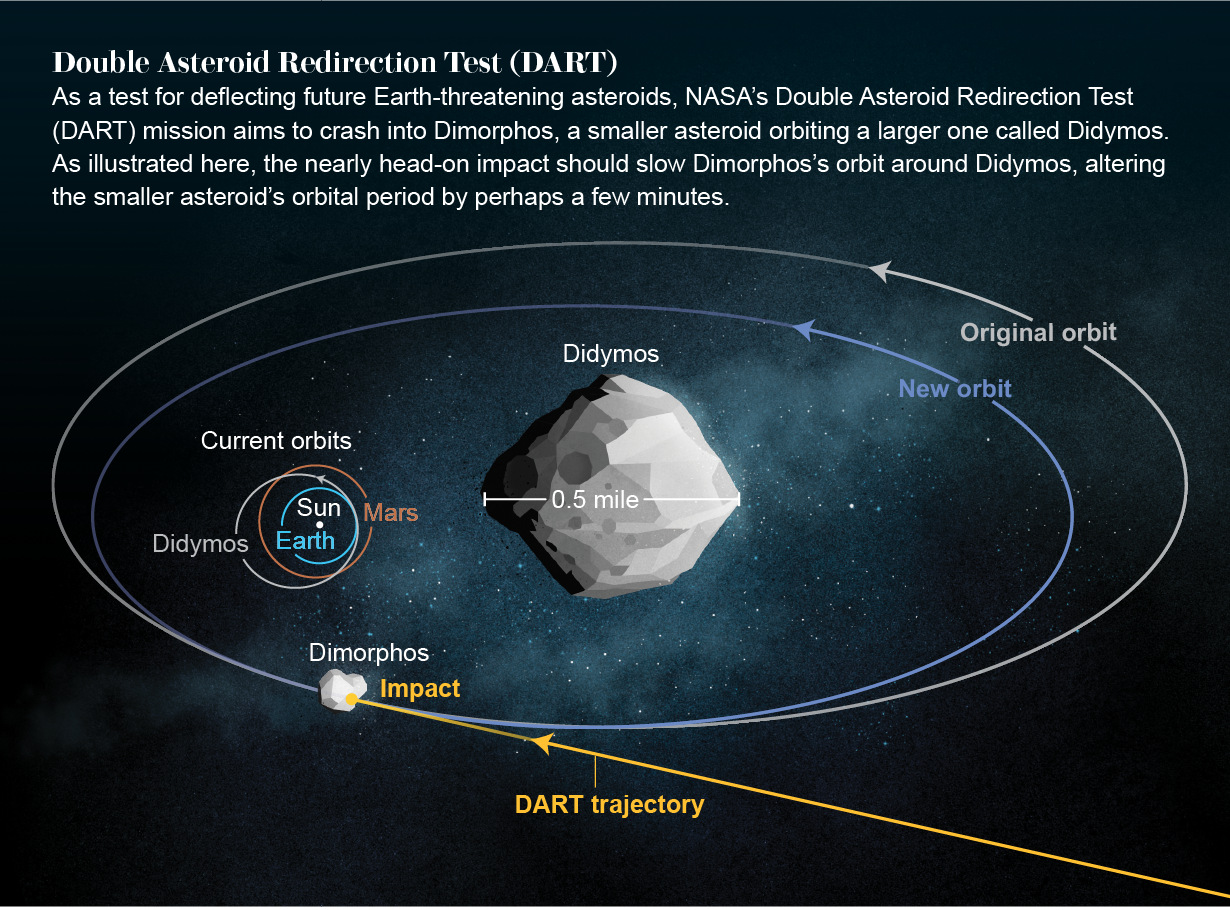
    Graphic shows how the DART mission will work to slow the moonlet Dimorphos’s orbit around the larger asteroid Didymos.


    Credit: Matthew Twombly; Source: NASA, Johns Hopkins APL (DART reference)

    Dimorphos completes an orbit of Didymos every 11.92 hours. The asteroids share a similar orbit with Earth yet pose no threat as they never come closer than a few million kilometers to our planet. But their angle of orbit means that Dimorphos regularly “eclipses” in front of Didymos, allowing its orbital period to be precisely measured. Following the impact, a variety of telescopes, including the James Webb Space Telescope and Hubble—and even spacecraft such as NASA’s Lucy probe, which is currently on its way to visit asteroids near Jupiter—will track this eclipse, allowing scientists to work out just how much Dimorphos’s orbit has been changed.

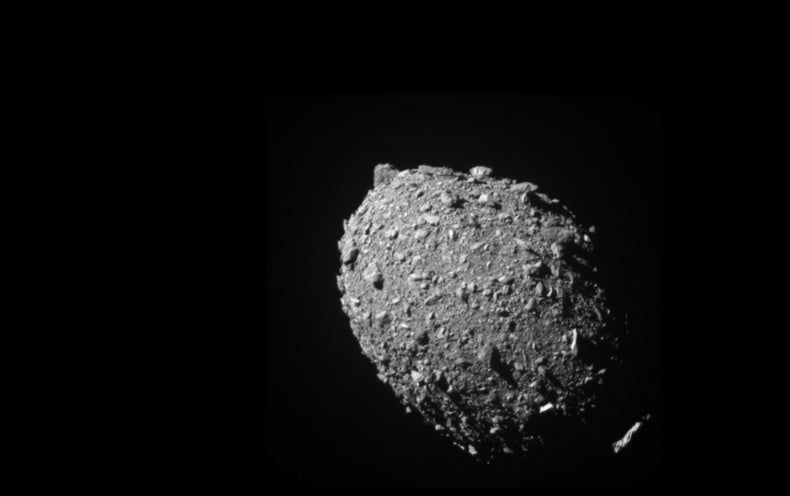
    DART hit the asteroid nearly head on, meaning it slowed Dimorphos’s orbit. The asteroid is so small, however, that mission scientists knew neither its exact shape nor its composition—whether Dimorphos was a rigid and solid object or rather a looser “rubble pile” of rocks and boulders that have gently accumulated together. During the final moments of its approach, DART beamed back images of Dimorphos’s rubble-strewn surface, indicating the asteroid was far from rock-solid. If it had been, the change in its orbit could have been barely more than a minute, as DART would have transferred only a relatively small amount of momentum to the asteroid. “We need at least 73 seconds of orbit change” for the mission to be heralded a success, Rivkin says. Instead, Dimorphos’s shabby appearance suggests the force of outward-spewing material (perhaps as much as a few tens of millions of kilograms) could cause a much larger shift in momentum, shortening the asteroid’s orbit by 10 minutes or more. Such an event could completely reshape Dimorphos or even send it tumbling head over heels. “The weaker the asteroid, the larger the crater,” says Sabina Raducan of the University of Bern in Switzerland, a DART team member. “Of course, we want there to be a lot of deflection and ejecta because that’s more interesting.”
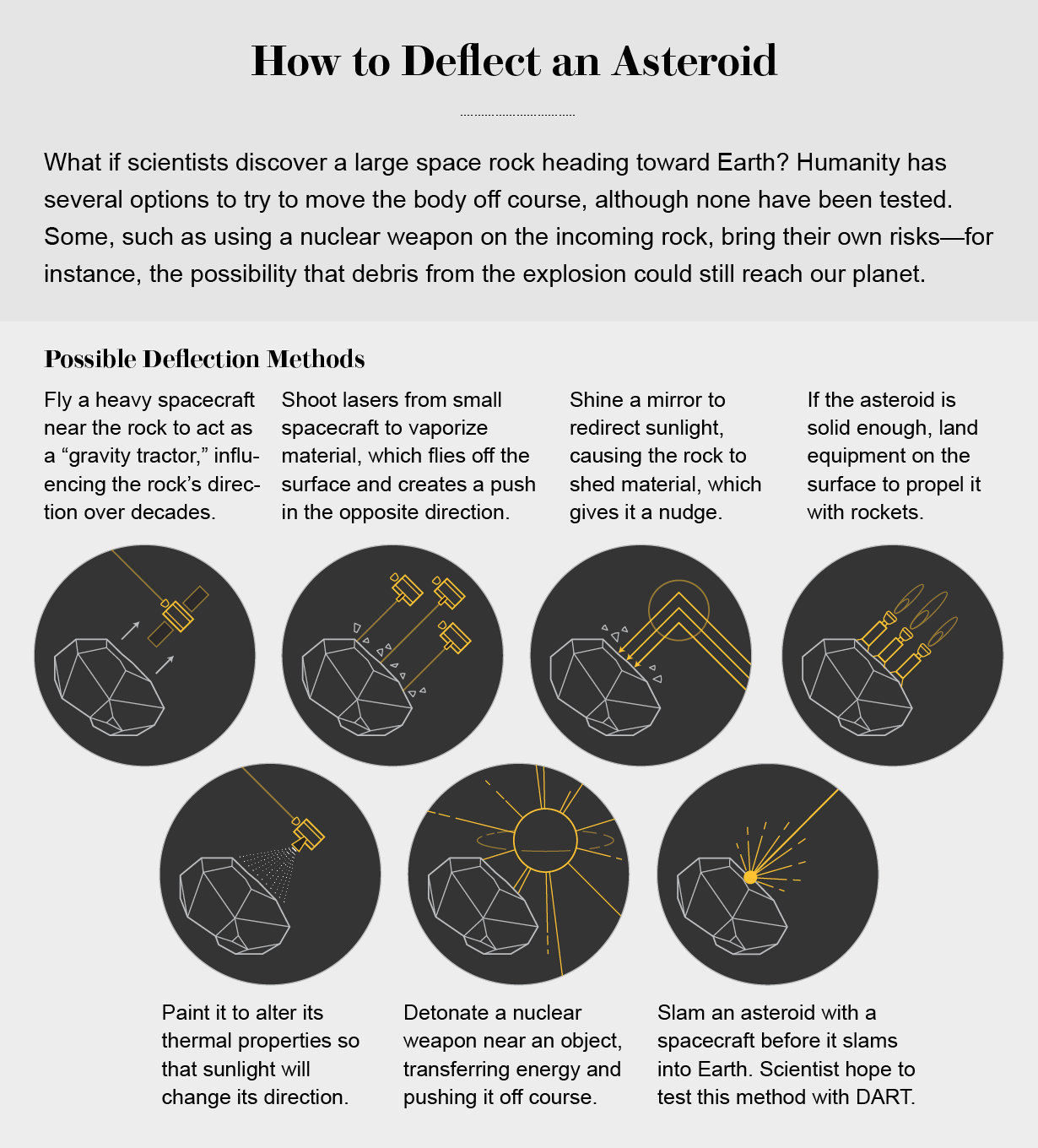
    Graphic shows seven possible ways to deflect an asteroid, including the method employed by the DART mission.


    Credit: Matthew Twombly

    Observations by telescopes and LICIACube should reveal roughly how much the orbit changed and how much ejecta was released, with the DART team set to announce preliminary results from the mission this December at a meeting of the American Geophysical Union in Chicago. But no one will know for certain how successful the mission was until Hera arrives in 2026. That spacecraft’s observations will accurately measure the mass of Dimorphos and get a more exact sense of how much its orbit has changed around Didymos, perhaps 10 times better than would otherwise be possible from more remote observations alone. “We’ll understand how big the push was and get a better understanding of what Dimorphos is made of,” says Angela Stickle of APL, a DART team member.

    That could be crucial information if something like DART is ever called on to save Earth in the future. “This is one of the most important things we’re doing at the moment,” says Detlef Koschny, deputy head of ESA’s Planetary Defense Office. “We’ve been talking about the need to demonstrate that we can deflect an asteroid for many years.” While no dinosaur-killer asteroids of several kilometers in size are known to be on an impact course with our planet, smaller asteroids like Dimorphos are less well constrained, with only an estimated few percent of their total population currently known. “We don’t yet know enough to feel safe,” Koschny says. An impact by a Dimorphos-sized space rock could instantly obliterate a city and cause widespread damage to an entire country, meaning there is good reason to look out for such asteroids.

    Upcoming telescopes, such as the Vera C. Rubin Observatory, set to come online in Chile later this decade, will better track these asteroids. If we ever do find one on a collision course with Earth, the outcomes of the DART mission may well dictate what action we take. “It is going to validate a tool that we could use,” Rivkin says. To divert a hazardous asteroid, perhaps a larger version of DART could be used or even a series of DART-sized spacecraft to slam into the offending space rock, one after another, incrementally deflecting its doom. “It depends on how much warning time we have,” Rivkin says. Such a perilous event is unlikely to befall humanity anytime soon. But perhaps, far in the future, our distant descendants will have this little spacecraft to thank. “If we can deflect Dimorphos, we can most likely deflect any other near-Earth asteroid,” Agrusa says.


    Original Source Link

    Share. Facebook Twitter Pinterest LinkedIn WhatsApp Email Reddit Telegram
    Previous Article10 Star Trek Characters That Deserve Their Own Spinoff, According To Reddit
    Next Article Finally, a Roomba that vacuums and mops • TechCrunch

    RELATED POSTS

    Google’s Project Suncatcher AI data center test has officially launched to space onboard SpaceX rocket

    October 2, 2026

    AI Apocalypse? By Howard Bloom

    October 2, 2026

    Measles Is Forcing Hospitals to Adapt to a New Normal

    October 1, 2026

    NASA directive might increase the odds of contaminating Mars

    October 1, 2026

    A Biotech Founder Makes the Moral Case for Gene-Editing Human Embryos

    September 30, 2026

    Blockbuster retatrutide trial signals a ‘new high-water mark’ for weight-loss drugs

    September 30, 2026
    latest posts

    Biggest Rock + Metal Albums Released Each Day in October History

    Here are the biggest albums of all time that were released each day in October.And…

    ‘Playing a dangerous game’: Putin threatens using ‘all its arsenal’ if Russian territory is attacked

    October 2, 2026

    After Reflecting Pool Humiliation, Rep. Jamie Raskin Gives DOJ Hot Tip On Felon Orange Vandal Desecrating DC

    October 2, 2026

    Browns’ late field goal spoils Aaron Rodgers’ Thursday night finale, seals Cleveland’s third straight win

    October 2, 2026

    Design Within Reach Promo Codes: 30% Off | October 2026

    October 2, 2026

    Google’s Project Suncatcher AI data center test has officially launched to space onboard SpaceX rocket

    October 2, 2026

    Ben Affleck Explains His Approach to Using AI Ethically on New Movie

    October 2, 2026
    Categories
    • Books (1,522)
    • Business (6,426)
    • Cover Story (14)
    • Film (6,363)
    • Lifestyle (4,411)
    • Music (6,436)
    • Politics (6,413)
    • Science (5,776)
    • Technology (6,362)
    • Television (6,062)
    • Uncategorized (3)
    • US News (6,411)
    popular posts

    Underscored readers favorite Amazon products of January 2023

    Reduce nightstand clutter with this compact 3-in-1 charger, which can power up your iPhone, Apple…

    GREG GUTFELD: The Dems picked a candidate with a shorter shelf life than fresh deli meat

    June 7, 2024

    Marriage Boot Camp Exclusive Sneak Peek: K. Michelle and Kastan Recall Their Biggest Fight

    May 12, 2022

    House Republicans Are Plotting Revenge Against The 1/6 Committee

    July 6, 2022
    Archives
    Browse By Category
    • Books (1,522)
    • Business (6,426)
    • Cover Story (14)
    • Film (6,363)
    • Lifestyle (4,411)
    • Music (6,436)
    • Politics (6,413)
    • Science (5,776)
    • Technology (6,362)
    • Television (6,062)
    • Uncategorized (3)
    • US News (6,411)
    About Us

    We are a creativity led international team with a digital soul. Our work is a custom built by the storytellers and strategists with a flair for exploiting the latest advancements in media and technology.

    Most of all, we stand behind our ideas and believe in creativity as the most powerful force in business.

    What makes us Different

    We care. We collaborate. We do great work. And we do it with a smile, because we’re pretty damn excited to do what we do. If you would like details on what else we can do visit out Contact page.

    Our Picks

    Google’s Project Suncatcher AI data center test has officially launched to space onboard SpaceX rocket

    October 2, 2026

    Ben Affleck Explains His Approach to Using AI Ethically on New Movie

    October 2, 2026

    How To Grow A Moustache Your Dad Would Be Proud Of

    October 2, 2026
    © 2026 Beverly Hills Examiner. All rights reserved. All articles, images, product names, logos, and brands are property of their respective owners. All company, product and service names used in this website are for identification purposes only. Use of these names, logos, and brands does not imply endorsement unless specified. By using this site, you agree to the Terms & Conditions and Privacy Policy.

    Type above and press Enter to search. Press Esc to cancel.

    We use cookies on our website to give you the most relevant experience by remembering your preferences and repeat visits. By clicking “Accept All”, you consent to the use of ALL the cookies. However, you may visit "Cookie Settings" to provide a controlled consent.
    Cookie SettingsAccept All
    Manage consent

    Privacy Overview

    This website uses cookies to improve your experience while you navigate through the website. Out of these, the cookies that are categorized as necessary are stored on your browser as they are essential for the working of basic functionalities of the website. We also use third-party cookies that help us analyze and understand how you use this website. These cookies will be stored in your browser only with your consent. You also have the option to opt-out of these cookies. But opting out of some of these cookies may affect your browsing experience.
    Necessary
    Always Enabled
    Necessary cookies are absolutely essential for the website to function properly. These cookies ensure basic functionalities and security features of the website, anonymously.
    CookieDurationDescription
    cookielawinfo-checkbox-analytics11 monthsThis cookie is set by GDPR Cookie Consent plugin. The cookie is used to store the user consent for the cookies in the category "Analytics".
    cookielawinfo-checkbox-functional11 monthsThe cookie is set by GDPR cookie consent to record the user consent for the cookies in the category "Functional".
    cookielawinfo-checkbox-necessary11 monthsThis cookie is set by GDPR Cookie Consent plugin. The cookies is used to store the user consent for the cookies in the category "Necessary".
    cookielawinfo-checkbox-others11 monthsThis cookie is set by GDPR Cookie Consent plugin. The cookie is used to store the user consent for the cookies in the category "Other.
    cookielawinfo-checkbox-performance11 monthsThis cookie is set by GDPR Cookie Consent plugin. The cookie is used to store the user consent for the cookies in the category "Performance".
    viewed_cookie_policy11 monthsThe cookie is set by the GDPR Cookie Consent plugin and is used to store whether or not user has consented to the use of cookies. It does not store any personal data.
    Functional
    Functional cookies help to perform certain functionalities like sharing the content of the website on social media platforms, collect feedbacks, and other third-party features.
    Performance
    Performance cookies are used to understand and analyze the key performance indexes of the website which helps in delivering a better user experience for the visitors.
    Analytics
    Analytical cookies are used to understand how visitors interact with the website. These cookies help provide information on metrics the number of visitors, bounce rate, traffic source, etc.
    Advertisement
    Advertisement cookies are used to provide visitors with relevant ads and marketing campaigns. These cookies track visitors across websites and collect information to provide customized ads.
    Others
    Other uncategorized cookies are those that are being analyzed and have not been classified into a category as yet.
    SAVE & ACCEPT