
Close Menu
Beverly Hills Examiner

    Subscribe to Updates

    Get the latest creative news from FooBar about art, design and business.

    What's Hot

    Arlo Parks announces 2026 ‘Desire’ tour in UK, Europe and North America

    March 6, 2026

    Iran war causes 23,000 cancelled flights and has ‘destabilized travel’ globally

    March 6, 2026

    Trump Runs Away And Ignores Questions When Asked About Kristi Noem Firing

    March 6, 2026
    Facebook X (Twitter) Instagram
    Beverly Hills Examiner
    • Home
    • US News
    • Politics
    • Business
    • Science
    • Technology
    • Lifestyle
    • Music
    • Television
    • Film
    • Books
    • Contact
      • About
      • Amazon Disclaimer
      • DMCA / Copyrights Disclaimer
      • Terms and Conditions
      • Privacy Policy
    Beverly Hills Examiner
    Home»Science»Notorious asteroid 2024 YR4 won’t crash into the moon after all
    Science

    Notorious asteroid 2024 YR4 won’t crash into the moon after all

    By AdminMarch 6, 2026
    Facebook Twitter Pinterest LinkedIn WhatsApp Email Reddit Telegram
    Notorious asteroid 2024 YR4 won’t crash into the moon after all


    Of all the asteroids that have imperiled the planet, 2024 YR4 is unparalleled. Soon after it was spotted in December 2024, worldwide telescopic observations quickly positioned it as the most dangerous space rock ever discovered—one that stood a 3.1-percent (or 1-in-32) chance of crashing into Earth on December 22, 2032. If it were to hit one of the cities potentially in its path, this 60-meter asteroid would have unleashed a force comparable to several atomic bombs, devastating the unfortunate metropolis.

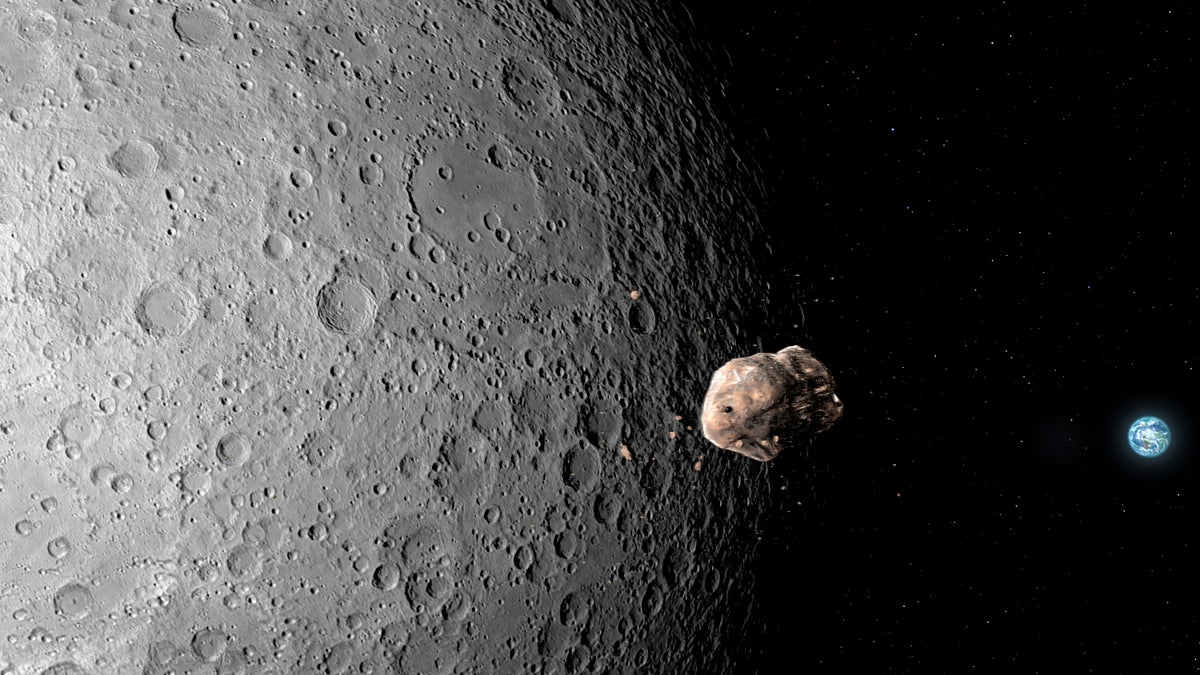
    An Earth impact was eventually ruled out in February of last year. But a late plot twist revealed 2024 YR4 stood a 4.3-percent (1-in-23) chance of slamming into our moon on the same date. Now, a concerted effort by astronomers indicates the asteroid will comfortably miss our alabaster companion too—by 21,200 kilometers.

    Remarkably, this revelation comes from the James Webb Space Telescope (JWST), an observatory that was designed to look at ancient black holes, distant galaxies, convulsing stars and far-flung planets—not help defend the planet from rogue asteroids. Its incredibly perceptive infrared vision, however, was able to track the asteroid in February when it was 450 million kilometers from Earth—a feat no other telescope could manage.


    On supporting science journalism

    If you’re enjoying this article, consider supporting our award-winning journalism by subscribing. By purchasing a subscription you are helping to ensure the future of impactful stories about the discoveries and ideas shaping our world today.


    “We think this is certainly the faintest solar system object that has ever been observed,” says Andy Rivkin, an astronomer and planetary defense researcher at Johns Hopkins Applied Physics Laboratory in Maryland, who led the JWST effort to track 2024 YR4.

    “I am truly amazed at what JWST has been able to do for us with a real-life, short-term response to an asteroid threat,” says Kathryn Kumamoto, the head of the planetary defense program at the Lawrence Livermore National Laboratory in California.

    Some may grumble that a seemingly harmless 2032 lunar impact—one explosive enough to be visible to the naked eye—is no longer in the cards. But there was a real risk some of the impact debris jettisoned off the moon could have sliced up several Earth satellites. If JWST had determined that 2024 YR4 was on course for a violent rendezvous with the moon, experts would have had six extremely short years to try to deal with it. “It’s really good that we’re not being forced to mitigate this asteroid on that timescale,” Kumamoto says.

    The NASA-funded Asteroid Terrestrial-impact Last Alert System (ATLAS) telescopic network first discovered 2024 YR4 just after Christmas Day in 2024. Initially, there appeared to be nothing to worry about. But additional observations by other observatories a 1-percent chance of an Earth impact in 2032. Those impact odds eventually rose to their unnerving peak of 3.1 percent in mid-February of 2025.

    All the relevant scientists were keen to find out if those impact odds would continue to rise or fall. But refining 2024 YR4’s orbit was a tall order: it was rapidly moving away from Earth, and by May 2025, it would have faded from view until it swung back around years later. “We were not expecting to observe the object again until the spring of 2028,” says Juan Luis Cano, an aerospace engineer with the European Space Agency’s Near-Earth Object Coordination Center.

    That would have given astronomers just four years to prepare if a catastrophic asteroid strike became likely. Even eight years was, according to planetary defense experts, insufficient to prepare a spaceflight mission that could swat the Earthbound asteroid away.

    Astronomers first needed to ascertain its true size. Observations with visible light can reveal just rough estimates of a space rock’s dimensions. But when viewed in infrared, the thermal glow of an asteroid corresponds almost exactly to its size.

    The same month 2024 YR4 was discovered, a study concluded that JWST could be used to hunt down small asteroids of interest. So when 2024 YR4 ambushed everyone, Rivkin and his colleagues submitted a proposal to scope it out with the $10 billion telescope. It worked wonders: they found the asteroid was 60 meters across, making it a comfortable city wrecker.

    By May, once an Earth impact was ruled out, scientists placed the odds of a lunar collision at 4.3 percent. Aside from the fact that there would likely be both American and Chinese astronauts on the moon by 2032, who certainly wouldn’t appreciate being pancaked or blasted into space by 2024 YR4, modeling studies suggested a shotgun spray of debris might knock several of Earth’s communication satellites out of the sky. “That would have had potentially global consequences,” Rivkin says.

    That prompted planetary defenders to outline a plan to prevent the lunar impact, which they described in an arXiv preprint. “In the event that substantial threats to space assets were demonstrated from an impact, there’s a reasonable chance we would have tried to do something to stop the asteroid from hitting,” says Kumamoto. But “you couldn’t really deflect it” in the time remaining. That left three options: ram it with a spacecraft to shatter the rock into tiny pieces, vaporize it with a nuclear device-armed spacecraft, or let the impact happen.

    “When we saw it might hit the moon, we wanted to follow up,” Rivkin says. “JWST was the only facility that could do that before 2028.” They had a small window of opportunity for two observations in February when 2024 YR4 would be close to several background stars that astronomers knew the positions of with high confidence; that would allow them to monitor the movements of the asteroid with great precision.

    During JWST’s observations, “the asteroid was four billion times fainter than the human eyes can see,” says Julien de Wit, a planetary scientist at the Massachusetts Institute of Technology and a member of Rivkin’s team. And yet it worked. Next, NASA’s Center for Near-Earth Object Studies in Southern California and the European Space Agency’s Near-Earth Object Coordination Center in Italy used the observations to recalculate 2024 YR4’s orbit. The upshot? The moon, too, was safe from harm.

    2024 YR4 may no longer be a danger. But NASA’s Near-Earth Object Surveyor space observatory (launching 2027) and the imminently operational Vera C. Rubin Observatory in Chile are set to find hundreds of thousands of potentially hazardous asteroids in the next few years. That JWST can lend a hand in protecting not just Earth, but the moon too, is welcome news.

    “We are prepared to face any future threats,” says Cano. “And they will come.”


    Original Source Link

    Share. Facebook Twitter Pinterest LinkedIn WhatsApp Email Reddit Telegram
    Previous ArticleThe Bride! review – it’s alive, but at what cost?
    Next Article Anthropic to challenge DOD’s supply-chain label in court

    RELATED POSTS

    Just one dose of psilocybin relieves symptoms of OCD for months

    March 5, 2026

    Big Tech Signs White House Data Center Pledge With Good Optics and Little Substance

    March 5, 2026

    NASA unveils dazzling new images of the ‘Cat’s Eye Nebula’

    March 4, 2026

    Phantom codes could help quantum computers avoid errors

    March 4, 2026

    War in Iran Spiked Oil Prices. Trump Will Decide How High They Go

    March 3, 2026

    U.S.’s and Israel’s war with Iran leaves uranium stockpiles uncertain

    March 3, 2026
    latest posts

    Arlo Parks announces 2026 ‘Desire’ tour in UK, Europe and North America

    AUGUST29 – The Howard Theatre, Washington, DC31 – Union Transfer, Philadelphia, PA SEPTEMBER01 – Royale,…

    Iran war causes 23,000 cancelled flights and has ‘destabilized travel’ globally

    March 6, 2026

    Trump Runs Away And Ignores Questions When Asked About Kristi Noem Firing

    March 6, 2026

    Tony Gonzales announces he won’t seek re-election after extramarital affair

    March 6, 2026

    Anthropic to challenge DOD’s supply-chain label in court

    March 6, 2026

    Notorious asteroid 2024 YR4 won’t crash into the moon after all

    March 6, 2026

    The Bride! review – it’s alive, but at what cost?

    March 6, 2026
    Categories
    • Books (1,100)
    • Business (6,007)
    • Film (5,941)
    • Lifestyle (4,042)
    • Music (6,009)
    • Politics (6,011)
    • Science (5,354)
    • Technology (5,940)
    • Television (5,629)
    • Uncategorized (2)
    • US News (5,992)
    popular posts

    What Is Kimchi? | Cooking School

    By Layla Khoury-Hanold for Food Network Kitchen Layla Khoury-Hanold is a contributor at Food Network.…

    “America is Back”: Highlights from President Donald Trump’s Historic Joint Address to Congress | The Gateway Pundit

    March 5, 2025

    ‘Let’s just embrace love and sex’

    March 13, 2024

    9 Best Coffee Subscription Boxes We’ve Tasted (2022): Gifting, Fresh, Decaf, Single-Origin

    June 30, 2022
    Archives
    Browse By Category
    • Books (1,100)
    • Business (6,007)
    • Film (5,941)
    • Lifestyle (4,042)
    • Music (6,009)
    • Politics (6,011)
    • Science (5,354)
    • Technology (5,940)
    • Television (5,629)
    • Uncategorized (2)
    • US News (5,992)
    About Us

    We are a creativity led international team with a digital soul. Our work is a custom built by the storytellers and strategists with a flair for exploiting the latest advancements in media and technology.

    Most of all, we stand behind our ideas and believe in creativity as the most powerful force in business.

    What makes us Different

    We care. We collaborate. We do great work. And we do it with a smile, because we’re pretty damn excited to do what we do. If you would like details on what else we can do visit out Contact page.

    Our Picks

    Notorious asteroid 2024 YR4 won’t crash into the moon after all

    March 6, 2026

    The Bride! review – it’s alive, but at what cost?

    March 6, 2026

    ‘Ladies of London’s Lottie Kane Addresses Husband Joshua’s Sexuality: Is He Gay?

    March 6, 2026
    © 2026 Beverly Hills Examiner. All rights reserved. All articles, images, product names, logos, and brands are property of their respective owners. All company, product and service names used in this website are for identification purposes only. Use of these names, logos, and brands does not imply endorsement unless specified. By using this site, you agree to the Terms & Conditions and Privacy Policy.

    Type above and press Enter to search. Press Esc to cancel.

    We use cookies on our website to give you the most relevant experience by remembering your preferences and repeat visits. By clicking “Accept All”, you consent to the use of ALL the cookies. However, you may visit "Cookie Settings" to provide a controlled consent.
    Cookie SettingsAccept All
    Manage consent

    Privacy Overview

    This website uses cookies to improve your experience while you navigate through the website. Out of these, the cookies that are categorized as necessary are stored on your browser as they are essential for the working of basic functionalities of the website. We also use third-party cookies that help us analyze and understand how you use this website. These cookies will be stored in your browser only with your consent. You also have the option to opt-out of these cookies. But opting out of some of these cookies may affect your browsing experience.
    Necessary
    Always Enabled
    Necessary cookies are absolutely essential for the website to function properly. These cookies ensure basic functionalities and security features of the website, anonymously.
    CookieDurationDescription
    cookielawinfo-checkbox-analytics11 monthsThis cookie is set by GDPR Cookie Consent plugin. The cookie is used to store the user consent for the cookies in the category "Analytics".
    cookielawinfo-checkbox-functional11 monthsThe cookie is set by GDPR cookie consent to record the user consent for the cookies in the category "Functional".
    cookielawinfo-checkbox-necessary11 monthsThis cookie is set by GDPR Cookie Consent plugin. The cookies is used to store the user consent for the cookies in the category "Necessary".
    cookielawinfo-checkbox-others11 monthsThis cookie is set by GDPR Cookie Consent plugin. The cookie is used to store the user consent for the cookies in the category "Other.
    cookielawinfo-checkbox-performance11 monthsThis cookie is set by GDPR Cookie Consent plugin. The cookie is used to store the user consent for the cookies in the category "Performance".
    viewed_cookie_policy11 monthsThe cookie is set by the GDPR Cookie Consent plugin and is used to store whether or not user has consented to the use of cookies. It does not store any personal data.
    Functional
    Functional cookies help to perform certain functionalities like sharing the content of the website on social media platforms, collect feedbacks, and other third-party features.
    Performance
    Performance cookies are used to understand and analyze the key performance indexes of the website which helps in delivering a better user experience for the visitors.
    Analytics
    Analytical cookies are used to understand how visitors interact with the website. These cookies help provide information on metrics the number of visitors, bounce rate, traffic source, etc.
    Advertisement
    Advertisement cookies are used to provide visitors with relevant ads and marketing campaigns. These cookies track visitors across websites and collect information to provide customized ads.
    Others
    Other uncategorized cookies are those that are being analyzed and have not been classified into a category as yet.
    SAVE & ACCEPT