
Close Menu
Beverly Hills Examiner

    Subscribe to Updates

    Get the latest creative news from FooBar about art, design and business.

    What's Hot

    The Cure’s Perry Bamonte Dies at 65

    January 1, 2026

    Copper records biggest annual gain since 2009 on supply bets

    January 1, 2026

    Trump Takes One Final Big Loss In Court Before The End Of The Year

    January 1, 2026
    Facebook X (Twitter) Instagram
    Beverly Hills Examiner
    • Home
    • US News
    • Politics
    • Business
    • Science
    • Technology
    • Lifestyle
    • Music
    • Television
    • Film
    • Books
    • Contact
      • About
      • Amazon Disclaimer
      • DMCA / Copyrights Disclaimer
      • Terms and Conditions
      • Privacy Policy
    Beverly Hills Examiner
    Home»Science»Our Sun Was Born in a Stellar Family Far, Far from Here
    Science

    Our Sun Was Born in a Stellar Family Far, Far from Here

    By AdminApril 28, 2023
    Facebook Twitter Pinterest LinkedIn WhatsApp Email Reddit Telegram
    Our Sun Was Born in a Stellar Family Far, Far from Here


    Is the sun an only child? Or was it born into a (very, very) big family?

    The answer tells us more than just how awkward holiday family reunions can be (if you think yours are bad, imagine how much worse it would be with a few thousand sibling rivals). After all, the sun’s origin story is, ultimately, our own. We’ve seen huge leaps in our understanding of how stars form, but, ironically, we still have some pretty fundamental questions left about our nearest, dearest one. Such as, whether the sun was born solo or along with a huge passel of other stars.

    Despite the sun being close enough that we can almost touch it, the biggest problem with discovering its origin story is that it’s old. Born 4.6 billion years ago, our star is well into middle age and has wandered far from its ancestral home—some nameless, now-vanished “stellar nursery” of gas that long ago dispersed or consolidated into stars.

    We can’t find that nursery, but we can still learn about it. We have some evidence of it, perhaps surprisingly, in the form of meteorites, some of which still carry clues about the gestational environment around them during the birth of the solar system. For example, isotopes of elements like potassium inside meteorites have told us where in the presolar nebula they formed, and variations between meteorites can be used to help determine the nebula’s conditions well before the emergence of any planets.

    With data from meteorites in hand and aided by state-of-the-art computer simulations, an international team of astronomers investigated the likely natal environment of the sun and recently published its results in the Monthly Notices of the Royal Astronomical Society. Using a clever line of reasoning, their research suggests the sun not only had many siblings but spawned in quite a metropolitan neighborhood.

    Stars are born in cosmic clouds called nebulae, forming when their interiors collapse onto a central pilelike point that becomes the nascent star. Nebulae come in many shapes and sizes, from small dark globules to immense giant molecular clouds. How a star forms in any given nebula is much more a story of nature than of nurture.
    Our Sun Was Born in a Stellar Family Far, Far from Here
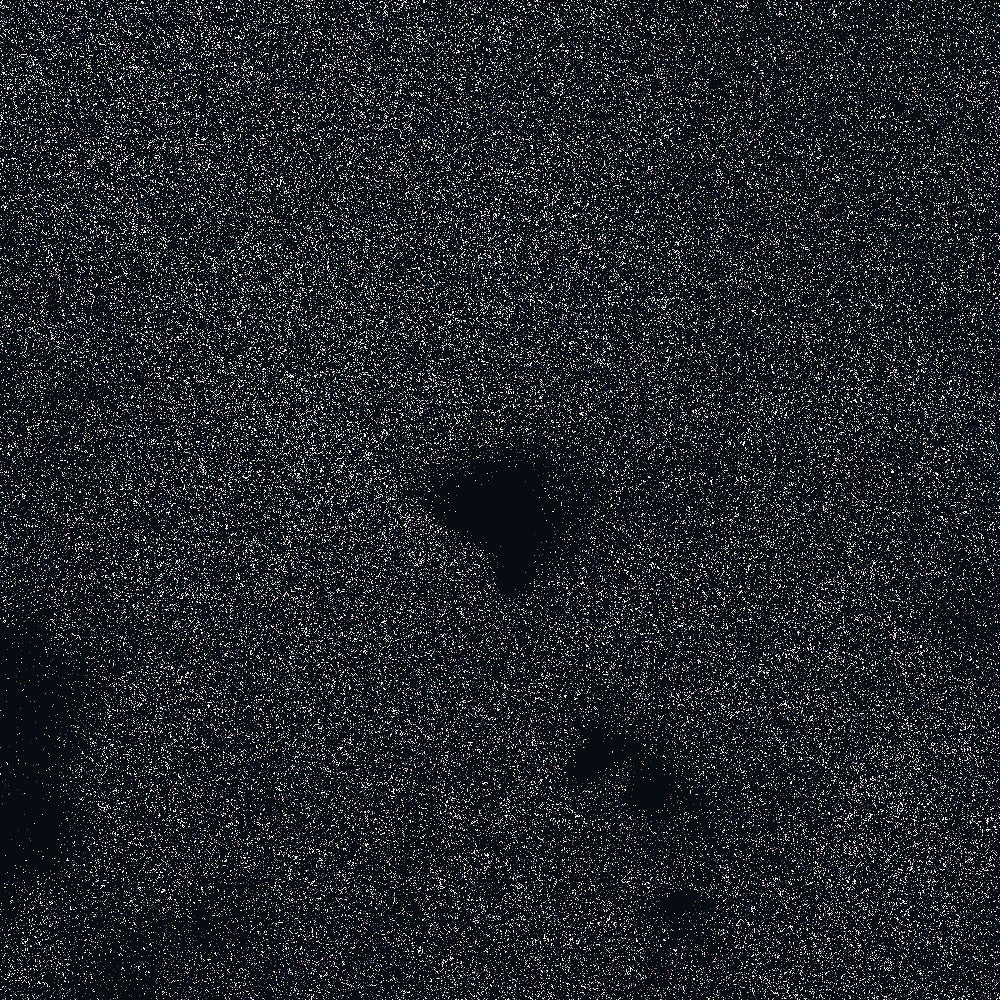
    The Barnard 68 molecular cloud as viewed by ESA’s Gaia satellite using information from the mission’s second data release. Credit: ESA/Gaia/DPAC

    For example, the nearby nebula Barnard 68 is a dark clot of cold gas and dust—tiny grains of silicates (rocky material) and complex carbon molecules similar to soot—relatively close to us in space, only a few hundred light-years away. It’s one of my favorite objects; an eerie, pitch-black ghostly mass that utterly blocks all light from stars behind it, like an opaque hole in the sky.

    It’s only half a light-year across (just about three trillion miles), with barely enough material in it to make a single star slightly heftier than the sun. It’s likely in the middle of that process now, and could transmogrify itself into a star in as little as 200,000 years.

    On the other end of the scale, we have the Orion B molecular cloud complex, a truly enormous site of active star formation that’s over a thousand light-years away and many hundreds of light-years across. It’s beefy enough to make a staggering number of stars—at least 100,000 like the sun. The iconic Orion nebula, visible to the naked eye and the birthplace of hundreds of stars, is only one small part of this huge stellar factory.
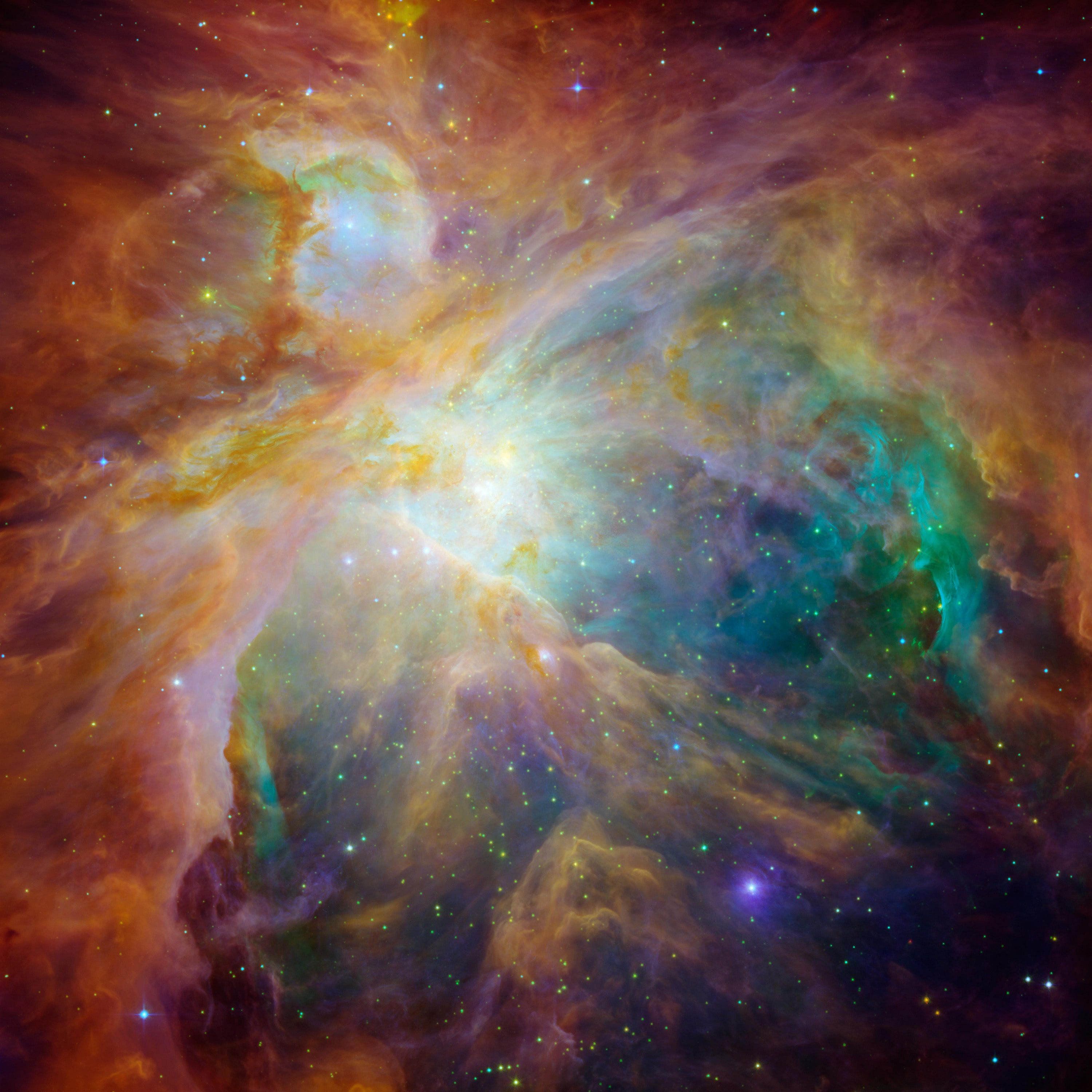
    Infant stars forming in the Orion Nebula.
    Infant stars forming in the Orion Nebula. Credit: NASA/JPL-Caltech/STScI 

    Giant clouds like this are relatively rare but crank out stars on an industrial scale, while the smaller clouds are less fecund but litter the galaxy. Just looking at those numbers statistically it’s not possible to discern the origin of the sun: it could have come from either kind of stellar nursery.

    However, these nebular environments are vastly different, which affects the stars they create. Massive stars found in a nebula have a big influence on their gestating siblings. They can blast out fierce winds of subatomic particles—like the solar wind but ramped up way past 11. These winds can seed forming stars with heavy elements like aluminum and magnesium. And later, when they explode as supernovae, they fling a different mix of these elements, such as iron and cobalt, a very long way.

    Massive stars, though, are rare. Maybe one out of a hundred stars is massive enough to hold this sort of sway, and small nebulae simply don’t make them. That means, in principle, looking at the chemical composition of the early solar system could tell us in what kind of nursery the sun was born.

    This was the focus of the newly published research. The astronomers looked at two elements in particular: aluminum-26 and iron-60. Aluminum-26 is created inside massive stars and blown out in their winds, while iron-60 is forged in the thermonuclear hell of an exploding star. Both elements are radioactive, decaying into magnesium and cobalt, so carefully measuring the amounts of these daughter elements in pristine samples from the earliest days of the solar system—from meteorites, that is—can tell us about the environment in which the sun formed.

    For their new analysis, the international team of scientists used the physics of nebulae and star formation to simulate a sunlike star’s birth in a variety of environments, from nebulae containing very few stars (a proxy for smaller clouds) up to huge ones with many thousands. Next, they calculated the elemental composition of the proto-proxy-presolar disk that emerged in each one, then compared these virtual yields against what’s actually measured in meteorites.

    Their results indicate that as it formed in its natal disk, the early sun was likely pummeled by powerful winds and supernovae explosions—both sourced from massive stars. That means the solar nursery was more like the Orion complex than Barnard 68.

    In other words, the sun was probably more of a downtown city kid than a rural small-town star. Of course, with its nebular nursery gone, we can’t confirm this easily. After all, you can’t go home again.

    And what of the sun’s siblings, the thousands of other stars in its extended family? Like the sun, they once nestled together like a litter of puppies, but likely wandered out on their own eons ago, and are now orphaned, scattered across the galaxy. Still, astronomers do look for them—ones with the same age and composition as the sun—so that we can learn more about our parent star.

    A reunion is pretty unlikely. If we want to see a family album, we’ll just have to put it together ourselves.

    This is an opinion and analysis article, and the views expressed by the author or authors are not necessarily those of Scientific American.


    Original Source Link

    Share. Facebook Twitter Pinterest LinkedIn WhatsApp Email Reddit Telegram
    Previous Article‘I never thought that I’d be a comedic actor’
    Next Article Muslims come into the frame in Southeast Asia’s fintech boom

    RELATED POSTS

    Poor Sleep Quality Accelerates Brain Aging

    January 1, 2026

    NASA Telescopes Capture Colliding Spiral Galaxies in Sparkling Detail

    December 31, 2025

    Star that seemed to vanish more than 130 years ago is found again

    December 31, 2025

    The Great Big Power Play

    December 30, 2025

    15 Million Years before the Megalodon, This Giant Ancient Shark Prowled the Oceans

    December 30, 2025

    Mathematicians unified key laws of physics in 2025

    December 29, 2025
    latest posts

    The Cure’s Perry Bamonte Dies at 65

    Perry Bamonte, the Cure’s longtime guitarist and keyboardist, has died following an undisclosed illness. He…

    Copper records biggest annual gain since 2009 on supply bets

    January 1, 2026

    Trump Takes One Final Big Loss In Court Before The End Of The Year

    January 1, 2026

    Zohran Mamdani sworn in as NYC mayor in midnight ceremony at Old City Hall

    January 1, 2026

    ‘College dropout’ has become the most coveted startup founder credential

    January 1, 2026

    Poor Sleep Quality Accelerates Brain Aging

    January 1, 2026

    Avengers, Toy Story 5, The Odyssey

    January 1, 2026
    Categories
    • Books (970)
    • Business (5,878)
    • Film (5,812)
    • Lifestyle (3,915)
    • Music (5,880)
    • Politics (5,882)
    • Science (5,224)
    • Technology (5,811)
    • Television (5,497)
    • Uncategorized (2)
    • US News (5,863)
    popular posts

    Taylor Swift’s Tour Security Guard Goes to Israel to Join the IDF – Billboard

    Taylor Swift‘s security guard who protected her during The Eras Tour has gone back to…

    ‘What We Do in the Shadows’ Team on Baby Colin & Guillermo’s Roles (VIDEO)

    July 27, 2022

    3 Somatic Breathwork Exercises to Begin Practicing Today

    January 10, 2025

    Blue Bloods Season 14 Episode 9 Review: Two of A Kind

    May 11, 2024
    Archives
    Browse By Category
    • Books (970)
    • Business (5,878)
    • Film (5,812)
    • Lifestyle (3,915)
    • Music (5,880)
    • Politics (5,882)
    • Science (5,224)
    • Technology (5,811)
    • Television (5,497)
    • Uncategorized (2)
    • US News (5,863)
    About Us

    We are a creativity led international team with a digital soul. Our work is a custom built by the storytellers and strategists with a flair for exploiting the latest advancements in media and technology.

    Most of all, we stand behind our ideas and believe in creativity as the most powerful force in business.

    What makes us Different

    We care. We collaborate. We do great work. And we do it with a smile, because we’re pretty damn excited to do what we do. If you would like details on what else we can do visit out Contact page.

    Our Picks

    Poor Sleep Quality Accelerates Brain Aging

    January 1, 2026

    Avengers, Toy Story 5, The Odyssey

    January 1, 2026

    ‘The Challenge’ Star Reveals Horrific Accident Blinded Him

    January 1, 2026
    © 2026 Beverly Hills Examiner. All rights reserved. All articles, images, product names, logos, and brands are property of their respective owners. All company, product and service names used in this website are for identification purposes only. Use of these names, logos, and brands does not imply endorsement unless specified. By using this site, you agree to the Terms & Conditions and Privacy Policy.

    Type above and press Enter to search. Press Esc to cancel.

    We use cookies on our website to give you the most relevant experience by remembering your preferences and repeat visits. By clicking “Accept All”, you consent to the use of ALL the cookies. However, you may visit "Cookie Settings" to provide a controlled consent.
    Cookie SettingsAccept All
    Manage consent

    Privacy Overview

    This website uses cookies to improve your experience while you navigate through the website. Out of these, the cookies that are categorized as necessary are stored on your browser as they are essential for the working of basic functionalities of the website. We also use third-party cookies that help us analyze and understand how you use this website. These cookies will be stored in your browser only with your consent. You also have the option to opt-out of these cookies. But opting out of some of these cookies may affect your browsing experience.
    Necessary
    Always Enabled
    Necessary cookies are absolutely essential for the website to function properly. These cookies ensure basic functionalities and security features of the website, anonymously.
    CookieDurationDescription
    cookielawinfo-checkbox-analytics11 monthsThis cookie is set by GDPR Cookie Consent plugin. The cookie is used to store the user consent for the cookies in the category "Analytics".
    cookielawinfo-checkbox-functional11 monthsThe cookie is set by GDPR cookie consent to record the user consent for the cookies in the category "Functional".
    cookielawinfo-checkbox-necessary11 monthsThis cookie is set by GDPR Cookie Consent plugin. The cookies is used to store the user consent for the cookies in the category "Necessary".
    cookielawinfo-checkbox-others11 monthsThis cookie is set by GDPR Cookie Consent plugin. The cookie is used to store the user consent for the cookies in the category "Other.
    cookielawinfo-checkbox-performance11 monthsThis cookie is set by GDPR Cookie Consent plugin. The cookie is used to store the user consent for the cookies in the category "Performance".
    viewed_cookie_policy11 monthsThe cookie is set by the GDPR Cookie Consent plugin and is used to store whether or not user has consented to the use of cookies. It does not store any personal data.
    Functional
    Functional cookies help to perform certain functionalities like sharing the content of the website on social media platforms, collect feedbacks, and other third-party features.
    Performance
    Performance cookies are used to understand and analyze the key performance indexes of the website which helps in delivering a better user experience for the visitors.
    Analytics
    Analytical cookies are used to understand how visitors interact with the website. These cookies help provide information on metrics the number of visitors, bounce rate, traffic source, etc.
    Advertisement
    Advertisement cookies are used to provide visitors with relevant ads and marketing campaigns. These cookies track visitors across websites and collect information to provide customized ads.
    Others
    Other uncategorized cookies are those that are being analyzed and have not been classified into a category as yet.
    SAVE & ACCEPT