
September 11, 2025
6 min read
Scientists Clash over whether Polar Geoengineering Is a Dangerous Gamble
Scientists are beginning to take clear sides on whether or not to use human-made interventions to preserve polar ice, such as pumping up seawater or launching aerosols into the atmosphere to cool the planet’s surface
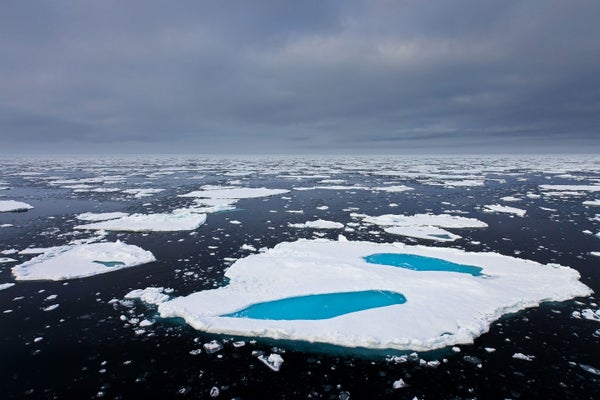
Melt ponds on Arctic sea ice near Svalbard, Norway.
Arterra/Sven-Erik Arndt/Universal Images Group via Getty Images
This story was produced in partnership with the Pulitzer Center’s Ocean Reporting Network.
A “civil war” is brewing in polar science. As climate change rapidly melts Earth’s ice, sides are being drawn among scientists on whether—and how—science should intervene to save it.
Those opposing sides on the use of geoengineering—human-made interventions to counteract global warming and its effects—at the poles are laid out in two opposing papers published this week in Frontiers in Science: One is a study in which more than 40 top glaciologists warn that geoengineering proposals to preserve glaciers and sea ice are infeasible and dangerous. The other is a responding commentary that argues that such polar geoengineering could effectively soften the blow of disastrous warming.
On supporting science journalism
If you’re enjoying this article, consider supporting our award-winning journalism by subscribing. By purchasing a subscription you are helping to ensure the future of impactful stories about the discoveries and ideas shaping our world today.
Earth’s poles are warming up to four times faster than the planet as a whole. The polar sea ice that has long reflected sunlight back into space is quickly vanishing: Arctic sea ice is expected to be completely gone during summers in the 2030s, further heating the planet. The West Antarctic and Greenland ice sheets are also melting at unprecedented rates, potentially raising sea levels by up to 1.9 meters by 2100. The Himalayas, often called the “Third Pole” because of their massive glaciers (which supply water to two billion people), saw record low snowpack in 2025.
“It seems very abstract—Antarctica, the Arctic—but of course it’s not,” says Robbie Mallett, a research fellow at the Arctic University of Norway, who was not involved with either of the two new papers. “This stuff, this cryosphere ice loss, has a real impact around the world.”
Earth has warmed by 1.3 degrees Celsius since the late 19th century—already perilously close to shattering the Paris climate agreement’s attempts to limit warming to “well below” two degrees C. And yet governments and corporations are now backing off on previous climate goals, and the planet’s annual greenhouse gas emissions continue to climb. The lack of action or will to curb this has led some researchers to seriously propose planetary-scale geoengineering schemes. For many years, these proposals were just that, confined firmly to the realm of ideas. But there is now real momentum and funding to begin work on some of these projects, with field trials being carried out around the world. One result of increased money and interest in geoengineering research “is almost inevitably going to be a ‘civil war’” in the polar science community, says Jeremy Bassis of the University of Michigan, who was also not involved with either of the new papers.
In May the U.K. became the first government to fund geoengineering field trials. It allocated about 57 million (around $77 million today) to various projects, including two companies conducting trials this year to drill holes into Canadian Arctic sea ice and pump seawater on top of Arctic sea ice, where it can freeze into new layers and thicken the ice. At the Arctic Repair conference at the University of Cambridge in June, more than 175 researchers discussed geoengineering ideas ranging from employing this sea ice thickening to placing gigantic sunshades in space. In the U.S. a 2024 white paper from a new geoengineering research program at the University of Chicago called for more study of interventions to preserve the ice sheets.

Tarps meant to reflect sunlight cover a portion of the ice grotto near the Rhône Glacier on August 21, 2025, near Gletsch, Switzerland.
The growing interest in geoengineering has alarmed some scientists, including Martin Siegert, a glaciologist at the University of Exeter in England and lead author of the new study. He and his co-authors felt the need to push back after polar geoengineering was discussed by panels at the annual United Nations climate summit in Dubai in 2023.
Their paper critiques five interventions that are being researched, including thickening sea ice and injecting aerosols into the stratosphere to cool the planet. Another is giant curtains that could be anchored to the seabed to deflect the warm ocean water that is melting key parts of the Antarctic ice sheet (including the Thwaites Glacier, nicknamed the “Doomsday Glacier”) from below. A fourth involves drilling through glaciers and pumping out the meltwater that lubricates their slide into the sea. The last is dumping iron dust into the Southern Ocean to provoke phytoplankton blooms that would suck heat-trapping carbon dioxide from the atmosphere, a move that set off a backlash when an American entrepreneur tried it off Canada in 2012.
The new study argues that sea ice thickening and the other ideas simply wouldn’t work in the real world. “Even if they could work at a small scale, they can’t work at the scale that’s needed and in the time that we need,” Siegert says of the five techniques. For instance, the study cites a 2017 paper that estimated that one million pumps would have to be deployed annually for 10 years to thicken just 10 percent of the Arctic Ocean ice—a number that is nearly impossible to deploy, Siegert and his co-authors write. As for the seabed curtain, the new study argues it would be prohibitively difficult to install complex, costly infrastructure in an iceberg-ridden region that one out of five research expeditions has failed to reach.
These techniques could also damage the fragile polar environment, according to Siegert and his colleagues’ paper. Though stratospheric aerosol injection over the poles could potentially cool the lower atmosphere atop the ice caps, the study notes that the aerosols could actually heat the overlying stratosphere—which could disrupt atmospheric circulation, warming Russia in the winter. But these aerosols could also deplete the ozone layer or worsen ocean acidification. And seabed curtains could divert warm water toward other glaciers, the paper argues, or disrupt the upwelling of nutrients that feed phytoplankton—a crucial food for many other species.
The biggest concern, Siegert and his co-authors argue, is that geoengineering could create a sociological effect called a “moral hazard,” diminishing the urgency of climate action among the public, fossil fuel companies or policymakers. “This is the fear—that instead of mitigation, they’re going to use that as an excuse to continue emitting,” says study co-author Regine Hock of the University of Alaska Fairbanks.
One earlier study suggested that people tend to think moral hazard is a risk, but another paper found that social media posts about geoengineering did little to tamp down the desire to tackle climate change. “On this very individual level, we do not find consistent evidence for moral hazard,” says Christine Merk of the Kiel Institute for the World Economy in Germany, who conducted the second experiment but was not involved with either of the new papers. That could change, however, she adds, if influential politicians or businesspeople start promoting geoengineering.
“You can’t just sit around documenting as the ship sinks. Let’s try and launch a few lifeboats.” —John Moore, University of Lapland
In the commentary published along with the study by Siegert and his co-authors, John Moore of the University of Lapland in Finland, who has been leading research on seabed curtains, and two co-authors argue that Siegert and his team fail to account for the “moral hazard of non-research”—for example, weighing the risks of geoengineering against the risks of crossing climate tipping points. Scientists today should not only inform the public about climate change; they should also start exploring ways to reduce its harms, the commentary contends. “You can’t just sit around documenting as the ship sinks,” Moore says. “Let’s try and launch a few lifeboats.”
Of 56 other polar geoengineering ideas cataloged by the University of the Arctic, a network of universities and other organizations, almost no research has been conducted on their efficacy or effects, the commentary says. It also cites a survey finding that members of Indigenous and minority ethnic groups—who are often more vulnerable than many others to the effects of climate change—viewed measures such as stratospheric aerosol injection more favorably than the general public, rating the risks and benefits as about equal. Some Indigenous groups’ reactions to field trials have been mixed, though. One sea ice thickening trial received approval from local Indigenous leaders, but a trial that involved covering lake ice in Alaska with reflective glass microspheres was shut down after protests from local Indigenous people who said that they weren’t properly consulted.
At the conference at the University of Cambridge earlier this summer, Gareth Davies of Free University Amsterdam argued that reactions to geoengineering are driven by personal worldviews—about whether and how much humans should intervene in nature or whether geoengineering could prop up systems that have damaged the planet. Because these opponents will never agree with geoengineering supporters like himself, Davies says, the only response is for each side to try to understand the other’s fears. “But the only way we can do that,” he said, “is to have public debate.”
Editor’s Note (9/11/25): This article was revised after posting to correct editorial errors in the descriptions of a paper that found that social media posts about geoengineering did little to tamp down the desire to tackle climate change and of a trial that involved covering lake ice in Alaska with reflective glass microsphere.