
Close Menu
Beverly Hills Examiner

    Subscribe to Updates

    Get the latest creative news from FooBar about art, design and business.

    What's Hot

    Jack White Blasts U.S. Congressman in Heated Statement

    December 30, 2025

    Meet the Teddy Roosevelt terrier, one of the American Kennel Club’s new dog breeds for 2026

    December 30, 2025

    Rounding up a year that mostly won’t be missed

    December 30, 2025
    Facebook X (Twitter) Instagram
    Beverly Hills Examiner
    • Home
    • US News
    • Politics
    • Business
    • Science
    • Technology
    • Lifestyle
    • Music
    • Television
    • Film
    • Books
    • Contact
      • About
      • Amazon Disclaimer
      • DMCA / Copyrights Disclaimer
      • Terms and Conditions
      • Privacy Policy
    Beverly Hills Examiner
    Home»Science»Shaken Baby Syndrome Has Been Discredited. Why Is Robert Roberson Still on Death Row?
    Science

    Shaken Baby Syndrome Has Been Discredited. Why Is Robert Roberson Still on Death Row?

    By AdminOctober 27, 2024
    Facebook Twitter Pinterest LinkedIn WhatsApp Email Reddit Telegram
    Shaken Baby Syndrome Has Been Discredited. Why Is Robert Roberson Still on Death Row?


    October 26, 2024

    5 min read

    Shaken Baby Syndrome Has Been Discredited. Why Is Robert Roberson Still on Death Row?

    Convicted of a crime that never happened, Roberson’s case is a prime example of how the U.S. legal system often fails to recognize advances in scientific knowledge
    By Jeff Kukucka & David Faigman

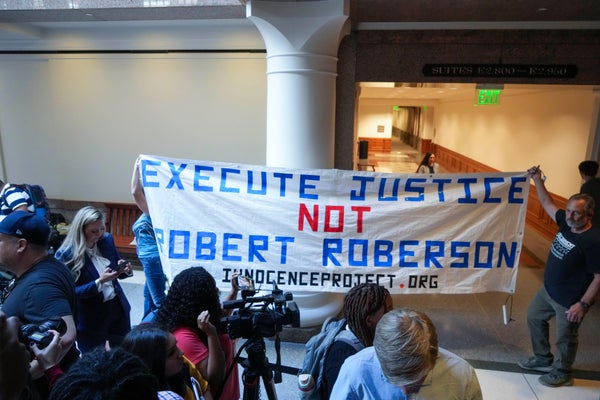
    Banner protesting Execution of Robert Roberson

    Protesters from the Innocence Project in the hallway outside a hearing room in Texas. Legislators issued an unusual last-minute subpoena to save death-row inmate Robert Roberson from his scheduled execution.

    Bob Daemmrich/Alamy Live News

    In a last-minute effort to save the life of a man on death row, a bipartisan group of Texas legislators has just done something extraordinary: they have unanimously subpoenaed Robert Roberson, convicted in 2003 of killing his daughter based on the now-discredited theory of shaken baby syndrome, to testify before them five days after he was scheduled to be executed, effectively forcing the state to keep him alive.

    Roberson is one of many people who have been imprisoned for injuries to a child that prosecutors argue resulted from violent shaking. But research has exposed serious flaws in these determinations, and dozens of other defendants who have been wrongly convicted under this theory have been exonerated. Yet Roberson remains on death row, even as politicians, scientists and others—including the lead detective who investigated him and one of the jurors who convicted him—have spoken out on his behalf. If his execution proceeds, they and many others believe that Texas will be killing an innocent man for a “crime” that never happened.

    As our scientific understanding of shaken baby syndrome has evolved over the past 20 years, justice requires that courts reexamine old convictions in light of new findings. This is especially true for Roberson, who would be the first person in the U.S. to be executed for a conviction based on shaken baby syndrome. No matter one’s view of the death penalty, the ultimate punishment must be held to the ultimate standard of proof—and Roberson’s case falls woefully short of that standard.


    On supporting science journalism

    If you’re enjoying this article, consider supporting our award-winning journalism by subscribing. By purchasing a subscription you are helping to ensure the future of impactful stories about the discoveries and ideas shaping our world today.


    The theory behind shaken baby syndrome dates back to the early 1970s, when two medical researchers—Norman Guthkelch and John Caffey—separately published the first scientific papers explaining that shaking an infant can cause fatal internal injuries even absent external injuries. Over time physicians and law enforcement officers, among others, widely began to rely on a triad of symptoms—brain bleeding, brain swelling and retinal bleeding—as definitive proof that someone had abused a child by shaking. To support this theory, researchers cited cases in which a child displayed these symptoms and a caretaker confessed to shaking the child, which ostensibly confirmed the triad as a reliable way to diagnose abuse.

    There is no doubt that shaking a child can cause injuries, including those that comprise the shaken baby syndrome triad. Newer research, however, has shown that shaking is not the only way to cause those injuries: They can also result from an accidental “short fall” (e.g., falling off a bed) as well as from other medical causes (e.g., pneumonia, improper medication)—all of which were true of Roberson’s daughter. In fact, a 2024 study found that the injuries historically used to diagnose shaking are actually more likely to result from accidents than from shaking. In short, modern science understands that the presence of these symptoms does not necessarily mean that a child was abused, nor does their absence mean that they were not abused.

    Why did clinicians wrongly trust this triad of symptoms for so long? The short answer is that correcting misconceptions requires a feedback loop that is often lacking in child abuse investigations. When a doctor diagnoses a living adult and prescribes a treatment, the effectiveness of that treatment provides feedback on the correctness of their diagnosis; if the treatment proves ineffective, doctors can learn from this misdiagnosis and adjust future diagnoses accordingly. Such feedback, however, is not always sufficient; for instance, doctors practiced bloodletting for centuries because it was generally accepted and seemed to work for some patients, though it was an illusory correlation. With respect to shaking, doctors rarely learn whether a child was actually shaken because the child is typically deceased or unable to articulate what happened, and thus doctors rarely receive feedback that the triad led to an incorrect diagnosis.

    As for the studies that used a caretaker’s confession to establish that abuse occurred, it is now well-known that innocent people sometimes confess to crimes they did not commit, such that confessions are not synonymous with truth. Some scholars have even argued that the unique circumstances of suspected shaking cases (e.g., suspects’ emotional state) create an especially high risk of false confession.

    Further complicating matters, child abuse determinations are subject to cognitive bias, in which extraneous information leads experts to interpret the same injury in different ways—at least one of which must be incorrect. In one study, for example, medical professionals more often judged the same childhood injury as abuse rather than an accident if told that the child’s parents were unmarried or drug users—both of which appear to be true of Roberson. Another study found that those same extraneous factors led emergency room doctors to misdiagnose accidental injuries as abuse in a staggering 83 percent of cases.

    Even merely knowing about a criminal accusation can affect how a doctor appraises a child’s injuries. In one study, independent experts reviewed medical records from cases where, unbeknownst to them, a fellow expert had testified that the child was shaken. In 94 percent of those cases, the independent experts concluded that the child’s “head injuries… possibly, or even probably, had a non-traumatic cause.”

    Autopsy decisions are likewise unreliable. In a 2021 study, medical examiners’ opinions of whether a child’s death was an accident or homicide were heavily swayed by the child’s race and who brought them to the hospital, even though the child’s injuries and history were otherwise identical. In response, prominent medical examiners explained that manner of death is “not a ‘scientific’ determination” and “often does not fit well in court.” Yet jurors—including some from at Roberson’s trial—often hear and trust these tenuous opinions, which has led some scholars to argue that manner of death testimony should not be admissible in U.S. courts, as is the case in nearly every other country.

    As research debunking shaken baby syndrome has grown, so too have successful legal challenges to criminal convictions that hinge on it, including another Texas case where—just eight days before Roberson’s scheduled execution—a man was granted a new trial on the grounds that “scientific knowledge has evolved” since his 2004 trial and “would likely yield an acquittal” in 2024. Before his 2016 death, even Guthkelch—one of the architects of the theory—lamented that his “friendly suggestion for avoiding injury to children has become an excuse for imprisoning innocent parents.” Roberson is one of those innocent parents.

    Science is constantly evolving, and when it reveals a past mistake, we do not simply resign ourselves to it; we take corrective action. Our legal system should be no different. When Robert Roberson was convicted, the injury triad was widely accepted as proof of shaking—but as science has progressed, that is no longer the case. The law’s guarantee of due process must account for such progress, especially when a person’s life literally depends on it. For the law to ignore evolving scientific knowledge is not merely unfair; it is criminal.

    This is an opinion and analysis article, and the views expressed by the author or authors are not necessarily those of Scientific American.


    Original Source Link

    Share. Facebook Twitter Pinterest LinkedIn WhatsApp Email Reddit Telegram
    Previous ArticleThe Front Room review – a strangely scatalogical chamber piece
    Next Article Renault 5 EV Review: Specs, Price, Availability

    RELATED POSTS

    The Great Big Power Play

    December 30, 2025

    15 Million Years before the Megalodon, This Giant Ancient Shark Prowled the Oceans

    December 30, 2025

    Mathematicians unified key laws of physics in 2025

    December 29, 2025

    People Who Drink Bottled Water on a Daily Basis Ingest 90,000 More Microplastic Particles Each Year

    December 29, 2025

    Why Active Rest Is Important During the Holidays

    December 28, 2025

    Mathematicians spent 2025 exploring the edge of mathematics

    December 28, 2025
    latest posts

    Jack White Blasts U.S. Congressman in Heated Statement

    Jack White has posted a heated statement in response to U.S. Congressman Tim Burchett sharing a…

    Meet the Teddy Roosevelt terrier, one of the American Kennel Club’s new dog breeds for 2026

    December 30, 2025

    Rounding up a year that mostly won’t be missed

    December 30, 2025

    Obamacare subsidies to expire after Congress failed to extend or replace them

    December 30, 2025

    Commodore 64 Ultimate Review: An Astonishing Remake

    December 30, 2025

    The Great Big Power Play

    December 30, 2025

    My Undesirable Friends Part I Last Air in Moscow Makes Oscar Shortlist

    December 30, 2025
    Categories
    • Books (967)
    • Business (5,875)
    • Film (5,809)
    • Lifestyle (3,912)
    • Music (5,877)
    • Politics (5,879)
    • Science (5,221)
    • Technology (5,808)
    • Television (5,494)
    • Uncategorized (2)
    • US News (5,860)
    popular posts

    ‘Blood & Treasure’ Recap: Season 2 Premiere — ‘Soul of Genghis Khan’

    Nearly three years after its freshman finale on CBS, Blood & Treasure resumed globe-trotting this…

    Internal Facebook memo warns company must be disciplined, prioritize

    June 30, 2022

    Wicked Little Letters review – a flimsy comic farce

    February 23, 2024

    ‘Harry Potter’ star Tom Felton reveals he ‘always had a secret love’ for co-star Emma Watson

    October 16, 2022
    Archives
    Browse By Category
    • Books (967)
    • Business (5,875)
    • Film (5,809)
    • Lifestyle (3,912)
    • Music (5,877)
    • Politics (5,879)
    • Science (5,221)
    • Technology (5,808)
    • Television (5,494)
    • Uncategorized (2)
    • US News (5,860)
    About Us

    We are a creativity led international team with a digital soul. Our work is a custom built by the storytellers and strategists with a flair for exploiting the latest advancements in media and technology.

    Most of all, we stand behind our ideas and believe in creativity as the most powerful force in business.

    What makes us Different

    We care. We collaborate. We do great work. And we do it with a smile, because we’re pretty damn excited to do what we do. If you would like details on what else we can do visit out Contact page.

    Our Picks

    The Great Big Power Play

    December 30, 2025

    My Undesirable Friends Part I Last Air in Moscow Makes Oscar Shortlist

    December 30, 2025

    ‘Stranger Things’ Review-Bombed, Will’s Coming-Out Scene Criticized

    December 30, 2025
    © 2025 Beverly Hills Examiner. All rights reserved. All articles, images, product names, logos, and brands are property of their respective owners. All company, product and service names used in this website are for identification purposes only. Use of these names, logos, and brands does not imply endorsement unless specified. By using this site, you agree to the Terms & Conditions and Privacy Policy.

    Type above and press Enter to search. Press Esc to cancel.

    We use cookies on our website to give you the most relevant experience by remembering your preferences and repeat visits. By clicking “Accept All”, you consent to the use of ALL the cookies. However, you may visit "Cookie Settings" to provide a controlled consent.
    Cookie SettingsAccept All
    Manage consent

    Privacy Overview

    This website uses cookies to improve your experience while you navigate through the website. Out of these, the cookies that are categorized as necessary are stored on your browser as they are essential for the working of basic functionalities of the website. We also use third-party cookies that help us analyze and understand how you use this website. These cookies will be stored in your browser only with your consent. You also have the option to opt-out of these cookies. But opting out of some of these cookies may affect your browsing experience.
    Necessary
    Always Enabled
    Necessary cookies are absolutely essential for the website to function properly. These cookies ensure basic functionalities and security features of the website, anonymously.
    CookieDurationDescription
    cookielawinfo-checkbox-analytics11 monthsThis cookie is set by GDPR Cookie Consent plugin. The cookie is used to store the user consent for the cookies in the category "Analytics".
    cookielawinfo-checkbox-functional11 monthsThe cookie is set by GDPR cookie consent to record the user consent for the cookies in the category "Functional".
    cookielawinfo-checkbox-necessary11 monthsThis cookie is set by GDPR Cookie Consent plugin. The cookies is used to store the user consent for the cookies in the category "Necessary".
    cookielawinfo-checkbox-others11 monthsThis cookie is set by GDPR Cookie Consent plugin. The cookie is used to store the user consent for the cookies in the category "Other.
    cookielawinfo-checkbox-performance11 monthsThis cookie is set by GDPR Cookie Consent plugin. The cookie is used to store the user consent for the cookies in the category "Performance".
    viewed_cookie_policy11 monthsThe cookie is set by the GDPR Cookie Consent plugin and is used to store whether or not user has consented to the use of cookies. It does not store any personal data.
    Functional
    Functional cookies help to perform certain functionalities like sharing the content of the website on social media platforms, collect feedbacks, and other third-party features.
    Performance
    Performance cookies are used to understand and analyze the key performance indexes of the website which helps in delivering a better user experience for the visitors.
    Analytics
    Analytical cookies are used to understand how visitors interact with the website. These cookies help provide information on metrics the number of visitors, bounce rate, traffic source, etc.
    Advertisement
    Advertisement cookies are used to provide visitors with relevant ads and marketing campaigns. These cookies track visitors across websites and collect information to provide customized ads.
    Others
    Other uncategorized cookies are those that are being analyzed and have not been classified into a category as yet.
    SAVE & ACCEPT