
Close Menu
Beverly Hills Examiner

    Subscribe to Updates

    Get the latest creative news from FooBar about art, design and business.

    What's Hot

    A month with the iPhone Duo has changed how I use my phone | TechCrunch

    November 26, 2026

    Former Biden official: AI is already collecting your Census data | Fortune

    November 26, 2026

    Inside the Madcap World of Chuyín: Everyone Sings About the Neverending Party. I Sing About the Hangover

    November 26, 2026
    Facebook X (Twitter) Instagram
    Beverly Hills Examiner
    • Home
    • US News
    • Politics
    • Business
    • Science
    • Technology
    • Lifestyle
    • Music
    • Television
    • Film
    • Books
    • Contact
      • About
      • Amazon Disclaimer
      • DMCA / Copyrights Disclaimer
      • Terms and Conditions
      • Privacy Policy
    Beverly Hills Examiner
    Home»Science»Sniffing Women’s Tears Makes Men Less Aggressive
    Science

    Sniffing Women’s Tears Makes Men Less Aggressive

    By AdminDecember 21, 2023
    Facebook Twitter Pinterest LinkedIn WhatsApp Email Reddit Telegram
    Sniffing Women’s Tears Makes Men Less Aggressive

    [ad_1]

    December 21, 2023

    4 min read

    For the first time, researchers have used behavioral measures, brain imaging and molecular biology to test how odorless chemicals from human tears affect people
    By Rachel Nuwer

    Sniffing Women’s Tears Makes Men Less Aggressive

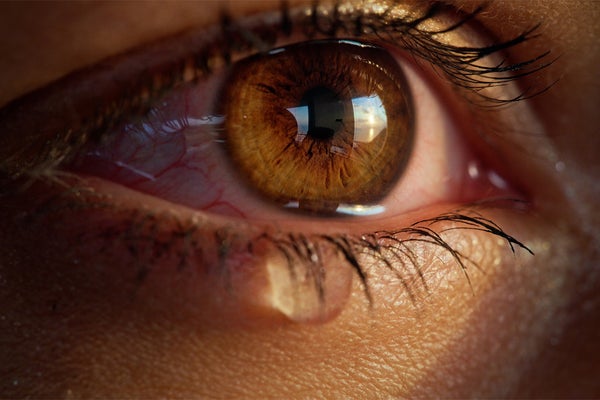
    When someone starts to cry, other people oftentimes feel empathy and concern. But the biological reasons for shedding tears can extend beyond merely prompting a sense of compassion. The tears themselves appear to take on a role as a chemical peacemaker between men and women, new research has discovered.

    Women’s tears act to reduce aggression in men who are close enough to catch a whiff of the waterworks, according to findings published in PLOS Biology and confirmed through human behavioral studies, brain imaging and molecular biology. The researchers speculate that tears from people who aren’t women likely have a similar effect, but this has yet to be tested.

    The new paper suggests that a fundamental reason why women shed emotional tears is “to convey a chemical signal that lowers aggression,” says Shani Agron, co-lead author of the study, which she conducted for her doctoral degree in neurobiology at the Weizmann Institute of Science in Israel. (Agron has since graduated.) “We believe this is a shared mechanism of many mammals.”

    Producing tears has long been considered a uniquely human behavior, but that’s a flawed notion, says co-senior author Noam Sobel, a neurobiologist at the Weizmann Institute of Science, who was Agron’s adviser. Dogs, for example, shed tears when they reunite with their owners after a period of separation. Baby mouse tears contain molecular cues that sway female mice to reject male advances, while pheromones in female mouse tears encourage males to stop fighting each other and mate with the female instead. Mole rat subordinates, moreover, go so far as to cover themselves in their own tears to chemically deflect aggression from dominant members in their group.

    Humans, like other mammals, communicate information with body odors. But it wasn’t obvious that tears would have any olfactory effect on human behavior because people cannot perceive a smell from them. Additionally, while most mammals have a second olfactory organ that is responsible for detecting pheromones, in humans, this organ is thought to be vestigial.

    The first evidence that tears can chemically influence human behavior emerged in 2011, when Sobel and his colleagues published a study in Science that showed that women’s tears reduced levels of testosterone and self-reported sexual arousal in men. This earlier work raised more questions than it provided answers for. It took years of effort to conduct a more thorough follow-up, in part because of the difficulty of collecting tears from donors. The researchers need at least one milliliter of tears to use on each experimental participant, which is “a lot of tears,” Sobel says. Using an onion or other irritant to force someone’s eyes to water is not an option, Agron adds, because “these are a completely different type of tears.”

    To collect the tears used in the new study, the team put out a call for volunteers who cry easily. Only a few men showed up, and none was able to produce enough tears to qualify. Of the 100 or so women who volunteered, only six were able to supply sufficient amounts of tears to warrant collection. Participants could use any means they wanted to elicit the tears—from listening to sad music to reading a sad letter—but most turned to the lab’s expansive “library of sad movies,” Agron says. In addition to tears, the researchers also collected drops of saline solution that they trickled down women’s face for use in control experiments.

    The researchers next gathered data from 25 male volunteers who played a game in the lab that is often used in studies of aggression. During the competitive game, participants were led to believe that their opponent was another person. It was in fact a computer algorithm, however. Occasionally, the opponent stole money from the participants, who could then either choose to take revenge, with no monetary gain for themselves, or let their opponent get away with it but continue collecting more money for themselves. The researchers calculated aggressiveness by the number of times a participant chose revenge divided by the number of times they were provoked. The team also repeated this experiment in a second group of 26 male volunteers who played the game while inside a magnetic resonance imaging scanner, allowing their brain activity data to be collected.

    All participants played the game twice, and before each session, they were asked to inhale from a “sniff jar” that they were told contained “assorted odors” but that in fact held either tears or saline. The researchers found that when the men sniffed the women’s tears, they were nearly 44 percent less aggressive in the game than when they sniffed the saline solution. The behavioral reduction in aggression was also accompanied by neuronal changes. The researchers observed that the men’s brain post-tear sniff exhibited less activity in the prefrontal cortex and the left anterior insula, regions that are associated with aggression and decision-making. Connectivity between the anterior insula and amygdala, a region that is responsible for emotional processing and also part of the olfactory network, increased as well.

    Working with colleagues at Duke University, the team used molecular biology methods to test the effects of tears and saline on 62 human olfactory receptors in a lab dish. They identified four receptors that responded to tears but not saline. This finding helps to answer “a major question” about how pheromonelike signals are processed in humans, Agron says.

    Agron, Sobel and their colleagues are now interested in running future experiments to test the effect of women’s tears on other women and that of babies’ tears on adults. Sobel hypothesizes that baby tears, especially, will likely have an aggressiveness-lowering effect on adults. “Babies cannot communicate with you in language,” he says. “But evolution may have provided babies with this tool to lower aggression.”

    The fact that people continue to be able to produce tears throughout adulthood, Agron adds, indicates that crying is probably “a behavior that serves us throughout life.”

    [ad_2]

    Original Source Link

    Share. Facebook Twitter Pinterest LinkedIn WhatsApp Email Reddit Telegram
    Previous ArticleSweet Sue review – a strange, disjointed film
    Next Article 25 Work From Home Gift Ideas: Chairs, Desks, Webcams, and Peripherals

    RELATED POSTS

    The Iowa Lead Detonation Happened. Now the Real Work Begins to Study It

    November 25, 2026

    Thanksgiving Travel Will Be a Stormy Mess

    November 24, 2026

    Voyager 1 Beat the Odds and Is Still Working a Light-Day Away From Earth

    November 18, 2026

    The Dark Side of the Moon Was the Brightest Part of 2026

    November 17, 2026

    Just 400 US Data Centers Use More Electricity Than Michigan

    November 16, 2026

    The EPAs Chemical-Detecting Plane Isnt Doing Its Job Anymore

    November 16, 2026
    latest posts

    A month with the iPhone Duo has changed how I use my phone | TechCrunch

    For years, the definition of a premium smartphone depended on its cameras, processors, and how…

    Former Biden official: AI is already collecting your Census data | Fortune

    November 26, 2026

    Inside the Madcap World of Chuyín: Everyone Sings About the Neverending Party. I Sing About the Hangover

    November 26, 2026

    Get Ready for the Great Asterix Film Festival and Three Restored Asterix Animated Movies!

    November 26, 2026

    Companies selling robot-training video used to call about privacy once a month. Now its several times a week | Fortune

    November 26, 2026

    See Sunrise on the Reaping Characters Side-By-Side With OG Hunger Games Cast

    November 26, 2026

    King Crimson Co-Founder Michael Giles Dies at 84

    November 25, 2026
    Categories
    • Books (1,630)
    • Business (6,536)
    • Cover Story (18)
    • Film (6,470)
    • Lifestyle (4,504)
    • Music (6,546)
    • Politics (6,522)
    • Science (5,876)
    • Technology (6,474)
    • Television (6,168)
    • Uncategorized (3)
    • US News (6,519)
    popular posts

    Pet influencers are hotter than ever. But how do dogs do taxes?

    [ad_1] A dog-tired husky with bright pink ears rests on the marble hotel floor, napping…

    Sandy Grigsby: Personal Branding Image Expert and Founder of Briofive

    August 26, 2022

    Are period-tracking apps still safe to use in the US post Roe v Wade?

    June 25, 2022

    Sarah Palin Raves About Trump’s Testicles During Toxic Self-Pity Rally Rant

    July 10, 2022
    Archives
    Browse By Category
    • Books (1,630)
    • Business (6,536)
    • Cover Story (18)
    • Film (6,470)
    • Lifestyle (4,504)
    • Music (6,546)
    • Politics (6,522)
    • Science (5,876)
    • Technology (6,474)
    • Television (6,168)
    • Uncategorized (3)
    • US News (6,519)
    About Us

    We are a creativity led international team with a digital soul. Our work is a custom built by the storytellers and strategists with a flair for exploiting the latest advancements in media and technology.

    Most of all, we stand behind our ideas and believe in creativity as the most powerful force in business.

    What makes us Different

    We care. We collaborate. We do great work. And we do it with a smile, because we’re pretty damn excited to do what we do. If you would like details on what else we can do visit out Contact page.

    Our Picks

    See Sunrise on the Reaping Characters Side-By-Side With OG Hunger Games Cast

    November 26, 2026

    King Crimson Co-Founder Michael Giles Dies at 84

    November 25, 2026

    S&P considers Nvidia credit downgrade over governance and key man risks | TechCrunch

    November 25, 2026
    © 2026 Beverly Hills Examiner. All rights reserved. All articles, images, product names, logos, and brands are property of their respective owners. All company, product and service names used in this website are for identification purposes only. Use of these names, logos, and brands does not imply endorsement unless specified. By using this site, you agree to the Terms & Conditions and Privacy Policy.

    Type above and press Enter to search. Press Esc to cancel.

    We use cookies on our website to give you the most relevant experience by remembering your preferences and repeat visits. By clicking “Accept All”, you consent to the use of ALL the cookies. However, you may visit "Cookie Settings" to provide a controlled consent.
    Cookie SettingsAccept All
    Manage consent

    Privacy Overview

    This website uses cookies to improve your experience while you navigate through the website. Out of these, the cookies that are categorized as necessary are stored on your browser as they are essential for the working of basic functionalities of the website. We also use third-party cookies that help us analyze and understand how you use this website. These cookies will be stored in your browser only with your consent. You also have the option to opt-out of these cookies. But opting out of some of these cookies may affect your browsing experience.
    Necessary
    Always Enabled
    Necessary cookies are absolutely essential for the website to function properly. These cookies ensure basic functionalities and security features of the website, anonymously.
    CookieDurationDescription
    cookielawinfo-checkbox-analytics11 monthsThis cookie is set by GDPR Cookie Consent plugin. The cookie is used to store the user consent for the cookies in the category "Analytics".
    cookielawinfo-checkbox-functional11 monthsThe cookie is set by GDPR cookie consent to record the user consent for the cookies in the category "Functional".
    cookielawinfo-checkbox-necessary11 monthsThis cookie is set by GDPR Cookie Consent plugin. The cookies is used to store the user consent for the cookies in the category "Necessary".
    cookielawinfo-checkbox-others11 monthsThis cookie is set by GDPR Cookie Consent plugin. The cookie is used to store the user consent for the cookies in the category "Other.
    cookielawinfo-checkbox-performance11 monthsThis cookie is set by GDPR Cookie Consent plugin. The cookie is used to store the user consent for the cookies in the category "Performance".
    viewed_cookie_policy11 monthsThe cookie is set by the GDPR Cookie Consent plugin and is used to store whether or not user has consented to the use of cookies. It does not store any personal data.
    Functional
    Functional cookies help to perform certain functionalities like sharing the content of the website on social media platforms, collect feedbacks, and other third-party features.
    Performance
    Performance cookies are used to understand and analyze the key performance indexes of the website which helps in delivering a better user experience for the visitors.
    Analytics
    Analytical cookies are used to understand how visitors interact with the website. These cookies help provide information on metrics the number of visitors, bounce rate, traffic source, etc.
    Advertisement
    Advertisement cookies are used to provide visitors with relevant ads and marketing campaigns. These cookies track visitors across websites and collect information to provide customized ads.
    Others
    Other uncategorized cookies are those that are being analyzed and have not been classified into a category as yet.
    SAVE & ACCEPT