
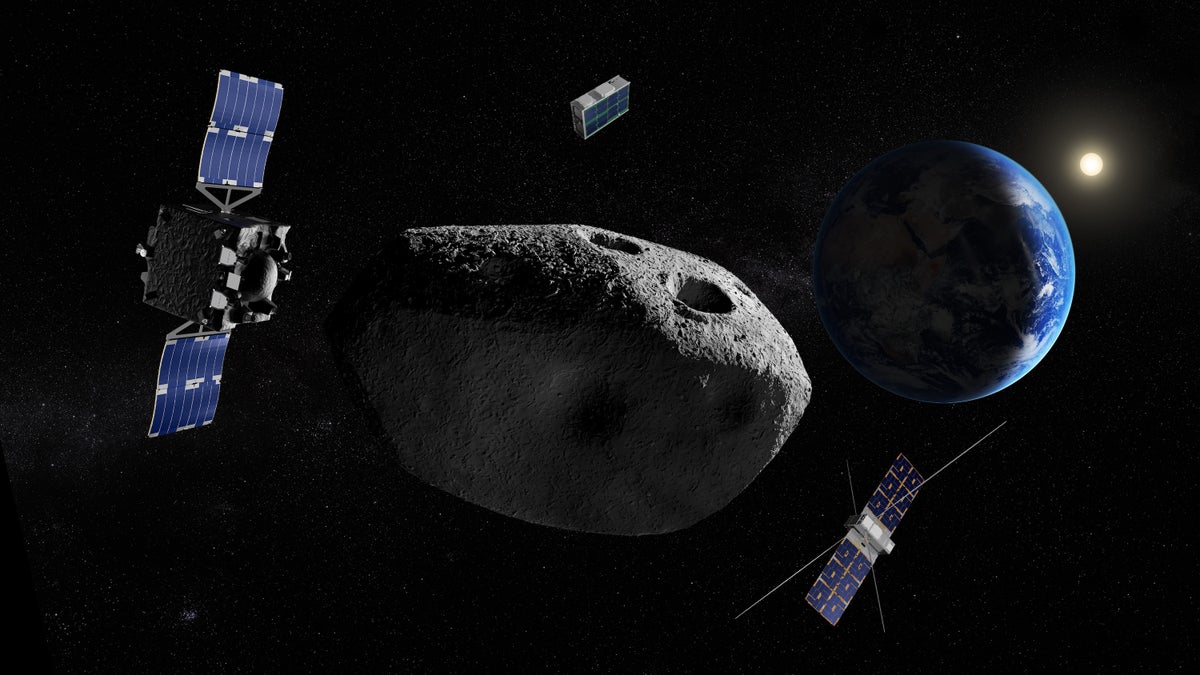
Discovered in 2004 while traveling on an alarming potential collision course with our planet, the near-Earth asteroid Apophis is now better known as the best example yet of our world dodging a cosmic bullet.
Initial calculations suggested the roughly 340-meter-diameter rock had a one-in-37 chance of impacting Earth in 2029. Careful tracking, however, subsequently dropped those odds to zero. But Apophis’s close approach in 2029 will still offer “a once-per-millennium natural experiment,” said Massachusetts Institute of Technology planetary scientist Richard Binzel at a recent workshop. After years of uncertainty about how a near miss with a near-Earth asteroid actually plays out, major space agencies are now ready to watch, listen and learn with multiple missions to monitor the event.
Apophis is set to pass within 32,000 kilometers of Earth on April 13, 2029, swooping below the altitude of geostationary satellites. Back in 2020, at the inaugural workshop dedicated to the encounter, no formal plans existed to study Apophis during this encounter. “It’s astounding,” Binzel said at the workshop’s third iteration, which was held in June in Padua, Italy. “It looked like nothing was happening…. Now we’re thinking about ‘air traffic control’ for Apophis.”
On supporting science journalism
If you’re enjoying this article, consider supporting our award-winning journalism by subscribing. By purchasing a subscription you are helping to ensure the future of impactful stories about the discoveries and ideas shaping our world today.
Three major missions are now set to get up close and personal with Apophis—one from NASA, another from the European Space Agency (ESA) and a third from the Japan Aerospace Exploration Agency (JAXA). Coordinated with and complementing one another, the trio of missions will be an international relay at the asteroid—and they could be joined by a smaller, student-led Chinese CubeSat mission bound for Apophis as well.
JAXA’s spacecraft DESTINY+ has a primary mission to fly by the active asteroid Phaethon, the parent body of the Geminid meteor shower. Originally intended to lift off in 2025, DESTINY+’s launch was pushed to no earlier than April 2028 after problems with its planned rocket, the Epsilon S, forced a switch to a different vehicle. Now the spacecraft will ride on the much larger H3 flagship rocket, which can give it a helpful boost to allow a timely visit to inbound Apophis. DESTINY+ should make first contact with the asteroid weeks ahead of the close encounter with Earth, flying by the space rock at a brisk relative speed of 1.5 kilometers per second. Its preliminary survey will help inform the next visitor, ESA’s Rapid Apophis Mission for Space Safety (Ramses); DESTINY+ will then head onward for Phaethon.
ESA’s Ramses will actually share the same ride to space as DESTINY+; the two spacecraft will nestle alongside each other in the H3 rocket thanks to a JAXA-ESA cooperation agreement signed in May. Facing the unforgiving launch deadline forced by DESTINY+’s mission profile, the Ramses mission’s scientists began working on it before actually securing full funding from ESA, said Paolo Martino, the mission’s project manager, at the June workshop. Save for its JAXA-provided solar arrays, the spacecraft is a near-replica of Hera, ESA’s asteroid-exploring predecessor, which is due to arrive this November at Didymos, the space rock that NASA’s Double Asteroid Redirection Test (DART) mission slammed into in 2022.
Ramses will be equipped with narrow- and wide-angle cameras, a high-resolution imager, hyperspectral and thermal infrared cameras, a plasma spectrometer and a laser altimeter. And it will get as close as 1 km to Apophis. It will also carry a pair of shoebox-sized CubeSats named Don Quijote and Farinella. Built in Spain, Don Quijote packs a seismometer and will be deployed a few days ahead of closest approach for a landing on Apophis. There, it will monitor the tidal forces from Earth’s gravitational field rippling through Apophis during the interplanetary encounter, giving researchers an unprecedented look at the interior of an asteroid. According to Naomi Murdoch of the Higher Institute of Aeronautics and Space (ISAE) in Toulouse, France, those insights could prove crucial for future planetary defense efforts by offering more guidance for scientists trying to develop ways to deflect or destroy threatening space rocks.
Apophis, like many asteroids, is essentially a rubble pile—but no one really knows what lies beneath the surface of such objects. Their interiors could be loose aggregates of rock held together by gravity alone, or they could pack a large coherent mass lurking at the core, explained Joe DeMartini, a postdoctoral researcher at the University of Helsinki, at the recent workshop in Padua. “Earth provides the experiment for us…. All we have to do is put an instrument there,” DeMartini said. The other Ramses-toted CubeSat, Farinella, will be deployed in the days after arrival at Apophis and will operate around the asteroid, where it will use a low-frequency radar to gather more information about the object’s internal structure.
At about this point in the asteroid’s approach, a small student-led mission from China’s Tsinghua University should make its move from a near-geostationary orbit in order to intercept and fly by Apophis. If all goes well—no certainty for any low-budget CubeSat mission—START (Student-Led Threatening Asteroid Reconnaissance of Tsinghua) will pass within around 7 km of Apophis at a relative speed of around 8.7 km per second. During its encounter, the small spacecraft will use a suite of imagers to capture changes to the asteroid’s surface as it hurtles by Earth. Approved by the China National Space Administration (CNSA), the mission will get a free ride on a Landspace Zhuque-3 rocket in early 2028. Coordination with the other missions will be necessary to minimize the chance of any deep-space snafus and will likely occur through a preexisting expert working group under the auspices of the United Nations.
While this intricate relay plays out in orbit, multiple observations will also be unfolding on the ground. Marina Brozovic of NASA’s Jet Propulsion Laboratory is coordinating observations planned for the Goldstone Solar System Radar in California; these observations will need to adjust their timing to avoid interference with transmissions to and from the Ramses mission.
Apophis’s brush with Earth will also be potentially visible as a fast-moving point of light to the vast majority of people on Earth, said cartographer Michael Zeiler and astronomer Richard Fienberg at the June workshop. The asteroid will make a nighttime pass across western Asia, Africa and Europe, although cloudy weather could be a limiting factor for many observers. This high-visibility approach from the formerly threatening asteroid will not be the end of the show, however.
While Ramses may continue its operations for a number of months, NASA’s OSIRIS-APEX mission—the name for the extended mission of the OSIRIS-REx spacecraft, which sampled the asteroid Bennu—is set to swoop in after Apophis buzzes Earth. APEX will arrive on June 5, 2029, beginning an 18-month campaign to study the asteroid. The Spacecraft Thruster Investigation of Regolith (STIR) experiment’s actions will include descending close to Apophis and firing thrusters to mobilize material from the surface, providing unique insight into weathering processes and the cohesiveness of stony asteroids.
Launched a decade ago, the spacecraft still has plenty of reserve fuel for this deep-space side quest, said Michael Nolan, the mission’s deputy principal investigator, at the workshop in Padua. But repurposing the spacecraft still brings challenges. OSIRIS-REx carried cameras designed to study Bennu, which is a B-type asteroid that Nolan says is “literally as dark as charcoal.” Meanwhile Apophis is a much brighter S-type asteroid, which mandates taking snapshots at higher sun angles to compensate and prevent overexposure.
The U.N.’s International Year of Asteroid Awareness and Planetary Defense takes place in 2029, with Apophis providing an exceedingly rare opportunity to highlight the potentially existential threats that lurk in the skies. “Apophis will safely pass the Earth,” Binzel said repeatedly during his workshop remarks. The asteroid, which takes its name from the Egyptian deity of chaos, will be seen and heard, but the only impacts will be on science and planetary defense.