
Close Menu
Beverly Hills Examiner

    Subscribe to Updates

    Get the latest creative news from FooBar about art, design and business.

    What's Hot

    Chips can survive the space environment. Can their financing? | TechCrunch

    November 20, 2026

    NYC sightseeing helicopter makes emergency landing after reporting possible engine trouble

    November 20, 2026

    Billie Eilish to Headline BST Hyde Park for First Time: She Inspires Fans, Challenges Our Industry to Be Better

    November 20, 2026
    Facebook X (Twitter) Instagram
    Beverly Hills Examiner
    • Home
    • US News
    • Politics
    • Business
    • Science
    • Technology
    • Lifestyle
    • Music
    • Television
    • Film
    • Books
    • Contact
      • About
      • Amazon Disclaimer
      • DMCA / Copyrights Disclaimer
      • Terms and Conditions
      • Privacy Policy
    Beverly Hills Examiner
    Home»Science»The SAT Problem That Everybody Got Wrong
    Science

    The SAT Problem That Everybody Got Wrong

    By AdminJune 20, 2023
    Facebook Twitter Pinterest LinkedIn WhatsApp Email Reddit Telegram
    The SAT Problem That Everybody Got Wrong

    [ad_1]

    The 1982 SAT infamously held a math question so tricky that even its creators didn’t include a correct answer. The botch required the rescoring of 300,000 exams, scholastic victims of the knotty coin rotation paradox.

    Here’s how the paradox works: Place two quarters flat on a table so that they are touching. Holding one coin stationary on the table, roll the other quarter around it, keeping edge contact between the two without slipping. When the moving quarter returns to its starting location, how many full rotations has it made? In other words, how many times has George Washington returned to his upright position in the graphic below? If you dig puzzles like this, take a minute to think about it.

    The SAT Problem That Everybody Got Wrong


    Credit: Amanda Montañez

    Many people suspect that George will make one full rotation. A quarter’s circumference is about three inches around. So the moving quarter rolls along a path with a length of three inches, the same distance as its own circumference. If we wrap a string around a quarter and roll it along a three-inch path, unfurling the string as we go, then surely three inches of string will unfurl—just enough for a single rotation.

    In fact, the moving quarter makes exactly two full rotations by the time it returns to its original position. The phenomenon defies common sense. If you find it hard to accept, I encourage you to test it for yourself. Any two disks of equal size will do.

    Related: Why the ‘Sleeping Beauty Problem’ Is Keeping Mathematicians Awake

    The version of this problem that snuck its way onto the 1982 SAT math section had a small variation: the center disk was larger than the one rolling around it. Here’s a version of that problem, with the wording slightly modified for clarity:

    The radius of circle B is three times the radius of circle A. Starting from the position shown in the figure, circle A rolls around circle B. When circle A returns to its starting point, how many rotations will it have completed?
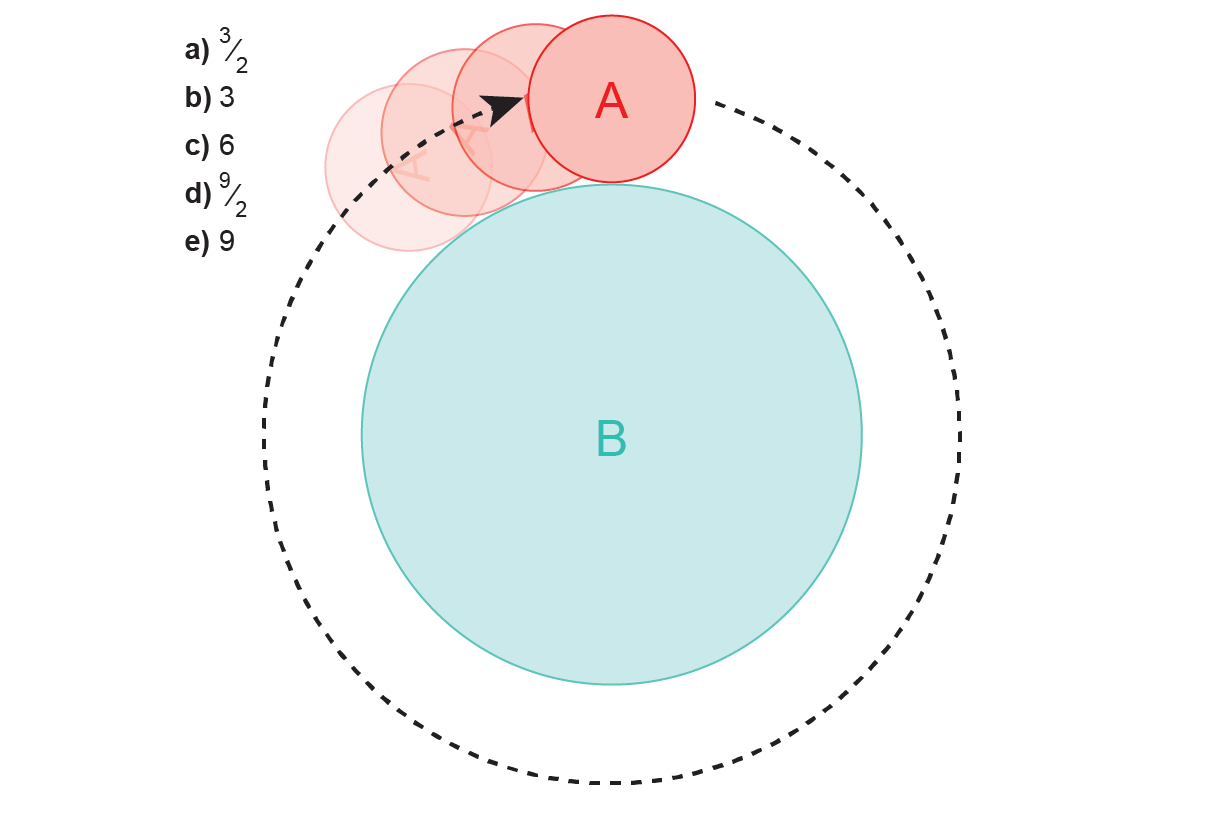
    Graphic shows circles A and B, as described in the SAT test question, along with the following answer choices: three halves, three, six, nine halves and nine.


    Credit: Amanda Montañez

    Does that seem familiar? Here, we’re told the larger circle’s radius is three times that of the smaller circle. This implies the same for the circumferences of the two circles: B is three times longer around its perimeter than A. It is tempting to reason that the smaller circle could “unwrap” itself exactly three times to encase the larger one. So “3” was the intended multiple-choice answer on the SAT. In fact, circle A makes four rotations on its trip—again, exactly one more rotation than intuition expects. The paradox was so far from the test writers’ awareness that four wasn’t offered as an option among the possible answers, so even the most astute students were forced to submit a wrong response. Three of the 300,000 students who took the test containing the question reported the issue to the College Board, and every exam had to be rescored.

    So why is there an extra rotation? The approach that led us astray above does contain some wisdom. Rolling a quarter along a three-inch straight-line path would involve only one rotation. Likewise, a small circle rolling in a straight line with a length that is three times its diameter would rotate three times. So the circular shape of the path somehow causes a rotation of its own. To see why, imagine rolling a quarter around the perimeter of a tiny poppy seed. George will rotate once even though the length around the seed is negligible. So there are two sources of rotation: one from rolling along a path (the longer it is, the more rotations) and another from revolving around an object, which contributes one rotation regardless of its size.

    Another helpful perspective comes from imagining rolling a quarter around a square. Each edge of the square is a straight-line segment, and George’s head will spin once for every three inches of length, but the moment you reach a corner, the quarter will have to rotate farther to clear that corner. (Again, try this for yourself if it’s hard to picture.) It turns out that this extra rotation at the corners is exactly 90 degrees, which results in one full rotation (360 degrees) by the time the coin traverses all four corners of the square and returns to its start. Similarly, rolling around a triangle would entail 120-degree rotations around each corner.

    The effect scales up to celestial bodies. The moon famously has a dark side and always shows the same face to us Earthlings. Many people erroneously interpret the unchanging view of the moon to mean that it must not spin about its axis like Earth does. If the moon didn’t spin during its orbit, though, we would see its dark side from some places on Earth. You can demonstrate this with your own fists—hold one steady and orbit the other around it, without any rotation. Observers standing on one of your stationary knuckles will get a different glimpse of the orbiting fist at different times. To eternally hide its derriere, the moon has to rotate once every time it completes an orbit. (This perfect parity between orbit time and rotation time is not an astronomical coincidence but rather an example of a phenomenon called tidal locking. We’re also sidelining our relativistic reference frame, with apologies to Albert Einstein.) With the coins and the SAT problem, we saw that there were two sources of rotation: some from “straight-line” rolling along any path and one extra from revolving around an object. The moon doesn’t do any straight-line rolling. If the Earth were flat, the moon would glide above it without rolling. So the single rotation of the moon is entirely because of its revolution about the very spherical Earth.

    If you had an aerial view of the solar system, how many times would you see Earth complete a rotation in a typical year? Many would say 365, but yet again, they would fall one short of the true answer: 366. (Note this has nothing to do with leap years, which are a completely separate matter.) Humanity has defined a day to be the amount of time it takes for the sun to return to the same location in the sky. It is convenient to always have the sun directly overhead at noon. But when Earth completes one rotation, the sun actually hasn’t quite returned to its perch in the sky yet. Let’s revisit the SAT diagram to see what’s going on—only this time we’ll mark a fixed dot on the small circle and observe what happens to the dot as that circle rolls around the big one:

    Graphic shows three iterations of a large circle, a small circle and a dot representing a fixed point on the small circle. The positions of the small circle and its dot in each panel show how rolling the small circle around the big one affects the position of the dot relative to the large circle over time.


    Credit: Amanda Montañez

    Think of the big circle as the sun, the little circle as Earth (not to scale) and the dot as a fixed point on our planet. In the first panel, the dot stares directly at the sun. It is exactly noon. In the last panel, the small circle has completed a full rotation (the dot points down again), but notice that it’s not noon for someone standing at the dot. The small circle would need to edge forward a little beyond one rotation for the dot to kiss the big circle again. Likewise, although Earth completes a rotation in 23 hours and 56 minutes (which is called a sidereal day), it takes four more minutes for the sun to return to its overhead location in the sky, yielding our definition of a 24-hour day. Over the course of 365 days, these four extra minutes of rotation per day add up to one additional rotation. 

    Thanks for rolling along with us on this tour of coins, testing errors and planetary motion—it’s enough to make anyone’s head spin. 

    [ad_2]

    Original Source Link

    Share. Facebook Twitter Pinterest LinkedIn WhatsApp Email Reddit Telegram
    Previous ArticleSeason 6 & When The Finale Airs
    Next Article How to Find the Titanic Sub Before It’s Too Late | WIRED

    RELATED POSTS

    Voyager 1 Beat the Odds and Is Still Working a Light-Day Away From Earth

    November 18, 2026

    The Dark Side of the Moon Was the Brightest Part of 2026

    November 17, 2026

    Just 400 US Data Centers Use More Electricity Than Michigan

    November 16, 2026

    The EPAs Chemical-Detecting Plane Isnt Doing Its Job Anymore

    November 16, 2026

    Its Getting Too Dry for Even Cactuses to Survive

    November 15, 2026

    Heres What We Know About the X-70 Fractal, NASAs Experimental New Plane

    November 10, 2026
    latest posts

    Chips can survive the space environment. Can their financing? | TechCrunch

    The push to build data centers in space faces plenty of obstacles, from tricky engineering…

    NYC sightseeing helicopter makes emergency landing after reporting possible engine trouble

    November 20, 2026

    Billie Eilish to Headline BST Hyde Park for First Time: She Inspires Fans, Challenges Our Industry to Be Better

    November 20, 2026

    All About B&B Star Heather Toms Husband & Famous Family

    November 20, 2026

    Ex-Super Micro exec married to Nvidias former sales chief says she took CEO job days before smuggling scandal broke | Fortune

    November 20, 2026

    Bo Derek Is Still a 10 at 70: It All Worked Out, Didnt It?

    November 20, 2026

    Are You Under Attack By Howard Bloom

    November 20, 2026
    Categories
    • Books (1,619)
    • Business (6,524)
    • Cover Story (17)
    • Film (6,458)
    • Lifestyle (4,500)
    • Music (6,534)
    • Politics (6,510)
    • Science (5,864)
    • Technology (6,462)
    • Television (6,155)
    • Uncategorized (3)
    • US News (6,508)
    popular posts

    Bros review – a smug, stereotypical chore

    [ad_1] Bros review – a smug, stereotypical chore About Little White Lies Little White Lies…

    Train Derails in Pennsylvania Sending Multiple Cars into River | The Gateway Pundit

    March 2, 2024

    Author Lindy Ryan’s Top Spine-Chilling Book Recs for Sweltering Summer Nights

    August 25, 2026

    2022 Film and TV Swag Quiz – The Hollywood Reporter

    December 25, 2022
    Archives
    Browse By Category
    • Books (1,619)
    • Business (6,524)
    • Cover Story (17)
    • Film (6,458)
    • Lifestyle (4,500)
    • Music (6,534)
    • Politics (6,510)
    • Science (5,864)
    • Technology (6,462)
    • Television (6,155)
    • Uncategorized (3)
    • US News (6,508)
    About Us

    We are a creativity led international team with a digital soul. Our work is a custom built by the storytellers and strategists with a flair for exploiting the latest advancements in media and technology.

    Most of all, we stand behind our ideas and believe in creativity as the most powerful force in business.

    What makes us Different

    We care. We collaborate. We do great work. And we do it with a smile, because we’re pretty damn excited to do what we do. If you would like details on what else we can do visit out Contact page.

    Our Picks

    Bo Derek Is Still a 10 at 70: It All Worked Out, Didnt It?

    November 20, 2026

    Are You Under Attack By Howard Bloom

    November 20, 2026

    Ex-officer convicted of killing Sandra Birchmore to keep Massachusetts woman quiet about sex abuse

    November 20, 2026
    © 2026 Beverly Hills Examiner. All rights reserved. All articles, images, product names, logos, and brands are property of their respective owners. All company, product and service names used in this website are for identification purposes only. Use of these names, logos, and brands does not imply endorsement unless specified. By using this site, you agree to the Terms & Conditions and Privacy Policy.

    Type above and press Enter to search. Press Esc to cancel.

    We use cookies on our website to give you the most relevant experience by remembering your preferences and repeat visits. By clicking “Accept All”, you consent to the use of ALL the cookies. However, you may visit "Cookie Settings" to provide a controlled consent.
    Cookie SettingsAccept All
    Manage consent

    Privacy Overview

    This website uses cookies to improve your experience while you navigate through the website. Out of these, the cookies that are categorized as necessary are stored on your browser as they are essential for the working of basic functionalities of the website. We also use third-party cookies that help us analyze and understand how you use this website. These cookies will be stored in your browser only with your consent. You also have the option to opt-out of these cookies. But opting out of some of these cookies may affect your browsing experience.
    Necessary
    Always Enabled
    Necessary cookies are absolutely essential for the website to function properly. These cookies ensure basic functionalities and security features of the website, anonymously.
    CookieDurationDescription
    cookielawinfo-checkbox-analytics11 monthsThis cookie is set by GDPR Cookie Consent plugin. The cookie is used to store the user consent for the cookies in the category "Analytics".
    cookielawinfo-checkbox-functional11 monthsThe cookie is set by GDPR cookie consent to record the user consent for the cookies in the category "Functional".
    cookielawinfo-checkbox-necessary11 monthsThis cookie is set by GDPR Cookie Consent plugin. The cookies is used to store the user consent for the cookies in the category "Necessary".
    cookielawinfo-checkbox-others11 monthsThis cookie is set by GDPR Cookie Consent plugin. The cookie is used to store the user consent for the cookies in the category "Other.
    cookielawinfo-checkbox-performance11 monthsThis cookie is set by GDPR Cookie Consent plugin. The cookie is used to store the user consent for the cookies in the category "Performance".
    viewed_cookie_policy11 monthsThe cookie is set by the GDPR Cookie Consent plugin and is used to store whether or not user has consented to the use of cookies. It does not store any personal data.
    Functional
    Functional cookies help to perform certain functionalities like sharing the content of the website on social media platforms, collect feedbacks, and other third-party features.
    Performance
    Performance cookies are used to understand and analyze the key performance indexes of the website which helps in delivering a better user experience for the visitors.
    Analytics
    Analytical cookies are used to understand how visitors interact with the website. These cookies help provide information on metrics the number of visitors, bounce rate, traffic source, etc.
    Advertisement
    Advertisement cookies are used to provide visitors with relevant ads and marketing campaigns. These cookies track visitors across websites and collect information to provide customized ads.
    Others
    Other uncategorized cookies are those that are being analyzed and have not been classified into a category as yet.
    SAVE & ACCEPT