

The sun just unleashed its most powerful solar flare in years
The sun is experiencing a violent solar storm, releasing one of the strongest solar flares seen in the past 30 years
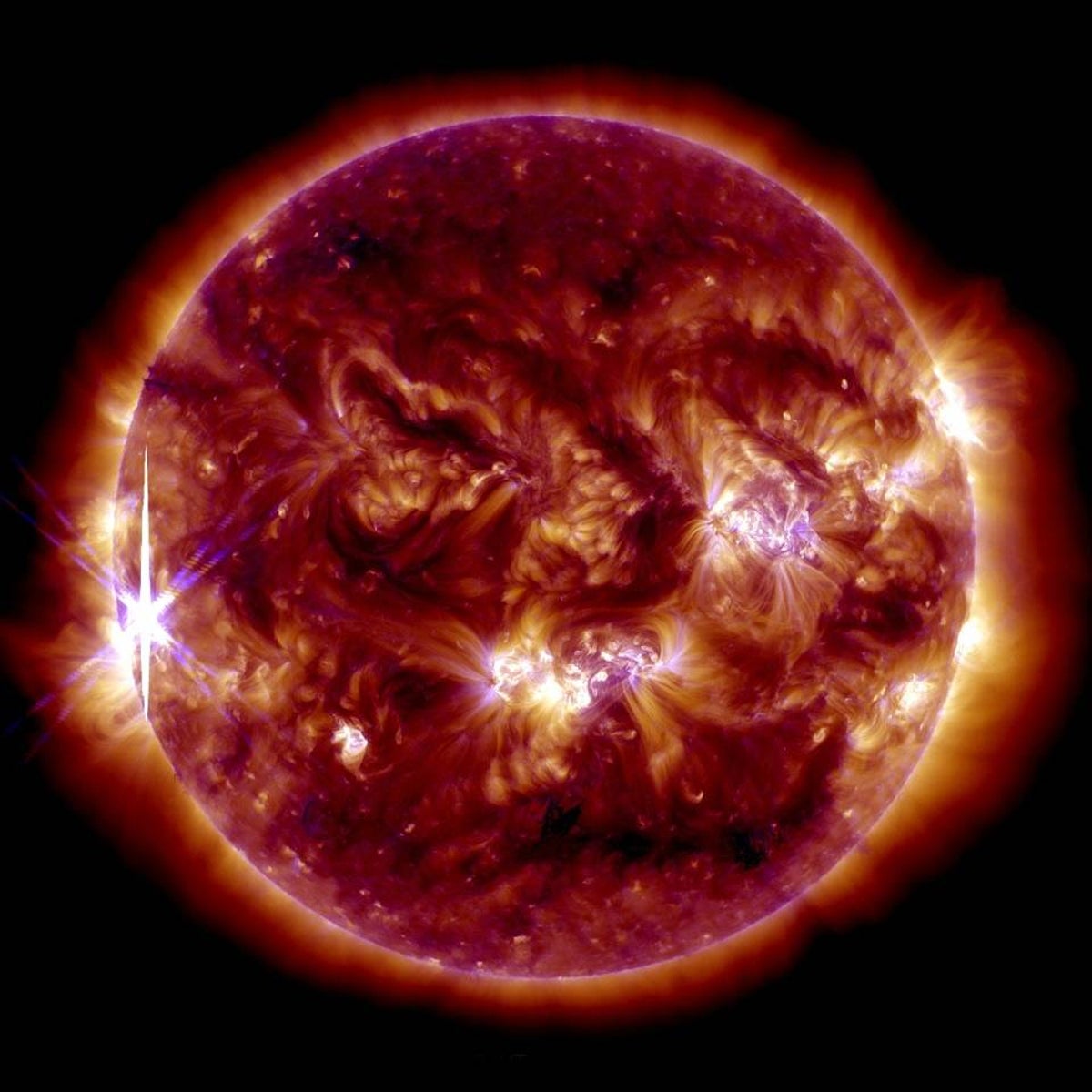
An X-class solar flare captured on camera by NASA’s Solar Dynamics Observatory in 2013. The sun blasted out four such flares in the past two days.
The sun is putting on a show. On Sunday the star unleashed several strong and bright solar flares, including one of the most powerful eruptions seen in decades.
Far from the steadily glowing orb we sometimes picture, the sun’s surface is made up of roiling plasma thrown about by twisting magnetic fields. When these fields snap, they can throw out huge bursts of energy and charged particles into space—a solar flare.
NASA’s Solar Dynamics Laboratory caught one such outburst yesterday at 7:33 A.M. EST and gave it an X-class ranking—the most intense. Throughout last night, three more X-class flares followed amid dozens of smaller spurts of activity. But the crescendo came at 6:37 P.M. EST, when the sun let rip an X8.1-class burst. That makes it the brightest flare since October 2024 and among the top 20 since 1996, according to SpaceWeatherLive.com.
On supporting science journalism
If you’re enjoying this article, consider supporting our award-winning journalism by subscribing. By purchasing a subscription you are helping to ensure the future of impactful stories about the discoveries and ideas shaping our world today.
Astronomers expect most of the expelled plasma to pass Earth sometime on Thursday. Specks of it could hit our atmosphere, potentially producing the spectacular celestial display the northern lights. The National Oceanic and Atmospheric Administration’s Space Weather Prediction Center is carefully monitoring the region of the sun that is responsible for the flares, with more expected activity yet to come.
The recent outbursts are the latest in an unusually tempestuous period for our star. The sun’s activity fluctuates on an 11-year time line, and while the star is believed to be beyond the peak of its current solar cycle, strong solar flares may continue for some time as it winds down.
It’s Time to Stand Up for Science
If you enjoyed this article, I’d like to ask for your support. Scientific American has served as an advocate for science and industry for 180 years, and right now may be the most critical moment in that two-century history.
I’ve been a Scientific American subscriber since I was 12 years old, and it helped shape the way I look at the world. SciAm always educates and delights me, and inspires a sense of awe for our vast, beautiful universe. I hope it does that for you, too.
If you subscribe to Scientific American, you help ensure that our coverage is centered on meaningful research and discovery; that we have the resources to report on the decisions that threaten labs across the U.S.; and that we support both budding and working scientists at a time when the value of science itself too often goes unrecognized.
In return, you get essential news, captivating podcasts, brilliant infographics, can’t-miss newsletters, must-watch videos, challenging games, and the science world’s best writing and reporting. You can even gift someone a subscription.
There has never been a more important time for us to stand up and show why science matters. I hope you’ll support us in that mission.