
Close Menu
Beverly Hills Examiner

    Subscribe to Updates

    Get the latest creative news from FooBar about art, design and business.

    What's Hot

    La Paciencia, No. 1 Latin Producer, on Bad Bunny & What’s Next

    December 31, 2025

    ‘Quiet luxury’ is coming for the housing market, The Corcoran Group CEO says

    December 31, 2025

    Trump Issues First Vetoes of Second Presidential Term

    December 31, 2025
    Facebook X (Twitter) Instagram
    Beverly Hills Examiner
    • Home
    • US News
    • Politics
    • Business
    • Science
    • Technology
    • Lifestyle
    • Music
    • Television
    • Film
    • Books
    • Contact
      • About
      • Amazon Disclaimer
      • DMCA / Copyrights Disclaimer
      • Terms and Conditions
      • Privacy Policy
    Beverly Hills Examiner
    Home»Science»Time Flowed Five Times Slower Shortly after the Big Bang
    Science

    Time Flowed Five Times Slower Shortly after the Big Bang

    By AdminJuly 19, 2023
    Facebook Twitter Pinterest LinkedIn WhatsApp Email Reddit Telegram
    Time Flowed Five Times Slower Shortly after the Big Bang


    Time Flowed Five Times Slower Shortly after the Big Bang

    In a first, astronomers have observed time ticking in slow motion in the early cosmos, confirming Albert Einstein’s century-old ideas about the reality-warping effects of our universe’s expansion.

    By tracking the flickering glows of luminous matter swirling through galaxies when the universe was a mere one billion years old (less than a tenth of its present age), two researchers have found that events back then appear to have unfolded at a pace five times slower than normal. Their findings were published earlier this month in Nature Astronomy.

    “For decades Isaac Newton gave us this vision of a universe where space and time is fixed, and every clock across the universe ticks at exactly the same rate. Then Einstein shattered this vision by proposing that time is actually rubbery and relative,” says Geraint Lewis, an astrophysicist at the University of Sydney and lead author of the study. “Now we’ve shown that Einstein was, once again, correct.”

    The Einsteinian concept of time running slower in the early universe arose in the late 1920s as astronomers were discovering cosmic expansion. Galaxies in the sky were found to be flying away from the Milky Way at high speed, swept along by the ceaselessly growing void—and the farther off they were, the faster they flew. This not only meant that the universe was once much smaller and denser—arising in a “big bang” from some compact, primordial point—but also that the most distant galaxies visible to us should be receding at close to the speed of light.

    According to Einstein’s special and general theories of relativity, both circumstances alter the flow of time. As light from one of those far-distant galaxies travels from the heavier gravitational grip of the deep, dense early cosmos and across the continuously expanding universe, it must traverse increasingly greater expanses of space to reach Earth. Consequently, time becomes stretched in a phenomenon known as time dilation: a clock running 10 billion years ago would tick at a normal rate to an observer from that time, but from the perspective of someone today, it would appear to be ticking much slower.

    Astronomers had previously validated this slow-motion cosmos about halfway back through the universe’s 13.8-billion-year history by examining the light from massive exploding stars called supernovae that detonated six to seven billion years ago. But such supernovae are too faint to observe at the immense distances needed to probe earlier cosmic epochs.

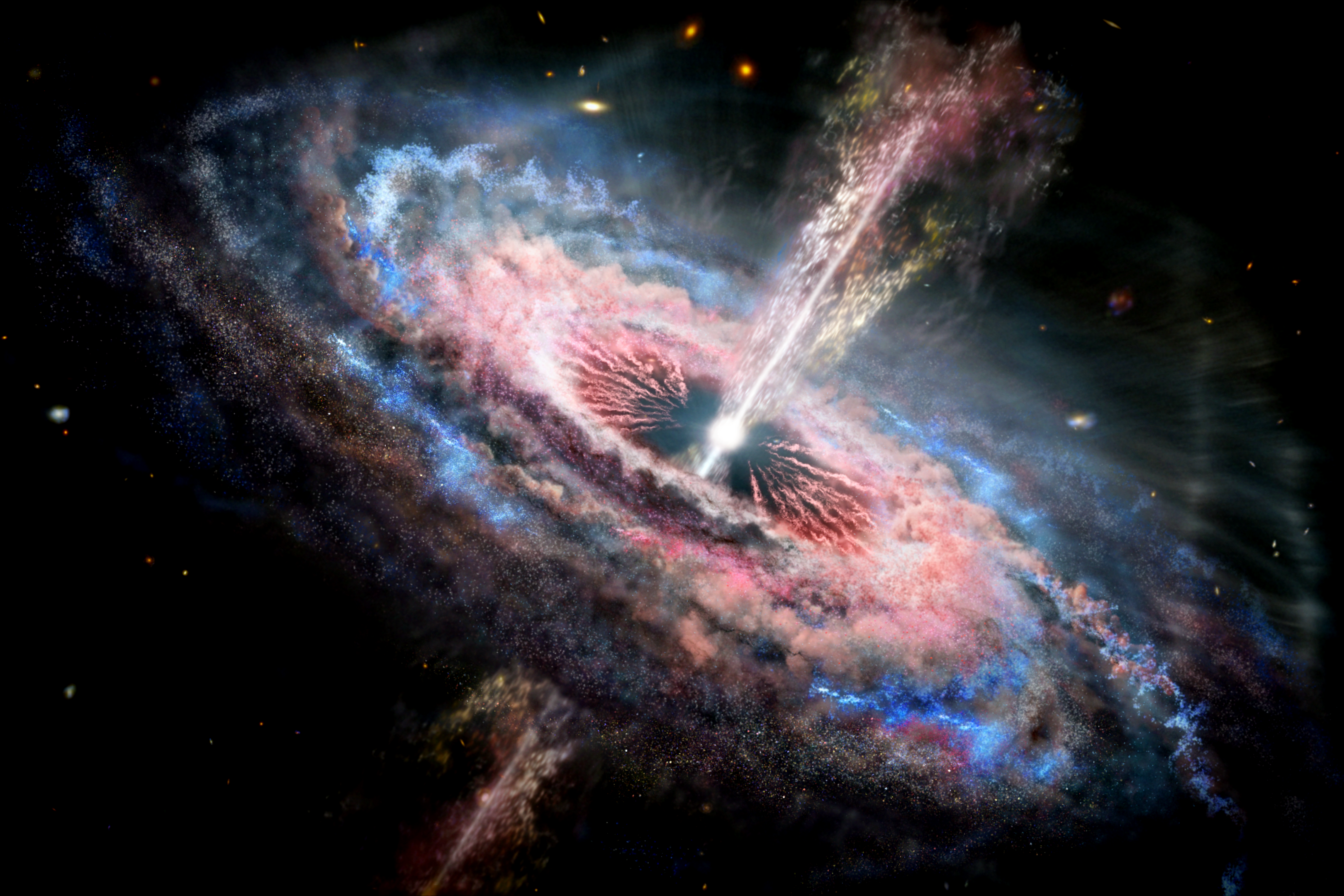
    So Lewis and astrostatistician Brendon Brewer instead investigated much larger, more luminous objects known as quasars—bright astrophysical beacons formed from supermassive black holes gorging on gas at the centers of distant galaxies. Gas piles up and spirals around as it funnels at nearly light speed into a feeding black hole, where it heats up to temperatures of several trillion degrees Fahrenheit and emits an incandescent glow visible across the cosmos.

    But this glow isn’t steady. Black holes are messy, fitful eaters—and trillion-degree gas can go down less like a smooth milkshake and more like chunky peanut butter. Although this variability makes quasars easier to identify, it complicates their use as standard markers of cosmic time. If supernovae are akin to a firework, burning bright and quickly fading away, then quasars change brightness more like the stock market, with an unpredictable pattern of turbulent flickers. In fact, prior studies have failed to find a time dilation effect between quasars very distant from us and ones relatively close by.

    “Those early findings inspired some fringe cosmologists to question whether quasars’ variability adheres to our existing models of the universe. There were even suggestions that our long-held, fundamental idea that the universe is expanding was wrong,” Lewis says. He adds that these studies used small samples or observed quasars over a short time period.

    In contrast, Lewis and Brewer used a new, much more expansive data set: they looked at 190 quasars in all, covering a range of cosmic time from about 2.5 billion to 12 billion years ago. Each quasar’s flickering was observed hundreds of times at multiple wavelengths across a span of two decades.

    The duo also grouped the quasars by intrinsic luminosity. “We boxed bright quasars with bright quasars and faint quasars with faint quasars,” Lewis says. This approach minimized the chance of making “apples-to-oranges” comparisons between distinctly different quasar types and allowed the researchers to calibrate each quasar’s “ticks,” yielding more certainty that some of the observed discrepancies in light fluctuations were caused by time dilation.

    Ultimately, the researchers found that the tick-tock of the quasar clocks behaved just as Einstein’s relativity predicts. Quasars found in faraway galaxies ticked slower than ones born in the later, nearby universe, with time dilation making those most distant appear to run at a glacial one fifth of the standard speed.

    Katie Mack, an astrophysicist who holds the Hawking Chair in Cosmology and Science Communication at the Perimeter Institute for Theoretical Physics in Ontario, says that these findings provide clarity on various uncertainties surrounding quasar behavior. Specifically, the study confirms that quasars align with consensus expectations—and it reinforces the need for astronomers to consider time dilation when studying them.

    “This is the first time that the effect of time dilation has been clearly observed with quasars, and it’s comforting to know that there’s nothing bizarre happening there,” says Mack, who was not affiliated with the study.

    While astronomers had anticipated the presence of the effect in the ancient universe, this prediction still needed to be tested. Michael Hawkins, an emeritus researcher at the University of Edinburgh’s Institute for Astronomy, says the study serves as a valuable reminder for scientists to avoid complacency with established cosmological models, adding that Einstein’s theory of general relativity upended centuries of science when it was introduced. Hawkins himself has previously conducted research that failed to detect time dilation in quasars, which he says underscores the significance of ongoing investigation and refinement in the field.

    “To uphold scientific practice, you have to maintain skepticism until the very end, so it’s critical to continue testing even the most well-established theories of the universe,” Hawkins says. As a next step, he would like to see future studies replicate the analysis with a larger sample of quasars originating from galaxies even deeper in the cosmic past.

    For Lewis, the work is more than a vindication of Einstein and modern cosmology. Accurate timestamping of ancient quasars might also prove useful for further exploring the nature of dark energy, the mysterious force thought responsible for a surprising acceleration in the universe’s expansion.

     “Standardizing and confirming our models is ultimately a step into the next generation,” Lewis says. “The goal now is to chart the expansion of the universe in as much detail as possible.”


    Original Source Link

    Share. Facebook Twitter Pinterest LinkedIn WhatsApp Email Reddit Telegram
    Previous ArticleA24 Able To Continue Making Movies Despite Actors Strike After SAG Approval
    Next Article Almost All Research on the Mind Is in English. That’s a Problem | WIRED

    RELATED POSTS

    NASA Telescopes Capture Colliding Spiral Galaxies in Sparkling Detail

    December 31, 2025

    Star that seemed to vanish more than 130 years ago is found again

    December 31, 2025

    The Great Big Power Play

    December 30, 2025

    15 Million Years before the Megalodon, This Giant Ancient Shark Prowled the Oceans

    December 30, 2025

    Mathematicians unified key laws of physics in 2025

    December 29, 2025

    People Who Drink Bottled Water on a Daily Basis Ingest 90,000 More Microplastic Particles Each Year

    December 29, 2025
    latest posts

    La Paciencia, No. 1 Latin Producer, on Bad Bunny & What’s Next

    For Roberto Rosado, better known as La Paciencia, the key to his craft has always…

    ‘Quiet luxury’ is coming for the housing market, The Corcoran Group CEO says

    December 31, 2025

    Trump Issues First Vetoes of Second Presidential Term

    December 31, 2025

    Putin accuses Ukraine of drone attack on residence as peace talks falter

    December 31, 2025

    Factor Meal Delivery Promo: Free $200 Withings Body-Scan Scale

    December 31, 2025

    NASA Telescopes Capture Colliding Spiral Galaxies in Sparkling Detail

    December 31, 2025

    ARC Raiders’ Latest Exploit Is Giving Players Instant Kills

    December 31, 2025
    Categories
    • Books (969)
    • Business (5,877)
    • Film (5,811)
    • Lifestyle (3,914)
    • Music (5,879)
    • Politics (5,881)
    • Science (5,223)
    • Technology (5,810)
    • Television (5,496)
    • Uncategorized (2)
    • US News (5,862)
    popular posts

    Charcuterie Board Ideas for Simple Hosting

    I have an emotional attachment to charcuterie boards. During my senior year of high school,…

    A Long-Standing Bit Returns & More Highlights From Episode 8 (RECAP)

    July 27, 2022

    Amazon CEO of worldwide consumer Dave Clark announces departure

    June 3, 2022

    Here’s everything that’s new and different in GPT-5, OpenAI’s long-awaited flagship AI model

    August 7, 2025
    Archives
    Browse By Category
    • Books (969)
    • Business (5,877)
    • Film (5,811)
    • Lifestyle (3,914)
    • Music (5,879)
    • Politics (5,881)
    • Science (5,223)
    • Technology (5,810)
    • Television (5,496)
    • Uncategorized (2)
    • US News (5,862)
    About Us

    We are a creativity led international team with a digital soul. Our work is a custom built by the storytellers and strategists with a flair for exploiting the latest advancements in media and technology.

    Most of all, we stand behind our ideas and believe in creativity as the most powerful force in business.

    What makes us Different

    We care. We collaborate. We do great work. And we do it with a smile, because we’re pretty damn excited to do what we do. If you would like details on what else we can do visit out Contact page.

    Our Picks

    NASA Telescopes Capture Colliding Spiral Galaxies in Sparkling Detail

    December 31, 2025

    ARC Raiders’ Latest Exploit Is Giving Players Instant Kills

    December 31, 2025

    Disorders From TLC Show Explained

    December 31, 2025
    © 2025 Beverly Hills Examiner. All rights reserved. All articles, images, product names, logos, and brands are property of their respective owners. All company, product and service names used in this website are for identification purposes only. Use of these names, logos, and brands does not imply endorsement unless specified. By using this site, you agree to the Terms & Conditions and Privacy Policy.

    Type above and press Enter to search. Press Esc to cancel.

    We use cookies on our website to give you the most relevant experience by remembering your preferences and repeat visits. By clicking “Accept All”, you consent to the use of ALL the cookies. However, you may visit "Cookie Settings" to provide a controlled consent.
    Cookie SettingsAccept All
    Manage consent

    Privacy Overview

    This website uses cookies to improve your experience while you navigate through the website. Out of these, the cookies that are categorized as necessary are stored on your browser as they are essential for the working of basic functionalities of the website. We also use third-party cookies that help us analyze and understand how you use this website. These cookies will be stored in your browser only with your consent. You also have the option to opt-out of these cookies. But opting out of some of these cookies may affect your browsing experience.
    Necessary
    Always Enabled
    Necessary cookies are absolutely essential for the website to function properly. These cookies ensure basic functionalities and security features of the website, anonymously.
    CookieDurationDescription
    cookielawinfo-checkbox-analytics11 monthsThis cookie is set by GDPR Cookie Consent plugin. The cookie is used to store the user consent for the cookies in the category "Analytics".
    cookielawinfo-checkbox-functional11 monthsThe cookie is set by GDPR cookie consent to record the user consent for the cookies in the category "Functional".
    cookielawinfo-checkbox-necessary11 monthsThis cookie is set by GDPR Cookie Consent plugin. The cookies is used to store the user consent for the cookies in the category "Necessary".
    cookielawinfo-checkbox-others11 monthsThis cookie is set by GDPR Cookie Consent plugin. The cookie is used to store the user consent for the cookies in the category "Other.
    cookielawinfo-checkbox-performance11 monthsThis cookie is set by GDPR Cookie Consent plugin. The cookie is used to store the user consent for the cookies in the category "Performance".
    viewed_cookie_policy11 monthsThe cookie is set by the GDPR Cookie Consent plugin and is used to store whether or not user has consented to the use of cookies. It does not store any personal data.
    Functional
    Functional cookies help to perform certain functionalities like sharing the content of the website on social media platforms, collect feedbacks, and other third-party features.
    Performance
    Performance cookies are used to understand and analyze the key performance indexes of the website which helps in delivering a better user experience for the visitors.
    Analytics
    Analytical cookies are used to understand how visitors interact with the website. These cookies help provide information on metrics the number of visitors, bounce rate, traffic source, etc.
    Advertisement
    Advertisement cookies are used to provide visitors with relevant ads and marketing campaigns. These cookies track visitors across websites and collect information to provide customized ads.
    Others
    Other uncategorized cookies are those that are being analyzed and have not been classified into a category as yet.
    SAVE & ACCEPT