
Close Menu
Beverly Hills Examiner

    Subscribe to Updates

    Get the latest creative news from FooBar about art, design and business.

    What's Hot

    KeiyaA Plots Tour, Drinks Milk in “Thirsty” Video

    May 13, 2026

    Kevin Warsh confirmed as Fed chair in party-line vote amid Elizabeth Warren’s ‘sock puppet’ criticism

    May 13, 2026

    JD Vance Compares Himself To An Abandoned Child At Deranged White House Event

    May 13, 2026
    Facebook X (Twitter) Instagram
    Beverly Hills Examiner
    • Home
    • US News
    • Politics
    • Business
    • Science
    • Technology
    • Lifestyle
    • Music
    • Television
    • Film
    • Books
    • Contact
      • About
      • Amazon Disclaimer
      • DMCA / Copyrights Disclaimer
      • Terms and Conditions
      • Privacy Policy
    Beverly Hills Examiner
    Home»Science»Tiny Probes Can Surf Sunlight to Explore Earth’s Mesosphere and Mars
    Science

    Tiny Probes Can Surf Sunlight to Explore Earth’s Mesosphere and Mars

    By AdminAugust 20, 2025
    Facebook Twitter Pinterest LinkedIn WhatsApp Email Reddit Telegram
    Tiny Probes Can Surf Sunlight to Explore Earth’s Mesosphere and Mars


    August 19, 2025

    4 min read

    These Tiny Disks Will Sail on Sunlight into Earth’s Mysterious ‘Ignorosphere’

    With no fuel or engines, tiny explorers will surf sun-warmed air alone to explore high in the skies of Earth and Mars
    By Payal Dhar edited by Lee Billings

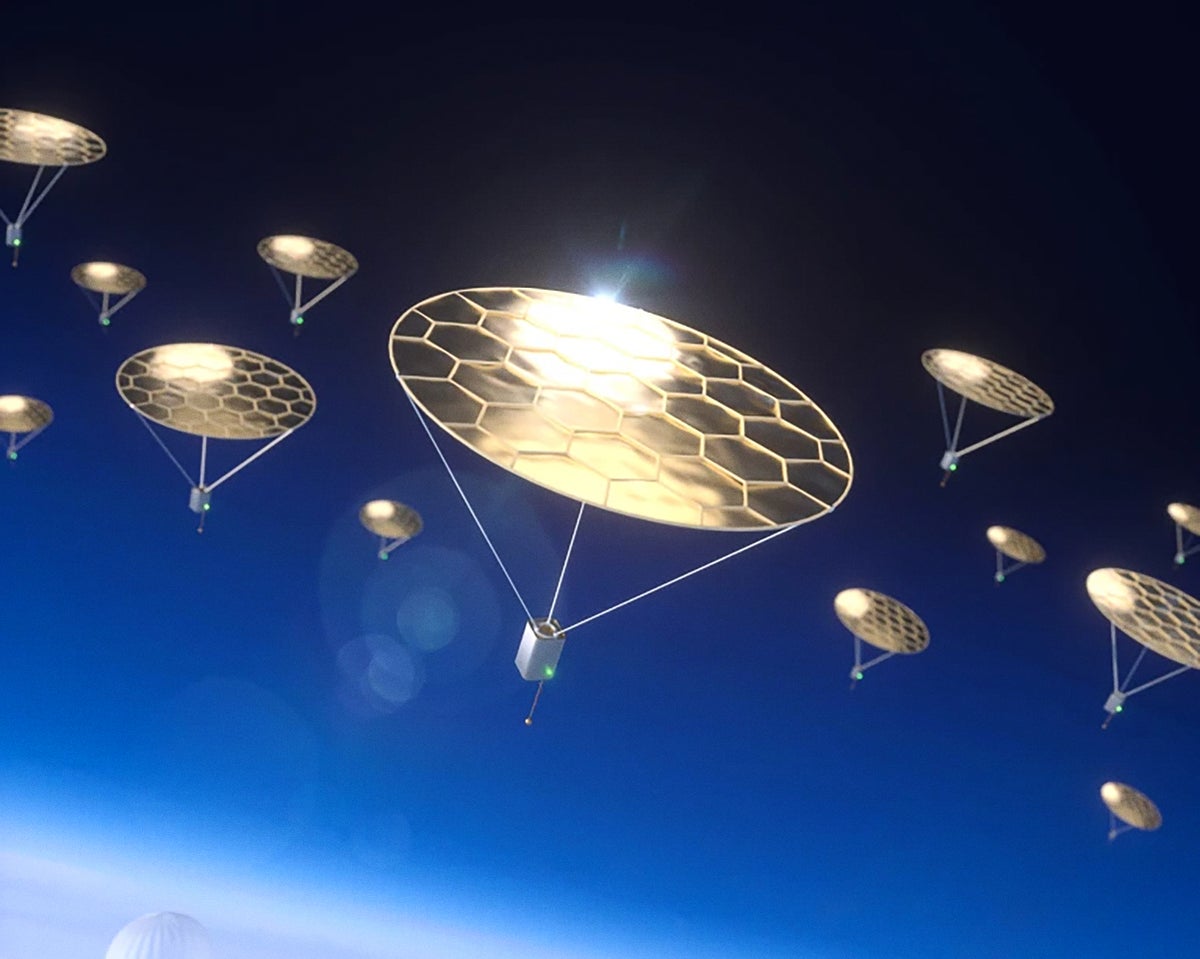
    An artist's impression of multiple small devices soaring on sunlight at the edges of Earth's atmosphere

    This artist’s impression shows multiple small devices soaring on sunlight at the edges of Earth’s atmosphere.

    Schafer et al. Nature (2025)

    Scientists have devised tiny featherweight disks that could float on sunlight in Earth’s mesosphere or the thin air of Mars, theoretically even while carrying payloads. Extending about 50 to 85 kilometers above Earth’s surface, the mesosphere is too high to be reached by aircraft and weather balloons but too low for access by satellites, making it one of our planet’s least-studied regions. Consequently, it’s sometimes simply called the “ignorosphere.”

    The new centimeter-wide disks are made from two thin perforated membranes of ceramic alumina connected by tiny vertical supports. They are kept aloft by a force called photophoresis: the light-induced movement of small particles at very low atmospheric pressures. In lab experiments simulating mesospheric air pressure and illumination, the researchers showed that their devices could float passively, without any power source. Their paper reporting the results was published in Nature on August 13.

    Photophoresis causes gas molecules to bounce more forcefully off the warmer side of an object than the cooler one, creating airflow. In this case, the research team coated the bottom of the disks with chromium to absorb light and heat up more than the top. Thus, gas molecules bouncing off the lower part gained more momentum than those at the top, generating lift similar to how a rocket’s jet produces upward thrust. Perforations in the disks increased this thrust, using an effect called thermal transpiration to passively channel the air from cooler to warmer regions. This enhancement boosted the disks’ performance to surpass photophoretic flyers previously demonstrated by other groups, which had required illumination several times brighter than that of sunlight.


    On supporting science journalism

    If you’re enjoying this article, consider supporting our award-winning journalism by subscribing. By purchasing a subscription you are helping to ensure the future of impactful stories about the discoveries and ideas shaping our world today.


    “The holes in the structure provide more pathways for air to flow,” says materials scientist Ben Schafer, co-lead author of the paper, who conducted the research as a graduate student at Harvard University. “So the air is not only moving around the sides of the structure—it moves through the structure, too, creating these little jets.”

    Photophoresis was first demonstrated in the 1870s by the physicist William Crookes. He developed what came to be known as a Crookes radiometer, a toylike device that spins its metallic fins when exposed to sunlight. But because photophoresis only works at very low pressures and generates very weak force, it was long seen as a mere novelty. That began to change a couple of decades ago, Schafer says, as advances in nanofabrication allowed researchers to make devices light enough to levitate using the meager force of photophoresis alone.

    Designing the disks to utilize thermal transpiration and optimizing them to carry the biggest possible payloads required careful computational modeling of mesospheric conditions and photophoretic forces, Schafer says. That prep work allowed the team to make informed trade-offs between, for instance, the density of the perforations and number of supports versus the resulting lofting force at a given atmospheric pressure. This “gave us really good insight into what would make an efficient structure” for mesospheric flight, he says.

    Using a laser to mimic sunlight, the researchers demonstrated photophoretic levitation on their centimeter-scale structures in a low-pressure chamber in the lab. They also designed a six-centimeter-wide version of the disk to carry a 10-milligram payload—which, in theory, would be enough to power a small communications system with a radio-frequency antenna, a solar cell and integrated circuits. The team calculates that this larger version of the disk could stay aloft at an altitude of 75 km during daytime; in summertime at polar latitudes, it could even achieve constant mesopheric flight, sustained after sundown by the photophoretic force of infrared light emanating from Earth’s gradually cooling surface.

    Ruth Lieberman, a heliophysicist who worked on earlier attempts at photophoretic technology but wasn’t involved in this project, calls it a brilliant design. “As long as the sun is shining, these things will work,” she says. “They are also made out of very inexpensive materials. Once you get past the prototype phase and can figure out how to manufacture [at scale], it strikes me as a really potentially fantastic solution for observing the atmosphere at very low cost in a way that gets you very good spatial temporal coverage.”

    Schafer envisions a future in which swarms of these structures are used for atmospheric sensing and telecommunications not only in Earth’s mesosphere but also in the tenuous atmosphere of Mars, which exhibits similarly low pressures. Schafer has co-founded a company based in part on the new research that is developing new iterations of the disks and planning to launch payload-free atmospheric test flights as early as 2026.

    Creating disks truly capable of pulling their own weight in the mesosphere or beyond is a more formidable task—akin to a five- to 10-year project, Schafer says. “If you wanted to put a payload on board these devices, I think it’s certainly doable, but it’s going to take a lot of time and work,” he says. Scaling up is going to be a materials manufacturing challenge, he adds, that warrants more research.


    Original Source Link

    Share. Facebook Twitter Pinterest LinkedIn WhatsApp Email Reddit Telegram
    Previous ArticleEva Victor: ‘I used the title as a way to reward…
    Next Article Even Rogers and Max Haot join the Space Stage at Disrupt 2025

    RELATED POSTS

    Almost half of the objects in Earth’s orbit are junk—and that’s only the stuff we know about

    May 13, 2026

    Can cloud seeding save us from water bankruptcy?

    May 13, 2026

    All Your Hantavirus Questions, Answered by an Infectious Disease Expert

    May 12, 2026

    Is the U.S. in a new era of political violence? Experts say it’s complicated

    May 12, 2026

    The story of the first human tool: the humble container

    May 11, 2026

    A Chevron Texas Power Plant Seeks School District Tax Break

    May 11, 2026
    latest posts

    KeiyaA Plots Tour, Drinks Milk in “Thirsty” Video

    KeiyaA has announced a tour of the United States and Europe behind Hooke’s Law. In…

    Kevin Warsh confirmed as Fed chair in party-line vote amid Elizabeth Warren’s ‘sock puppet’ criticism

    May 13, 2026

    JD Vance Compares Himself To An Abandoned Child At Deranged White House Event

    May 13, 2026

    Dallas County Sheriff Marian Brown pushes back on Paxton’s ICE deadline

    May 13, 2026

    Everyone at the Musk v. Altman Trial Is Using Fancy Butt Cushions

    May 13, 2026

    Almost half of the objects in Earth’s orbit are junk—and that’s only the stuff we know about

    May 13, 2026

    A Woman’s Life – first-look review

    May 13, 2026
    Categories
    • Books (1,238)
    • Business (6,144)
    • Cover Story (4)
    • Film (6,082)
    • Lifestyle (4,167)
    • Music (6,152)
    • Politics (6,145)
    • Science (5,493)
    • Technology (6,078)
    • Television (5,771)
    • Uncategorized (3)
    • US News (6,129)
    popular posts

    How Hard Should Tesla Fight for Elon Musk's Attention?

    The June vote on the CEO’s 2018 pay package raises questions about what a board…

    Under Armour CEO Patrik Frisk Is Stepping Down

    May 18, 2022

    Niall Horan Earns Third No. 1 on Top Album Sales Chart With ‘The Show’ – Billboard

    June 20, 2023

    Zillow introduces Calendly-like instant booking for rental property tours • TechCrunch

    January 24, 2023
    Archives
    Browse By Category
    • Books (1,238)
    • Business (6,144)
    • Cover Story (4)
    • Film (6,082)
    • Lifestyle (4,167)
    • Music (6,152)
    • Politics (6,145)
    • Science (5,493)
    • Technology (6,078)
    • Television (5,771)
    • Uncategorized (3)
    • US News (6,129)
    About Us

    We are a creativity led international team with a digital soul. Our work is a custom built by the storytellers and strategists with a flair for exploiting the latest advancements in media and technology.

    Most of all, we stand behind our ideas and believe in creativity as the most powerful force in business.

    What makes us Different

    We care. We collaborate. We do great work. And we do it with a smile, because we’re pretty damn excited to do what we do. If you would like details on what else we can do visit out Contact page.

    Our Picks

    Almost half of the objects in Earth’s orbit are junk—and that’s only the stuff we know about

    May 13, 2026

    A Woman’s Life – first-look review

    May 13, 2026

    Hayden Panettiere’s Ex Defends Domestic Violence, Bad Edit?

    May 13, 2026
    © 2026 Beverly Hills Examiner. All rights reserved. All articles, images, product names, logos, and brands are property of their respective owners. All company, product and service names used in this website are for identification purposes only. Use of these names, logos, and brands does not imply endorsement unless specified. By using this site, you agree to the Terms & Conditions and Privacy Policy.

    Type above and press Enter to search. Press Esc to cancel.

    We use cookies on our website to give you the most relevant experience by remembering your preferences and repeat visits. By clicking “Accept All”, you consent to the use of ALL the cookies. However, you may visit "Cookie Settings" to provide a controlled consent.
    Cookie SettingsAccept All
    Manage consent

    Privacy Overview

    This website uses cookies to improve your experience while you navigate through the website. Out of these, the cookies that are categorized as necessary are stored on your browser as they are essential for the working of basic functionalities of the website. We also use third-party cookies that help us analyze and understand how you use this website. These cookies will be stored in your browser only with your consent. You also have the option to opt-out of these cookies. But opting out of some of these cookies may affect your browsing experience.
    Necessary
    Always Enabled
    Necessary cookies are absolutely essential for the website to function properly. These cookies ensure basic functionalities and security features of the website, anonymously.
    CookieDurationDescription
    cookielawinfo-checkbox-analytics11 monthsThis cookie is set by GDPR Cookie Consent plugin. The cookie is used to store the user consent for the cookies in the category "Analytics".
    cookielawinfo-checkbox-functional11 monthsThe cookie is set by GDPR cookie consent to record the user consent for the cookies in the category "Functional".
    cookielawinfo-checkbox-necessary11 monthsThis cookie is set by GDPR Cookie Consent plugin. The cookies is used to store the user consent for the cookies in the category "Necessary".
    cookielawinfo-checkbox-others11 monthsThis cookie is set by GDPR Cookie Consent plugin. The cookie is used to store the user consent for the cookies in the category "Other.
    cookielawinfo-checkbox-performance11 monthsThis cookie is set by GDPR Cookie Consent plugin. The cookie is used to store the user consent for the cookies in the category "Performance".
    viewed_cookie_policy11 monthsThe cookie is set by the GDPR Cookie Consent plugin and is used to store whether or not user has consented to the use of cookies. It does not store any personal data.
    Functional
    Functional cookies help to perform certain functionalities like sharing the content of the website on social media platforms, collect feedbacks, and other third-party features.
    Performance
    Performance cookies are used to understand and analyze the key performance indexes of the website which helps in delivering a better user experience for the visitors.
    Analytics
    Analytical cookies are used to understand how visitors interact with the website. These cookies help provide information on metrics the number of visitors, bounce rate, traffic source, etc.
    Advertisement
    Advertisement cookies are used to provide visitors with relevant ads and marketing campaigns. These cookies track visitors across websites and collect information to provide customized ads.
    Others
    Other uncategorized cookies are those that are being analyzed and have not been classified into a category as yet.
    SAVE & ACCEPT