
This story was co-published with the Monterey Herald and supported by a grant from the Pulitzer Center.
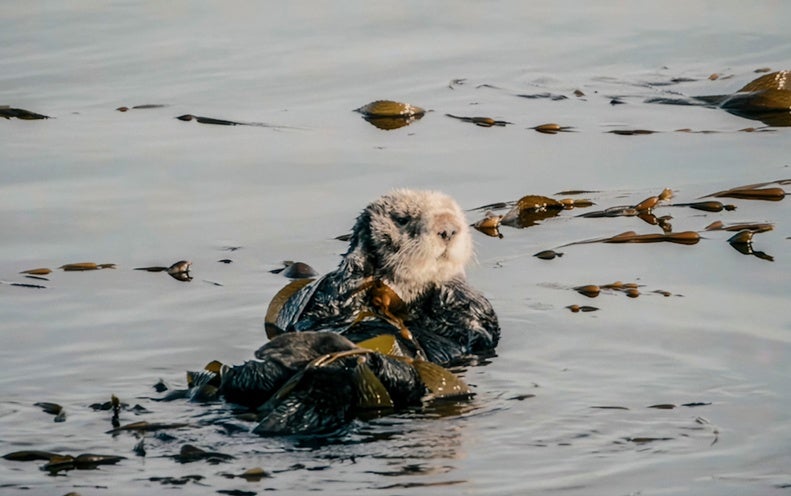
It’s 1988. The Monterey Bay Aquarium is four years old, and so am I. It is my favorite place on earth, and the sea otters are my favorite animal. During a presentation, an aquarium employee tells me that the southern sea otter has more than one million hairs per square inch (about 155,000 per square centimeter) of its body.
“Who counted all that hair?” I wonder.
While the southern sea otter captures the attention of younger visitors, the symbol of the aquarium is another Monterey Bay icon: a whorl of kelp.
Giant kelp is the common name for Macrocystis pyrifera, a species of alga that grows into lush underwater forests along the coast of the northeastern Pacific Ocean, from Baja California north to southeastern Alaska. Reaching from the ocean floor to the surface, the huge, leafy stalks of giant kelp provide food and habitats for thousands of species.
In 1988 a visitor on the aquarium’s observation deck would have seen a lush kelp forest canopy stretching thick from the breakwater to Point Pinos in Pacific Grove, Calif., and beyond.
These days it’s a patchwork at best.
It’s 2022, and I’m surveying the water beyond Monterey, Calif.’s Cannery Row from a small University of California, Santa Cruz, boat named Sebastes.
“Yeah, it’s an awesome boat,” says Joshua Smith affectionately as he dons a crusty old wetsuit with a bright pink patch right on the butt. When I ask him about the patch, he laughs. “This wetsuit got me through my Ph.D., so I couldn’t afford a new one,” Smith says. He goes on to explain that the man who made the custom 10-millimeter-thick wetsuit—vital for cold-water diving—has since retired. Smith is holding out as long as he can before replacing the suit. “It’s an antique!” he says.
Smith has an easy smile and large glasses. He is a postdoctoral researcher at the National Center for Ecological Analysis and Synthesis at the University of California, Santa Barbara, who has been studying kelp forest ecology for more than a decade. “Most of my research has been in Monterey Bay,” he says.
Smith seems optimistic for someone who’s about to tell me kelp populations have been collapsing up and down the coast of California since 2014, some by as much as 90 percent.
But how does one know something like “90 percent of kelp in northern California are gone” with any accuracy? Does a scientist in a rowboat go and count individual stalks of kelp like the hairs on an otter’s head? And how do we know what causes a population to collapse?
The answers to these questions involve scuba excursions (such as the one Smith is about to take), satellites, motivated undergrads, artificial intelligence and people wading in tide pools.
And it all began in 1989, when an oil tanker named the Exxon Valdez struck Bligh Reef off of Prince William Sound, Alaska, and spilled more than 11 million gallons (more than 41 million liters) of crude oil into the North Pacific. The cleanup efforts lasted years. The litigation lasted decades. Environmentalists and lawyers both wanted to know “What was the impact of the spill?” But biologists couldn’t accurately measure pollution impact on the Alaskan coast without knowing what the undersea environment looked like before the spill.
“They asked us to set up a comprehensive monitoring program,” says Peter Raimondi, a professor of ecology and evolutionary biology at U.C. Santa Cruz. “And one of the things that affords is that you have the opportunity to see change over time.”
Researchers such as Raimondi started visiting these subtidal environments and building a record of observations. In 2013, on one such excursion in Monterey Bay, he and his students noticed something surprising.
“One day we were down, and everything was normal, and [then] next we saw starfish starting to disintegrate basically in front of us,” Raimondi says. “There was Pycnopodia decaying, and [it] would just turn into literally the outline of a sea star and bacteria on the bottom.”
The species was Pycnopodia helianthoides, commonly known as the sunflower sea star, a large predatory starfish found in the northeastern Pacific.
I should say it was formerly found in the northeastern Pacific. Starting in 2013 the sunflower sea star and several other species of starfish died off in mass numbers
“Pycnopodia [was] gone within two weeks, and then some of the other ones took three or four months to go away,” Raimondi says. “In the end, every species that I can think of ended up at least susceptible, and many of them got taken down to incredibly low numbers, compared to what they had been before. And this [was] true for Mexico up to Alaska.”
This phenomenon is called sea star wasting syndrome. Though the exact mechanism that causes the sea stars to dissolve into bacterial piles is still a subject of research, similar events have been observed as early as the 1970s, and they are typically associated with warming waters.
The mass die-off caused immediate concern in the media but also in the public. People were motivated to get involved. Raimondi’s team created a Web site for interested divers and tide-pool combers to contribute photographs and observations of sea stars in the wild.
“Almost all the information that we got, probably 90 percent of the information we got, was from people, citizens,” he says.
So what do these disappearing sea stars have to do with kelp? They help keep an underwater hoard at (the bottom of the) bay.
Back on the Sebastes, Smith and his colleagues are done preparing for their dive. I’m going to be following them with a small remotely operated vehicle, or ROV. Today they are looking for purple sea urchins. They don’t need to look hard.
Raimondi explains, “Normally in a kelp forest, these native sea urchin grazers are living down, tucked away in the cracks and crevices because they don’t want to encounter predators. So they’re hidden down in these crevices, and they’re eating drift kelp.”
Drift kelp are the fronds that shed from the living underwater forest. If you’ve ever been to a California beach, you’ve seen them in piles or perhaps jumped out of the water when one brushed past your leg.
In 2014 a major marine heat wave bathed the California coast in warm water. Kelp forests require cold, nutrient-rich water to thrive, so this heat wave slowed them down. Normally, they would just bounce back when the water cools off again, but this time an army of purple urchins ascended to feed. “They didn’t have this big sea star predator lurking around. So they came storming out of those crevices, roaming on the reef surface, looking for any live kelp that they could find to chow down on,” Smith says. This change in behavior is why we’re at the reef: Smith and his fellow researcher Tim Tinker of U.C. Santa Cruz, are harvesting urchins to observe them in a lab.
Already depleted by the unprecedented warming event, the sea urchin explosion clear-cut kelp all the way to the reef surface, creating a so-called urchin barren. In many places, all that was left was a carpet of purple.
On our dive, I see the evidence myself: large swaths of purple sea urchins covering rocky outcroppings that used to be kelp forest. What’s especially striking is the absence of any other life in these areas. Without the shelter and food supply of the forest, nothing seems to survive. I’m reminded of tumbleweeds in a California ghost town, haunting spaces once vibrant with life.
When we finally enter one of the remaining patches of kelp, the contrast is incredible: Harbor seals frolic. Fish swim from floor to surface among emerald green fronds. The experience has been compared to a cathedral, and I can see why: light comes through the canopy above like a living stained glass window.
I’m so entranced by the effect that I lose track of my position and get the ROV’s cable tangled in the anchor chain of the Sebastes. As we disentangle the little yellow robot, I’m thinking about how easy it is to miss the kelp forest for the—kelp trees? Certainly things look bad down here. in this little section of Monterey Bay, but clearly some kelp are left. How can researchers know anything about the amount of kelp underwater from Mexico to Alaska? Who counts them?
“In 2015 it was very motivated undergrads” says Tom W. Bell, an assistant scientist at Woods Hole Oceanographic Institution.
Bell’s work involves remote sensing—a process that uses reflected and emitted radiation at a distance, such as from satellites or aircraft, to detect and monitor an area’s physical characteristics.
For Bell’s recent research on kelp, that meant oring over photographs of the California coast in a publicly available library of government satellite images. His group analyzed the images’ individual pixels to determine if they might contain the telltale light signature of a kelp canopy visible on the surface of the ocean. In this way, they compared the range and density of kelp every 16 days from the 1980s to a couple of years ago.“When we are looking at change through our own set of eyes, our scale is fairly small,” Bell says. “Remote sensing provides scope.”
That scope comes with a cost in human effort. Bell’s analysis looks at images captured as far back as the mid-1980s. Each pixel in them is 30 meters across (about the size of a baseball infield), and each image covers about 12,190 square miles (31,570 square kilometers), which means more than 35 million pixels per image. I can’t help but think of the millions of hairs on an otter’s head.
These days Bell’s team uses computers to automate the analysis, but a certain amount must still be completed by human eyes. “There’s a new push called Floating Forests on a platform called Zooniverse,” he tells me, where citizen scientists from around the globe can help analyze images.
That brings us to 2021: as a part of his research, Bell co-authored a paper that made some waves in the news.
The headlines read, “The Death of an Ecosystem,” “The Collapse of Northern California Kelp Forests Will Be Hard to Reverse” and (my favorite in the New York Times) “‘Zombie’ Urchins Are Destroying Kelp Forests. Can’t We Just Eat Them?”
These articles, and many others like them, drew from the paper, which was published in Communications Biology. The picture it painted was pretty bleak: 90 percent of kelp in northern California were lost starting in 2014. I wanted to know “Did this decline represent a permanent loss of kelp forests? Or could they recover?”
Bell answers, “We haven’t seen the opportunity for kelp to rebound since 2014–2020 was an unprecedented warm period without much kelp recovery.” adds that there’s cause for concern: if this unprecedented warming keeps happening, decade after decade, we will lose species that depend on the kelp forests for food and shelter.
So why is it important to understand kelp? “Kelp forests can grow and decline very quickly,” Bell says. “We can see these massive cycles. If we [can] understand these patterns, if they transfer to other systems, we can use it as a model for how other ecosystems work.”
After our dive in Monterey Bay, Smith and Tinker published a paper confirming that the urchin barrens are caused by a change in behavior. If and when the urchins leave an area and return to their crevices, the kelp can regrow. The question remains: Will the sea stars ever return to save the kelp forests?
Our world is changing in ways bigger than any single person can observe or understand. It will take a massive diversity of inquiry and effort to understand these dynamic systems and humans’ role in them.
From kelp to sea stars to urchins, what we know about the underwater world is often a tapestry of observations made by scientists, students, citizens and computers. Science is a process; it involves thousands of people working together across time, recording observations.
It’s 2024. The Monterey Bay Aquarium is 40 years old, and so am I. My daughter loves the aquarium. The otters are her favorite. We stand on the observation deck and look out at the bay. What will we see?