
Close Menu
Beverly Hills Examiner

    Subscribe to Updates

    Get the latest creative news from FooBar about art, design and business.

    What's Hot

    Phoebe Bridgers to make acting debut in A24 drama ‘Primetime’

    August 8, 2026

    GOP senators look to pass Trump’s voting bill in budget package that funds the Iran war and Pentagon

    August 8, 2026

    Trump Admits He Is Stealing Things From Government Buildings

    August 8, 2026
    Facebook X (Twitter) Instagram
    Beverly Hills Examiner
    • Home
    • US News
    • Politics
    • Business
    • Science
    • Technology
    • Lifestyle
    • Music
    • Television
    • Film
    • Books
    • Contact
      • About
      • Amazon Disclaimer
      • DMCA / Copyrights Disclaimer
      • Terms and Conditions
      • Privacy Policy
    Beverly Hills Examiner
    Home»Science»When Did Neandertals and Humans Interbreed? Genomics Closes In on a Date
    Science

    When Did Neandertals and Humans Interbreed? Genomics Closes In on a Date

    By AdminDecember 12, 2024
    Facebook Twitter Pinterest LinkedIn WhatsApp Email Reddit Telegram
    When Did Neandertals and Humans Interbreed? Genomics Closes In on a Date


    Scientists have long known that humans outside of Africa owe 2 to 3 percent of their genome to Neandertal ancestors. But now, using the oldest modern human DNA ever analyzed, two separate studies have traced this ancestry to a single surge of interbreeding that occurred between 45,000 and 49,000 years ago.

    Neandertals (Homo neanderthalensis) and modern humans (Homo sapiens) encountered each other many times over tens of thousands of years: modern human DNA is found in Neandertals who lived more than 200,000 years ago, and some human populations mingled further with Neandertals until the latter species went extinct 39,000 years ago. But not all of these interactions left a shared imprint on all non-African populations today. The moment that left this near-global genetic fingerprint happened over a period of a few thousand years, occurring between Neandertals who were established in Europe and humans who were newly arriving in their territory.

    “The height of this interaction was, we think, 47,000 years ago—which also gives us a rough estimate of when this out-of-Africa migration might have happened,” says Leonardo Iasi, a postdoctoral researcher in evolutionary genetics at the Max Planck Institute for Evolutionary Anthropology in Leipzig, Germany, and lead author of one of the studies, which was published on Thursday in Science. He is also a co-author of the other paper, which was published concurrently in Nature.


    On supporting science journalism

    If you’re enjoying this article, consider supporting our award-winning journalism by subscribing. By purchasing a subscription you are helping to ensure the future of impactful stories about the discoveries and ideas shaping our world today.


    Multiple waves of humans left Africa, where the Homo genus originally evolved, over thousands of years and established populations in the Near East and Europe. There they encountered and sometimes bred with Neandertals, descendants of an earlier human ancestor who had left Africa hundreds of thousands of years earlier. The last common ancestor of Neandertals and modern humans remains unknown, but that species likely lived between 650,000 and 500,000 years ago. Researchers still can’t quite say exactly where the Neandertal-human intermingling occurred, but the two new studies narrow down the question of “when” considerably.

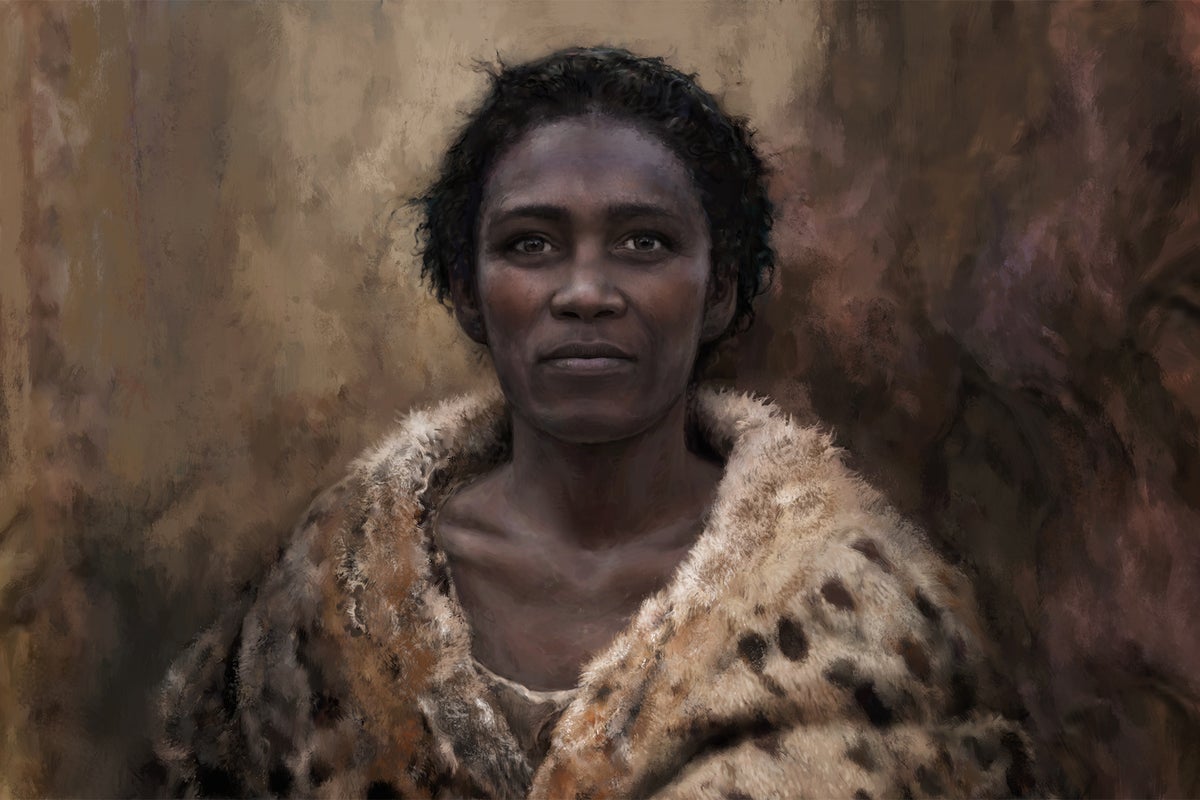
    In the Nature study, biochemist Johannes Krause, archaeogeneticist Kay Prüfer and doctoral student Arev Sümer, all at the Max Planck Institute for Evolutionary Anthropology, and their colleagues sequenced genomes from six individuals discovered in Ranis, Germany, and one from the Zlatý kůň site in the Czech Republic. These people, who lived between 49,000 and 42,000 years ago, included some of the oldest modern human genomes ever sequenced. They also turned out to include the oldest known family of modern humans, Sümer says. The people in Ranis included a mother and her young daughter, plus another female individual from the same extended family. Even more surprisingly, the person from Zlatý kůň—a female individual known from her skull bones—was a more distant relative to this Ranis family.

    These linked populations, which probably consisted of only about 300 members spread across Central Europe, also shared 2.9 percent Neandertal ancestry. By looking at the length of the Neandertal gene segments in these human genomes, the researchers were able to gauge when Neandertal ancestry was introduced. (Longer segments are more recent additions because genetic recombination hasn’t had a chance to scramble them. Shorter segments come from a more distant interbreeding event.) The scientists found that these Central Europeans were removed by about 80 generations, or between 1,500 and 1,000 years, from ancestors who mixed with Neandertals.

    In the Science study, researchers looked at a larger dataset of 59 ancient human genomes from between 45,000 and 2,200 years ago, plus the genomes of a diverse group of 275 present-day humans. “We were interested in estimating the timing of the Neandertal ancestry and also checking if this happened over a short duration or over an extended period of time,” says Priya Moorjani, a population geneticist at the University of California, Berkeley, who, with Benjamin Peter of the Max Planck Institute for Evolutionary Anthropology, was co-senior author of the paper. (Peter is also a co-author of the Nature paper.)

    Like Krause’s team, Moorjani and her colleagues found evidence of a single pulse of Neandertal genetics entering the human genome between approximately 50,500 and 43,500 years ago. The scientists also saw evidence of natural selection in these genes: within about 100 generations, the human genome looked a lot like it does today, in terms of which segments had lots of Neandertal genes and which had very few. For example, the modern X chromosome has few Neandertal genes.

    This genetic change is fascinating, says Joshua Akey, a Princeton University genomicist, who was not involved in the new studies, because it points to places on the human genome where Neandertal genes may have either boosted survival and reproduction and become permanently incorporated or caused harm and disappeared. “Everyone is innately fascinated by what makes us potentially different from other types of humans that existed,” Akey says. “And if there are genetic substrates that define differences, then these are the places on the genome where they reside.”

    The researchers also found that the people in Ranis and Zlatý kůň, despite their connection to the out-of-Africa population that spread across the world, left no descendants behind. “There are multiple lineages that we have identified now that did not contribute to modern people,” Krause says, “which also tells us that the human story is not just a story of success. We also went extinct.”

    Additionally, these findings raise new questions about the dispersion of modern humans and the way humans gradually replaced Neandertals as the dominant species in Europe, says Isabelle Crevecoeur, a paleoanthropologist at the French National Center for Scientific Research (CNRS) and the University of Bordeaux in France, who was not involved in the new studies. “Now the big challenge for us, as paleoanthropologists or prehistorians, is really to try to connect the genetic results with the cultural or archaeological data—and try to make sense of it,” she says.


    Original Source Link

    Share. Facebook Twitter Pinterest LinkedIn WhatsApp Email Reddit Telegram
    Previous ArticleMarvel Rivals’ First Collaboration Is Massively Disappointing
    Next Article RFK Plans to Take on Big Pharma. It’s Easier Said Than Done

    RELATED POSTS

    Hank Green AI controversy raises questions for science communicators

    August 8, 2026

    Latest Pentagon UFO files release includes video of mysterious ‘cold orbs’

    August 8, 2026

    Scientists Used AI to Create 16 New Viruses

    August 7, 2026

    OpenAI’s latest math breakthroughs commit research misconduct, experts say

    August 7, 2026

    Meteor Showers, Eclipses, and More Are on the August 2026 Astronomical Calendar

    August 6, 2026

    Trump CDC pick Erica Schwartz confirmed to lead nation’s top public health agency

    August 6, 2026
    latest posts

    Phoebe Bridgers to make acting debut in A24 drama ‘Primetime’

    Phoebe Bridgers will make her acting debut in the upcoming film Primetime inspired by the series…

    GOP senators look to pass Trump’s voting bill in budget package that funds the Iran war and Pentagon

    August 8, 2026

    Trump Admits He Is Stealing Things From Government Buildings

    August 8, 2026

    Kwara State hostages freed after 6 months held by jihadi kidnappers

    August 8, 2026

    OpenAI says it slowed Astra model development over security concerns

    August 8, 2026

    Hank Green AI controversy raises questions for science communicators

    August 8, 2026

    Stephen King’s 6 Most Underrated TV Shows

    August 8, 2026
    Categories
    • Books (1,413)
    • Business (6,317)
    • Cover Story (9)
    • Film (6,256)
    • Lifestyle (4,316)
    • Music (6,327)
    • Politics (6,300)
    • Science (5,666)
    • Technology (6,251)
    • Television (5,947)
    • Uncategorized (3)
    • US News (6,302)
    popular posts

    Sha’Carri Richardson misses 200M final at US track and field championships

    NEWYou can now listen to Fox News articles! A rough week for American sprinter Sha’Carri…

    How to Use Your Smartphone to Counteract Vision Loss (2023): iPhone, Android, Apps

    February 3, 2023

    [VIDEO] ‘Matilda the Musical’ Movie Teaser — Netflix

    June 16, 2022

    Soft Rock Documentary Sometimes When We Touch Coming to Paramount+

    December 13, 2022
    Archives
    Browse By Category
    • Books (1,413)
    • Business (6,317)
    • Cover Story (9)
    • Film (6,256)
    • Lifestyle (4,316)
    • Music (6,327)
    • Politics (6,300)
    • Science (5,666)
    • Technology (6,251)
    • Television (5,947)
    • Uncategorized (3)
    • US News (6,302)
    About Us

    We are a creativity led international team with a digital soul. Our work is a custom built by the storytellers and strategists with a flair for exploiting the latest advancements in media and technology.

    Most of all, we stand behind our ideas and believe in creativity as the most powerful force in business.

    What makes us Different

    We care. We collaborate. We do great work. And we do it with a smile, because we’re pretty damn excited to do what we do. If you would like details on what else we can do visit out Contact page.

    Our Picks

    Hank Green AI controversy raises questions for science communicators

    August 8, 2026

    Stephen King’s 6 Most Underrated TV Shows

    August 8, 2026

    Are A’ja Wilson and Bam Adebayo Still Together? NBA and WNBA Stars’ Relationship Updates

    August 8, 2026
    © 2026 Beverly Hills Examiner. All rights reserved. All articles, images, product names, logos, and brands are property of their respective owners. All company, product and service names used in this website are for identification purposes only. Use of these names, logos, and brands does not imply endorsement unless specified. By using this site, you agree to the Terms & Conditions and Privacy Policy.

    Type above and press Enter to search. Press Esc to cancel.

    We use cookies on our website to give you the most relevant experience by remembering your preferences and repeat visits. By clicking “Accept All”, you consent to the use of ALL the cookies. However, you may visit "Cookie Settings" to provide a controlled consent.
    Cookie SettingsAccept All
    Manage consent

    Privacy Overview

    This website uses cookies to improve your experience while you navigate through the website. Out of these, the cookies that are categorized as necessary are stored on your browser as they are essential for the working of basic functionalities of the website. We also use third-party cookies that help us analyze and understand how you use this website. These cookies will be stored in your browser only with your consent. You also have the option to opt-out of these cookies. But opting out of some of these cookies may affect your browsing experience.
    Necessary
    Always Enabled
    Necessary cookies are absolutely essential for the website to function properly. These cookies ensure basic functionalities and security features of the website, anonymously.
    CookieDurationDescription
    cookielawinfo-checkbox-analytics11 monthsThis cookie is set by GDPR Cookie Consent plugin. The cookie is used to store the user consent for the cookies in the category "Analytics".
    cookielawinfo-checkbox-functional11 monthsThe cookie is set by GDPR cookie consent to record the user consent for the cookies in the category "Functional".
    cookielawinfo-checkbox-necessary11 monthsThis cookie is set by GDPR Cookie Consent plugin. The cookies is used to store the user consent for the cookies in the category "Necessary".
    cookielawinfo-checkbox-others11 monthsThis cookie is set by GDPR Cookie Consent plugin. The cookie is used to store the user consent for the cookies in the category "Other.
    cookielawinfo-checkbox-performance11 monthsThis cookie is set by GDPR Cookie Consent plugin. The cookie is used to store the user consent for the cookies in the category "Performance".
    viewed_cookie_policy11 monthsThe cookie is set by the GDPR Cookie Consent plugin and is used to store whether or not user has consented to the use of cookies. It does not store any personal data.
    Functional
    Functional cookies help to perform certain functionalities like sharing the content of the website on social media platforms, collect feedbacks, and other third-party features.
    Performance
    Performance cookies are used to understand and analyze the key performance indexes of the website which helps in delivering a better user experience for the visitors.
    Analytics
    Analytical cookies are used to understand how visitors interact with the website. These cookies help provide information on metrics the number of visitors, bounce rate, traffic source, etc.
    Advertisement
    Advertisement cookies are used to provide visitors with relevant ads and marketing campaigns. These cookies track visitors across websites and collect information to provide customized ads.
    Others
    Other uncategorized cookies are those that are being analyzed and have not been classified into a category as yet.
    SAVE & ACCEPT