
Close Menu
Beverly Hills Examiner

    Subscribe to Updates

    Get the latest creative news from FooBar about art, design and business.

    What's Hot

    F**ked Up’s “Good Goat Saw a Leaf”

    September 19, 2026

    agrees to leave Greenland with Denmark and boost US military presence

    September 19, 2026

    Hasan Piker Says He’ll Campaign for AOC if She Runs for President in 2028 (VIDEO) * The Gateway Pundit * by Mike LaChance

    September 19, 2026
    Facebook X (Twitter) Instagram
    Beverly Hills Examiner
    • Home
    • US News
    • Politics
    • Business
    • Science
    • Technology
    • Lifestyle
    • Music
    • Television
    • Film
    • Books
    • Contact
      • About
      • Amazon Disclaimer
      • DMCA / Copyrights Disclaimer
      • Terms and Conditions
      • Privacy Policy
    Beverly Hills Examiner
    Home»Science»Why AI is speeding up scientific research but not lab experiments
    Science

    Why AI is speeding up scientific research but not lab experiments

    By AdminSeptember 19, 2026
    Facebook Twitter Pinterest LinkedIn WhatsApp Email Reddit Telegram
    Why AI is speeding up scientific research but not lab experiments


    Ask any mathematician where artificial intelligence stands in their field, and you’ll hear it moved into the office down the hall, knocked off a few open problems and is elbowing in on the credit. Ask a biologist or chemist, and you’ll hear it’s still circling the parking lot. People have spent years expecting AI to change how new medicines are discovered, for example. So why hasn’t it?

    In recent months, AI companies have turned to generating proofs, including results that have prompted accusations that they scooped academics, to put notches in their models’ belts and showcase scientific capability. Meanwhile the U.S. government has repeatedly stressed, including in a National Science Foundation (NSF) memo last week, that AI will “transform the questions researchers can answer” and the way science is done, highlighting it as a research priority. But those advances haven’t translated into anything like the same acceleration for drug discovery or experimental biological research.

    A report out this week from Google, Google DeepMind and the Massachusetts Institute of Technology’s MIT FutureTech quantifies some of the gaps. The researchers set out to measure how AI is changing the economics of science in a variety of fields and, in the process, pointed to places where it still stalls. The study combines a survey of 637 scientists with analyses of 15 million Gemini conversations and an inventory of more than 2,600 specialized models. (The scientists were recruited through specialist panels, so frequent AI users may have been overrepresented.) About 44 percent of those scientists said that, over the past two years, their main research bottleneck had shifted downstream, toward later stages such as physical experimentation and data collection. Forty-one percent said their backlog of untested hypotheses had grown. 


    On supporting science journalism

    If you’re enjoying this article, consider supporting our award-winning journalism by subscribing. By purchasing a subscription you are helping to ensure the future of impactful stories about the discoveries and ideas shaping our world today.


    Stacked bar chart shows the breakdown of survey responses about how often scientists use AI tools in their research: 46.6 percent use them intensively, 30.6 percent do so frequently, 15.5 percent employ them sometimes, and 7.2 percent use them rarely or never.

    “Eight-nine percent of those who save time using AI spend more than a 10th of the time that they’re saving actually checking AI outputs,” says Mihai Codreanu, a research economist at Google and co-lead author of the report. “Forty-six percent spend more than a quarter.”

    Codreanu says the time spent checking whether responses and predictions are correct affects which types of work AI can do—and how useful it can be in different fields. “There is a lot of heterogeneity,” he says. A mathematical proof can be checked against formal rules, for instance, but a predicted protein function has to be built in a lab and tested in a living system.

    The people building and studying these systems point to different causes for the jam.

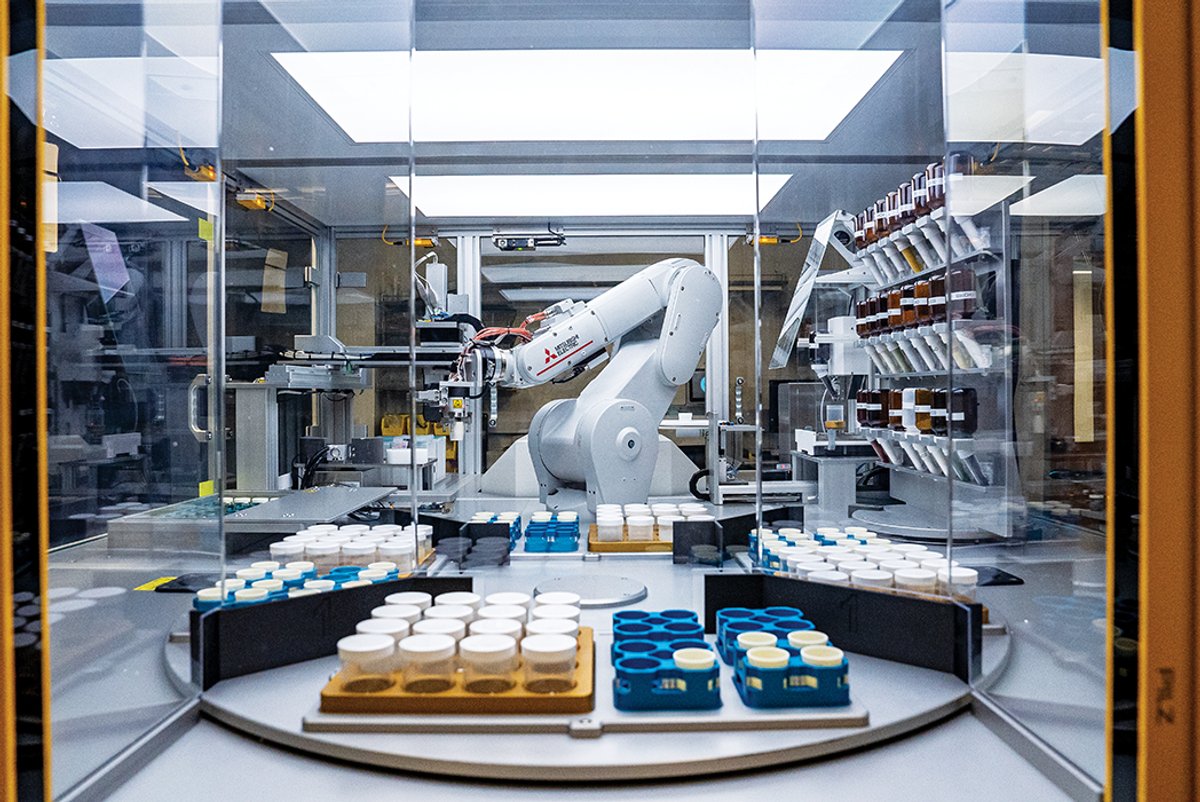
    At Stanford University, biomedical data scientist James Zou has built methods for handing research over to both large language models (LLMs) and specialized tools such as DeepMind’s AlphaFold, including fully virtual automated labs. He says extending that automation to the real world has a lot of hurdles to overcome. “They’re still fairly limited in the kinds of experiments that can be automated, mostly some chemistry experiments,” Zou says. “But [with] things that involve, let’s say, animals, it becomes much harder.”

    As the experiments become larger or more complex, so, too, do the models that simulate them, and the data to train those models is hard to come by. Robots handling real-world materials raise safety questions that are unknown to software. And, as Zou points out, the existing automated labs can be prohibitively expensive.

    One stacked bar chart shows the breakdown of survey responses about where scientists’ main research bottleneck has moved in the past two years: for 43.5 percent, it has shifted downstream, for 42.4 percent, it has remained the same, and for 13.8 percent, it has shifted upstream. Another stacked bar chart shows the breakdown of survey responses about how scientists’ backlog of untested hypotheses has changed in the past three years: for 40.5 percent, it has increased, for 33.8 percent, it has stayed the same, and for 24.8 percent, it has decreased.

    Others think the problem comes down to the type of questions different scientists ask. “When you look at the tasks where AI has made much progress, they are the ones where you have ground truth,” says Daron Acemoglu, an economics Nobel laureate at M.I.T., who studies AI’s labor impacts. “In most of medicine, there is no ground truth.

    The slowness can be deliberate. Clinical trials move at the pace of regulatory review, and any experiment involving people is constrained by safety checks before, during and after. Nobody has explained how AI would compress that or why we’d want it to.

    Some scientists are trying to clear the hurdles anyway. Julius B. Lucks, principal investigator of the AI-Driven, Rapid, Experimental Automation Machine (DREAM) Cloud Lab for Protein Engineering at Northwestern University, is trying to automate more of the protein-engineering cycle. His lab, which received $20 million from the NSF over the summer as part of a new national network of programmable cloud laboratories, is building systems that let researchers remotely design, build and test proteins with automated equipment. Lucks says he’s taking it one step at a time. But he’s also thinking past it. “We’ll learn,” he says. “We’ll figure out what makes sense: What is the thing that we need to automate next?”


    Original Source Link

    Share. Facebook Twitter Pinterest LinkedIn WhatsApp Email Reddit Telegram
    Previous ArticleShaun the Sheep: The Beast of Mossy Bottom review…
    Next Article Flock Offers Employees Buyouts as Customers Flee

    RELATED POSTS

    Will AI Kill Us? How Electronic Bandits Invented Religion By Howard Bloom

    September 18, 2026

    He Won the Nobel Prize for Protein Design. Now He Uses AI to Create Molecules Not Found in Nature

    September 18, 2026

    See the first new species of cat discovered in more than a century—it’s adorable

    September 18, 2026

    The Trump Administration Sends a New Signal to Alien Disclosure Whistleblowers

    September 17, 2026

    Missing pages of priceless missing Henry VIII–era manuscript finally found

    September 17, 2026

    Why It Seems Like Great White Sharks Are Overrunning Maine

    September 16, 2026
    latest posts

    F**ked Up’s “Good Goat Saw a Leaf”

    Heavy Song of the Week is a feature on Heavy Consequence breaking down the top…

    agrees to leave Greenland with Denmark and boost US military presence

    September 19, 2026

    Hasan Piker Says He’ll Campaign for AOC if She Runs for President in 2028 (VIDEO) * The Gateway Pundit * by Mike LaChance

    September 19, 2026

    Caitlin Clark returns after FIBA title as Kelsey Mitchell sets WNBA scoring mark in Fever victory over Tempo

    September 19, 2026

    Flock Offers Employees Buyouts as Customers Flee

    September 19, 2026

    Why AI is speeding up scientific research but not lab experiments

    September 19, 2026

    Shaun the Sheep: The Beast of Mossy Bottom review…

    September 19, 2026
    Categories
    • Books (1,496)
    • Business (6,400)
    • Cover Story (12)
    • Film (6,337)
    • Lifestyle (4,389)
    • Music (6,410)
    • Politics (6,385)
    • Science (5,749)
    • Technology (6,335)
    • Television (6,035)
    • Uncategorized (3)
    • US News (6,385)
    popular posts

    Trump’s New Campaign Video Is Demented Late Night Infomercial Of Hallucinogenic Gibberish

    If this Trump video is an example of what Republicans are going to put forward…

    The one human quality we need most to navigate the AI era

    November 6, 2025

    Goldman Sachs thinks that only an unforeseen shock is likely to cause a recession in 2024

    November 16, 2023

    Facts and Trivia About ‘Roseanne,’ the Show That Started It All

    April 23, 2025
    Archives
    Browse By Category
    • Books (1,496)
    • Business (6,400)
    • Cover Story (12)
    • Film (6,337)
    • Lifestyle (4,389)
    • Music (6,410)
    • Politics (6,385)
    • Science (5,749)
    • Technology (6,335)
    • Television (6,035)
    • Uncategorized (3)
    • US News (6,385)
    About Us

    We are a creativity led international team with a digital soul. Our work is a custom built by the storytellers and strategists with a flair for exploiting the latest advancements in media and technology.

    Most of all, we stand behind our ideas and believe in creativity as the most powerful force in business.

    What makes us Different

    We care. We collaborate. We do great work. And we do it with a smile, because we’re pretty damn excited to do what we do. If you would like details on what else we can do visit out Contact page.

    Our Picks

    Why AI is speeding up scientific research but not lab experiments

    September 19, 2026

    Shaun the Sheep: The Beast of Mossy Bottom review…

    September 19, 2026

    High Protein Snacks You Can Prep on Sunday

    September 19, 2026
    © 2026 Beverly Hills Examiner. All rights reserved. All articles, images, product names, logos, and brands are property of their respective owners. All company, product and service names used in this website are for identification purposes only. Use of these names, logos, and brands does not imply endorsement unless specified. By using this site, you agree to the Terms & Conditions and Privacy Policy.

    Type above and press Enter to search. Press Esc to cancel.

    We use cookies on our website to give you the most relevant experience by remembering your preferences and repeat visits. By clicking “Accept All”, you consent to the use of ALL the cookies. However, you may visit "Cookie Settings" to provide a controlled consent.
    Cookie SettingsAccept All
    Manage consent

    Privacy Overview

    This website uses cookies to improve your experience while you navigate through the website. Out of these, the cookies that are categorized as necessary are stored on your browser as they are essential for the working of basic functionalities of the website. We also use third-party cookies that help us analyze and understand how you use this website. These cookies will be stored in your browser only with your consent. You also have the option to opt-out of these cookies. But opting out of some of these cookies may affect your browsing experience.
    Necessary
    Always Enabled
    Necessary cookies are absolutely essential for the website to function properly. These cookies ensure basic functionalities and security features of the website, anonymously.
    CookieDurationDescription
    cookielawinfo-checkbox-analytics11 monthsThis cookie is set by GDPR Cookie Consent plugin. The cookie is used to store the user consent for the cookies in the category "Analytics".
    cookielawinfo-checkbox-functional11 monthsThe cookie is set by GDPR cookie consent to record the user consent for the cookies in the category "Functional".
    cookielawinfo-checkbox-necessary11 monthsThis cookie is set by GDPR Cookie Consent plugin. The cookies is used to store the user consent for the cookies in the category "Necessary".
    cookielawinfo-checkbox-others11 monthsThis cookie is set by GDPR Cookie Consent plugin. The cookie is used to store the user consent for the cookies in the category "Other.
    cookielawinfo-checkbox-performance11 monthsThis cookie is set by GDPR Cookie Consent plugin. The cookie is used to store the user consent for the cookies in the category "Performance".
    viewed_cookie_policy11 monthsThe cookie is set by the GDPR Cookie Consent plugin and is used to store whether or not user has consented to the use of cookies. It does not store any personal data.
    Functional
    Functional cookies help to perform certain functionalities like sharing the content of the website on social media platforms, collect feedbacks, and other third-party features.
    Performance
    Performance cookies are used to understand and analyze the key performance indexes of the website which helps in delivering a better user experience for the visitors.
    Analytics
    Analytical cookies are used to understand how visitors interact with the website. These cookies help provide information on metrics the number of visitors, bounce rate, traffic source, etc.
    Advertisement
    Advertisement cookies are used to provide visitors with relevant ads and marketing campaigns. These cookies track visitors across websites and collect information to provide customized ads.
    Others
    Other uncategorized cookies are those that are being analyzed and have not been classified into a category as yet.
    SAVE & ACCEPT