Close Menu
Beverly Hills Examiner

    Subscribe to Updates

    Get the latest creative news from FooBar about art, design and business.

    What's Hot

    The Cure’s Perry Bamonte Dies at 65

    January 1, 2026

    Copper records biggest annual gain since 2009 on supply bets

    January 1, 2026

    Trump Takes One Final Big Loss In Court Before The End Of The Year

    January 1, 2026
    Facebook X (Twitter) Instagram
    Beverly Hills Examiner
    • Home
    • US News
    • Politics
    • Business
    • Science
    • Technology
    • Lifestyle
    • Music
    • Television
    • Film
    • Books
    • Contact
      • About
      • Amazon Disclaimer
      • DMCA / Copyrights Disclaimer
      • Terms and Conditions
      • Privacy Policy
    Beverly Hills Examiner
    Home»Science»Why Homes Often Feel Warmer Than the Thermostat Suggests
    Science

    Why Homes Often Feel Warmer Than the Thermostat Suggests

    By AdminAugust 7, 2023
    Facebook Twitter Pinterest LinkedIn WhatsApp Email Reddit Telegram
    Why Homes Often Feel Warmer Than the Thermostat Suggests


    The following essay is reprinted with permission from Why Homes Often Feel Warmer Than the Thermostat SuggestsThe Conversation, an online publication covering the latest research.

    Picture two homes on the same street: one constructed in the 1950s and the other in the 1990s. There are no trees or other shade. The air conditioning units are identical, recently replaced, and operating perfectly. Identical thermostats are set at 82 degrees Fahrenheit (27.8 Celsius).

    When it’s 110 F (43.3 C) outside, the 1950s house will likely feel at least 10 F (5.6 C) warmer inside, even with the same air temperature.

    Why?

    The answer has to do with radiant heat. Radiant heat is what keeps you toasty warm at a campfire on a cold winter night. The fire doesn’t warm the air much; rather, like the Sun, most of the fire’s heat moves through invisible waves directly from the campfire to your body.

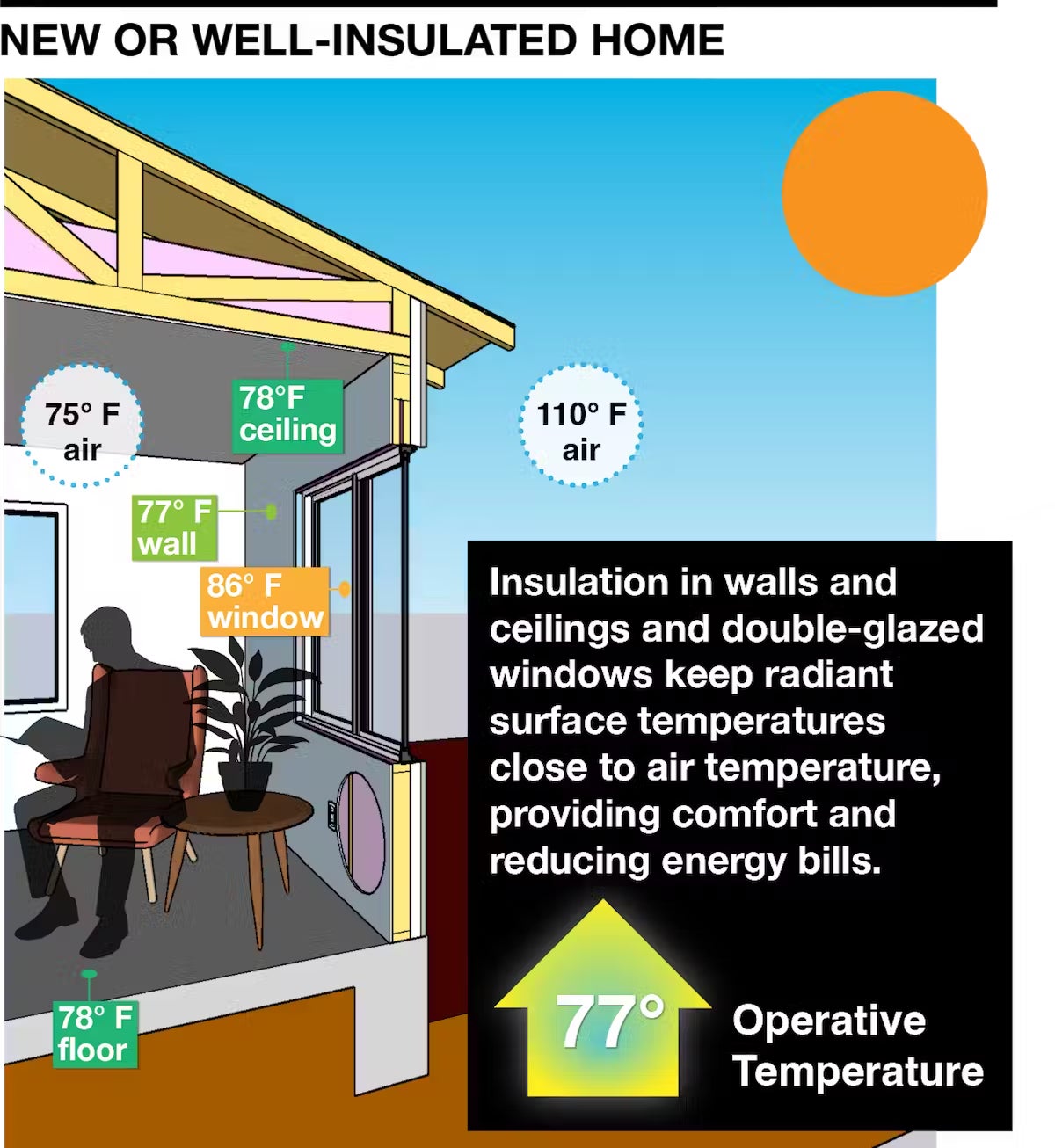
    In the radiant heat of the Arizona sun, the surface temperature of the uninsulated post-and-beam ceilings in my house, one of 41,000 built in Tucson during the post-World War II era, can reach over 100 F (37.8 C). The single-glazed steel windows register 122 F (50 C), and the uninsulated concrete block walls aren’t much cooler.

    Inside my house on triple-digit days, it can feel like I’m standing near a campfire, even with the air conditioner roaring to maintain 75 F (23.9 C). And when the system breaks – as it did during the long-running 2023 heat wave, when Phoenix hit 110 F (43.3 C) every day for weeks – temperatures rise dangerously fast. Without the AC, the hot surfaces plus the swirl of air from the ceiling fan makes the house feel like an air fryer.

    Air temperature: An incomplete indicator of comfort

    While people are used to thinking about how clothing, air movement, temperature and humidity affect comfort, two lesser-known measures help explain how they experience comfort indoors:

    1. Mean radiant temperature. This is the average temperature of all the surfaces that surround us: ceiling, windows, walls, floor. For radiant heat to move between an object and the human body, it needs an uninterrupted line of sight, so ceilings and unobstructed windows have an outsized influence on the radiant temperature experienced in a specific place in a house.

    2. Operative temperature. This can be approximated by averaging the mean radiant temperature and the average air temperature in a room. Other calculations of operative temperature take into account effects of air movement, humidity and additional variables. Roughly half of how you experience comfort is determined by the radiant environment.

    Unfortunately, as the building scientist Robert Bean (no relation) says, “an entire industry of manufacturers, suppliers, builders and tradespeople incorrectly equate thermal comfort with air temperatures.” The result is that most people are completely oblivious to what actually makes a space feel comfortable — or uncomfortably hot.
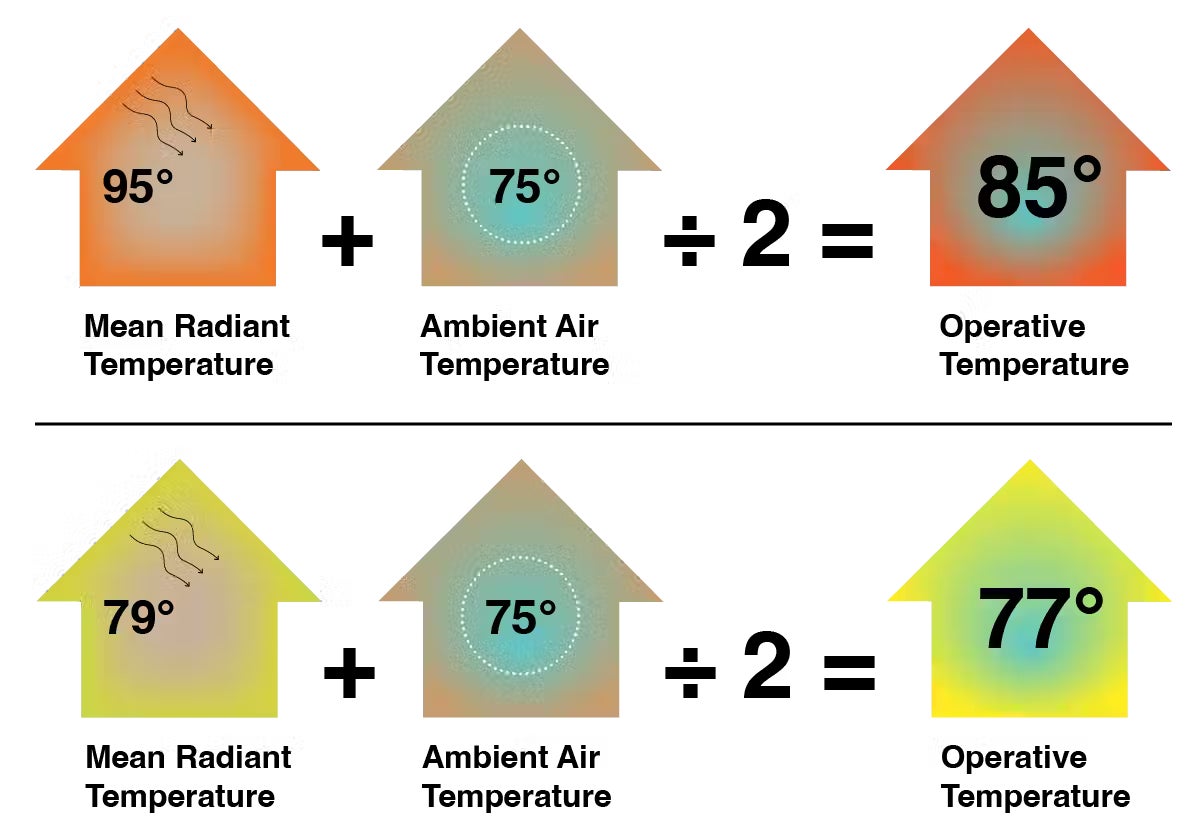
    Graphics of the temperature of indoor surfaces makes a big difference for comfort, even when the indoor air is the same temperature.
    The temperature of indoor surfaces makes a big difference for comfort, even when the indoor air is the same temperature. Credit: Jonathan Bean (CC BY-ND)

    On a hot, sunny day, good insulation and double-pane windows slow heat transfer enough for air conditioning to keep the mean radiant temperature inside the building within a few degrees of the air temperature.

    However, in an under-insulated building, such as my house, or in some older public housing projects in Phoenix, the high mean radiant temperature can push the operative temperature over 90 F (32.2 C) – even with the thermostat set to 75 F (23.9 C). When the surface temperature exceeds the temperature of our skin, heat will begin to radiate from the hot surface into the body, making heat stroke more likely.
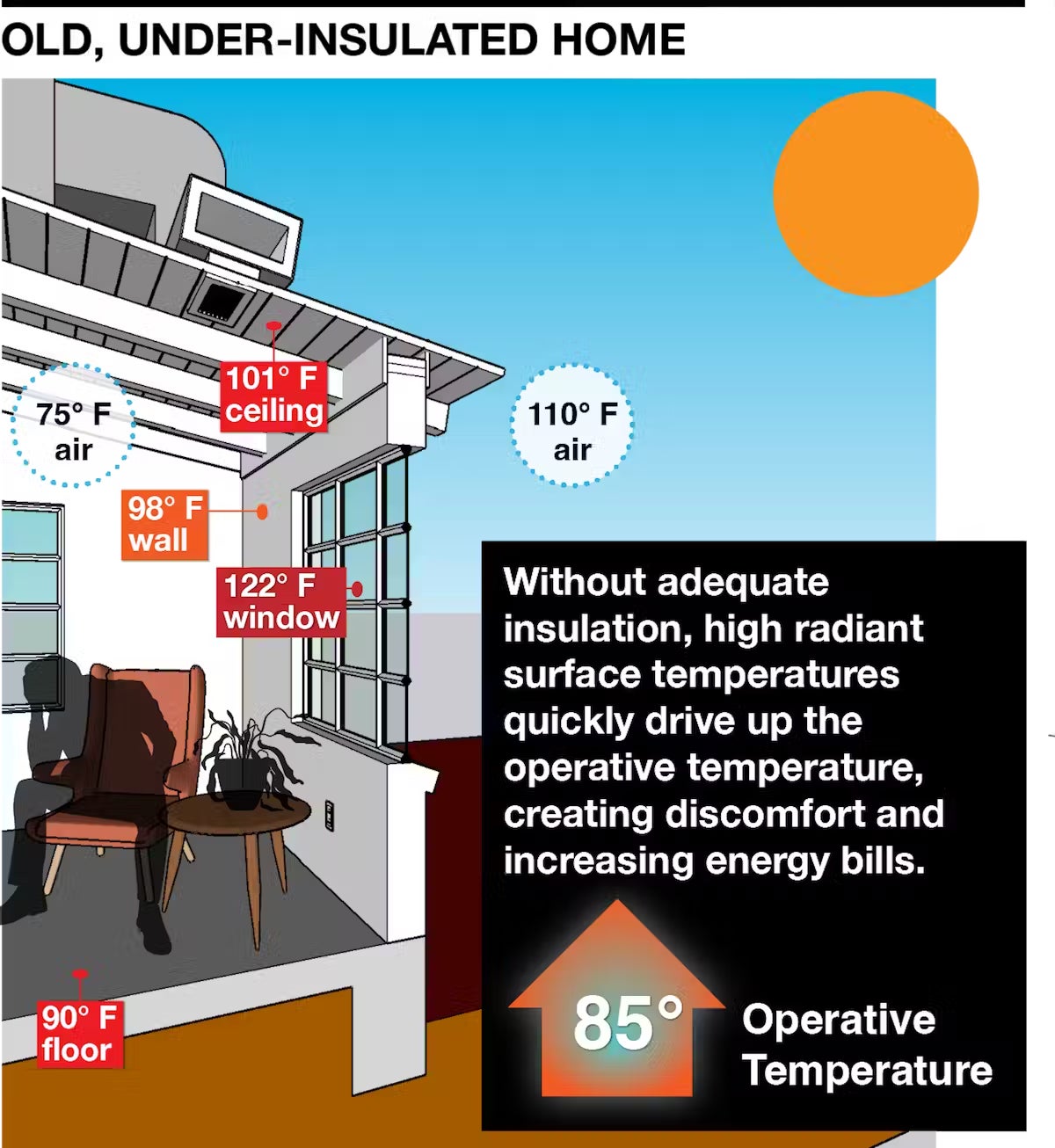
    Graphic of the high radiant mean temperature in old, under-insulated homes
    The high radiant mean temperature in old, under-insulated homes makes them much less comfortable than new or well-insulated homes. Credit: Jonathan Bean (CC BY-ND)

    Credit: Jonathan Bean (CC BY-ND)

    While the exact threshold where overheating becomes dangerous is debated, most people would agree that 90 F (32.2 C) is far too warm for comfort.

    Hot surfaces are why smaller buildings, such as mobile homes, tiny homes, shipping containers and garages turned into apartments, often feel uncomfortable regardless of the thermostat setting. Smaller structures expose occupants to three, four or even six surfaces with the exterior exposed to the sun and hot outside air. More warm surfaces, more discomfort.

    Cooler surfaces, more comfort

    If you live in an under-insulated building and don’t mind using more electricity, you can set the thermostat lower. But if the mean radiant temperature is high, a 2 F (1.1 C) drop in air temperature will feel like only 1 F (0.6 C) — and those hot surfaces will still make you feel uncomfortable.

    Adding insulation to your roof and replacing single-pane windows with double-pane units with low-emissivity (low-E) glass can help reduce the mean radiant temperature and your energy bills. They’re expensive improvements, but new federal tax credits and forthcoming rebates, to be administered by individual states, can help.

    Trees, awnings and exterior shades can also reduce mean radiant temperatures by blocking direct sunlight. However, glass is a lousy insulator, so in very hot climates, single-pane windows completely protected from the sun can still become uncomfortably warm.

    Adding a curtain inside — and keeping it closed — can help decrease mean radiant temperature because the curtain will be closer to the air temperature than the glass.

    What about renters in old buildings?

    Renters in older, under-insulated buildings are often less able to afford large energy bills, and landlords may be unable or unwilling to make expensive improvements. Making matters worse, older air conditioning systems use two to three times as much energy as newer units to deliver the same amount of cooling.

    Since creating a comfortable operative temperature requires setting the thermostat lower, an HVAC system in an under-insulated building must work longer and harder, using more energy and further raising the cost. And the costs of discomfort are not only financial: Hot buildings also have adverse impacts on health and productivity.

    Millions of Americans now live in places where cooling is the only thing preventing a mass casualty event. In Phoenix, city code requires rental units cooled by air conditioning to maintain a temperature of no more than 82 F (27.8 C), measured 3 feet above the floor in the center of the room. Unfortunately, the code does not specify whether 82 F is the operative temperature or the air temperature.

    That one word makes a world of difference.

    In an older, under-insulated building similar to my house — or, in what might be the worst-case scenario, a sun-fried southwest unit of the top floor of an uninsulated concrete high-rise — a seemingly safe air temperature of 82 F could easily mask dangerous operative temperatures of 96 F (35.6 C) or higher.

    The key to better design

    As a professor of architecture and building science, I believe today’s byzantine building codes and rental rules could be greatly improved for comfort by regulating mean radiant temperature rather than air temperature. Vast sections of code could be jettisoned by requiring that interior surfaces, which are easy to measure with an inexpensive infrared thermometer, be kept within a comfort range above 60 F (15.6 C) and below 85 F (29.4 C).

    For more comfortable buildings, architects and engineers can apply simple, established principles, such as natural ventilation, shading and the right insulation and windows for the climate. Keeping heat out in the first place means we don’t have to spend so much on energy for cooling. Research shows that these measures can also make us safer by keeping buildings cooler for longer in summer power outages.

    The happy result: homes and other buildings that are not only comfortable, but also safer and more affordable to operate.

    This article was originally published on The Conversation. Read the original article.


    Original Source Link

    Share. Facebook Twitter Pinterest LinkedIn WhatsApp Email Reddit Telegram
    Previous ArticleJoy Ride review – hands-over-eyes, wretched hilarity
    Next Article Threads app is rolling out to a way to see your liked posts

    RELATED POSTS

    Poor Sleep Quality Accelerates Brain Aging

    January 1, 2026

    NASA Telescopes Capture Colliding Spiral Galaxies in Sparkling Detail

    December 31, 2025

    Star that seemed to vanish more than 130 years ago is found again

    December 31, 2025

    The Great Big Power Play

    December 30, 2025

    15 Million Years before the Megalodon, This Giant Ancient Shark Prowled the Oceans

    December 30, 2025

    Mathematicians unified key laws of physics in 2025

    December 29, 2025
    latest posts

    The Cure’s Perry Bamonte Dies at 65

    Perry Bamonte, the Cure’s longtime guitarist and keyboardist, has died following an undisclosed illness. He…

    Copper records biggest annual gain since 2009 on supply bets

    January 1, 2026

    Trump Takes One Final Big Loss In Court Before The End Of The Year

    January 1, 2026

    Zohran Mamdani sworn in as NYC mayor in midnight ceremony at Old City Hall

    January 1, 2026

    ‘College dropout’ has become the most coveted startup founder credential

    January 1, 2026

    Poor Sleep Quality Accelerates Brain Aging

    January 1, 2026

    Avengers, Toy Story 5, The Odyssey

    January 1, 2026
    Categories
    • Books (970)
    • Business (5,878)
    • Film (5,812)
    • Lifestyle (3,915)
    • Music (5,880)
    • Politics (5,882)
    • Science (5,224)
    • Technology (5,811)
    • Television (5,497)
    • Uncategorized (2)
    • US News (5,863)
    popular posts

    Dementia: 7 things to do to avoid the condition even if you have high genetic risk

    A study of people in the US suggests those at high genetic risk of dementia…

    ‘Magnum P.I.’ Cast Rects to NBC Saving Series, Season 5 & 6 Renewal

    July 1, 2022

    Armed man killed in gunfire exchange near U.S. consulate in Saudi Arabia

    June 29, 2023

    New Mystery & Thriller Novels for Fans of The Perfect Couple

    September 21, 2024
    Archives
    Browse By Category
    • Books (970)
    • Business (5,878)
    • Film (5,812)
    • Lifestyle (3,915)
    • Music (5,880)
    • Politics (5,882)
    • Science (5,224)
    • Technology (5,811)
    • Television (5,497)
    • Uncategorized (2)
    • US News (5,863)
    About Us

    We are a creativity led international team with a digital soul. Our work is a custom built by the storytellers and strategists with a flair for exploiting the latest advancements in media and technology.

    Most of all, we stand behind our ideas and believe in creativity as the most powerful force in business.

    What makes us Different

    We care. We collaborate. We do great work. And we do it with a smile, because we’re pretty damn excited to do what we do. If you would like details on what else we can do visit out Contact page.

    Our Picks

    Poor Sleep Quality Accelerates Brain Aging

    January 1, 2026

    Avengers, Toy Story 5, The Odyssey

    January 1, 2026

    ‘The Challenge’ Star Reveals Horrific Accident Blinded Him

    January 1, 2026
    © 2026 Beverly Hills Examiner. All rights reserved. All articles, images, product names, logos, and brands are property of their respective owners. All company, product and service names used in this website are for identification purposes only. Use of these names, logos, and brands does not imply endorsement unless specified. By using this site, you agree to the Terms & Conditions and Privacy Policy.

    Type above and press Enter to search. Press Esc to cancel.

    We use cookies on our website to give you the most relevant experience by remembering your preferences and repeat visits. By clicking “Accept All”, you consent to the use of ALL the cookies. However, you may visit "Cookie Settings" to provide a controlled consent.
    Cookie SettingsAccept All
    Manage consent

    Privacy Overview

    This website uses cookies to improve your experience while you navigate through the website. Out of these, the cookies that are categorized as necessary are stored on your browser as they are essential for the working of basic functionalities of the website. We also use third-party cookies that help us analyze and understand how you use this website. These cookies will be stored in your browser only with your consent. You also have the option to opt-out of these cookies. But opting out of some of these cookies may affect your browsing experience.
    Necessary
    Always Enabled
    Necessary cookies are absolutely essential for the website to function properly. These cookies ensure basic functionalities and security features of the website, anonymously.
    CookieDurationDescription
    cookielawinfo-checkbox-analytics11 monthsThis cookie is set by GDPR Cookie Consent plugin. The cookie is used to store the user consent for the cookies in the category "Analytics".
    cookielawinfo-checkbox-functional11 monthsThe cookie is set by GDPR cookie consent to record the user consent for the cookies in the category "Functional".
    cookielawinfo-checkbox-necessary11 monthsThis cookie is set by GDPR Cookie Consent plugin. The cookies is used to store the user consent for the cookies in the category "Necessary".
    cookielawinfo-checkbox-others11 monthsThis cookie is set by GDPR Cookie Consent plugin. The cookie is used to store the user consent for the cookies in the category "Other.
    cookielawinfo-checkbox-performance11 monthsThis cookie is set by GDPR Cookie Consent plugin. The cookie is used to store the user consent for the cookies in the category "Performance".
    viewed_cookie_policy11 monthsThe cookie is set by the GDPR Cookie Consent plugin and is used to store whether or not user has consented to the use of cookies. It does not store any personal data.
    Functional
    Functional cookies help to perform certain functionalities like sharing the content of the website on social media platforms, collect feedbacks, and other third-party features.
    Performance
    Performance cookies are used to understand and analyze the key performance indexes of the website which helps in delivering a better user experience for the visitors.
    Analytics
    Analytical cookies are used to understand how visitors interact with the website. These cookies help provide information on metrics the number of visitors, bounce rate, traffic source, etc.
    Advertisement
    Advertisement cookies are used to provide visitors with relevant ads and marketing campaigns. These cookies track visitors across websites and collect information to provide customized ads.
    Others
    Other uncategorized cookies are those that are being analyzed and have not been classified into a category as yet.
    SAVE & ACCEPT