
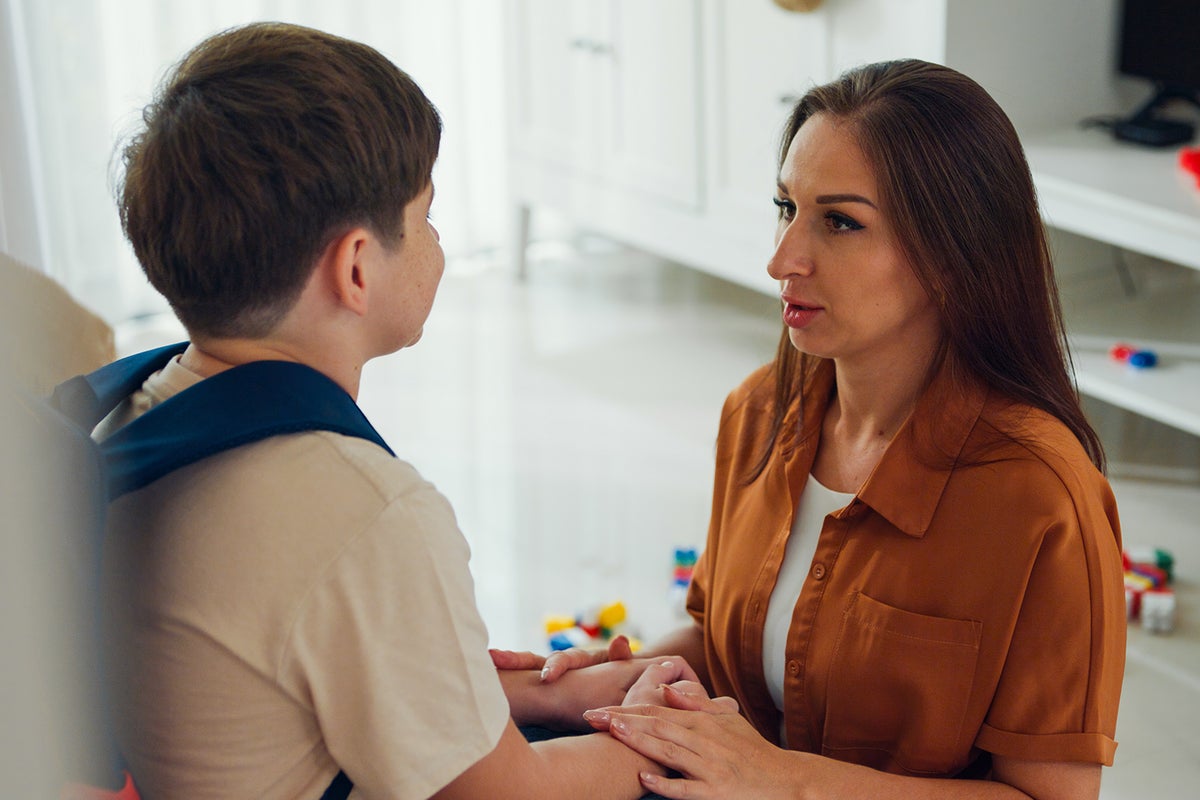
When my son was three years old, he told me one day after preschool that he didn’t want to play with me because I was Black. He went on; Black people are mean, he said, and he only wanted to play with his dad because my husband was white, like him.
We were shocked and I was hurt—my child thought I was bad because I was Black. And even though my son is biracial, he characterized himself as white.
What my son said that day unfortunately reinforced what research has long shown: children absorb racial biases from their environment. I study racial socialization—the ways children learn about race and racism—and I know how early these biases form. I also know that talking about race and racism can shape how children perceive others. Yet when white parents tell me their children say things like “Black people are not nice” or “I don’t want to play with Black kids,” they also tell me they ignore what their children said or simply tell their children it was mean. Without a real conversation about why their child might think that way or how to counter those ideas, children don’t unlearn bias; they just learn not to say it out loud.
On supporting science journalism
If you’re enjoying this article, consider supporting our award-winning journalism by subscribing. By purchasing a subscription you are helping to ensure the future of impactful stories about the discoveries and ideas shaping our world today.
In 2022, even though research on white parents discussing racism was still emerging, my colleagues and I argued that they needed to have these conversations with their children. At the time, we pointed to the subtle ways children can absorb racial biases—the diversity (or lack thereof) of their parents’ social circles, the characters they see on TV, and the differences they notice in social class.
But, in 2025, subtlety is a thing of the past. In attacking diversity, equity and inclusion initiatives, the Trump administration is legitimizing and emboldening racism in ways that children—especially white children—undoubtedly notice. If my son, at three years old, could absorb anti-Black messages when overt racism was more widely condemned, imagine what white children today are internalizing in a climate where political leaders openly promote racism.
White parents who see themselves as egalitarian must recognize that the stakes are now higher than ever. If you want to raise children who reject racism rather than passively absorbing it, right now, today, talk with your child about race and racism.
By preschool, children start associating Black people with negative traits and white people with positive traits. These biases form as children pick up on patterns—who holds power, how groups are portrayed in media and how others interact with them. Even subtle nonverbal cues, like smiling at one group and frowning at another, influence children’s preferences. Not surprisingly, young children favor groups receiving positive signals and mimic those behaviors, reinforcing biases. These small cues accumulate, shaping how children perceive racial groups.
While most parents of color talk to their children early about race to prepare them for potential discrimination, white parents often avoid these discussions. In our research on parents of children in age ranges of 8–12and 13–17, less than 40 percent of white parents talked to their children about race, and many who did downplayed racism. This avoidance is concerning, given how racial attitudes develop. Without parental guidance, children interpret racial patterns on their own, often reinforcing societal biases.
Our work revealed that some of the most common reasons white parents avoid discussing racism are the beliefs that their children are too young for such conversations and that they need to shield them from the reality of racism. This fear is unfounded. Studies show that, even in young children, when parents and teachers openly discuss race—explaining disparities and fairness—children develop less biased attitudes, greater empathy for people of color, and a stronger ability to recognize and challenge racism.
Talking about race and racism with children doesn’t have to be overwhelming. As with many difficult topics, starting early and making these conversations a natural part of your family’s dialogue can help children develop a more accurate and empathetic understanding of the world. Here’s how:
Start early with fairness and inclusion. Children understand and value fairness from an early age. Parents can use this as an entry point. When reading books or watching TV, ask: “Do you think it’s fair if someone is treated differently just because of how they look?” Choose diverse books and media featuring characters of color as protagonists—not just in stories about struggle, but as heroes and leaders.
Use color-conscious language. Telling children that “race doesn’t matter” or “we’re all the same” ignores the reality of racism. Instead, explain that while everyone deserves equal treatment, some people face unfair challenges because of their race.
Connect the past to the present: “A long time ago, Black people weren’t allowed to go to certain schools or have certain jobs. Although some things are better, Black people are still treated unfairly because of their race. Can you think of any examples?”
Ask open-ended questions: “Have you ever seen someone treated unfairly because of their race? How did that make you feel?”
Talk about stereotypes and bias. Stereotypes are learned early, and children can recognize them if they are taught to think critically. When my son was five, we started talking about stereotypes–what they are and why they are unfair. A year later, when we read The Sneetches by Dr. Seuss, a book in which Sneetches with stars on their bellies had negative assumptions about those without stars, he immediately made the connection. “Hey, that’s a stereotype!” he said. “There’s no reason to dislike them just because they don’t have stars;” He made the connection between how stereotypes can lead to discrimination. These may seem like complex concepts, but children understand them when given the opportunity to do so.
Talk about racism when it happens. If your child says something biased or asks a race-related question, that’s an opportunity for discussion. If they say something problematic, don’t shame them. Instead ask: “What made you think that?” Then gently correct misconceptions: “Actually, that’s a stereotype, which means it’s an unfair way of thinking about a group of people.”
If you witness racism together—on TV, in a book or in real life—use it as a teachable moment: “Why do you think that happened? How do you think that person felt?” This not only encourages empathy and perspective taking; it also equips children with the knowledge they need to understand what discrimination looks like and allows them to make sense of it should they witness it again.
Create a supportive environment for questions. Children need to know that it’s okay to ask about race and racism. Foster an open, nonjudgmental space. If your child brings up race, don’t shut them down with “We don’t talk about that.” Instead say, “I’m really glad you asked. Let’s talk about it together.” Validate their feelings if they express confusion, sadness or anger about injustice.
After that unexpected and difficult conversation with my three-year-old, I began talking to him about race. At that age, he identified as white—not because we told him he was but because he was already learning that white was seen as the “better” color to be. But through our ongoing conversations, his understanding has evolved.
At first, we talked about skin tone—how people come in different shades, and how all skin tones are beautiful. Over time these discussions grew to include fairness, history and the experiences of Black people. Now, he’s seven. When writing this, I asked him how he identifies. He said, “I identified as a mixed person who is a descendant of African people who were enslaved.” But he also recognizes that his grandparents came from Poland, Italy, Ireland and England.
These conversations aren’t always easy. Sometimes, learning about the difficult parts of Black history makes him sad. But he also feels proud—proud to be part of a lineage of people who fought for justice and equal rights. And as he continues to navigate what it means to be multiracial in America, we talk about the complexities of being both Black and white. His understanding of race is still forming, and at times, he feels conflicted. But what matters most is that he knows he can ask questions, share his feelings, and that these conversations will always be open. I feel lucky that he shared his thoughts with me that day, and even luckier that he knows he can always come to me with questions about race and racism.
Talking about race and racism doesn’t make a child racist. Raising an antiracist child isn’t about checking a box or making a onetime statement. It is an ongoing process that requires honest, intentional conversations. If we want the next generation to be less racist than the ones that came before, the time to start is now.
This is an opinion and analysis article, and the views expressed by the author or authors are not necessarily those of Scientific American.