
Kendra Pierre-Louis: For Scientific American’s Science Quickly, I’m Kendra Pierre-Louis, in for Rachel Feltman. You’re listening to our weekly science news roundup.
First up, if it feels like almost everyone you know either has the flu, is getting over the flu or has just gotten over the flu, you’re not totally wrong.
In the U.S., more than 8 percent of all visits to a health care provider in the week that ended December 27 were for respiratory illness, according to the Centers for Disease Control and Prevention. That’s the highest rate the agency has recorded since it began keeping track in 1997. According to the CDC, so far this season the flu has contributed to an estimated 120,000 hospitalizations and 5,000 deaths, including nine children.
On supporting science journalism
If you’re enjoying this article, consider supporting our award-winning journalism by subscribing. By purchasing a subscription you are helping to ensure the future of impactful stories about the discoveries and ideas shaping our world today.
This surge comes even as the CDC has rolled back its flu vaccine guidance for children. In early January the agency reversed its decade’s long recommendation that everyone over the age of six months get vaccinated. The agency now advises parents to discuss influenza vaccination with their child’s doctor. Last year, shortly after Robert F. Kennedy Jr, was sworn in as the Secretary of Health and Human Services, the CDC canceled a promotion campaign encouraging flu vaccination that health officials had deemed effective. They also removed the campaigns related webpages.
Much of the uptick in cases and hospitalizations this flu season seems to be driven by a new variant of H3N2 known as subclade K. The good news is that vaccinated people are less likely to be hospitalized or die from the flu, and research suggests that even if they get the flu they may be less likely to infect others.
While the current vaccine is not a perfect match for subclade K, since it was developed months before the identification of the variant, it does still reduce the risk of severe illness, according to preliminary data from University of Pennsylvania researchers.
And of course, wearing securely fitting masks such as N95s and KN95s in indoor public spaces can also help reduce the chance you’ll catch the flu. If you do get sick, drink plenty of fluids, stay home and rest up as best you can—although the flu can famously make it hard to sleep.
Speaking of sleep, a new study led by researchers at Stanford University details a new way to potentially predict future disease risk while you’re catching your Zzzz’s.
The researchers built what’s known as a foundation model, a kind of AI model that trains itself on massive datasets and then applies that information in specific contexts. Large language models like ChatGPT and multimodal diffusion models like the video AI app Sora 2 are examples of foundation models.
In the new study researchers trained their model, called SleepFM, on polysomnography sleep data. Scientists call it the “gold standard” of sleep assessments. It uses sensors to record a host of bodily data such as eye and leg movements and brain activity while the patient sleeps—or at least tries to). The team was able to train their model on almost 600,000 hours of polysomnography data from 65,000 patients, far more information than any person could process themselves.
Once the model was trained up the researchers went about testing it, first on analyzing basic aspects of sleep such as the different stages. The team says it found that SleepFM fared about as well as, if not better than, many of the sleep models currently in use. The researchers then explored if their model could predict health outcomes based on sleep behavior. To figure that out they went back to the Stanford Sleep Medicine Center. The center provided sleep data for more than half of the patients the team had trained the model on and retrieved information about their long-term health outcomes.
Ultimately, the researchers found that SleepFM was successful at predicting Parkinson’s disease, dementia, hypertensive heart disease, heart attacks, prostate cancer, breast cancer and death. These are also all health outcomes that poor sleep is believed to contribute to.
Perhaps most interestingly, according to Emmanuel Mignot, a co-senior author of the study, the best predictors for disease was not when they looked at a single unit of data – like heart data – but when they combined information. He says, “A brain that looks asleep but a heart that looks awake, for example, seemed to spell trouble.” SleepFM is a reminder of the many ways that tech can impact our lives.
For more on how tech is shaking things up let’s head to Las Vegas, where Scientific American’s senior tech editor, Eric Sullivan, was on the ground at the CES technology conference. Here he is.
Eric Sullivan: CES, is the largest consumer technology conference in America. It happens every January in Las Vegas, Nevada. It launched in 1967, and it bounced around cities for a while. It is gathering of upwards of 150,000 people, little bit less last year.
CES matters because it’s an opportunity for all of these different people involved in technology, every level to come together and schmooze and to check out the latest products to try to locate the trends that will ultimately sort of help drive their business decisions moving into the new year.
And so it’s also a lot of media there. Media is a much smaller segment, but we are there in order to observe the trends and try to get a sense of where various sectors in the technology industry are heading.
So CES 2026 felt like the year that AI jumped out of the chat box and into the real world. AI showed up in physical manifestations of all sorts of products. And physical AI is actual hardware that operates alongside human beings in the real world and that includes humanoid robots, which were also everywhere this year.
I think that one of the challenges I faced was trying to figure out the perception of the technology when it came to humanoid robots and the actual reality of whether this was in fact a leap forward. However, clearly it’s a major trend in the industry.
Of all the nonstop talk at CES this year about artificial intelligence, including in accessibility tech. You know, I think that some of the most insightful stuff that I heard was from none other than Stevie Wonder, whom I spotted walking the expo floor. He had some handlers with him, but I was able to saddle up alongside and ask him a few questions.
And he is not new to the world of technology. Stevie Wonder has been using technology in his music for decades. So I was curious to hear whether he was planning to use any artificial intelligence in his new album, which is, it’s gonna be his first album in 20 years. He did not equivocate. He said, “I will not let my music be programmed. I’m not going to use it to do me and do the music I’ve done.”
So I think that he wasn’t rejecting the technology so much as he was protecting what he considers to be human territory. The human domain. He said, “We can go on and on talking about technology. Let’s see how you make things better for people in their lives—not to emulate life but to make life better for the living.”
And, I think that really stuck with me, that quote, and it really kind of framed the rest of the expo for me—the notion that technology, at its best, is not necessarily the shiny object that is trying to replace human beings. It is the technology that is trying to make life better for those that are here.
So my takeaway from CES 2026 is that AI is now infrastructure. It’s dominating the chips that are developed, the platforms that are made, the compute that is being developed, and AI is entering the physical world in the form of robots, devices that we wear, that we interact with every day.
And I think that the best announcements we saw at CES were the ones that made those two lanes really sort of feel connected. You can read more about my experiences at CES 2026 at scientificamerican.com
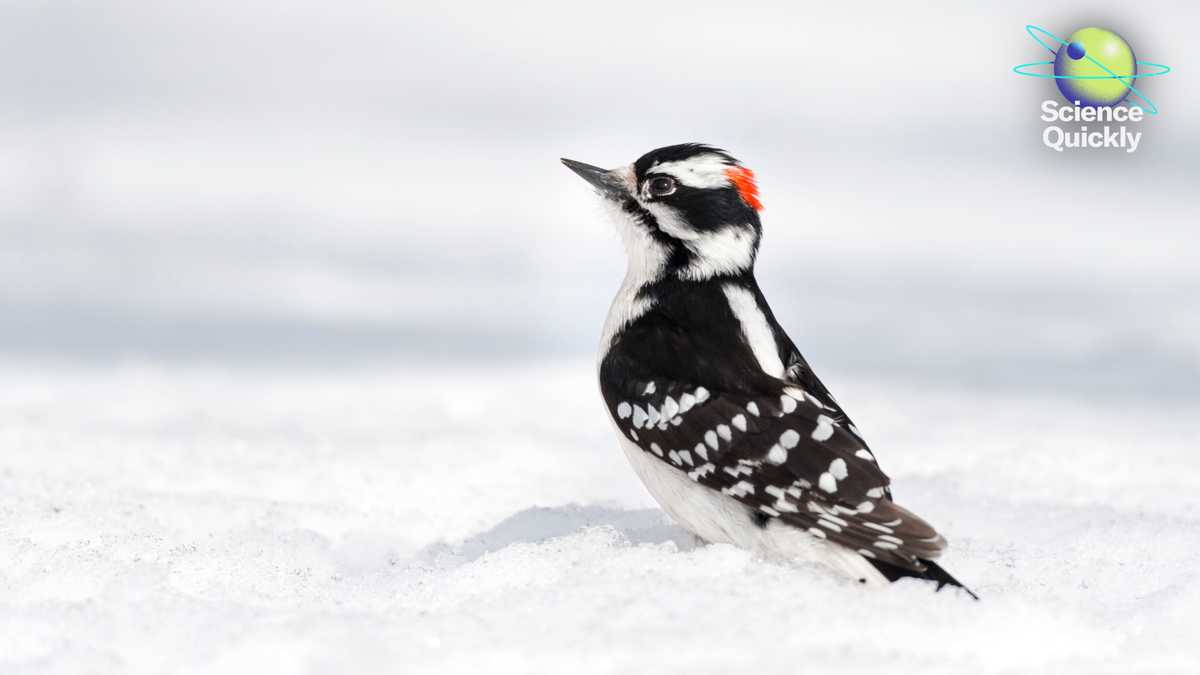
Pierre-Louis: And finally, some fun animal news. Research led by Brown University scientists offers new insight into how nature’s original headbangers, woodpeckers, are so skilled at pounding wood.
The diminutive birds can pierce through solid wood with a force up to 30 times their own body weight while bashing their beaks as many as 13 times per second.To find out how, researchers humanely captured eight downy woodpeckers. Once the birds were in the lab researchers carefully inserted electrodes into the animals’ muscles to record signals as they pecked.
According to the study, the electrodes revealed that for woodpeckers, pecking is a full-body affair. The birds tightened their tails and abs in preparation, thrusting their hip flexors and tightening the back of their heads mirroring how you or I might tighten the back of our wrists when hammering a nail.
Nicholas Antonson, a Brown biologist and the study’s lead author, told SciAm, “Woodpeckers really are nature’s hammer in a sense.”
That’s all for today’s episode. Tune in on Wednesday, when we’ll take a deep dive into the weird world of seed oils.
Science Quickly is produced by me, Kendra Pierre-Louis, along with Fonda Mwangi, Sushmita Pathak and Jeff DelViscio. This episode was edited by Alex Sugiura. Shayna Posses and Aaron Shattuck fact-check our show. Our theme music was composed by Dominic Smith. Subscribe to Scientific American for more up-to-date and in-depth science news.
For Scientific American, this is Kendra Pierre-Louis. Have a great week!