
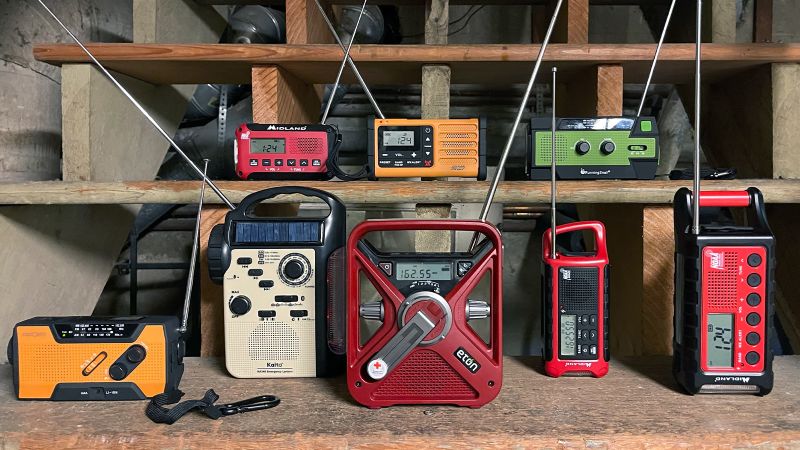
Because severe weather situations can develop extremely quickly, it’s imperative you give yourself as much time as possible to prepare. Emergency radios are designed to give you a head start, providing access to NOAA weather frequencies that can alert you to upcoming or current weather situations like flash floods, hurricanes, blizzards, tornadoes and more. And to make sure you can keep using them as an emergency is happening, many are also designed with hand cranks and solar panels so you can extend their running time practically indefinitely even without access to power. With battery-charging capability and AM/FM bands, they’re also a useful addition to camping or hiking gear.
We put nine of the most popular emergency radios to the test, comparing their ability to issue alerts and receive emergency weather broadcasts, and assessing how functional and useful they would be in an actual emergency situation.
The best emergency radio overall
With easy-to-use alerts, four charging options, a bright LCD screen, a powerful flashlight and straightforward controls, the Midland ER310 outperformed the other radios we tested in every area and makes a valuable addition to your household emergency kit.
The best emergency radio overall: Midland ER310
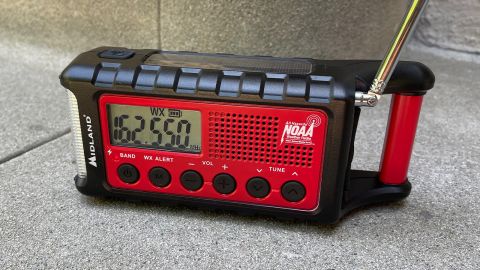
If you’re looking for an emergency radio that’s extremely easy to use while providing a variety of useful bells and whistles, look no further than the Midland ER310, a solidly built weather alert radio that performed well on all of our tests and was simple to use — which means it’ll be there if you need it and you’ll have no problem operating it when you do.
The ER310 is well-built, with a sturdy, high-quality feel, and the textured body makes it comfortable to pick up and maintain a good grip on while carrying around. Thanks to a large, bright, backlit LCD screen I was able to maneuver through the different bands and frequencies without any trouble, and the clear, helpful instruction manual provided any extra assistance I needed. The ER310 is a weather alert radio, not just a weather band radio, which means it is able to receive emergency-band alerts automatically without you having to tune in first — a useful feature during hurricane season.
An emergency checklist was included in the box as well, which was a nice perk and valuable for anyone buying this radio as part of a larger household emergency kit.
The Midland ER310 performed well in testing, providing an impressive 26 minutes of radio time after just 60 seconds of hand cranking. The large handle of the crank was also the most comfortable of all the radios in our group, which can make a big difference if you end up needing it in an extended emergency situation. Its solar panel was also able to charge the radio enough after an hour in direct sunlight to provide full functionality, and filled the battery to 1/3 after six hours. Your results may vary on these measures depending on the speed you turn the crank or cloudiness of the sky, but under the conditions in which we tested, and in relation to the rest of the radios tested, these results put the ER310 at the top of the group.
Setting up the ER301 to receive alerts and receiving the NOAA weather alert test to confirm couldn’t have been easier, thanks to a dedicated “Alert” button that enables the function. Other radios we tested used a multipurpose button that enabled alerts and functioned as a “menu” button. Even though that’s not a dealbreaker, we appreciated that the ER310 gave us one less step to remember, an additional point in its favor in a stressful situation.
I was also impressed with the brightness of the integrated flashlight, which provided three settings to choose from: standard, bright and flashing. Lower light settings help to conserve battery life, and come in handy if you need to read a map and not just illuminate a hallway. The placement of the button and raised grip also gave an ergonomic, flashlight-like feel to the whole unit, making it easy to direct the beam where I needed it.
Its rechargeable 2,600 mAh battery was the second-largest in our testing group, and combined with the three other power options (solar, hand crank or six AAA batteries) makes the Midland ER310 a reliable choice for anyone who wants to be prepared for power outages and have the ability to charge their mobile devices.
What’s the difference between an emergency radio and regular radio?
Emergency radios are designed to provide accurate and up-to-date weather information and alerts using the NOAA (National Oceanic and Atmospheric Administration) network of radio stations, while your typical transistor radio will only receive AM/FM stations. Granted, in an emergency like a hurricane or flood situation, your AM/FM stations may provide weather info, but they’re not going to provide the around-the-clock updates that you get from a dedicated NOAA station. Emergency radios can also offer additional features that can be valuable in an emergency, like hand cranks and solar panel chargers when batteries run low, and USB ports to charge your phone.
If you think you could be in an emergency weather situation, you should probably get an emergency radio. Power grids can go out, cell towers can go down, phone batteries can die, and in fast-moving weather events, up-to-date information can give you time to get to safety.
Those who live in areas frequented by dangerous weather events like flash floods, tornadoes, and hurricanes should absolutely have an emergency radio. Plus, according to the National Weather Service, NOAA broadcasts can include non-weather emergencies and natural disasters when appropriate, making them even more useful.
The extra bells and whistles of an emergency radio may seem gimmicky at first, but considering the uncertain and unpredictable nature of weather and natural emergencies, they can be extremely useful when the time comes. To choose the best option for you, take some time to think about the types of weather emergencies that are common to your area, and the features that would be most helpful to you.
You should also make sure you’re aware of whether or not you’re buying a weather band radio or a weather alert radio. We suggest a weather alert radio, like the Midland ER310 — these will automatically alert you of weather emergencies whether the radio is turned on and tuned in or not, while weather band radios must be turned on and tuned into the emergency band to receive the alert. Weather band radios have their uses if you’re expecting poor weather, but weather alert radios are more generally useful since situations can change quickly.
If you want to give yourself as many options as possible when it comes to power, go with a radio that has at least three charging methods. Whether those are solar panels, hand cranks, a rechargeable battery or replaceable alkaline batteries, they all add up to being more prepared for emergencies that could last more than a day or two.
USB charging capability is another useful feature. Having your radio double as a power bank for your phone can be even more valuable than receiving NOAA transmissions, and can allow you to call for help when necessary. Combined with a manual crank or solar panel, these two features can keep your phone functioning even during power outages.
The type of light source is another factor to consider. While flashlight-style beams are great for searching around the house when the power goes out, they’re not as useful for tasks like reading or eating in the dark. These activities would benefit from a lantern-style light that can cast a broader beam and doesn’t require anyone to hold it in place.
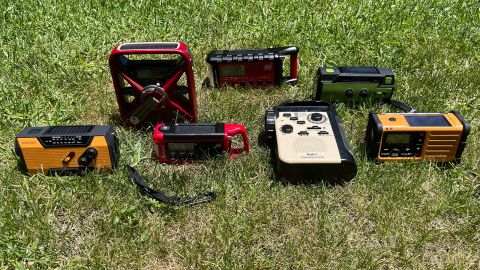
Since many of the radios we tested had similar features, and it can be overwhelming to try and choose one without seeing them in person, we ran each one through a comprehensive testing and evaluation process. This allowed us to confidently select our top pick, and will hopefully provide the information you need to choose the best option for you.
Perhaps most importantly, an emergency radio should be easy to use, since you won’t want to waste precious time searching and pressing buttons or fumbling through an instruction manual during an emergency. We paid close attention to the layout and function of the buttons or dials, and made note of any steps or controls that were confusing or required any trial and error to use correctly.
To assess performance, we tuned each radio into our local NOAA weather broadcast, comparing both how simple the tuning process was and the clarity of the transmission from our basement. For the radios that were designed to automatically alert you when a weather alert is issued, we activated the “alert” setting, and waited until the NOAA’s weekly alert test, which occurs every Wednesday. We compared how effectively each radio received the alert, as well as how having the “alert” setting activated affected the rest of the radio’s functions. (The Kaito KA340 Weather Alert Radio for example, required you to turn this alert setting off if you wanted to use any other radio function, which seems impractical.)
After draining the batteries overnight, we evaluated the effectiveness of each radio’s various charging methods. To look at hand-crank charging, we cranked continuously for one minute, then left the radio running on the NOAA weather station and timed how long it took to run out of juice. We noted how ergonomic the crank handles felt, how comfortable they were to use and the effort required to turn them. For radios with solar panels, we again drained their batteries overnight and then placed them in direct sunlight in our backyard. We checked in after an hour to see how much, or if any, battery power was generated, and again six hours later.
While setting up and testing each radio, we kept a close eye on their overall build quality. We noted whether they felt cheap and flimsy or sturdy and well-built. We also made sure to use all the dials, sliders, knobs and buttons to see if any were loose and rattled around, or if they had a solid, secure feel.
We explored each radio’s light features, especially those that had multiple settings like SOS beacons or lantern-style LEDS that could be more useful than just a simple flashlight-style beam. We compared their brightness as well, and how simple or confusing they were to turn on and off.
The storage capacity of the battery, measured in mAh, indicates how much power your radio will be able to hold and how effective it will be when charging a cell phone (current flagship phones have batteries rated in the 3,000-4,000 mAh range). We checked each radios specs to find out their specific mAh, and was surprised to find such a wide range (850 to 4,000 mAh) within our testing group; we preferred radios with more capacity.
We compared each radio’s power source options, battery capacity, any USB charging abilities and whether or not they had a backlit display. This gave us a better idea of each radio’s overall functionality and the value it could provide in an emergency.
FosPower Emergency Solar Hand Crank Portable Radio
A low-cost alternative, the FosPower Emergency Solar Hand Crank Portable Radio still provides a good amount of useful features and four charging options. Its manual tuner knobs were simple to use, and I had no issues quickly finding the NOAA station I was looking for. This is a weather band radio rather than a weather alert model, so it won’t automatically receive NOAA alerts; you’ll have to tune in first when you expect to face threatening weather conditions. This radio lacks the digital tuning and push-button controls of higher-end options, but that’s not necessarily a bad thing — the simple design, without menus or digital control, means there’s little to go wrong, and there’s no need to remember what buttons perform which functions if you’re under stress. And older users may appreciate these manual tuner controls over digital. This radio also provided an impressive 32 minutes of listening time after one minute of hand cranking, but struggled in my solar testing (zero function after one hour). The low price of this radio could be appealing to those looking for a budget-friendly option, but if that’s your priority, we’d recommend shelling out the extra $5 and choosing the similar RunningSnail MD-090P and its 4,000 mAh battery.
Although the Kaito KA340 Weather Alert Radio had some interesting features, like Bluetooth connectivity and a microSD memory card slot, the confusing layout of the controls makes it difficult to recommend for emergency use. The physical controls — a collection of sliders, knobs and buttons — had a flimsy, loose feel to them, which made it hard to achieve precise volume or radio settings. I was most confused by the lack of visual arrow or indicator on the band selection slider, which made it tough to tell which setting you were selecting. This was made even more challenging by the large range of options (seven!) to choose from. I did appreciate its variety of power options — rechargeable lithium-ion battery, four AA batteries, hand crank and solar panel — and the hand crank in particular provided 26 minutes of radio time after just 60 seconds of cranking. The flashlight threw a nice wide beam, and the large lantern light was a nice perk as well. Although it felt less durable and rugged than the other radios I tested, this could be a useful choice for those interested in taking advantage of the plethora of media inputs. Although this radio is able to receive NOAA alerts, you won’t be able to use any other function while the “alert” setting is selected.
Midland ER210
This Midland model is essentially just a scaled-down version of our top pick, the Midland ER310, providing nearly all the bells and whistles in a smaller package. It only lacks the dog whistle and the ability to use disposable batteries, but still provides the same hand crank and solar charging ability, as well as the multi-beam flashlight. I really enjoyed the smaller size of this radio, especially when it came to using the hand crank, although I wish the crank handle had a bit more material to hold onto. Sixty seconds of cranking provided an impressive 32 minutes of listening time, which was one of the longest of the radios I tested. The NOAA weather alert was simple to set up, the straightforward controls made switching between bands easy and I especially liked how the display would flash back to the current time every 10 seconds or so. The backlit LED screen was easy to read in the dark, too. This radio also has a convenient carrying handle like the Midland ER310, which made it comfortable to carry around.
Midland ER10VP
If you’re looking for an effective, high-quality radio that won’t take up much room in a drawer or backpack, this 5 by 3 by 1.5-inch Midland model could be just what you’re looking for. The younger sibling of the Midland ER310 and Midland ER210, this radio fits in the palm of your hand and weighs just 8.8 ounces, by far the lightest I tested. Despite the small size, this little radio still provides automatic NOAA alerts without your having to tune in first, a feature that several much larger and more expensive radios did not. You also get a flashlight with three settings, a headphone jack and a handy wrist lanyard so you can attach it to your pack or hang from a tree limb at your campsite. Its controls were extremely easy to use, and setting up the NOAA alert was simple to do as well. The only drawback to this little radio is that it only runs on three AA batteries, so no rechargeable battery, hand crank or solar panels. That being said, Midland claims that its battery will last for up to 26 days when in alert standby mode, which should be sufficient for most emergency situations.
Midland WR120B/WR120EZ Emergency Weather Alert Radio
What this Midland radio lacks in portability and power source options, it makes up for in customization. Unlike our other radios that only pick up NOAA weather bands and alerts, this model can be used with S.A.M.E. (Specific Area Message Encoding) programming. This allows you to input your current location and only receive alerts for that area. This radio also allows you to pick and choose the alerts you want to receive, and disable any that you don’t want to be bothered with. These settings may seem complicated, but we were pleasantly surprised at how easy it was to program and configure the specific alerts you want, thanks to the helpful instruction manual. Our favorite feature of this radio was probably the extra-large “Weather” button on the front of the unit, which allows you to get the current weather report at the push of a button. No tuning or band selection needed. Its trilingual settings (English, Spanish and French) also make it useful for potential users who may not use English as their primary language. This radio, however, is really useful only for alerts in advance of an emergency since it does need to be plugged into a wall outlet to function — you’ll need an external power source of some kind to keep it working.
The most impressive feature of this radio is its 4,000 mAh battery, which is substantially larger than any other model we tested, with the two closest competitors offering 2,600 mAh batteries. This means that the RunningSnail MD-090P should be able to run longer than any other, which also translates to more charging capacity when it comes to using it as a power bank to keep your devices working. This in itself is a hugely valuable benefit in an emergency situation when the power goes out. I also appreciated the powerful flashlight and separate “reading lamp,” which provides a wide, soft light source, perfect for reading a map or book or performing any emergency repair or maintenance tasks. Like the FosPower model we looked at, the RunningSnail is only a weather band radio, and doesn’t have automated weather alert functionality (though it can clearly receive NOAA weather stations). This lack of automatic alerts ultimately kept it out of our consideration for the top spot, but if that’s not a dealbreaker for you, the low price and large battery of this radio could make it a solid all-in-one emergency solution.
I was a big fan of nearly every aspect of this weather alert radio, except for its 850 mAh battery capacity, the smallest in the testing group. This doesn’t make it a poor choice in itself, but if a long running time before having to recharge is a priority for you, you might want to consider another model. That being said, the controls were simple to use, and the orange backlit display made it easy to work with in low light conditions. It was also the only model I tested that offered radio presets, which could be convenient for those who plan on using its AM/FM radio frequently. I also appreciated the rubber end caps that cover all four corners of the unit, which provided a very durable and rugged feel and made me confident that it could survive a moderate drop or fall. This radio performed well in all performance tests too, providing 32 minutes of listening time after 60 seconds of hand cranking, and it reached half capacity after six hours in the sun.
The Eton — an update to a well-regarded Red Cross-branded model — exhibited poor enough charging speeds in both the solar and hand crank tests that we wouldn’t recommend it at all. One minute of cranking provided zero power, and even after an additional five minutes, the battery was still dead. An hour in the sun had the same result in my solar test, although after six hours in direct sunlight it did register that two of the three battery bars were filled and the unit was functioning normally. This may well have been a quality control issue — a CNN Underscored editor owns and has used the precursor to this model, the FRX3, and has never encountered this issue — but should you order, you’ll want to make sure it works out of the box.
It was fairly simple to set up and find the band and station you want, and the NOAA alert worked perfectly — but without the battery power, it won’t last you through a significant power outage. I do wish the flashlight were more powerful or, considering the unit’s height when stood upright, that it featured some kind of lantern-style illumination. The unique X-shaped design does make it easy to carry around, although the large shape may not be convenient if you plan on keeping it in a small drawer or emergency kit.