
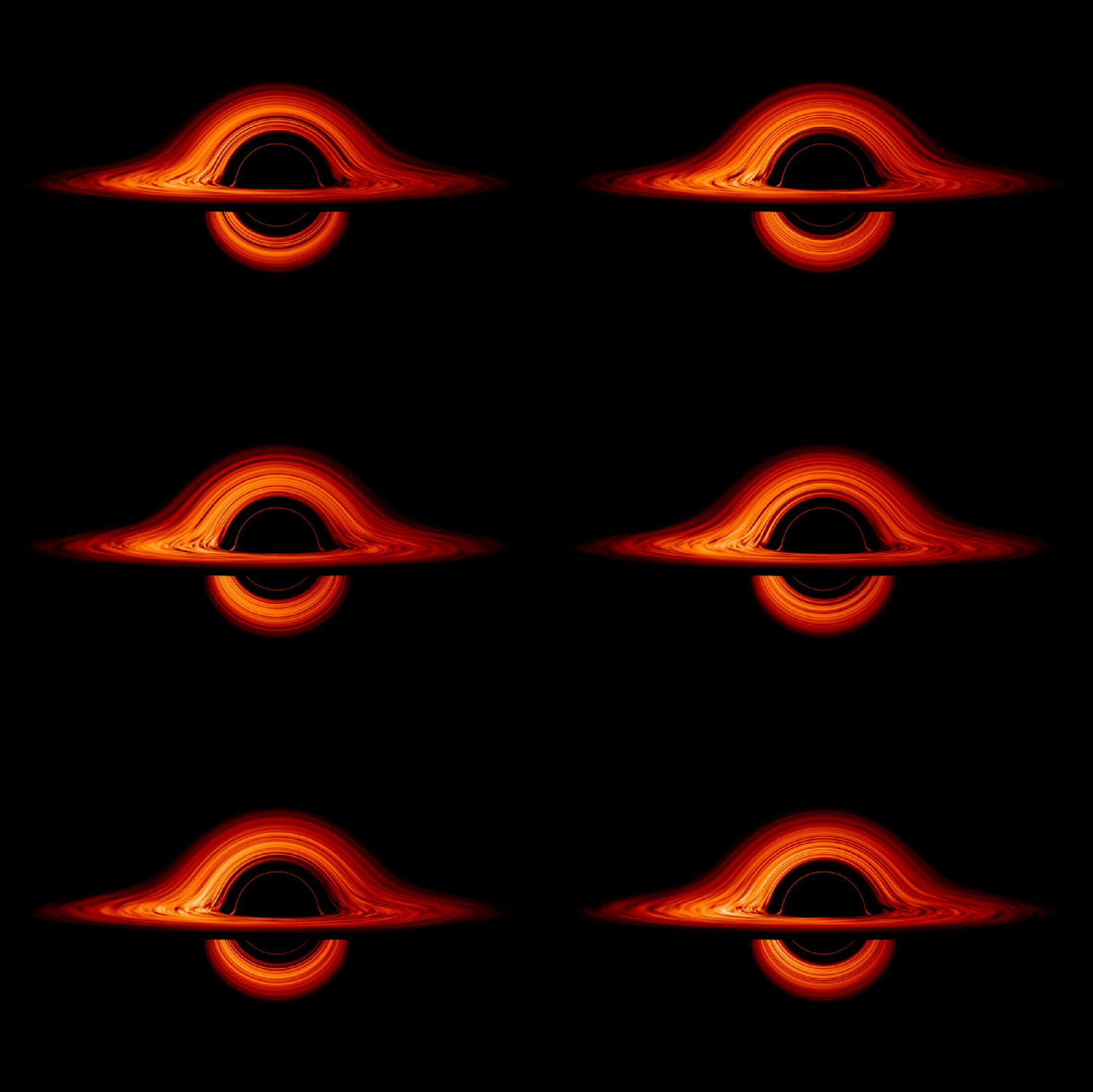
Black holes are eaters of all things, even radiation. But what if their rapacious appetites had an unexpected side effect? A new study published in Physical Review Letters suggests that black holes might spew dark energy—and that they could help explain an intriguing conflict between different measurements of the universe.
Dark energy is the force driving the accelerated expansion of the universe. No one knows what it is, but it’s thought to permeate everything. In the theory proposed in the new study, dark energy is also something that arises from dead stars—and therefore didn’t exist in the universe until stars were around to begin dying. Although the idea is controversial, it’s a prominent example of a newly energized attempt to understand how dark energy works, whether it changes over time and whether our cosmic accounting may be off.
“I view this black hole paper as an interesting entry in this growing canon of people testing out, ‘What if I add these physics—does that reconcile these tensions?’” says Jessie Muir, a physicist at the University of Cincinnati.
On supporting science journalism
If you’re enjoying this article, consider supporting our award-winning journalism by subscribing. By purchasing a subscription you are helping to ensure the future of impactful stories about the discoveries and ideas shaping our world today.
Cosmic Fudge Factor
The story starts with Albert Einstein, whose theory of general relativity predicted the existence of black holes. At that time, he also thought the universe was static, which didn’t mesh with his theory of gravity; in his equations, everything should have clumped together into one big blob. Because it didn’t, Einstein came up with a cosmic fudge factor called a “cosmological constant” to describe a persistent and omnipresent force that kept things stable. In 1929, when astronomers discovered that the universe was actually expanding, Einstein dropped the constant.
Fast-forward three quarters of a century. In 1998 astronomers realized that not only was the universe expanding but also that this growth was accelerating—a fact that could be explained by a persistent and omnipresent force. Einstein’s constant was back, and cosmologists have been trying to understand it ever since.
This dark energy, which Einstein labeled with the Greek letter lambda, has long been assumed to be unchanging and reliable through time. Even so, cosmologists have learned that dark energy was less influential in the past than it is now. In the beginning, radiation was the most important factor affecting the growth of the baby universe. In the cosmic middle ages, matter dominated that process—both regular matter, which includes stars and whales and us, and dark matter, which we cannot see or describe. Today the universe’s growth is most influenced by dark energy. But dark energy’s changing role makes it harder to study through time.
“The whole problem with dark energy is that it only became important, like, yesterday,” says Zach Weiner, a physicist at the Perimeter Institute in Ontario.
DESI’s Surprise
Studying how dark energy has evolved through time is one goal of the Dark Energy Spectroscopic Instrument (DESI), which measures galaxies and sound waves from the early universe. Perched on a mountain called Iolkam Du’ag in Arizona, DESI uses Kitt Peak National Observatory to scrutinize objects that were around when the universe was less than half its current size. Astronomers combine these measurements with other dark energy and matter distribution studies, including the Dark Energy Survey (DES) measurements of distant supernovae and maps of the cosmic microwave background light left over from the dawn of the universe. In 2024 and 2025, results from the DESI experiment showed that galaxies appear to be spread apart less than they should be if dark energy’s strength was constant through cosmic time. But if dark energy is changeable, it can’t be the cosmological constant. When DESI’s results are combined with the other data sets, the picture looks even worse. But lambda, or constant dark energy, is a central paradigm of the standard model of cosmology, which has so far withstood almost any test.
Enter black holes. The new hypothesis about them is one of several novel ideas that theorists have been proposing since this spring, when the latest DESI results were published.
Physicists Kevin Croker of the University of Arizona and Greg Tarlè of the University of Michigan, two of the co-authors of the new black hole hypothesis study, say the DESI results can be interpreted as a signal of matter being converted into dark energy inside of black holes. Put another way, black holes are basically tiny bubbles of dark energy. Einstein would find this notion familiar: energy and mass are equivalent, as he showed (E = mc2), and can be converted into one another. The first stars would have collapsed into supermassive black holes, which somehow created dark energy as they grew.
This scenario could help answer two especially difficult questions, Tarlè notes: Why is dark energy showing itself now, at this epoch in our cosmic history? And why is the density of dark energy so close to the density of regular matter, an oddly neat coincidence? He says these cosmologically coupled black holes could answer both mysteries.
“Why now? Stars had to form, and form black holes, and those black holes had to grow, and everything else had to dilute,” he says. “And why is it close to the matter density at the present time? You had to turn the matter into dark energy in black holes, and then it had to grow. The dark energy came from the matter.”
The model lines up with recent measurements of the star-formation rate in the early universe, and it also satisfies a strange problem with ghostly particles known as neutrinos.
Neutrinos are chargeless and don’t interact with regular matter. They come in three flavors that can oscillate among each other as they travel. Physicists know neutrinos have mass because they’ve measured the differences between the varying neutrino flavors as the neutrinos flip-flop identities. But no one knows the precise mass of each flavor; we can measure the difference among them but not their individual values. The measurements from DESI and other surveys don’t leave a lot of room for massive neutrinos, however, suggesting some cosmic accounting is off.
Croker and Tarlè say the dark-energy-making black holes enable a plump neutrino mass.
Black Hole Skeptics
Still, the idea of black holes converting mass to dark energy remains controversial. Several researchers said they were skeptical of Croker and Tarlè’s analysis.
“It is interesting that this can fit the data,” says Muir, who wasn’t involved in the theory. “It is interesting to take a look at what it does to the neutrino mass [limits]. It is a point in favor of maybe this being not a thing to dismiss.” But she and others were hesitant to say more.
The presence of cosmologically coupled black holes is not the only new potential explanation for the DESI results. Another leading idea suggests that dark energy is a sort of fluidlike field, called quintessence, that temporarily “thaws out” in the later universe after being held in check. Another describes an “emergent” dark energy that would have been vanishingly rare or undetectable in early cosmic history but appears in the recent past. And some teams are working on “mirage” dark energy, which tweaks models to reproduce the distance to the cosmic microwave background. Kushal Lodha of the Korea Astronomy and Space Science Institute and several colleagues recently posted a preprint to the server arXiv.org that examined several versions of these theories and found that studying fluid physics models could be a promising path forward.
Meanwhile other teams are looking elsewhere in the darkness for new ideas. Vitor Petri of the Federal University of Espírito Santo in Brazil recently led a study posted to arXiv.org as a preprint that argues that potential interactions between dark energy and dark matter explain the DESI findings better than the standard model of cosmology.
All of the new ideas could be a sign that theorists are more inclined to believe the DESI result and are increasingly looking for ways to interpret what it means, Weiner says.
The idea of black holes as bubbles of dark energy has been debated for a few decades, according to Croker, but many cosmologists dismissed it or questioned the analysis behind it. Croker has been publishing research on such black holes since 2019 with several colleagues. Their key argument is that material traveling near light speed—no matter where it is in the universe—would be tied to the expansion rate of the universe. They argued that black hole masses grew dramatically over cosmic time, in ways that could not be explained by typical black hole growth theories. But this growth makes sense if the black holes somehow bubble up dark energy in their hearts. In a paper Croker, Tarlè and Duncan Farrah, a physicist at the University of Hawaii at Manoa, published in 2023, the researchers calculated that the combined dark energy produced by the growth rate of the first stars in the universe matches the amount of dark energy we see today. But several other scientists criticized that work.
Nevertheless, Croker and his colleagues continued their research, especially when they realized the theory could help explain the new DESI findings. Several members of the DESI collaboration signed on as co-authors for the new black hole paper, which was published in August. Croker says colleagues are increasingly interested this time.
“It’s how science works. You’ve got to build the case,” he says.
While Croker and colleagues continue that process, not everyone agrees that the DESI dark energy results are accurate to begin with. Katie Freese, a physicist at the University of Texas at Austin, is one prominent critic of the DESI measurements. She takes issue with some of the decisions in the DESI analysis, including the way it describes two values for dark energy that can explain the way dark energy changes over time. But in the event DESI does show conclusively that dark energy varies over time, she says, Croker’s explanation is intriguing.
“I am not convinced that the evidence is there yet,” she says. “I am not going to say it’s wrong, but it is still tentative. So I am definitely interested to hear what comes from this.”
Weiner is skeptical that black holes are dark energy producers. He argues that the model in the new paper is incomplete. Weiner also says it’s worth exploring a variety of theories that can explain the apparent DESI findings. He believes more clues may be found by tinkering with a variety of models that describe dark matter and testing whether it interacts with dark energy in some way.
While physicists continue developing new ideas, Freese says she hopes there is a way to demonstrate that dark energy—lambda, Einstein’s constant, the bane of theorists’ existence—is indeed a changeling. It would open the door to new physics and new interpretations of everything we think we have known since Einstein.
“That,” she says, “would be a lot more fun than having it be a constant.”