
Close Menu
Beverly Hills Examiner

    Subscribe to Updates

    Get the latest creative news from FooBar about art, design and business.

    What's Hot

    40 Unique Gifts Your Wife Will Surely Swoon Over

    February 4, 2026

    PepsiCo will cut the cost of snacks like Doritos by ‘up to 15%’

    February 4, 2026

    California Dems lash out at ICE during gubernatorial debate

    February 4, 2026
    Facebook X (Twitter) Instagram
    Beverly Hills Examiner
    • Home
    • US News
    • Politics
    • Business
    • Science
    • Technology
    • Lifestyle
    • Music
    • Television
    • Film
    • Books
    • Contact
      • About
      • Amazon Disclaimer
      • DMCA / Copyrights Disclaimer
      • Terms and Conditions
      • Privacy Policy
    Beverly Hills Examiner
    Home»Science»How Food Banks Prevent Climate Change by Averting Carbon Emissions
    Science

    How Food Banks Prevent Climate Change by Averting Carbon Emissions

    By August 18, 2024
    Facebook Twitter Pinterest LinkedIn WhatsApp Email Reddit Telegram
    How Food Banks Prevent Climate Change by Averting Carbon Emissions


    August 17, 2024

    4 min read

    How Food Banks Prevented 1.8 Million Metric Tons of Carbon Emissions Last Year

    Redistributing food to food banks before it’s tossed or wasted doesn’t just fight hunger—such efforts also fight climate change
    By Frida Garza & Grist

    How Food Banks Prevent Climate Change by Averting Carbon Emissions

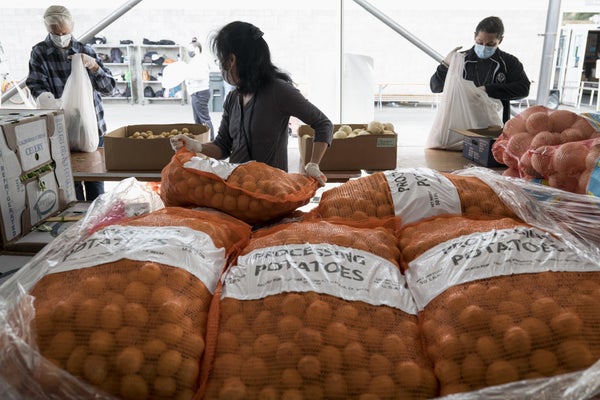
    Volunteers stack bags of potatoes at the San Francisco-Marin Food Bank in San Francisco, Calif., on May 28, 2020.

    David Paul Morris/Bloomberg via Getty Images

    The latest annual impact report from the Global Foodbanking Network — a nonprofit that works with regional food banks in more than 50 countries to fight hunger — found that its member organizations provided 1.7 billion meals to more than 40 million people in 2023. According to the nonprofit, this redistribution of food, much of which was recovered from farms or wholesale produce markets, mitigated an estimated 1.8 million metric tons of carbon dioxide equivalent.

    These numbers reflect an ongoing, high demand for food banks. Last year, the Global Foodbanking Network, or GFN, served almost as many people as it did in 2020, when the COVID-19 pandemic sent food insecurity soaring. In order to respond to this pressing need in their communities, many of GFN’s member organizations have invested in agricultural recovery, working to rescue food from farmers before it gets thrown out.

    Their efforts show how food banks can serve the dual purpose of addressing hunger and protecting the environment. By intercepting perfectly good, edible food before it winds up in the landfill, food banks help mitigate harmful greenhouse gas emissions created by food loss and waste.


    On supporting science journalism

    If you’re enjoying this article, consider supporting our award-winning journalism by subscribing. By purchasing a subscription you are helping to ensure the future of impactful stories about the discoveries and ideas shaping our world today.


    “There is always food that is unnecessarily wasted,” said Emily Broad Leib, the founding director of the Food Law and Policy Clinic at Harvard Law School, who has worked with GFN before but was not involved in the recent study. All that unnecessary waste means “there is ongoing need for scaling up food banks and food-recovery operations,” Broad Leib added.

    A recent analysis from the United Nations Environment Programme estimated that 13 percent of food was lost while it was making its way from producers to retailers in 2022. Subsequently, 19 percent was wasted by retailers, restaurants, and households. The world’s households alone let 1 billion meals go to waste each day. The scope of food wasted around the world has been shockingly high for years: In 2011, the Food and Agricultural Organization of the United Nations released a study that suggested roughly one-third of food produced globally is never eaten.

    Food waste at this scale comes with massive planetary impacts. When food goes uneaten, all of the emissions associated with growing, transporting, and processing it are rendered unnecessary. Furthermore, when food rots in landfills, it emits methane, a greenhouse gas that is roughly 80 times more potent than CO2 over a 20-year period. Last year, the Environmental Protection Agency reported that 58 percent of methane emissions from U.S. landfills come from food waste. Globally, food loss and waste have been estimated to be responsible for 8 percent to 10 percent of greenhouse gas emissions, and reducing them is essential for achieving climate targets.

    Food banks can play a special role in that reduction by rescuing more food before it’s lost and redirecting it to people in need. “Our members have been building out their redistribution capacity,” said Lisa Moon, the president and CEO of GFN. “I think that was our first challenge in the face of this rising need: How do we as an organization capture more supply?”

    In order to do this, food banks within GFN member organizations have been coordinating more closely with farmers to redirect surplus food from landfills. GFN defines surplus food as food from commercial streams that was grown for human consumption but that, for some reason or another, cannot be sold. So-called “ugly” produce — misshapen food that never makes it to the grocery store because of its looks — falls into this category.

    Some of this redirection actually looks like cutting out food banks as the middleman. Moon gives the example of a food bank that receives a call from a farmer with excess green beans. Instead of traveling to the farm to pick them up, traveling back to the food bank’s distribution hub, storing the green beans, and having folks wait for the next distribution day to collect them, the food bank in question might simply reach out to beneficiaries in the area (think: soup kitchens) to inform them of how many green beans are available and where so they can pick them up. GFN refers to this as “virtual food banking” because of how members are using tech platforms to match farmers with beneficiaries, rather than physically moving the produce themselves.

    The result of this emphasis on agricultural recovery is that fruit and vegetables now make up the largest portion — 40 percent — of food redistributed by GFN members by volume. Moon says the organization is “just only scratching the surface” of possibilities for recovering fresh produce.

    In order to calculate that 1.8 million metric tons of carbon dioxide equivalent was mitigated by these efforts, GFN utilized the Food Loss and Waste Protocol developed by the World Resources Institute. This framework takes a number of things into account, including where recovered food would have ended up had it not been intercepted from the waste stream. These waste destinations can be landfills but also include animal feed, compost, and anaerobic digesters (a waste management technology that converts organic waste into biogas — but that can come with its own emissions problems). Moon acknowledged that GFN does not know in every case what would happen to the surplus food if it were not rescued by a food bank — but pointed out that most of the places where the network operates do not have a robust circular economy for food.

    Broad Leib, the Harvard Law food policy expert, described GFN’s estimate of carbon dioxide equivalent mitigated as “a good proxy for impact.” While other waste destinations are possible, “we also know that the large majority of wasted food globally goes to landfill,” she said. “I think their estimate is likely not far off from actual emissions avoided.”

    This story was originally published by Grist, a nonprofit media organization covering climate, justice, and solutions.


    Original Source Link

    Share. Facebook Twitter Pinterest LinkedIn WhatsApp Email Reddit Telegram
    Previous ArticleRomulus’ Topping Busy Box Office With $40M-$42M Opening
    Next Article The New Sonos App Is So Bad, the Company Might Bring Back the Old One

    RELATED POSTS

    Why Are Some Women Training for Pregnancy Like It’s a Marathon?

    February 4, 2026

    NASA’s Artemis II moon mission engulfed by debate over its controversial heat shield

    February 4, 2026

    Dutch air force reads pilots’ brainwaves to make training harder

    February 3, 2026

    HHS Is Using AI Tools From Palantir to Target ‘DEI’ and ‘Gender Ideology’ in Grants

    February 3, 2026

    The sun just unleashed its most powerful solar flare in years

    February 2, 2026

    The best new popular science books of February 2026 include titles by Maggie Aderin and Michael Pollan

    February 2, 2026
    latest posts

    40 Unique Gifts Your Wife Will Surely Swoon Over

    All products and services featured are independently chosen by editors. However, Billboard may receive a…

    PepsiCo will cut the cost of snacks like Doritos by ‘up to 15%’

    February 4, 2026

    California Dems lash out at ICE during gubernatorial debate

    February 4, 2026

    Anthony Davis joins Wizards in trade from Mavericks: report

    February 4, 2026

    A New AI Math Startup Just Cracked 4 Previously Unsolved Problems

    February 4, 2026

    Why Are Some Women Training for Pregnancy Like It’s a Marathon?

    February 4, 2026

    The Spooky Reason Robert Pattinson’s Batcave Is Batman’s Best Live-Action HQ Yet

    February 4, 2026
    Categories
    • Books (1,040)
    • Business (5,946)
    • Film (5,882)
    • Lifestyle (3,984)
    • Music (5,950)
    • Politics (5,951)
    • Science (5,293)
    • Technology (5,880)
    • Television (5,569)
    • Uncategorized (2)
    • US News (5,932)
    popular posts

    Opinion: The danger of period-tracking apps in a post-Roe world

    As we face a likely future in which Roe v. Wade will be struck down…

    Americans worried about the economy even before inflation boom, Fed survey shows

    May 23, 2022

    Jeff Bezos says ‘the hardest thing I’ve ever done’ was raising the first million dollars for Amazon

    December 15, 2025

    Jack White Performs “If I Die Tomorrow” on Colbert: Watch

    July 22, 2022
    Archives
    Browse By Category
    • Books (1,040)
    • Business (5,946)
    • Film (5,882)
    • Lifestyle (3,984)
    • Music (5,950)
    • Politics (5,951)
    • Science (5,293)
    • Technology (5,880)
    • Television (5,569)
    • Uncategorized (2)
    • US News (5,932)
    About Us

    We are a creativity led international team with a digital soul. Our work is a custom built by the storytellers and strategists with a flair for exploiting the latest advancements in media and technology.

    Most of all, we stand behind our ideas and believe in creativity as the most powerful force in business.

    What makes us Different

    We care. We collaborate. We do great work. And we do it with a smile, because we’re pretty damn excited to do what we do. If you would like details on what else we can do visit out Contact page.

    Our Picks

    Why Are Some Women Training for Pregnancy Like It’s a Marathon?

    February 4, 2026

    The Spooky Reason Robert Pattinson’s Batcave Is Batman’s Best Live-Action HQ Yet

    February 4, 2026

    Shaboozey Slammed For Tone Deaf Grammy Speech, Jelly Roll

    February 4, 2026
    © 2026 Beverly Hills Examiner. All rights reserved. All articles, images, product names, logos, and brands are property of their respective owners. All company, product and service names used in this website are for identification purposes only. Use of these names, logos, and brands does not imply endorsement unless specified. By using this site, you agree to the Terms & Conditions and Privacy Policy.

    Type above and press Enter to search. Press Esc to cancel.

    We use cookies on our website to give you the most relevant experience by remembering your preferences and repeat visits. By clicking “Accept All”, you consent to the use of ALL the cookies. However, you may visit "Cookie Settings" to provide a controlled consent.
    Cookie SettingsAccept All
    Manage consent

    Privacy Overview

    This website uses cookies to improve your experience while you navigate through the website. Out of these, the cookies that are categorized as necessary are stored on your browser as they are essential for the working of basic functionalities of the website. We also use third-party cookies that help us analyze and understand how you use this website. These cookies will be stored in your browser only with your consent. You also have the option to opt-out of these cookies. But opting out of some of these cookies may affect your browsing experience.
    Necessary
    Always Enabled
    Necessary cookies are absolutely essential for the website to function properly. These cookies ensure basic functionalities and security features of the website, anonymously.
    CookieDurationDescription
    cookielawinfo-checkbox-analytics11 monthsThis cookie is set by GDPR Cookie Consent plugin. The cookie is used to store the user consent for the cookies in the category "Analytics".
    cookielawinfo-checkbox-functional11 monthsThe cookie is set by GDPR cookie consent to record the user consent for the cookies in the category "Functional".
    cookielawinfo-checkbox-necessary11 monthsThis cookie is set by GDPR Cookie Consent plugin. The cookies is used to store the user consent for the cookies in the category "Necessary".
    cookielawinfo-checkbox-others11 monthsThis cookie is set by GDPR Cookie Consent plugin. The cookie is used to store the user consent for the cookies in the category "Other.
    cookielawinfo-checkbox-performance11 monthsThis cookie is set by GDPR Cookie Consent plugin. The cookie is used to store the user consent for the cookies in the category "Performance".
    viewed_cookie_policy11 monthsThe cookie is set by the GDPR Cookie Consent plugin and is used to store whether or not user has consented to the use of cookies. It does not store any personal data.
    Functional
    Functional cookies help to perform certain functionalities like sharing the content of the website on social media platforms, collect feedbacks, and other third-party features.
    Performance
    Performance cookies are used to understand and analyze the key performance indexes of the website which helps in delivering a better user experience for the visitors.
    Analytics
    Analytical cookies are used to understand how visitors interact with the website. These cookies help provide information on metrics the number of visitors, bounce rate, traffic source, etc.
    Advertisement
    Advertisement cookies are used to provide visitors with relevant ads and marketing campaigns. These cookies track visitors across websites and collect information to provide customized ads.
    Others
    Other uncategorized cookies are those that are being analyzed and have not been classified into a category as yet.
    SAVE & ACCEPT