
Today’s edition was written by Eleanor Pringle, Senior Reporter, Economics and Markets.
Quick note: Subscribe to the forthcoming Fortune Gulf Brief. Every Tuesday, this new newsletter will deliver clear-eyed, authoritative intelligence on the deals, decisions, policies, and power shifts shaping one of the world’s most consequential regions, written for the people who need to act on it. Sign up here.
THE MARKETS
Traders on edge as they wait for long-promised peace deal with Iran
- S&P 500 futures were back up 0.8% this morning after a volatile day on the markets yesterday. The index closed down 0.16% yesterday.
- In Europe, the Stoxx 600 was up 0.7% in early trading and the U.K.’s FTSE 100 was up 0.5% before lunch.
- Asia: South Korea’s KOSPI was up 2.63%. Japan’s Nikkei 225 was up by 0.84%. India’s Nifty 50 was up a minor 0.4%.. China’s CSI 300 was up 1%.
- Brent crude is at $107 a barrel this morning.
- Bitcoin was at $81,107—up slightly on yesterday.
Nerves are once again fraying as investors wait on news of a U.S.-Iran deal that they have now been promised for some time.
They may be waiting a little longer, with President Trump’s attention now turned to Beijing, with a bevy of billionaires in tow. Meetings with President Xi are expected to cover trade, AI and Taiwan to name a few. Analysts have some reasons to be optimistic: Relations between the two economic powers may normalize somewhat after the bumpy months following tariff “Liberation Day,” and China may even be coaxed into action to help reach a deal with Iran.
Resolving the Iran issue feels all the more pressing following yesterday’s CPI report, with inflation now sitting at 3.8%. UBS’s Paul Donovan advised clients this morning not to overemphasize the hotter-than-expected data, but added that the details of the report raise political concerns: Since President Trump took office, he noted, coffee prices are up 24%, beef over 19%, gas over 19% and vegetables 10.5%.
“These are price increases that consumers notice and remember,” Donovan added. “Trump claimed not to think about Americans’ financial situation, but markets are betting the president does care (and policy decisions will reflect that).”
ONE BIG THING
Brace for a ‘breathtaking’ correction in stock prices
Staying with stock markets, Fortune’s Shawn Tully has noticed a pattern: A handful of famed and decorated investors are warning of an almighty correction coming down the pike.
The rumblings began (perhaps unsurprisingly) with Michael Burry, of ‘The Big Short’ fame, who declared in a new Substack post that while the market has so far “jumped the shark,” “a complete reversal” in the soaring, tech-laden NASDAQ 100 is at hand.
Fellow famed veteran Paul Tudor Jones later told CNBC that the current scenario reminds him of 1999, noting that if the current momentum keeps rolling, we could be facing “breathtaking kinds of corrections.”
Wall Street bulls are quick to explain away sky-high asset prices with their favorite justification: As Burry calls it, “absolutely non-stop AI.” They’re not alone in their optimism—everyone from the incoming Fed chairman to your everyday investor wants to believe in the star power of the hyperscalers. Wells Fargo even recommended traders buy into the “euphoria.”
Unfortunately, a renowned cyclically-adjusted price earnings ratio (CAPE) developed by Yale professor emeritus and Nobel Prize laureate, Robert Shiller, splashes cold water on the feverish excitement.
The CAPE (which marshals a 10-year average of inflation-adjusted earnings, meaning zig-zagging of the data is smoothed to calculate a more accurate PE) hit an alarming milestone on May 11: 40.3. Previously, it has only exceeded 40 in its entire 145-year history 21 times, all concentrated in a single continuous period running from January of 1999 to September of 2000. That interlude marked the height of the Dot Com frenzy.
IRAN
Will China weigh in on Iran?
Trump’s meeting with President Xi may present an opportunity for Beijing to be quietly nudged into action over the Middle East conflict. So far, China has steered clear of the war between allies the U.S. and Israel, and Iran.
That doesn’t mean it’s not hurting the Chinese economy—it is the largest importer of Iranian oil, some 80% of total shipped supply. Will this fact be enough to help President Trump nudge President Xi into supporting a conclusion to the war?
Macquarie’s strategist Thierry Wizman wrote in a note seen by Fortune that while some analysts suspect the U.S.-Iran issue will feature prominently at the summit, it is also possible that the focus remains on U.S.-China economic issues only.
“If China is unwilling to weigh in on the matter of the U.S. and Iran, then it seems as if the window of risk for a renewal of kinetic actions against Iran begins early next week, when Trump has returned to the U.S. from China,” Wizman noted.
Stronger than suspected
Iran may not quite be the broken shell of a nation that the Trump administration has been portraying, according to a report from the New York Times.
Citing classified assessments compiled earlier this month, the Times reported that Iran has regained access to the majority of its missile sites, launchers, and underground facilities. Worryingly for officials, the documents seen by the NYT suggest the Iranian regime has restored operational access to 30 of the 33 missile sites it maintains along the Strait of Hormuz—posing a further threat to global oil supply as a result.
“When the fake news says that the Iranian enemy is doing well, militarily, against us, it’s virtual TREASON in that it is such a false, and even preposterous, statement,” President Trump posted on Truth Social last night. “They are aiding and abetting the enemy!”
AI
Nvidia’s compensation packages shielded exec pay from Liberation Day tariffs
Nvidia’s 2026 proxy statement shows the board built in a pre-approved contingency to guard against the impact of export control restrictions on sales of its H20 products and the subsequent hit to executive payouts, Fortune’s Amanda Gerut tells me.
The Nvidia board’s compensation committee in March 2025 set compensation plan goals for the fiscal year of 2026, which included a revenue goal of $190 billion and non-GAAP operating income of $120 billion.
However, in April 2025, the government broke the news that a license would be required for exports of Nvidia’s H20 products in the China market, triggering an automatic adjustment to the goals. The new revenue goal was $160 billion and non-GAAP operating income was set at $96 billion.
The adjustment ended up being moot for payout purposes—Nvidia hit $215.9 billion in revenue and $137.3 billion in non-GAAP operating income. CEO Jensen Huang’s pay was valued at $36.3 million in fiscal 2026.
Altman on the stand
OpenAI CEO Sam Altman appeared before a federal jury in Oakland, California, saying Tesla CEO Elon Musk not only wanted to make the ChatGPT maker a for-profit business, but he also wanted to pass it on to his children.
Musk is suing the business he helped co-found, saying it has breached their charitable trust by establishing a for-profit subsidiary that OpenAI says helps scale research and deployment efforts.
Altman claimed Musk wanted the business for himself, testifying: “A particularly hair-raising moment was when my cofounders asked, ‘If you have control, what happens when you die?’ He said something like ‘…maybe it should pass to my children.'”
MORE FROM FORTUNE
Frankenpipelines: Inside Trump’s bid to resurrect Keystone XL and stretch Dakota Access north by Jordan Blum
Japanese snack giant resorts to black-and-white bags of potato chips as Iran War literally sucks color out of the world by Marco Quiroz-Gutierrez.
‘That doesn’t sound very healthy’: Amazon’s reported tokenmaxxing might gamify AI usage, analyst warns by Eva Roytburg
Shaq’s father once gave his White Castle burgers to a homeless vet—and it inspired the NBA legend’s business and philanthropy empire – Emma Burleigh
CHART OF THE DAY
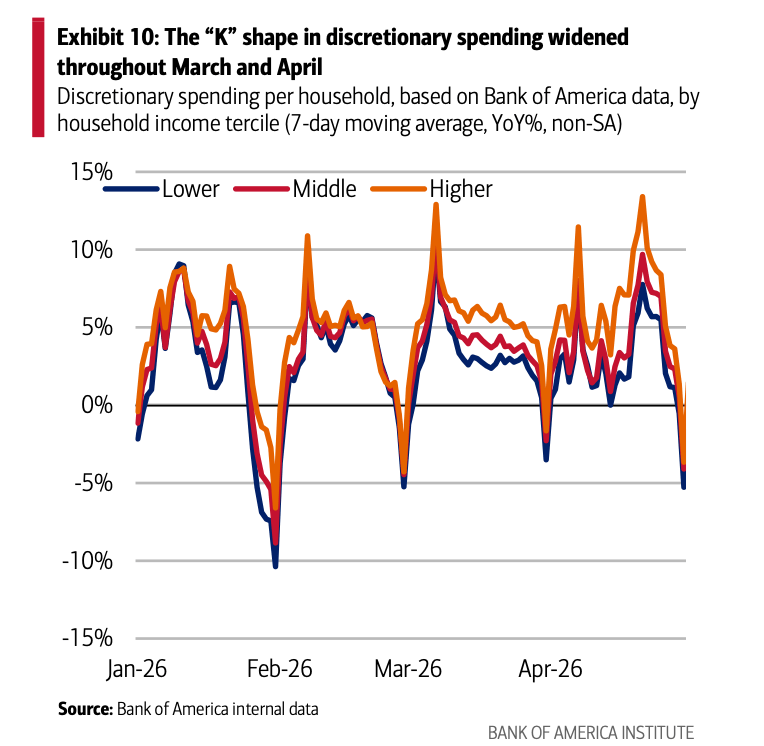
The K-shaped economy widened even further in recent months, writes the Bank of America Institute in its latest consumer checkpoint. The largest divergence in spending growth appeared around bigger ticket items like travel, reflecting either hesitancy around vacation planning due to wage growth, or gas prices.
NUMBER OF THE DAY
25%
Goldman Sachs has shaved its recession odds by 5%. In a note seen by Fortune, chief economist Jan Hatzius wrote the revision came thanks to the bank’s financial conditions index easing back below pre-war levels. Economic activity has also held up well, he added, and the labor market has generally beaten expectations.
This baseline sits at odds with market sentiment in many cases, Hatzius added: “If we wrote down the most frequent topics in discussion with participants, the vast majority would be negative.” Concerns include an oil supply shock, large fiscal deficits, Fed independence, population shrinkage, cyber/AI security, and the U.S.-China rivalry.
THE FRONT PAGES TODAY
Donald Trump’s plan to discuss Taiwan arms sales with Xi Jinping rattles Asian allies – FT
Walmart Lays Off or Relocates About 1,000 Corporate Workers – WSJ
SoftBank posts $46 billion gain at Vision Fund driven mainly by massive OpenAI bet – CNBC
Jamie Dimon warns JP Morgan may rethink new London office if ‘very smart’ Starmer is ousted as UK PM – CNBC
Nonprofits say they are in crisis – Axios
ONE MORE THING
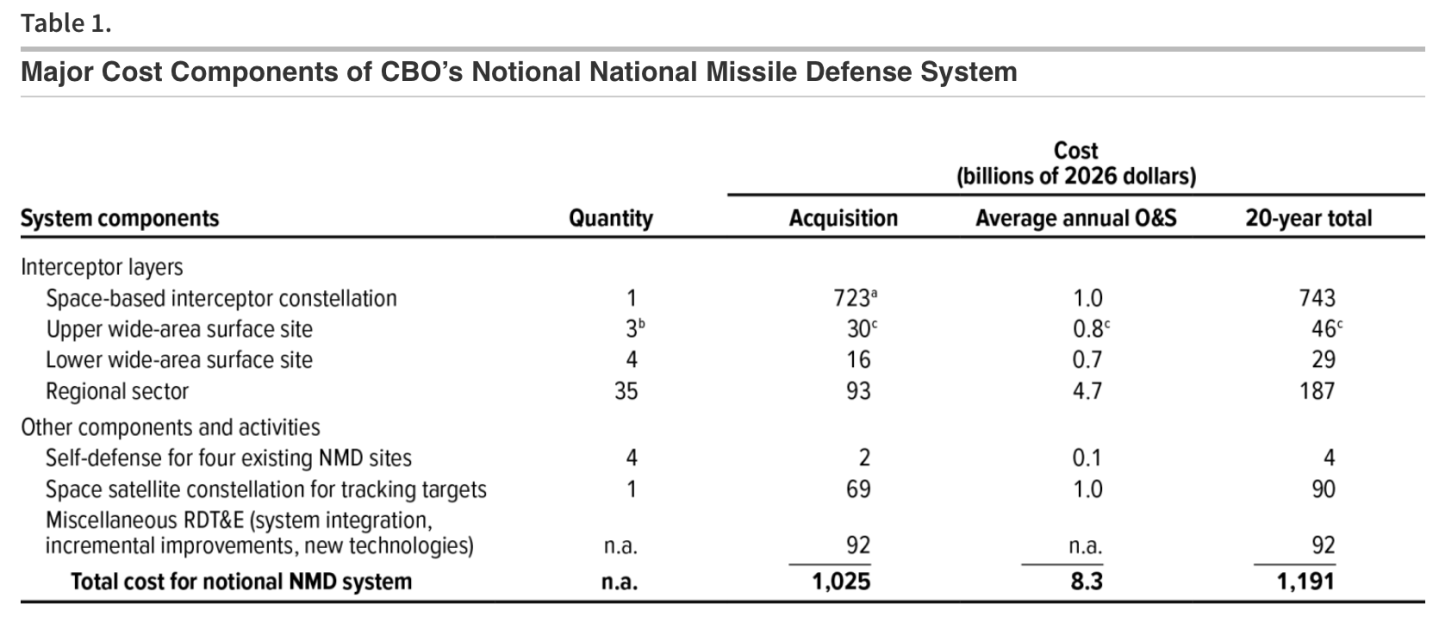
The Congressional Budget Office (CBO) has done some number crunching on President Trump’s plan for the national missile defense system, nicknamed the Golden Dome.
The CBO reported the plan outlined in Trump’s executive order would cost about $1.2 trillion to develop, deploy, and operate for 20 years. These sums are significantly ahead of the numbers initially proposed by the administration, which suggested costs would land around $175 billion.
Moreover, the CBO warned the capabilities of the dome would be limited. It wrote the system would have the capacity to fully engage an attack mounted by a regional adversary with limited capabilities, such as North Korea, or a small-scale attack launched by a near-peer adversary (such as Russia or China) However, the system could be overwhelmed by a full-scale attack mounted by a peer or near-peer adversary.