
Close Menu
Beverly Hills Examiner

    Subscribe to Updates

    Get the latest creative news from FooBar about art, design and business.

    What's Hot

    Zach Bryan Wears ‘Free Palestine’ Shirt at Gillette Stadium

    October 3, 2026

    Mark Ruffalo: Paramount’s Warner Bros. deal ‘Will stifle creativity, weaken free speech’

    October 3, 2026

    Suburban High School Football Teams Shine in Week 7

    October 3, 2026
    Facebook X (Twitter) Instagram
    Beverly Hills Examiner
    • Home
    • US News
    • Politics
    • Business
    • Science
    • Technology
    • Lifestyle
    • Music
    • Television
    • Film
    • Books
    • Contact
      • About
      • Amazon Disclaimer
      • DMCA / Copyrights Disclaimer
      • Terms and Conditions
      • Privacy Policy
    Beverly Hills Examiner
    Home»Science»AI Spots Hidden Signs of Consciousness in Comatose Patients before Doctors Do
    Science

    AI Spots Hidden Signs of Consciousness in Comatose Patients before Doctors Do

    By AdminSeptember 1, 2025
    Facebook Twitter Pinterest LinkedIn WhatsApp Email Reddit Telegram
    AI Spots Hidden Signs of Consciousness in Comatose Patients before Doctors Do


    August 31, 2025

    3 min read

    AI Spots Hidden Signs of Consciousness in Comatose Patients before Doctors Do

    A machine-learning algorithm spotted signs of “covert consciousness” in coma patients—in some cases, days before doctors could do so
    By Andrew Chapman edited by Allison Parshall

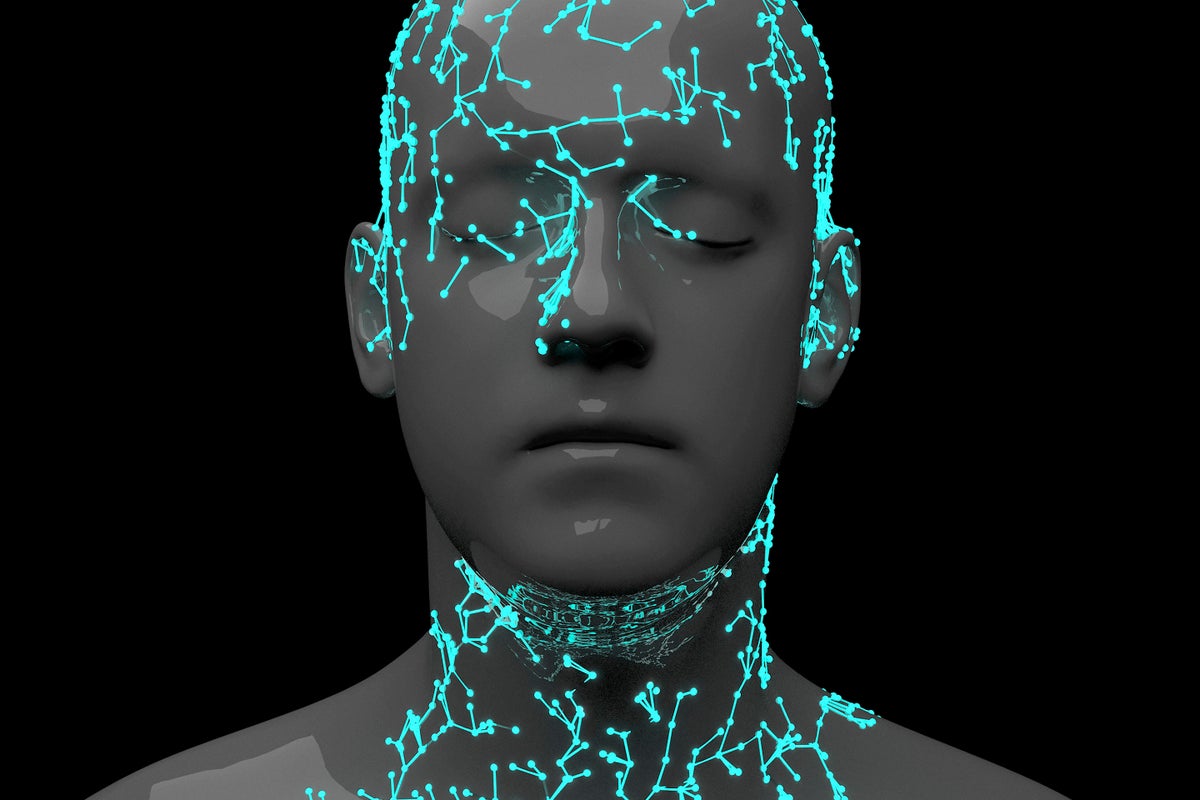
    Conceptual digital illustration of a gray person with eyes closed on black background, with glowing cyan digital lines branching across face and neck

    Design Cells/Science Source

    Imagine lying in a hospital bed, awake but unable to move your body to communicate with the people around you. This experience of “covert consciousness” is a reality for many people who have sustained traumatic brain injuries. In a new study published in Communications Medicine, researchers found that they could detect signs of consciousness in comatose patients by using artificial intelligence to analyze facial movements that were too small to be noticed by clinicians.

    Covert consciousness was first detected in 2006, when researchers asked an unresponsive woman and healthy volunteers to imagine doing specific tasks while in a brain scanner. The team found that the woman showed brain activity in the same regions as the volunteers. Just last year researchers using similar brain imaging methods found that one in four behaviorally unresponsive patients was covertly conscious. Such tests aren’t routinely performed on people in an unresponsive state because this type of neuroimaging is time-consuming and its operation requires specialized skills. Instead, doctors typically rely on more subjective visual examinations to gauge a person’s level of consciousness, testing whether they open their eyes, respond to commands or startle at a loud noise.

    “We were trying to find a way to quantify how conscious these patients are” using simple and readily available technology, says Sima Mofakham, a computational neuroscientist at Stony Brook University and senior author of the new study.


    On supporting science journalism

    If you’re enjoying this article, consider supporting our award-winning journalism by subscribing. By purchasing a subscription you are helping to ensure the future of impactful stories about the discoveries and ideas shaping our world today.


    Mofakham and her team recorded videos of 37 patients with recent brain injuries who outwardly appeared to be in a coma. They tracked the participants’ facial movements in extraordinary detail—on the level of individual pores—after they were given commands such as “open your eyes” or “stick out your tongue.” The researchers’ AI tracking tool, which they call SeeMe, detected any facial movements and then analyzed whether the movements were specific to the command given. SeeMe documented eye-opening responses in 30 of 36 patients and mouth movements in 16 of 17 patients with analyzable videos. Five of these patients did not go on to produce larger signs of movement that were visible to doctors, though most of the others did. On average, SeeMee detected participants trying to open their eyes and moving their mouths respectively 4.1 and 8.3 days before clinicians spotted these signs.

    “What we found was: patients develop [small] movements before going to more obvious movements,” Mofakham says. The results suggest that, in some cases, people are conscious days before doctors notice. Patients with larger and more frequent facial movements also had better clinical outcomes, indicating that the technology may help predict prognoses.

    This ability to detect consciousness earlier is clinically meaningful, says Jan Claassen, a neurologist at Columbia University, who wasn’t involved in the new research. Signs of consciousness can provide another layer of information for doctors and family members choosing between a range of treatments, from palliative care to more aggressive therapies. “Every day is potentially important” for those difficult decisions, Claassen says. Earlier detection could also allow care teams to start rehabilitation programs used to improve patients’ motor skills sooner. Separate research shows that starting rehab earlier is associated with greater improvements in physical function.

    Consciousness recovery after a brain injury is often gradual and unpredictable. “When somebody recovers consciousness, it’s almost like a flickering light bulb,” Claassen says. “It doesn’t just come on or off.” The new study only followed participants until six months after they were discharged from the hospital. But it’s possible that some patients whose conditions have remained more static and who are currently presumed unconscious in long-term care facilities might also show signs of awareness that could be detected, whether with more advanced neuroimaging techniques or the simpler SeeMe technology. “We have to do the experiments and see,” Mofakham says. “There is a chance.”

    Next, Mofakham plans to examine whether patients can answer yes-or-no questions using specific facial movements. “This has a big ethical implication” because people who cannot communicate “cannot participate in their care,” she says. “This study opens a way to communicate with these patients.”

    It’s Time to Stand Up for Science

    If you enjoyed this article, I’d like to ask for your support. Scientific American has served as an advocate for science and industry for 180 years, and right now may be the most critical moment in that two-century history.

    I’ve been a Scientific American subscriber since I was 12 years old, and it helped shape the way I look at the world. SciAm always educates and delights me, and inspires a sense of awe for our vast, beautiful universe. I hope it does that for you, too.

    If you subscribe to Scientific American, you help ensure that our coverage is centered on meaningful research and discovery; that we have the resources to report on the decisions that threaten labs across the U.S.; and that we support both budding and working scientists at a time when the value of science itself too often goes unrecognized.

    In return, you get essential news, captivating podcasts, brilliant infographics, can’t-miss newsletters, must-watch videos, challenging games, and the science world’s best writing and reporting. You can even gift someone a subscription.

    There has never been a more important time for us to stand up and show why science matters. I hope you’ll support us in that mission.


    Original Source Link

    Share. Facebook Twitter Pinterest LinkedIn WhatsApp Email Reddit Telegram
    Previous Article‘Vanilla’ Film by Mayra Hermosillo on Family, Identity: Venice Trailer
    Next Article Latam-GPT: The Free, Open Source, and Collaborative AI of Latin America

    RELATED POSTS

    Could a giant iceberg really break off Greenland? Scientists check Tom Cruise’s new movie Digger

    October 3, 2026

    There Are Plenty of Reasons to Be Concerned About Bioweapons Development—Even Without AI

    October 2, 2026

    Google’s Project Suncatcher AI data center test has officially launched to space onboard SpaceX rocket

    October 2, 2026

    AI Apocalypse? By Howard Bloom

    October 2, 2026

    Measles Is Forcing Hospitals to Adapt to a New Normal

    October 1, 2026

    NASA directive might increase the odds of contaminating Mars

    October 1, 2026
    latest posts

    Zach Bryan Wears ‘Free Palestine’ Shirt at Gillette Stadium

    Grammy winner Zach Bryan took a pointed fashion stance at Gillette Stadium on Friday night…

    Mark Ruffalo: Paramount’s Warner Bros. deal ‘Will stifle creativity, weaken free speech’

    October 3, 2026

    Suburban High School Football Teams Shine in Week 7

    October 3, 2026

    Northwestern Wildcats christen new Ryan Field with impressive win over Penn State Nittany Lions

    October 3, 2026

    20% Off Brooks Promo Code | October 2026

    October 3, 2026

    Could a giant iceberg really break off Greenland? Scientists check Tom Cruise’s new movie Digger

    October 3, 2026

    Blade Runner Is Officially Switching Genres In 2027 In Upcoming Gaming Release

    October 3, 2026
    Categories
    • Books (1,524)
    • Business (6,428)
    • Cover Story (14)
    • Film (6,365)
    • Lifestyle (4,413)
    • Music (6,438)
    • Politics (6,415)
    • Science (5,778)
    • Technology (6,364)
    • Television (6,064)
    • Uncategorized (3)
    • US News (6,413)
    popular posts

    Russell Crowe to Star in Supernatural Thriller ‘The Pope’s Exorcist’ – The Hollywood Reporter

    Russell Crowe is set to star in The Pope’s Exorcist, a supernatural thriller that Julius…

    ‘Today’ Al Roker’s Legal Confession Shocks Co-Stars

    July 26, 2026

    40 South Carolina church members return to US after being stranded in Israel

    March 8, 2026

    Megadeth’s Dave Mustaine and Gibson Unveil Songwriter Acoustic Guitar

    May 10, 2022
    Archives
    Browse By Category
    • Books (1,524)
    • Business (6,428)
    • Cover Story (14)
    • Film (6,365)
    • Lifestyle (4,413)
    • Music (6,438)
    • Politics (6,415)
    • Science (5,778)
    • Technology (6,364)
    • Television (6,064)
    • Uncategorized (3)
    • US News (6,413)
    About Us

    We are a creativity led international team with a digital soul. Our work is a custom built by the storytellers and strategists with a flair for exploiting the latest advancements in media and technology.

    Most of all, we stand behind our ideas and believe in creativity as the most powerful force in business.

    What makes us Different

    We care. We collaborate. We do great work. And we do it with a smile, because we’re pretty damn excited to do what we do. If you would like details on what else we can do visit out Contact page.

    Our Picks

    Could a giant iceberg really break off Greenland? Scientists check Tom Cruise’s new movie Digger

    October 3, 2026

    Blade Runner Is Officially Switching Genres In 2027 In Upcoming Gaming Release

    October 3, 2026

    What We’re Actually Buying in September: Editors’ Favorites

    October 3, 2026
    © 2026 Beverly Hills Examiner. All rights reserved. All articles, images, product names, logos, and brands are property of their respective owners. All company, product and service names used in this website are for identification purposes only. Use of these names, logos, and brands does not imply endorsement unless specified. By using this site, you agree to the Terms & Conditions and Privacy Policy.

    Type above and press Enter to search. Press Esc to cancel.

    We use cookies on our website to give you the most relevant experience by remembering your preferences and repeat visits. By clicking “Accept All”, you consent to the use of ALL the cookies. However, you may visit "Cookie Settings" to provide a controlled consent.
    Cookie SettingsAccept All
    Manage consent

    Privacy Overview

    This website uses cookies to improve your experience while you navigate through the website. Out of these, the cookies that are categorized as necessary are stored on your browser as they are essential for the working of basic functionalities of the website. We also use third-party cookies that help us analyze and understand how you use this website. These cookies will be stored in your browser only with your consent. You also have the option to opt-out of these cookies. But opting out of some of these cookies may affect your browsing experience.
    Necessary
    Always Enabled
    Necessary cookies are absolutely essential for the website to function properly. These cookies ensure basic functionalities and security features of the website, anonymously.
    CookieDurationDescription
    cookielawinfo-checkbox-analytics11 monthsThis cookie is set by GDPR Cookie Consent plugin. The cookie is used to store the user consent for the cookies in the category "Analytics".
    cookielawinfo-checkbox-functional11 monthsThe cookie is set by GDPR cookie consent to record the user consent for the cookies in the category "Functional".
    cookielawinfo-checkbox-necessary11 monthsThis cookie is set by GDPR Cookie Consent plugin. The cookies is used to store the user consent for the cookies in the category "Necessary".
    cookielawinfo-checkbox-others11 monthsThis cookie is set by GDPR Cookie Consent plugin. The cookie is used to store the user consent for the cookies in the category "Other.
    cookielawinfo-checkbox-performance11 monthsThis cookie is set by GDPR Cookie Consent plugin. The cookie is used to store the user consent for the cookies in the category "Performance".
    viewed_cookie_policy11 monthsThe cookie is set by the GDPR Cookie Consent plugin and is used to store whether or not user has consented to the use of cookies. It does not store any personal data.
    Functional
    Functional cookies help to perform certain functionalities like sharing the content of the website on social media platforms, collect feedbacks, and other third-party features.
    Performance
    Performance cookies are used to understand and analyze the key performance indexes of the website which helps in delivering a better user experience for the visitors.
    Analytics
    Analytical cookies are used to understand how visitors interact with the website. These cookies help provide information on metrics the number of visitors, bounce rate, traffic source, etc.
    Advertisement
    Advertisement cookies are used to provide visitors with relevant ads and marketing campaigns. These cookies track visitors across websites and collect information to provide customized ads.
    Others
    Other uncategorized cookies are those that are being analyzed and have not been classified into a category as yet.
    SAVE & ACCEPT