
CLIMATEWIRE | Water levels have fallen so low on the Colorado River that they are threatening a dam relied upon by millions of Americans. In Texas, it was so hot last week the state’s grid operator had to twice ask people to conserve electricity. And in western Kansas, it is so dry that barely any wheat sprouted this year, further straining global agricultural markets upended by the war in Ukraine.
Such events are a sign of how climate change is altering life in the United States. Yet they have yet to provoke a serious response in Washington, where Sen. Joe Manchin of West Virginia told his Democratic counterparts last week he could not support climate provisions in a wider budget bill (E&E Daily, July 15). In an evenly divided Senate, the pronouncement likely kills the prospects for federal climate legislation.
The result is a collision of political and atmospheric reality.
The atmospheric reality is this: The world already has warmed by about 1 degree Celsius from pre-industrial levels, juicing many of the extreme weather events observed today. As long as people continue to put more carbon dioxide and methane into the atmosphere than machines and the Earth can absorb, the planet will get hotter. And a hotter planet is a recipe for even more frequent and stronger heat waves, droughts and hurricanes, among other extreme weather events.
But the political reality is that the federal government of the United States, which sets policies for the second largest emitter in the world today, is not taking steps that would lead to a significant reductions in greenhouse gases this decade. That leaves it to states, cities and markets — not to mention other countries — to try and make up for the lack of action in Washington.
Few analysts believe they can deliver the needed reductions.
“There isn’t time for the largest carbon emitters in the world to thumb their nose at emission cuts,” said Rob Jackson, an earth systems scientist at Stanford University.
Jackson is a leader of the Global Carbon Project, a group of international climate researchers who track global emissions. In 2021, they estimated the world had 11 years at current emissions rates before the planet reached 1.5 C of warming, the threshold after which the dangers of a warming world begin to rapidly accelerate. The planet has 32 years before it reaches 2 C of warming, the initial target of the Paris climate accord.
In recent years, Democrats have talked up efforts to curb emissions. And so when the party took control of the House of Representatives, the Senate and the White House in 2020, expectations for a federal climate bill soared. Yet the combination of narrow legislative majorities and a slew of historic crises have relegated climate on President Joe Biden and congressional Democrat’s to-do list.
“The political reality is that climate isn’t a top priority for Democrats,” Jackson said. “I think it means we will zoom past 1.5 C in a couple years and hurdle toward 2 C before we know it.”
The situation is reminiscent of 2009, when then-President Barack Obama and Democratic lawmakers passed a federal stimulus bill, health care legislation and financial reforms only to falter on climate, Jackson said. The problem, he said, is that the world’s emissions budget is nearly exhausted and Republicans have shown no serious sign of engaging in climate policy.
“We don’t have the luxury of waiting another 10 years,” Jackson said.
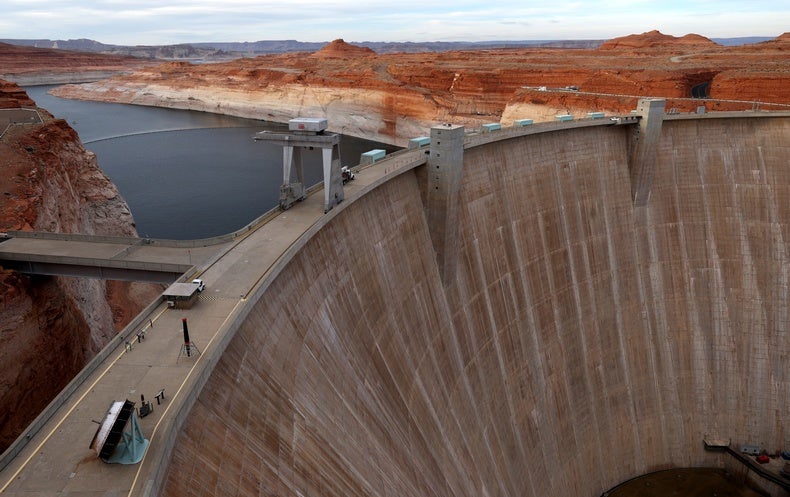
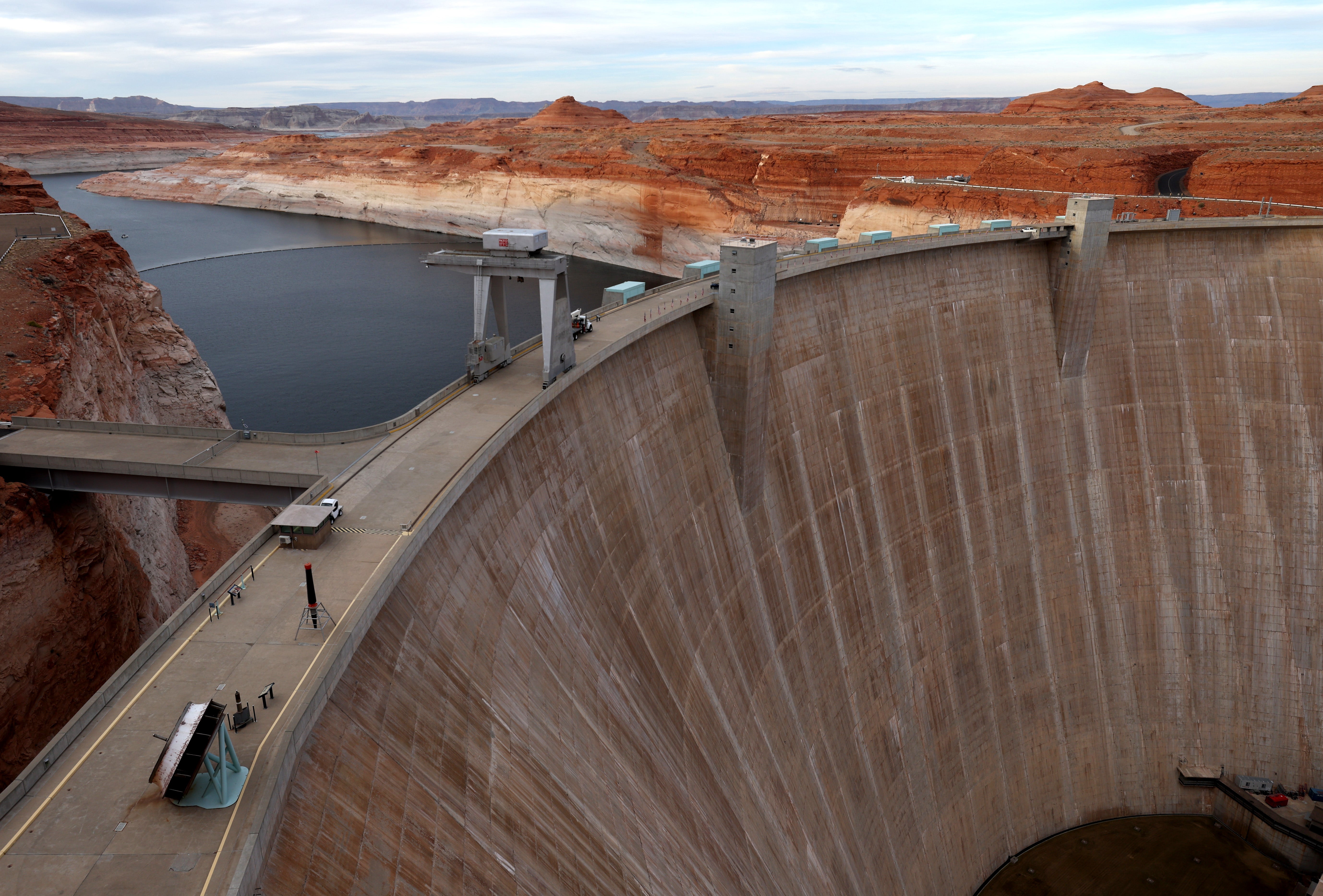
As Washington dithers, Americans are beginning to grapple with the consequences of a warming planet. In the Southwest, federal regulators recently warned states that they needed to drastically cut back water consumption to protect the dams at Lake Mead and Lake Powell in Nevada and Arizona, respectively. The two impoundments are critical for managing the flow of water along the Colorado River, making them a key source of water for some 40 million Americans in the desert Southwest. And as large hydroelectric facilities, they are also keystone’s of the West’s electric grid.
At least, they have been.
Water levels were just 32 feet above the elevation needed to generate electricity at the Glen Canyon Dam on Lake Powell earlier this year, prompting the U.S. Bureau of Reclamation to take unprecedented efforts to bolster the reservoir’s levels (Greenwire, May 3). In an average year, Glen Canyon Dam generates about 5 billion kilowatt-hours of electricity, according to Reclamation, enough to power about 466,000 homes. But as water levels have dropped, so too has the dam’s output. Initial Energy Department data shows it generated a little more than 3 billion kWh of power last year.
In the middle of the country, Texas is experiencing its hottest summer since 2011 (Climatewire, July 12). Temperatures in Austin reached 105 degrees Fahrenheit on five consecutive days, according to the National Weather Service, the third-longest streak on record. The searing heat sent power demand soaring as Texans sought the relief of their air conditioning. The Electric Reliability Council of Texas, the state’s primary grid operator, twice asked consumers to cut back on power consumption to avoid rolling black outs.
Further to the north, parts of western Kansas have gone more than 300 days without recording an inch of rain. Wheat cultivation there is suffering as a result, an unwelcome development when the world is scrambling to find grain following Russia’s invasion of Ukraine (Climatewire, July 8).
Climate change alone is not solely responsible for events like low water levels at Lake Powell or the struggles of Texas’ grid. In both those cases, soaring population growth is taxing water and electricity supplies. A changing electricity grid, which is seeing old coal and gas plants replaced by renewables, is also a factor.
But a warming planet has made those challenges harder.
“We’ve been through a degree of warming. In a sense, we at least have a sense for the magnitude of the impacts. Two degrees of warming would be twice as intense,” said John Nielsen-Gammon, a professor of atmospheric science at Texas A&M University and the Texas state climatologist. “But it gets us farther outside of historical conditions, which means the extreme events get more and more likely to be worse than anything previously experienced.”
Scientists were once hesitant to ascribe individual weather events like the heat wave that baked Texas last week to global warming. Yet that thinking has begun to change in recent years amid a growing body of irrefutable evidence the planet is getting warmer.
Events such as the heat dome that enveloped the Pacific Northwest last year are nearly impossible in a cooler world, scientists said. So are storms like Hurricane Harvey, which dropped up to 60 inches of rain on parts of Texas, one of the most significant rainfall events since record-keeping began in earnest in the 1880s.
Finding consensus over policies that can cut emissions is difficult enough, as shown by Congress’s inability to pass significant federal climate legislation. But the challenge is compounded by atmospheric reality. Methane emitted today will stay in the atmosphere for several decades. Carbon dioxide released in the air today can stay there for centuries, according to NASA.
“If we wake up in 5 to 10 years and say, ‘This is unbearable to our economy, to our communities, to a livable future; we must act,’ it will be too late to cut and stem the losses that will be going on,” said Kim Cobb, a climate scientist at Brown University. “This is a challenge where the decisions we make this year, the next year and the next year will determine what type of climate we will have at least until mid century and most likely beyond.”
Right now, Washington is making the decision to not to act in a way that would seriously limit emissions this decade. Congress passed an infrastructure law last year that shovels money into research for technologies such as advanced nuclear, hydrogen and carbon capture and sequestration. Yet most experts expect it would take at least a decade before those technologies can begin to be deployed at scale (Climatewire, Aug. 13, 2021).
In an interview with a West Virginia radio station on Friday, Manchin held open the door to working on a climate bill after Congress’ summer recess. The West Virginia senator said he wanted to see July’s inflation figures before proceeding with a climate bill. But many Democrats signaled they had little hope of securing Manchin’s vote, which is needed in a 50-50 senate, after seeing him back out of two potential climate packages (Greenwire, July 15).
The Biden administration, meanwhile, is hamstrung by a recent Supreme Court ruling that limits the options available to EPA for regulating emissions from power plants. While the agency has some significant tools remaining for regulating CO2, the high court’s ruling suggests the justices would look skeptically at future agency actions that do not have explicit congressional approval.
For all those difficulties, emission reductions are likely to continue. Continued renewable deployment and increasing electric vehicle adoption means emissions are likely to fall 24 to 32 percent of 2005 levels by the end of the decade without significant changes in policy, the Rhodium Group said in an analysis last week. U.S. emissions were 17 percent below 2005 levels in 2021, Rhodium reported.
The problem is that those reductions fall far short of the 50-52 percent reduction targeted by Biden — and leave the United States well adrift of achieving net zero emissions by midcentury.
The impact of American climate inaction on global emissions ultimately will depend on how far the United States falls from meeting its targets, said Michael Mann, a climate scientist at Pennsylvania State University.
“The direct impact on global emissions might be modest, but the indirect impact could be huge,” he wrote in an email. “If the U.S., the world’s largest historical emitter, is unable to meet its commitments to the rest of the world, that provides an excuse for countries like China and India, who are likely to dominate further emissions, to ease off in their own efforts.”
The risks of a warming planet grow as temperatures rise. At 1.5 C, there will be more glacier melt and sea-level rise, causing additional “death and destruction,” Mann said. But the impact becomes even more damaging and pervasive after temperatures breach 2 C, he noted.
“It is a world,” Mann said, “that we want to avoid.”
Reprinted from E&E News with permission from POLITICO, LLC. Copyright 2022. E&E News provides essential news for energy and environment professionals.