
It’s February 2025. The world feels like complete chaos, and it’s hard to step away from the news. Maybe your body feels tight, and perhaps your mind is racing.
Take a deep breath, then keep reading.
It isn’t just you: lots of people have expressed that they have felt overwhelmed and burned out from the events of recent months. Disasters, including Hurricane Helene and the Los Angeles–area wildfires, served as the backdrop to a frighteningly tense presidential election. And the new administration has acted loud and fast, often in ways that judges are already declaring unconstitutional.
On supporting science journalism
If you’re enjoying this article, consider supporting our award-winning journalism by subscribing. By purchasing a subscription you are helping to ensure the future of impactful stories about the discoveries and ideas shaping our world today.
To a degree, the result feels familiar. News overload is nothing new; major crises such as September 11 and the early months of the COVID pandemic delivered a similar onslaught of rapid-fire headlines that were laden with fear and uncertainty. But experts say the developments during these first weeks of President Donald Trump’s second administration are posing a very real mental health threat that people may need new skills to manage. Scientific American spoke with experts in psychology and beyond about what’s happening and how to stay calm and grounded through it.
What Is the ‘Flood the Zone’ Strategy?
Political strategist Steve Bannon, who advised Trump during his first term, has openly discussed overwhelming the media as a key priority to advance right-wing objectives. “All we have to do is flood the zone,” Bannon told Frontline in 2019. “Every day we hit them with three things. They’ll bite on one, and we’ll get all of our stuff done: bang, bang, bang.”
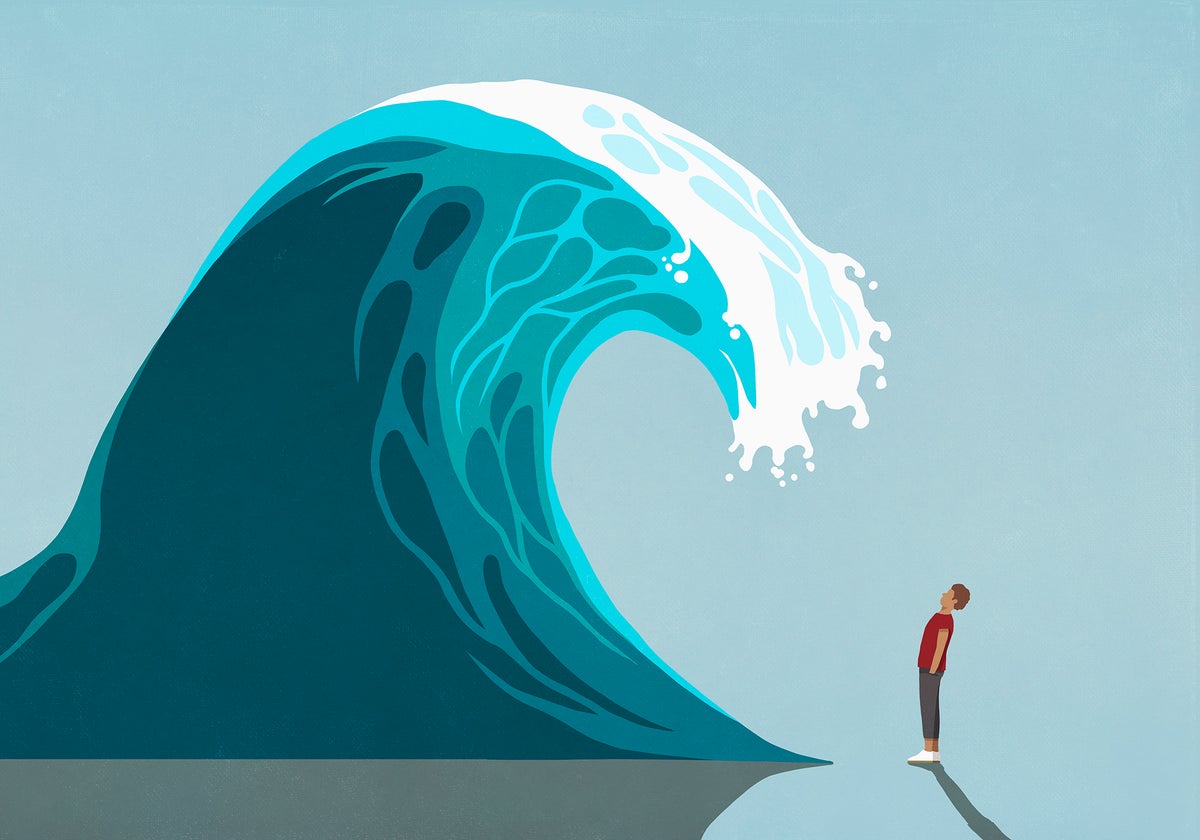
This approach is reminiscent of the “Gish gallop” tactic that Trump has used during debates to barrage opponents and fact-checkers with so many lies and half-truths that it becomes impossible to adequately address them all. Away from the podium and inside the Oval Office, it’s a strategy that harkens back to a predigital Soviet practice of producing huge amounts of disinformation meant to make people question reality, as many experts have noted. The Trump administration’s version of this tactic uses volume to create paralysis among the opposition, says Dannagal Young, a professor of communication at the University of Delaware. “It’s the sense that you are being overwhelmed by a tidal wave,” she says. “How do you push back against a tidal wave? You can’t.”
In addition to the sheer number of actions coming from the administration, many are also entirely unprecedented. Without historical U.S. parallels to work from, our brain is less able to calculate what these developments might lead to, and that can make processing the news even more difficult. “The chaos that ensues is really hard to make sense of because we don’t know the consequences,” says Kristen Lee, a psychotherapist and a teaching professor of behavioral science at Northeastern University.
But it’s not just the volume of headlines and the intellectual difficulty of understanding what’s happening that make current news overwhelming. The key, psychologists say, is the emotional weight of those headlines’ content—especially for people who find what’s happening in the U.S. today to be genuinely frightening.
Fear in the Brain, Fear in Societies
For someone worried about the administration’s policies creating tangible harm, each new headline can create a spark of fear—and fear is a remarkably powerful emotion. “Threat and fear take the priority in our brains,” says Arash Javanbakht, a psychiatrist and a neuroscientist at Wayne State University. “When you’re afraid, all you’re thinking about is what you’re afraid of.”
Think of the effects of fear on the brain in two categories: cognitive and emotional. Cognitively, fear hijacks our ability to think well—and this makes us more likely to rely on other people’s reasoning than to think through our own opinions and values, Javanbakht says. Lee notes that fear can also interfere with attention, leaving people vulnerable to what psychologists call cognitive distortions. This term is often used in discussing conditions such as depression and anxiety, in which our brain can fixate on predicting the worst or ignoring small positives. Ultimately, cognitive distortions are convenient mental shortcuts that our brain can slip into. Such habits include jumping to conclusions and engaging in black-and-white thinking, and they bypass our critical thinking skills.
As an emotion, unaddressed fear can morph and grow. Fear often becomes anger, Javanbakht says. And as fear and anger build up, they turn into a state of feeling overwhelmed, as well as exhaustion and sadness. If someone doesn’t feel like they have any control over a situation, this emotional cocktail can create a sense of helplessness that can become paralyzing—like a caged lab animal that shuts down amid shocks it doesn’t believe it can stop, even if an avenue of escape finally does become available.
On top of this, feeling anxious about the news can drive people to follow current events even more closely. “Anxiety stimulates our need to search for information,” Young says. But in chaotic times, the next news story won’t actually resolve the anxiety—and neither will the second or third or 10th.
And if fear is difficult for someone to cognitively and emotionally manage, the effects are even more profound when that individual is surrounded by other people who are also afraid. That’s because humans are fundamentally social beings who are attuned to one another’s emotions; our connections within our local communities are how we have managed to survive as a species.
In today’s digitally connected world, however, our exposure goes far beyond perceived threats to us and our daily companions. We now have intimate access to the emotions of hundreds or thousands of people we’re connected to online. We feel scared and angry, we go online, we encounter other people being scared and angry, and that rubs off on us. “When people who we think of as on our team are outraged and upset and anxious, the natural and adaptive response is for us to have the contagion of their experience,” Young says.
And because our fear has already reduced our cognitive abilities, we’re also more likely to instantly take on someone else’s view of the world without examining it for ourselves—especially if we consider them a leader—Javanbakht says.
Moving Forward
We can better understand how people have been feeling over recent weeks by thinking about the experience of a car accident, says Fathali Moghaddam, a Georgetown University psychologist who has studied the psychology of democracy and dictatorship. “You’re in a state of shock, and you are just trying to adjust to what happened,” he says. “The car is damaged; you are hurt; everything is bewildering.”
In the moment, the shock can feel so intense that it’s difficult to imagine life ever feeling normal again. But psychologists know that humans adjust to their circumstances—and surprisingly quickly. What feels unbearable in the short term can become more manageable with time. “We have to adjust,” Moghaddam says.
It can be difficult advice to heed in the throes of fear and the feeling of being overwhelmed, but experts also encourage us to remember that people of many generations have encountered crises before. “We are not the first cohort in humanity to face existential threats,” Lee says.
Although some people in the U.S. are certainly in immediate risk, many, realistically, are not. And as unpleasant as 2025 may seem for people living today, the modern era is still an improvement over much of the past, Javanbakht notes. “At the end of the day, we are living in one of the safest, most prosperous times of humanity,” he says. “But we have lost sight of that.”
So know that, on both an individual and societal level, as difficult as you might find this time, things will become more manageable. All the experts interviewed for this article also shared recommendations on ways for emotionally struggling people to manage the current situation and stay healthy.
Coping Strategies to Stay Informed without Feeling Drained

J.A. Bracchi/Getty Images
Take a deep breath. Do so literally and figuratively. Breathing deeply will help your body recognize that, right now, you are safe, allowing your cognitive brain some room to come back online. And you may need a broader pause—an hour, a day, even a weekend away from the news—to evaluate where you are and what you need. “When our system is so taxed, we have to be mindful and step back,” Lee says.
See the bigger picture. To make the task of processing the Trump administration’s relentless flood of actions a little less daunting, Young recommends considering them within the larger narrative of the president’s goals and priorities. For example, staffing and funding cuts at the Centers for Disease Control and Prevention and at the National Oceanic and Atmospheric Administration are all aspects of Trump’s well-known lack of trust in science and scientists. This thought process can make individual news events feel less overwhelming, Young says. “Actually, that tidal wave is all coming from one place,” she says. “I think that that reframe is essential.”
Limit news consumption. Experts encourage people who are struggling with the news to manage their exposure—while still staying reasonably informed. There are plenty of options: People who usually watch news programs can consider reading articles instead. Those accustomed to checking the news all day long can establish one or two set times each day to catch up. And people who find themselves doomscrolling on social media can reduce their exposure.
Lee encourages people to use common behavioral-change tactics to make this process easier. For example, you can make doomscrolling more difficult by setting time limits for specific apps on your phone or by unplugging your router at a certain time, and you can make healthier habits easier by keeping a book or walking shoes close at hand. You can also manufacture a “fresh start” and recruit a friend to help you monitor your progress.
Stay with science. Moghaddam argues that, given Trump’s authoritarian leanings, standing up for science has become particularly important. “Science is the most democratic procedure that humans have invented,” he says—and he expects attacks on science to ramp up as the administration continues.
Even as the chaos surrounding scientific funding persists, Young encourages active researchers to resist the temptation to get distracted. “Not only do you still have work to do, but you have an obligation to get to work,” she says. “And do it without feeling guilt about what you’re doing. Because if you are in the scientific community, your work is the production of knowledge.”
Reach for something good. Javanbakht points out that it’s valuable to balance one’s political news intake with stories about science, the arts, sports, and more. These articles give your brain a break from fear and keep it cognitively active. Similarly, he and others encourage people to look for good things in life more generally as a way to stay even-keeled.
Connect with ourselves and other people. If current events are affecting your perception of yourself and your impact on the world, Young recommends picking up a pencil. Writing about what’s happening can help your brain look at your role in a new way. “There’s a lot of amazing work from the mental health literature on people writing their own narrative and how it can shape how we view ourselves and our own agency,” Young says. “Writing can help people construct an image of themselves anew.” Writing about your values or the ways you’re showing up for the people in your life might be steadying when things are difficult.
And connecting with other people—offline and not about politics—is also grounding. Good conversations not only help fortify our brain against a fear-induced shutdown; they also strengthen our community ties and remind us of the world beyond politics. “Rediscover the art of the dinner party, of the game night,” Young says.
Take action. Most of all, researchers recommended simply doing something—anything, really. Javanbakht recommends exercise, given that plentiful research shows its deep mental health benefits. Young emphasizes that reaching out to elected officials, building community and volunteering can all counteract the paralyzing effects of fear-inducing news. “Your local school board is still holding meetings,” she says. “Your town hall is still trying to figure out ‘Are you going to get the money to fill the potholes or not?’”
And for her, taking these actions are the real point of reading the news anyway. “News consumption is not an end in itself,” she says. “From a democratic theory standpoint, news consumption is a means to become informed to act.”