
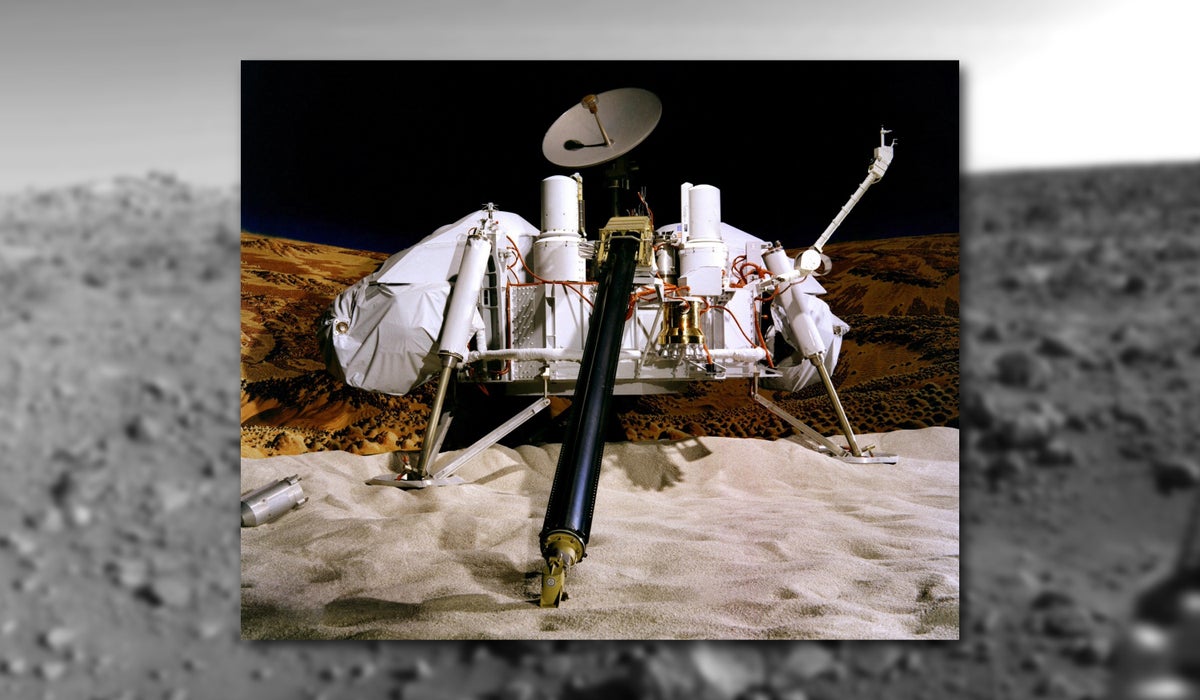
On July 20, 1976, NASA’s Viking 1 lander became the first spacecraft to safely touch down on Mars. Shortly after, it beamed back our first close-up image of the surface—a drab view of pebbles strewn at the lander’s feet.
“I don’t think we’d have been surprised if there were blades of grass,” recalls Tom Young, Viking’s mission director. Scientists had speculated for years about what scenes would await Viking 1 and its twin, Viking 2, which landed elsewhere on Mars a few weeks later. Most thought any Martians would, at most, be simple, small life-forms—although Carl Sagan had impishly suggested that polar-bear-sized creatures could populate the landscape.
Humans have imagined other inhabited worlds for millennia. And we’ve even “discovered” life on Mars more than once across the last century or two. Yet each time we’ve built sharper tools and taken a closer look, all those claims have evaporated, much like the Red Planet’s ancient seas. By the time the Viking landers launched, we knew there were no signs of life that could be seen from orbit.
On supporting science journalism
If you’re enjoying this article, consider supporting our award-winning journalism by subscribing. By purchasing a subscription you are helping to ensure the future of impactful stories about the discoveries and ideas shaping our world today.
But there was still hope that perhaps something stirred there—hope enough to launch the Viking landers on an audacious mission to look for it. Their results, however, weren’t conclusive. Most experts agree the twin spacecraft failed to find definitive signs of organisms in scoops of Martian soil, but some scientists continue to believe they did.
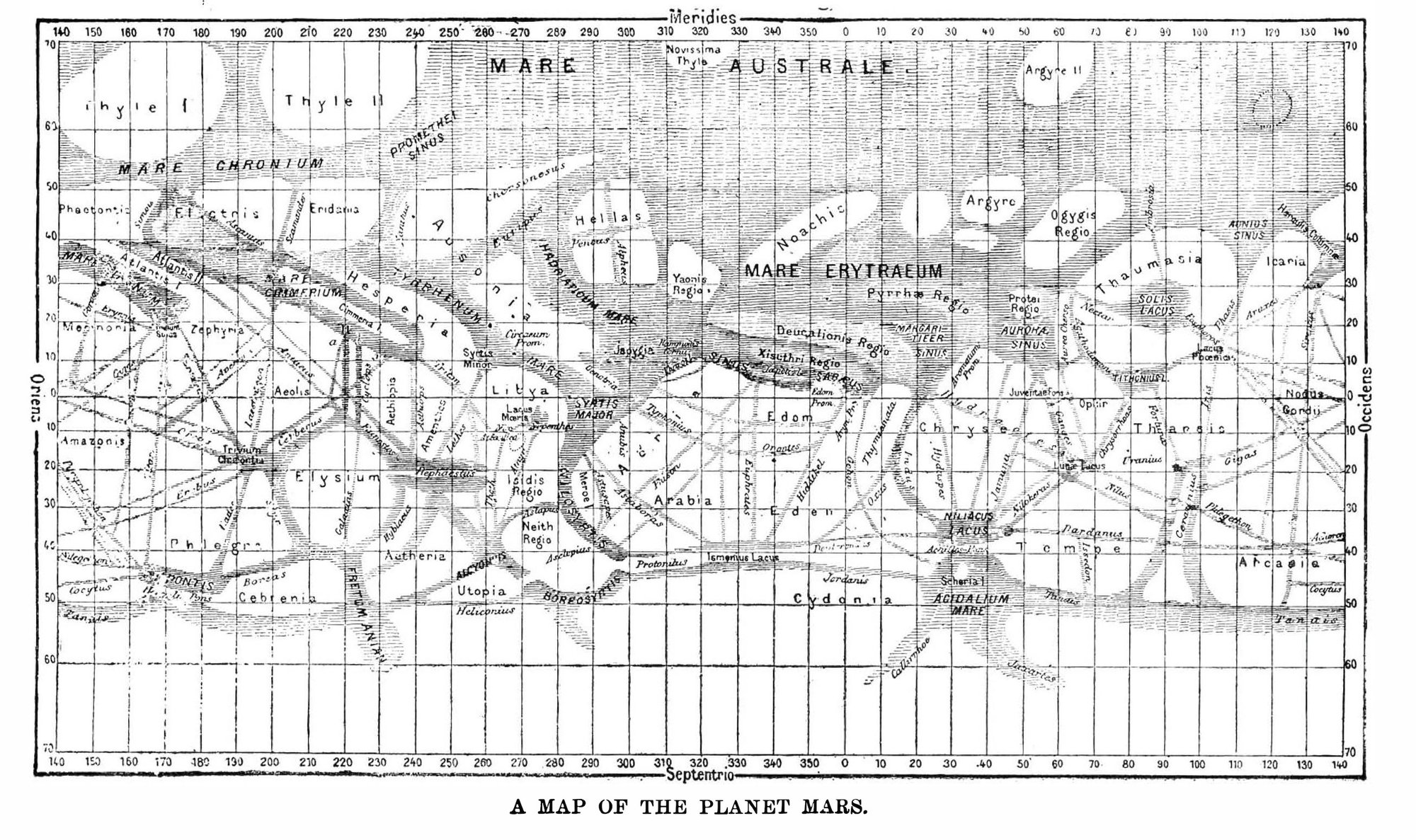
A map of the planet Mars and its putative “canals,” produced by the astronomer Percival Lowell for the October 1894 issue of Scientific American.
Even now, a half-century later, the outcome of those investigations fuels debate, and the Viking landers remain the only missions ever sent to the surface of another world to search for extant alien life. The ambiguity that wafted from their soil samples has become emblematic of the uncertainty that plagues the greater search for extraterrestrial life—not just on Mars and our sun’s other worlds but across the observable universe. Our knowledge of life’s physical limits and the unearthly forms it might take remains so incomplete that we could all too easily declare a discovery where none truly exists—or fail to recognize genuine extraterrestrial biology hidden in plain view.
As a result, astrobiologists have, for decades, defaulted to a conservative burden of proof that leans into two aphorisms coined by Sagan when he wasn’t musing about Martian polar bears: life, he and his co-authors wrote, should be considered a “hypothesis of last resort,” largely because “extraordinary claims require extraordinary evidence.”

Carl Sagan stands in front of a Viking lander model in Death Valley, California.
But what if Sagan had it all wrong? If we live in a universe where life is common and not extraordinary at all, setting such an extraordinarily high bar for its discovery beyond Earth can backfire. What if life’s fingerprints have been on Mars all along, and we were too cautious to admit that we’d found them?
Already, a growing pile of evidence suggests ancient Mars could very well have been an inhabited planet—and may still be. Our search for life there is a bit like bobbing for apples blindfolded—except we don’t know what an “apple” might feel like, and the apples may exist only in scattered pieces. What’s needed, many scientists argue, is a clearer way of separating signs of “life” from “nonlife,” a quantitative method that leverages statistics and probabilities to guide our interpretations of biology’s potential fingerprints.
“There’s all these different lines of evidence that keep coming together that make me go, ‘Gosh, it’s becoming more and more difficult to explain everything on Mars abiotically,’” says Amy Williams, an astrobiologist at the University of Florida. “I’m not yet ready to say that we’ve found evidence for life, but I think the story is building to help us understand what that potential is —to put a probability on that instead of just saying ‘yes’ or ‘no.’”
Present-day Mars is marginally habitable at best, but 3.5 billion years ago the planet was almost certainly a more life-friendly world. Ancient Mars was warmer, with a thicker atmosphere and a global magnetic field that protected its surface from cosmic radiation; seas and lakes filled its basins, and rivers tumbled through its valleys. Over eons, Mars lost its magnetic field and, with it, those bodies of water and thick, insulating atmosphere.

An artist’s concept of an ocean in the northern hemisphere of Mars, from billions of years ago when the planet was warmer, wetter and presumably more habitable than it is today.
NASA’s Goddard Space Flight Center
Yet across the sweep of Mars’s lifetime, organic compounds—life’s building blocks—have rained down on the planet, delivered by meteorites and cosmic dust.
“If we live in a universe where life takes advantage of watery environments when there’s juicy chemistry going on—which is the way I picture the universe, but that’s unvalidated intuition—then something should have started happening in some of those places on Mars,” says astrobiologist David Grinspoon of the Planetary Science Institute. “So there’s this predisposition to think, ‘Either there should have been an origin of life on Mars—or we’re really wrong about something on Earth.’”
Since 2012 NASA’s Curiosity rover has been searching for signs of ancient habitable environments in Gale Crater. And in 2021 the agency’s Perseverance rover touched down in Jezero Crater with the goal of looking specifically for ancient biosignatures, not present-day life. Now, based on the results of those robotic explorations, many experts suspect that ancient Mars was indeed a biological world, even if they can’t yet prove it.
“The evidence for habitable environments and life on early Mars is getting stronger every time we look at it,” says Chris McKay, an astrobiologist at NASA’s Ames Research Center.
The most compelling clue comes via a reddish mudstone found by Perseverance that’s dappled with “leopard spots,” or mineral assemblages that contain chemically altered iron and organics. Such spots on Earth rocks are usually the work of mineral-munching microbes. In fact, scientists haven’t yet found a convincing way to explain the observation on Mars without biology; for such chemistry to occur without life, it seems, the rock would’ve had to experience a set of events or conditions that appear rather improbable, given our current understanding of its history and environment.
From rocks scattered about Gale Crater, Curiosity contributed another intriguing observation: a peculiar abundance of long-chain alkanes, carbon-containing molecules that, on Earth, sometimes originate from fatty acids such as those in cell membranes. Scientists think the Martian chains are fragments of larger fatty acids that were degraded long ago by cosmic radiation and then, much later, by the instrument on Curiosity that studied them. If so, Williams says, the original molecules would have been hard for abiotic sources, such as meteorites, to deliver; the longest of the fatty acids would be longer than anything yet found in meteorites.
While not definitive, those observations from Mars are certainly exciting. “It’s what you might call permissive evidence of life—it could be that microbes left behind this material,” McKay says. “But it’s not persuasive.”
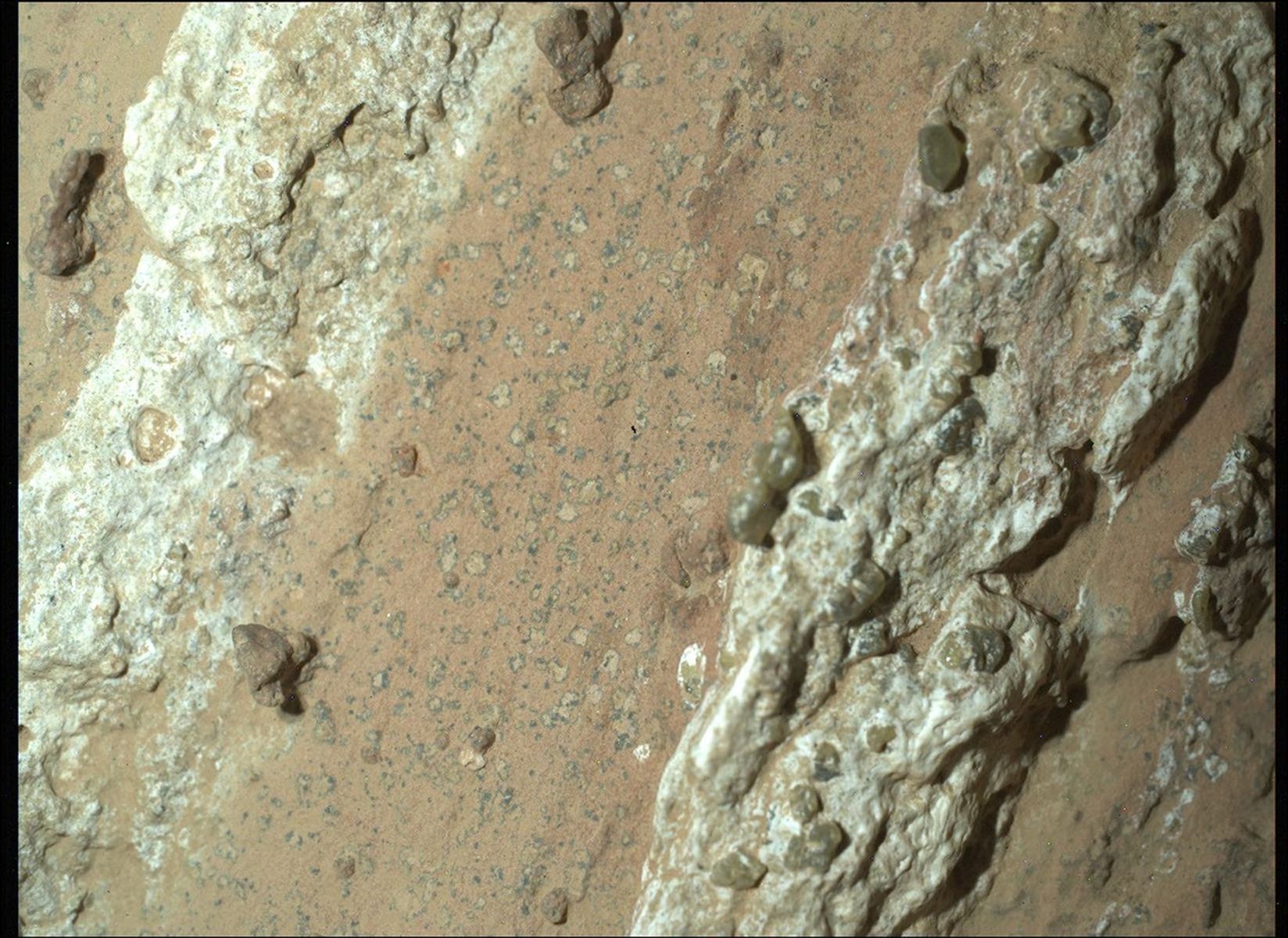
Potentially microbe-made small dark “poppy seed” speckles and larger dark-rimmed “leopard spot” blobs dot the surface of “Cheyava Falls,” one of the most intriguing rocks ever found on Mars.
To definitively answer the question of whether those molecules bear biology’s fingerprints, scientists first need to rule out every possible abiotic explanation—an endeavor that requires a full understanding of a potential biosignature’s environmental context. That’s hard enough to do on this planet, and it’s even harder to achieve remotely.
Or we could bring samples from Mars to study in labs here on Earth. NASA had been planning to use its Mars Sample Return mission to retrieve pieces of the leopard-spotted rock and other choice Perseverance-collected specimens, but the plan grew so complex and expensive that Congress defunded it. Astrobiologists still hope the samples will eventually find a cheaper, more workable way back to Earth.
The search for life beyond Earth should be the agency’s highest priority, Young says. And the mystery of our seeming cosmic solitude could be solved by a cache on rocks that are just waiting for retrieval on Mars.
“I think that’s really important for us to do,” he says. “Every leader who passes on the opportunity to bring those samples back has put a dark mark on their leadership.”
Until—or unless—Mars Sample Return happens, astrobiologists are forced to wrestle with what, exactly, would make a potential biosignature “persuasive.” Sure, we can all imagine a few scenarios in which proof of extraterrestrial life would be unequivocal: prime numbers encoded in a radio transmission, a fossilized trilobite on Mars, squidlike aliens in the outer solar system’s ocean moons.
When it comes to ancient Mars, however, most experts don’t expect to find “one piece of data, and now we know the answer,” says Rebecca McCauley Rench, NASA’s lead scientist for astrobiology in planetary sciences.
But if ringing the “alien life” bell will likely rely on a preponderance of evidence rather than any singular, slam-dunk observation, wouldn’t astrobiologists do better to abandon Sagan’s aphorisms?
“‘Extraordinary claims require extraordinary evidence’ is a pithy slogan, but it’s kind of limiting,” says Christopher House, an astrobiologist at Pennsylvania State University. In deference to Sagan’s credo, he says, “people will bend over backward to say that whatever they’ve found is abiotic.” Instead, House suggests, scientists should consider explanations that invoke life with the same rigor and sincerity with which they evaluate abiotic conclusions.
Plus, chemist Steven Benner says, “what’s ‘extraordinary’ as a claim depends on who is perceiving it.” If it’s not so crazy to imagine that ancient Mars was a biological world, then maybe “life” isn’t such an extraordinary claim after all.
“What if we live in a universe where life is very ordinary?” asks Michael Wong, an astrobiologist at Carnegie Science. “If we only let something’s rareness guide us to life, we may miss a lot of life that is just ordinary life, and we may be drawn to extraordinary nonbiological processes and think they’re life instead.”
To conclude anything with confidence from a set of “ordinary” observations, scientists need to build a quantitative way to determine whether a set of observations are a signature of biology. “That quantitative biosignature analysis should be a goal within the community,” says astrobiologist David Catling of the University of Washington, “because otherwise it’s all just hand-waving, and we’re not making any definitive answers. It’s still interesting, and discoveries always move things forward, but we have to be more quantitative about it.”

NASA’s Perseverance Mars rover took this selfie, made up of 62 individual images, on July 23, 2024. A rock nicknamed “Cheyava Falls,” which bears tantalizing features suggesting it may contain ancient microbial fossils, is to the left of the rover near the center of the image.
Say you have 100 Mars rovers poking around in various craters, and each of them finds something like the leopard spots or those long-chain alkanes. You do the work to rule out geology and realize that while you could explain the observations without invoking biology, those explanations each require conditions or processes that are improbable. Or maybe, says Morgan Cable, a planetary scientist at Victoria University of Wellington in New Zealand, you do all that work and end up finding abiotic explanations that are mutually exclusive.
“When do we get over the threshold to say, ‘Yeah, the likelihood of us finding this many potential biosignatures means we can remove the word potential’?” Cable says. “It’s almost like we have to take Carl Sagan’s ‘hypothesis of last resort’ and apply that to the abiotic case as well.”
For any quantitative approach to work, though, “you need a certain amount of data,” Catling says. “And at the moment, it’s kind of spotty.”
Tedious though it may be, scientists must for now be satisfied to proceed with “business as usual” in their search for life on Mars. New tools such as AI-augmented robotic explorers and machine-learning algorithms that analyze observations may come to the fore, but the core objectives remain unchanged: Keep looking deeper for clues hidden in the Martian rock record and gradually build up a more complete understanding of the planet.
In other words, the frustrating but necessary task is to somehow transform gobs of “ordinary” data into an account that might tell us something “extraordinary” about Mars and its history. That doesn’t quite recapitulate Sagan’s strict criteria—it’s more of a variation on a theme—but it doesn’t profoundly deviate from them, either.
“I think we owe it to the community and to ourselves—to humanity, really: if you’re going to make a claim like this,” Williams says, “you have to be right.”
The search for life on Mars is filled with cautionary tales of scientists who made great claims and then had to walk them back. But according to Benner—a somewhat iconoclastic scientist who is self-employed via his nonprofit research organization, the Foundation for Applied Molecular Evolution—this troubled legacy has left today’s astrobiologists too cautious and unable to see what, to him, is increasingly obvious.
“More likely than not,” there is life on Mars today, he argues. And the Viking landers probably detected it a half-century ago. The science community’s collective failure to acknowledge this, he says, “is an excellent example of how science is not self-correcting, even when the facts are clear.” (Benner’s peers find his views on Viking controversial, to say the least.)
Each Viking lander carried three biology experiments, all designed to detect the metabolic murmurs of microbes that might live in the planet’s dirt. One experiment added water and nutrient soup to the soil and looked for respired gases. Another added nutrient broth with a radioactive tracer to soil and then looked to see whether any of those “radiolabeled” traces emerged in exhaled carbon dioxide. The third asked whether a process like photosynthesis could incorporate radiolabeled carbon dioxide into organic molecules.
Curiously, at both landing sites, the Martian soil that was exposed to radiolabeled broth seemed to produce radiolabeled gases. “The curve was incredible,” Young recalls. “If you looked at just that experiment, it could not have been more positive.”
Yet the mission team ultimately declared present-day Mars a lifeless world. Another instrument onboard, a mass spectrometer designed to detect organic molecules, had seemingly come up empty. And that was a conundrum because no one could explain how life might exist where organic molecules do not.
“That influenced everybody, myself included, into thinking ‘life’ is out of the question,” McKay says. “You can’t have life without organics.” No organics, no life:for a time, that disappointing conclusion cast the mission as a failure and slammed the brakes on NASA’s Mars exploration program.
“The thing that we really learned from Viking was that environmental context is extremely important,” McCauley Rench says. “You can’t just ‘go try to detect life.’ This is part of what makes the search so hard.”
It would take 20 years and another tantalizing hint of life on Mars to revive the space agency’s interest in the planet. In 1996 scientists found what looked like tiny microbial fossils embedded in a Martian meteorite that had been collected from Antarctica’s Allan Hills region. Years later the “discovery” was ultimately deemed a misinterpretation but not before it inspired then president Bill Clinton to describe it in a televised address as a “vindication of America’s space program.”
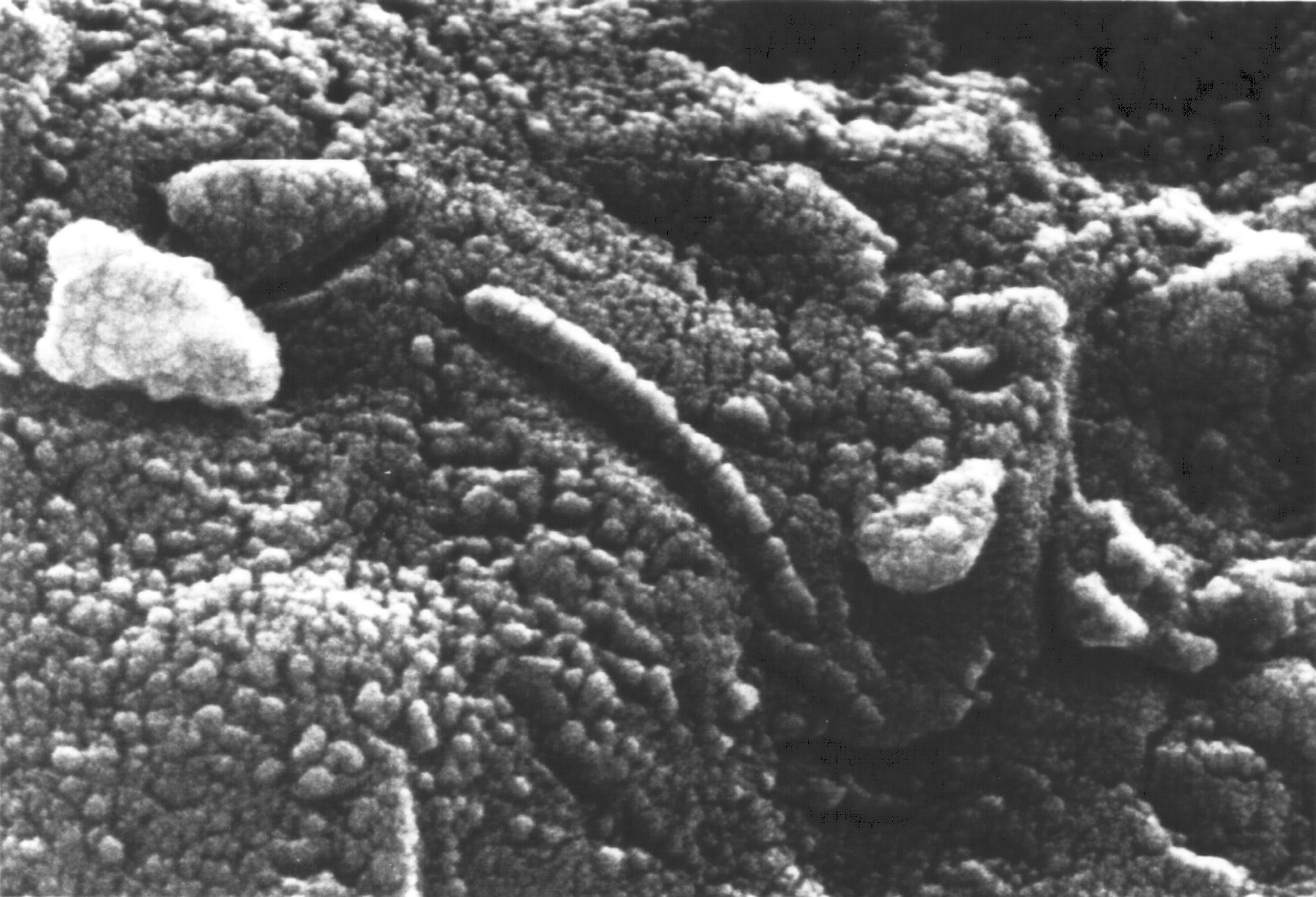
This electron microscope image of the Martian meteorite Allan Hills 84001 shows linear, tubelike structures resembling microbes.
NASA’s renewed Mars program would pursue a more modest, incremental goal: to understand whether the planet was once habitable rather than whether anything still lived there or ever had. But a partial solution to Viking’s Mars life conundrum turned up unexpectedly in 2008. In the soil at its perch in the Martian arctic, NASA’s Phoenix lander found perchlorate salts—which tend to destroy organic molecules upon heating.
If perchlorate was common in Martian soils, McKay and others argued, that would explain why Viking’s mass spectrometer hadn’t seen organics: the perchlorate had chewed through them during the experiment. And it is indeed very common on the planet: in 2013 Curiosity also found perchlorate in Gale Crater, 3,500 miles away from the Phoenix lander.
“That’s when the story changed dramatically,” McKay says. “‘No organics’ goes out the window. There were organics there, and there was perchlorate there.”
Curiosity and Perseverance each followed up by definitively detecting organic compounds at their respective landing sites in a series of discoveries that continually revealed more complex molecules. Mars was proving to be richer and more chemically dynamic than most scientists had dared to dream—even though some, including the late Gil Levin, principal investigator for Viking’s labeled release experiment, had suspected as much. “To the day Gil died,” Young says, “he was convinced that life was there.”
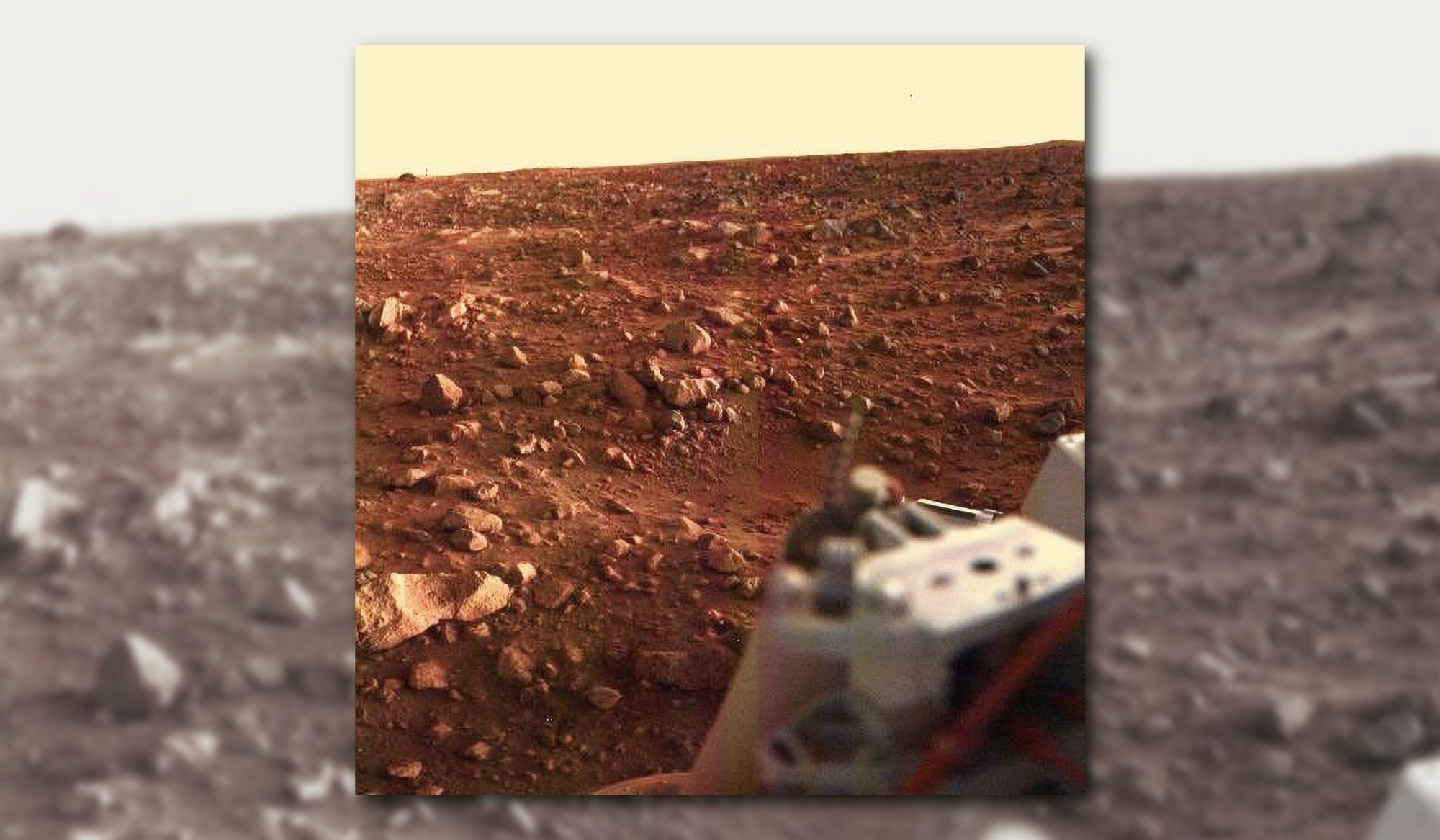
NASA’s Viking 1 lander snapped this image of a Martian sunset from the planet’s Chryse Planitia region on Aug. 21, 1976.
In truth, scientists don’t need “life” to explain Levin’s labeled release results. That experiment sampled a process called oxidation, in which larger molecules are broken down and stripped of electrons for energy. The Martian surface itself is naturally oxidizing: radiation breaks perchlorate into highly reactive compounds that don’t need heat to degrade molecules. That could explain how the added nutrients were broken down to release radiolabeled carbon dioxide. Additionally, some of the nutrients in the broth could decay into carbon dioxide on their own.
More recent work by Benner and his colleagues revisits the third experiment—in McKay’s view, the “orphan of the Viking trio.” This often overlooked attempt to see if something like photosynthesis occurred in Martian soils “absolutely gave what, prelaunch, was considered a positive result,” House says. But this Viking result made no sense on a planet that was then thought to be organics-free, and it was disavowed as a false positive by the very scientists behind it. Called the pyrolytic release experiment, the investigation tested whether labeled carbon atoms, in carbon dioxide or carbon monoxide gases, were incorporated into larger organic molecules. On Earth, photosynthetic organisms do this through a process called carbon fixation.
In a published paper and a new book, Benner argues that this Viking experiment showed that something in the Martian soil appeared to be turning inorganic gas into organic matter. That’s the opposite of destroying organics, Benner says, and cannot be explained by perchlorate or any other oxidant. “There’s nothing out there right now which explains that result,” he says.
That is, there is nothing except, perhaps, life.
Benner makes an important argument that is not easy to dismiss, McKay says, as long as his assumptions are right. “Evidence of reduction on such an oxidizing world would be hard to understand without invoking life,” McKay says. But both McKay and Benner acknowledge that more work is needed to truly rewrite our understanding of Viking’s oft-overlooked experiment.
For now, Viking’s results may continue to rest in ambiguity—at least until scientists return to Mars with a fresher suite of life-detecting instruments and a lot more information about our vermillion neighbor’s surface. No more getting fooled by perchlorate or premature declarations of sterility—just an acknowledgment that when we dare to ask big questions, we may not immediately understand nature’s answer.
“I do sometimes think about the Viking experiments and how interesting it would be if, 100 years from now, we recognize that that was the first time life was found on Mars,” Grinspoon says, “and we just didn’t accept it for another 75 years.”