
Close Menu
Beverly Hills Examiner

    Subscribe to Updates

    Get the latest creative news from FooBar about art, design and business.

    What's Hot

    Pearl Jam Announce First Gig Since Drummer Departure at 2026 Ohana Fest

    May 13, 2026

    Trump’s Golden Dome plan will cost $1.2 trillion, says the CBO, five times more than expected

    May 13, 2026

    He Doesn’t Care About The American People

    May 13, 2026
    Facebook X (Twitter) Instagram
    Beverly Hills Examiner
    • Home
    • US News
    • Politics
    • Business
    • Science
    • Technology
    • Lifestyle
    • Music
    • Television
    • Film
    • Books
    • Contact
      • About
      • Amazon Disclaimer
      • DMCA / Copyrights Disclaimer
      • Terms and Conditions
      • Privacy Policy
    Beverly Hills Examiner
    Home»Science»There Is Too Much Trash in Space
    Science

    There Is Too Much Trash in Space

    By May 17, 2024
    Facebook Twitter Pinterest LinkedIn WhatsApp Email Reddit Telegram
    There Is Too Much Trash in Space


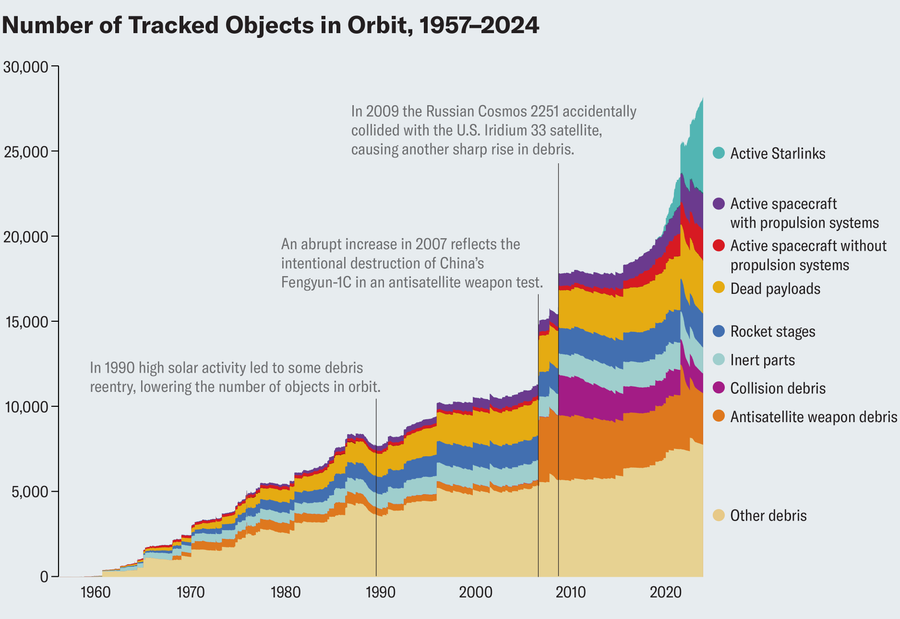
    Space should not be a garbage dump. Nevertheless, we have treated the sky as a wrecker’s yard for more than half a century, and the amount of space junk orbiting Earth has skyrocketed in recent years. Now filled with the decaying hulks of defunct rockets and satellites, our polluted orbital environment is becoming more crowded by the day, threatening the growing space economy. It’s time for nations—and the billionaires commoditizing space—to clean up Earth’s near orbit.

    The U.S. Air Force tracks more than 25,000 pieces of space junk larger than 10 centimeters—about the size of a bagel— weighing together some 9,000 metric tons. This dangerous trash zips around Earth at speeds of roughly 10 kilometers per second, or more than 22,000 miles per hour. Collisions between millimeter-scale objects too small to track and working satellites are now routine, as are near-miss disasters. One example is a NASA research satellite that almost hit a defunct Russian satellite in February. Orbital debris collisions cost satellite operators an estimated $86 million to $103 million in losses a year, a figure that will grow as each operator and each collision generates more debris.

    The threat isn’t just in space. In March part of a pallet from a discarded International Space Station battery fell to Earth, smashing through the roof of a Florida home. In 2020 an Ivory Coast village recovered a 12-meter-long pipe from space, courtesy of a Chinese rocket that cast off its empty core after launch. And a 2022 Nature Astronomy study puts the odds of space junk killing someone on the ground at 10 percent every decade. Needlessly.


    On supporting science journalism

    If you’re enjoying this article, consider supporting our award-winning journalism by subscribing. By purchasing a subscription you are helping to ensure the future of impactful stories about the discoveries and ideas shaping our world today.


    Under the 1967 Outer Space Treaty, nations are supposed to be responsible for damages caused by space junk, even if it was originally launched by a private firm. That puts taxpayers, not space-exploring billionaires, on the hook for damages from orbital debris if its origin can be proved and the company shown negligent—a tough proposition for untraceable paint chips. No surprise, this hasn’t worked. The problem is, after decades of discussion, there is still no international treaty that limits space junk or sets standards for negligence. We need one that outlines responsibilities and imposes fines on the companies whose spacecraft debris causes harm.

    As long as doing the right thing is voluntary, it may not happen, concluded a 2018 Air Force Association report. The limited action since then tells us the world is way overdue for an agreement on mandatory standards. Few countries or companies currently design rockets for their complete life cycle. They must be forced to store enough fuel and retain the capability for spacecraft to steer safely out of space when their useful life is over. Painful financial and regulatory penalties should afflict spacefaring industries and nations that fail to play by the new rules.

    Why? Because the physics of orbital debris spells doom. Between 775 and 975 kilometers overhead, derelict satellites pass within 1,000 meters of one another 1,000 times a year. Any collision would instantly double the amount of trackable debris in orbit and create countless smaller, yet still dangerous, bits of space junk to rain down on valuable satellites below them. The 2013 film Gravity, about astronauts lost in space after orbital debris destroyed their space shuttle, was fictional, but the threat of a cascade of space debris is real. This is the so-called Kessler syndrome, where smash- ups produce so much garbage that Earth’s orbit becomes untenable. A 2023 study predicted that low-Earth orbit can hold only about 72,000 satellites without serious risk of this catastrophe occurring.

    We are far closer to that red line than many people realize. There is a land rush happening right over our heads, in space. And it is coming from private companies, not national governments. There are almost 10,000 satellites in orbit right now, up from 6,500 only three years ago. The nearly 6,000 Starlink satellites launched by Elon Musk’s SpaceX now make up more than half of the total, and they are part of a planned fleet of up to 42,000. Starlink is only the first of at least six more such “mega-constellations” underway or in the offing.

    There Is Too Much Trash in Space

    SpaceX and its rocket industry competitors plan to further fill space as we move into the new space economy. The jumbo Starship rocket Musk is testing right now in Texas promises to be able to carry six times more satellites to orbit than its predecessor, the workhorse Falcon 9 rocket, at a lower cost per pound. The economy of the 21st century will run on the ubiquitous fleets of satellites delivered by these kinds of rockets, providing communications, transactions, observations, and much else. Unless we wreck the sky.

    Satellite slots are now allocated by the International Telecommunications union (ITu), based in Geneva, as well as individual nations’ rules. The ITu largely concerns itself with ensuring that satellite radio-frequency assignments don’t interfere with one another. The agency doesn’t even check that satellites are actually in their promised orbits, to address collision concerns. In 2020 the Inter-Agency Space Debris Coordination Committee, governed by 13 space agencies, including the U.S., Russian and Chinese ones, released guidelines for limiting space debris. They called for deorbiting satellites—burning them back to Earth or retrieving them—within 25 years, which the Federal Aviation Administration made a rule for U.S. launches only last year. This is an overdue but good start from the U.S.

    Although commerce might be the bulk source of space debris, the militarization of Earth’s orbit has had and will continue to play a role in cluttering orbits. We need a global treaty along the lines of the Antarctic convention to keep space clean before tensions rise any further. This could be led by the united Nations Committee on the Peaceful uses of Outer Space. In 2023 NASA proposed a comprehensive plan to remove derelict hulks in orbit and smaller debris. We should fund that endeavor as a mission of the civilian space agency, starting with deorbiting U.S. derelicts. The mission would be a boon to the growing U.S. space industry, as if common sense didn’t offer reason enough.

    Along those economic lines, even without a Kessler syndrome cascade, economists estimate space debris will cost nearly 1 percent of global gross domestic product every year by the next century, the one wherein a Kessler cascade will almost certainly take place if we aren’t careful.

    That might not sound like a lot, but that penny tax would represent a trillion-dollar cost humanity—an unnecessary one, even by the size of today’s world economy.

    The laws governing satellite orbits were written during the cold war in the mid to late 20th century, at a time when only a few governments operated only a few satellites. We live in a new era of private space exploration, one that is more extractive and invasive than before, with many nations and companies participating. We need better rules to keep us from trashing Earth’s orbit as badly as we have trashed Earth itself.


    Original Source Link

    Share. Facebook Twitter Pinterest LinkedIn WhatsApp Email Reddit Telegram
    Previous ArticleKinds of Kindness – first-look review
    Next Article There’s New Hope for an HIV Vaccine

    RELATED POSTS

    Can cloud seeding save us from water bankruptcy?

    May 13, 2026

    All Your Hantavirus Questions, Answered by an Infectious Disease Expert

    May 12, 2026

    Is the U.S. in a new era of political violence? Experts say it’s complicated

    May 12, 2026

    The story of the first human tool: the humble container

    May 11, 2026

    A Chevron Texas Power Plant Seeks School District Tax Break

    May 11, 2026

    Is testosterone therapy safe and effective? What we know

    May 10, 2026
    latest posts

    Pearl Jam Announce First Gig Since Drummer Departure at 2026 Ohana Fest

    Pearl Jam have booked their first gig since the departure of longtime drummer Matt Cameron…

    Trump’s Golden Dome plan will cost $1.2 trillion, says the CBO, five times more than expected

    May 13, 2026

    He Doesn’t Care About The American People

    May 13, 2026

    President Trump must put American hostages first in high-stakes Beijing summit

    May 13, 2026

    Medicare’s new payment model is built for AI, and most of the tech world has no idea

    May 13, 2026

    Can cloud seeding save us from water bankruptcy?

    May 13, 2026

    My Cannes Moment: Anaïs Demoustier

    May 13, 2026
    Categories
    • Books (1,237)
    • Business (6,143)
    • Cover Story (4)
    • Film (6,081)
    • Lifestyle (4,166)
    • Music (6,151)
    • Politics (6,144)
    • Science (5,492)
    • Technology (6,077)
    • Television (5,770)
    • Uncategorized (3)
    • US News (6,128)
    popular posts

    Saw X review – America’s most blood-thirsty civil engineer is back

    Saw X review – America’s most blood-thirsty civil engineer is back About Little White Lies…

    Wet Leg share remix of Depeche Mode’s ‘Wagging Tongue’

    July 8, 2023

    Asylums announce details of new album ‘Signs of Life’

    June 8, 2022

    Conservative Catholic Group Launches “Hide the Pride” Program

    June 13, 2022
    Archives
    Browse By Category
    • Books (1,237)
    • Business (6,143)
    • Cover Story (4)
    • Film (6,081)
    • Lifestyle (4,166)
    • Music (6,151)
    • Politics (6,144)
    • Science (5,492)
    • Technology (6,077)
    • Television (5,770)
    • Uncategorized (3)
    • US News (6,128)
    About Us

    We are a creativity led international team with a digital soul. Our work is a custom built by the storytellers and strategists with a flair for exploiting the latest advancements in media and technology.

    Most of all, we stand behind our ideas and believe in creativity as the most powerful force in business.

    What makes us Different

    We care. We collaborate. We do great work. And we do it with a smile, because we’re pretty damn excited to do what we do. If you would like details on what else we can do visit out Contact page.

    Our Picks

    Can cloud seeding save us from water bankruptcy?

    May 13, 2026

    My Cannes Moment: Anaïs Demoustier

    May 13, 2026

    ‘Chicago’ and More Finales, One More Good Omen, ‘Off Campus’ Hockey Romance, ‘Margo’ Goes to War

    May 13, 2026
    © 2026 Beverly Hills Examiner. All rights reserved. All articles, images, product names, logos, and brands are property of their respective owners. All company, product and service names used in this website are for identification purposes only. Use of these names, logos, and brands does not imply endorsement unless specified. By using this site, you agree to the Terms & Conditions and Privacy Policy.

    Type above and press Enter to search. Press Esc to cancel.

    We use cookies on our website to give you the most relevant experience by remembering your preferences and repeat visits. By clicking “Accept All”, you consent to the use of ALL the cookies. However, you may visit "Cookie Settings" to provide a controlled consent.
    Cookie SettingsAccept All
    Manage consent

    Privacy Overview

    This website uses cookies to improve your experience while you navigate through the website. Out of these, the cookies that are categorized as necessary are stored on your browser as they are essential for the working of basic functionalities of the website. We also use third-party cookies that help us analyze and understand how you use this website. These cookies will be stored in your browser only with your consent. You also have the option to opt-out of these cookies. But opting out of some of these cookies may affect your browsing experience.
    Necessary
    Always Enabled
    Necessary cookies are absolutely essential for the website to function properly. These cookies ensure basic functionalities and security features of the website, anonymously.
    CookieDurationDescription
    cookielawinfo-checkbox-analytics11 monthsThis cookie is set by GDPR Cookie Consent plugin. The cookie is used to store the user consent for the cookies in the category "Analytics".
    cookielawinfo-checkbox-functional11 monthsThe cookie is set by GDPR cookie consent to record the user consent for the cookies in the category "Functional".
    cookielawinfo-checkbox-necessary11 monthsThis cookie is set by GDPR Cookie Consent plugin. The cookies is used to store the user consent for the cookies in the category "Necessary".
    cookielawinfo-checkbox-others11 monthsThis cookie is set by GDPR Cookie Consent plugin. The cookie is used to store the user consent for the cookies in the category "Other.
    cookielawinfo-checkbox-performance11 monthsThis cookie is set by GDPR Cookie Consent plugin. The cookie is used to store the user consent for the cookies in the category "Performance".
    viewed_cookie_policy11 monthsThe cookie is set by the GDPR Cookie Consent plugin and is used to store whether or not user has consented to the use of cookies. It does not store any personal data.
    Functional
    Functional cookies help to perform certain functionalities like sharing the content of the website on social media platforms, collect feedbacks, and other third-party features.
    Performance
    Performance cookies are used to understand and analyze the key performance indexes of the website which helps in delivering a better user experience for the visitors.
    Analytics
    Analytical cookies are used to understand how visitors interact with the website. These cookies help provide information on metrics the number of visitors, bounce rate, traffic source, etc.
    Advertisement
    Advertisement cookies are used to provide visitors with relevant ads and marketing campaigns. These cookies track visitors across websites and collect information to provide customized ads.
    Others
    Other uncategorized cookies are those that are being analyzed and have not been classified into a category as yet.
    SAVE & ACCEPT