
We spend 90 percent of our lives indoors, yet most of us seldom spare a thought for the quality of the air we breathe there.
More than a century ago, pioneering nurse and statistician Florence Nightingale proclaimed the importance of open air and bedroom ventilation for tuberculosis patients. Today in Nordic countries, it is common practice to let babies nap outside, sometimes in freezing temperatures. But even though humans have long attributed health benefits to fresh outdoor air, it is a lesson many of us seemed to have largely forgotten—until the COVID-19 pandemic forced us to relearn it.
It is now widely acknowledged that SARS-CoV-2, the virus that causes COVID, is frequently transmitted by airborne droplets called aerosols that hang in the air and can travel over short and long distances. “This is a virus that spreads through the air almost exclusively indoors. If we start there, then the building matters,” says Joseph Allen, an associate professor at the Harvard T. H. Chan School of Public Health and director of its Healthy Buildings program.
As the U.S. and many other countries drop mask mandates and other short-term measures to help reduce the spread of SARS-CoV-2, improving indoor air quality is becoming even more crucial. “As we start to shift away from these broad government mandates and regulations, we need strategies … that are passive, that are operating in the background,” Allen says. “Clean air shouldn’t be partisan.”
Cleaner indoor air has other benefits besides reducing COVID risk. Influenza and other respiratory viruses also spread through the air and cause a huge amount of illness and lost productivity. Plus, studies have shown that poor ventilation has all kinds of other health effects, from “sick building syndrome” to cognitive impacts.
Perhaps society could take a lesson from the way it regards water treatment. Extensive measures are taken to ensure water quality in public systems. Why not do the same for air?
For the most part, “we don’t rely on people in the U.S. to filter their water individually; we provide clean, safe drinking water,” says Linsey Marr, a professor of civil and environmental engineering at Virginia Tech and a leading expert on aerosol transmission of viruses. “I think it’s time to start thinking about our indoor air in the same way.”
“Acceptable” Air Quality
In the past 40 years or so, engineers have designed buildings to have tighter “envelopes”—meaning they allow less air exchange with the outside—in order to improve energy efficiency, according to Allen. But the upshot of this is that many of our buildings are now optimized germ factories.
Much attention is paid to the quality of outdoor air—that is one of the main roles of the U.S. Environmental Protection Agency. But people spend much more time indoors, where we are routinely exposed not just to environmental pollutants but to indoor ones ranging from pathogens to cooking fumes to chemicals released by furniture.
“Humans are incredible indoor creatures,” says Richard Corsi, dean of the College of Engineering at the University of California, Davis. The average U.S. lifespan before the pandemic was about 79 years, and “we spend 69 years inside buildings.” Of that, Corsi notes, “54 years are spent inside of homes.”
The American Society of Heating and Air-Conditioning Engineers (ASHRAE) is a U.S. industry body that sets standards for what it calls “acceptable indoor air quality.” For nonresidential buildings, this is defined as “air in which there are no known contaminants at harmful concentrations, as determined by cognizant authorities, and with which a substantial majority (80 percent or more) of the people exposed do not express dissatisfaction.” For residential buildings, the definition is “air toward which a substantial majority of occupants express no dissatisfaction with respect to odor and sensory irritation and in which there are not likely to be contaminants at concentrations that are known to pose a health risk.”
Allen says building designers and managers should be striving for something better than merely “acceptable.” These standards are “well below” what is needed to protect against COVID, influenza and other infectious diseases, he says. Others agree. “Think about if somebody’s selling a car and used that kind of advertising: ‘Purchase our car; it will be acceptable to you,’” Corsi says. “I don’t think a lot of people would buy that car.”
ASHRAE standards aim to limit exposure to harmful substances with known exposure limits, such as formaldehyde and other volatile organic compounds, but not to pathogens—for which there are far fewer data—according to William P. Bahnfleth, chair of the ASHRAE Epidemic Task Force and a professor of architectural engineering at Pennsylvania State University. “Current minimum ventilation rates—alone—do not provide complete mitigation of airborne disease transmission risk,” Bahnfleth wrote in an e-mail to Scientific American. He added that although transmission risk cannot be reduced to zero, combining precautions such as vaccination, mask use and occupancy limits with engineering practices, including ventilation, filtration and air disinfection, “is the most effective way to minimize risk.”
Changing air quality standards takes time. Meanwhile some steps can be taken immediately to improve the air we breathe indoors. These steps involve strengthening four main pillars of indoor air quality: source control, ventilation, filtration and disinfection.
Source Control
In 1858 chemist Max von Pettenkofer, one of the pioneers of the indoor air quality movement, wrote that if a space contains a pile of manure, one should not try to remove the odor by ventilation but rather remove the manure.
In modern, broader terms, this means that people can prevent pollutants from being released into the air in the first place by limiting potential sources. For example, one could reduce cooking fumes by using an electric stove instead of a gas one.
When it comes to pathogens like SARS-CoV-2, a person who has been knowingly exposed could wear a high-quality mask or could stay home if they have any symptoms.
Of course, such measures alone cannot prevent all pathogens or other pollutants from entering the air, which is why other steps are needed.
Ventilation
A building’s ventilation level refers to how much fresh outdoor air is being brought in; this fresh air dilutes the concentration of virus-laden particles in the air. Imagine a SARS-CoV-2 particle indoors as a drop of food coloring in a cup of water. Outdoors, it is more like a drop of dye in the ocean—it rapidly becomes so diluted as to be undetectable. Ventilation makes the indoor “cup” more like the outdoor “ocean.”
The simplest and cheapest way to improve ventilation is to open a window, but that is not always a viable option—especially if the air outside is more polluted than that inside. “This is a huge equity issue. Not everyone can open the windows and bring in fresh air,” says Kimberly Prather, an atmospheric chemist and professor at the Scripps Institution of Oceanography and the University of California, San Diego. People of color, for example, are more likely to live and work in places where they are exposed to harmful pollution. Wildfire smoke also frequently creates poor air quality in many parts of the western U.S.
Aside from windows, another source of indoor airflow is a heating, ventilation and air conditioning (HVAC) system. Most of these systems allow a building manager to vary the amount of fresh air intake. It should generally be set to maximum, experts say—provided the outdoor air quality is safe. Yet many buildings, especially before the pandemic, have had their HVAC system set to recirculate old, stale air. A good rule of thumb is to aim for having at least six air exchanges per hour through ventilation or the equivalent amount of fresh air through filtration.
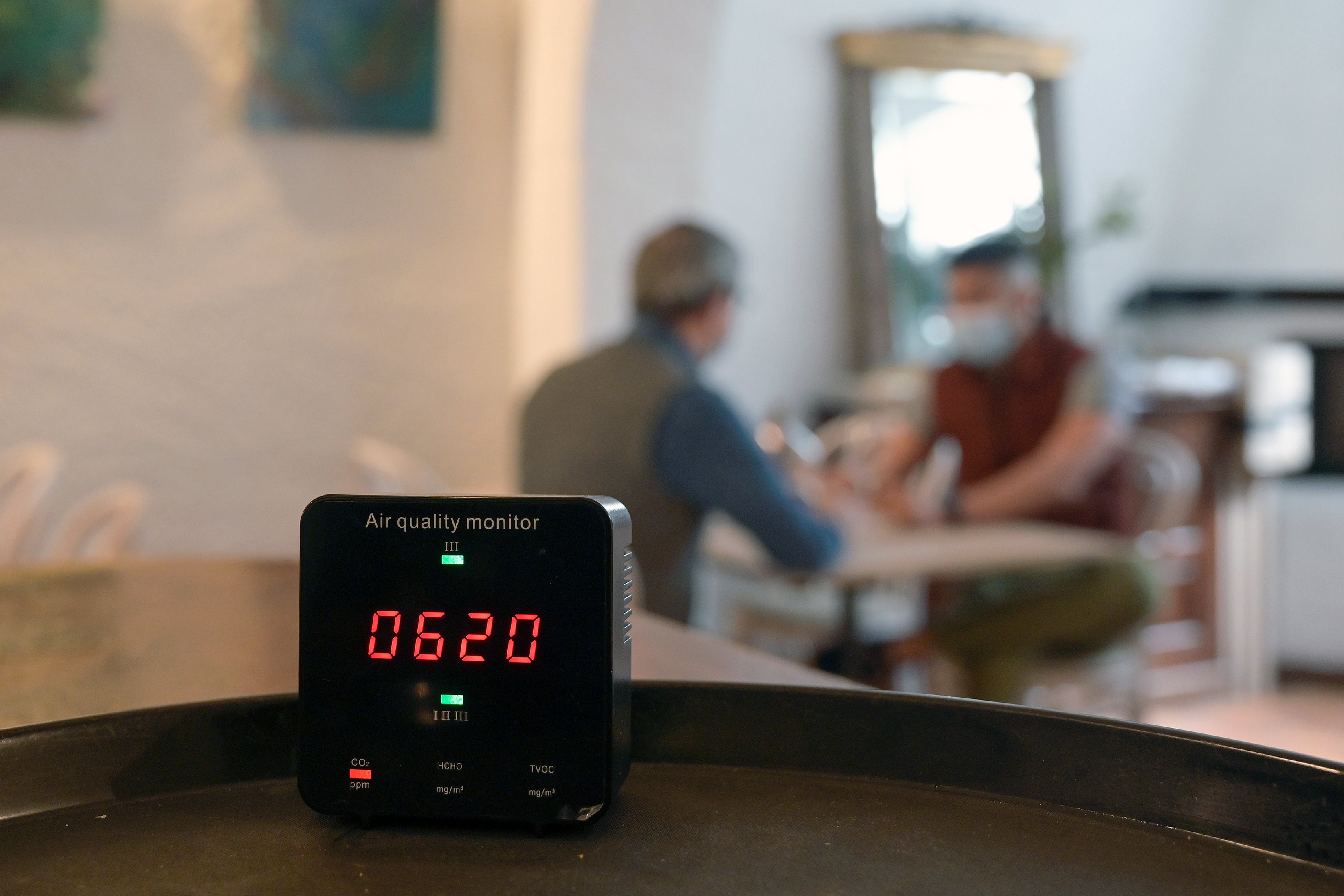
One way to assess the amount of ventilation in a space is to use a carbon dioxide monitor. Humans exhale CO2 when we breathe, so levels of this gas provide a good proxy for how diluted the air is. Values below about 800 parts per million are potentially well ventilated, according to the U.S. Centers for Disease Control and Prevention.
Filtration
Filtration involves removing particles and other pollutants from the air. A standard called minimum efficiency reporting values (MERV) offers a way of comparing different filters. The gold standard filter is a high-efficiency particulate air (HEPA) filter, which can remove 99.97 percent of airborne particles that are 0.3 micron in size, and an even greater percentage of larger or smaller particles (both of which are trapped more efficiently). HEPA is equivalent to a rating of MERV 17 or higher. Prather and Corsi both recommend upgrading filters to at least MERV 13 for most indoor settings such as schools or offices. Many HVAC systems can be upgraded to this standard—but some very old ones may have trouble with higher-efficiency filters, and this could cause air to leak around the filters, so it’s a good idea to check with an HVAC expert.
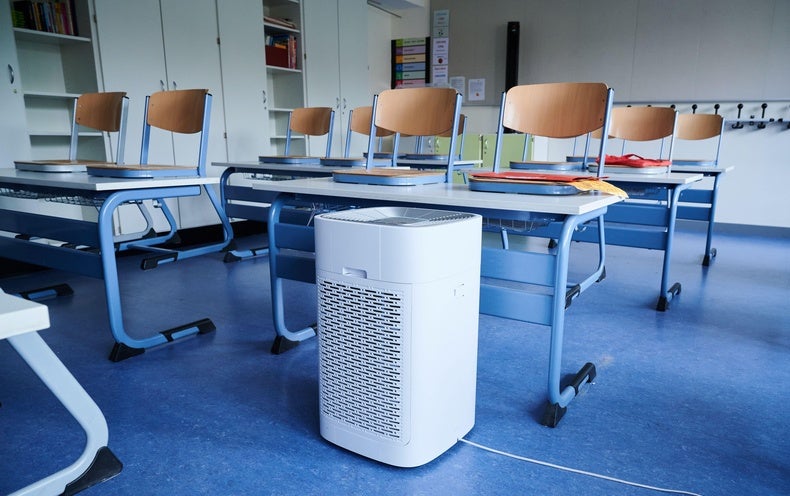
If the building in question does not have an HVAC system—many homes, for example, do not—one option is to purchase one or more portable air cleaners. These devices generally work well, provided they are the appropriate size for a room. They can be run at high speed to filter the air more quickly during specific times such as a party or when someone in the family is sick with COVID.
Portable air cleaners are not cheap, however; a good quality model starts at around $200, and the price goes up from there. Fortunately, some researchers have come up with a more affordable solution known as a Corsi-Rosenthal box. Named after U.C. Davis’s Corsi and Jim Rosenthal, CEO of filter manufacturer Tex-Air Filters, who both helped develop the idea, it is basically a DIY air cleaner made up of a box fan and four or five MERV filters duct-taped together. Instructions for building these boxes are available online, and they work surprisingly well. A Corsi-Rosenthal box in a 200-square-foot (about 19-square-meter) dorm room achieved the equivalent of about 24 air exchanges per hour—on par with a typical U.S. hospital and better than most similarly sized portable air cleaners. This is because, even though a Corsi-Rosenthal box’s filtration efficiency is lower than that of the HEPA filters in most portable air cleaners, the flow rate is much greater, thanks to the large fan. The only complaint is the noise, but Corsi and his colleagues are working on quieter designs.
Air Disinfection
Finally, there is air disinfection: inactivating viruses using ultraviolet light. This is best for high-risk environments such as hospitals or school cafeterias, Virginia Tech’s Marr says. It works by shining UV light across the top of a room, which neutralizes airborne pathogens as they circulate through that space. Some wavelengths of UV light are harmful to humans, although there is a wavelength called far UVC that may be safer for people.
Most UV systems are expensive to install, however. And there’s a lot of snake oil out there. “If it sounds too good to be true,” Marr says, “it probably is.” For most homes and small businesses, focusing on ventilation and filtration is probably the easiest way to improve air quality.
Investing in Better Air
The Biden administration recently called on building managers in schools, universities and other settings to improve air indoor quality and also held a public briefing to draw attention to the importance of clean indoor air. Upgrading air quality can be expensive, but there are federal funds to support such efforts. According to a White House statement, the American Rescue Plan contains $122 billion to help schools stay open and $350 billion for state, local and tribal governments to upgrade ventilation and other infrastructure in local establishments and businesses.
“It’s a massive win to have the White House signal that healthy buildings are one of the pillars of pandemic response,” says Harvard’s Allen.
COVID has injected momentum into efforts to improve air quality inside buildings, and experts hope this momentum will result in lasting investments in this area.
“I think we are on the cusp of a new awareness about indoor air quality,” Marr says. “It’s so bad in many places that there’s lots of room for improvement.” Upgrading buildings will require an investment, Marr adds, but one that “I believe will pay off in terms of improved health and productivity.”